
Caregiver decision guide
Short-Term Care for Elderly: A Crisis Decision Guide for Family Caregivers
When a parent is hospitalized, has a fall, or needs sudden care, choosing the right short-term option can feel overwhelming. This guide helps adult children quickly compare in-home respite, SNF rehab, adult day, and trial assisted living — with costs, payment options, and a rapid evaluation checklist.

The Crisis Moment: When You Need Short-Term Care, Fast
It happens in a single phone call. Your mother fell in the kitchen and is now in the ER. Your father's hip replacement surgery is scheduled for next week and the hospital says he will need "rehab" afterward, but no one has explained what that means or how to arrange it. Or maybe you are the one who has hit a wall — you have been providing care for months, you missed three deadlines at work this month, and your doctor just told you that your blood pressure is dangerously high.
In these moments, the phrase "short-term care" gets thrown around by discharge planners, social workers, and well-meaning relatives. But short-term care is not a single service. It is four distinct categories of support, each designed for a different situation, each with a different price tag, and each covered by different payment sources. Choosing the wrong one can mean paying thousands of dollars for care your parent does not need — or, worse, sending them to a setting that cannot provide the level of medical attention they actually require.
This guide is built for that moment of crisis. It will help you quickly identify which type of short-term care fits your specific situation, understand what it will cost, figure out how to pay for it, and evaluate a facility in under 24 hours — all while giving yourself permission to take the break you almost certainly need.
The Four Types of Short-Term Care: What They Are and Who They Serve
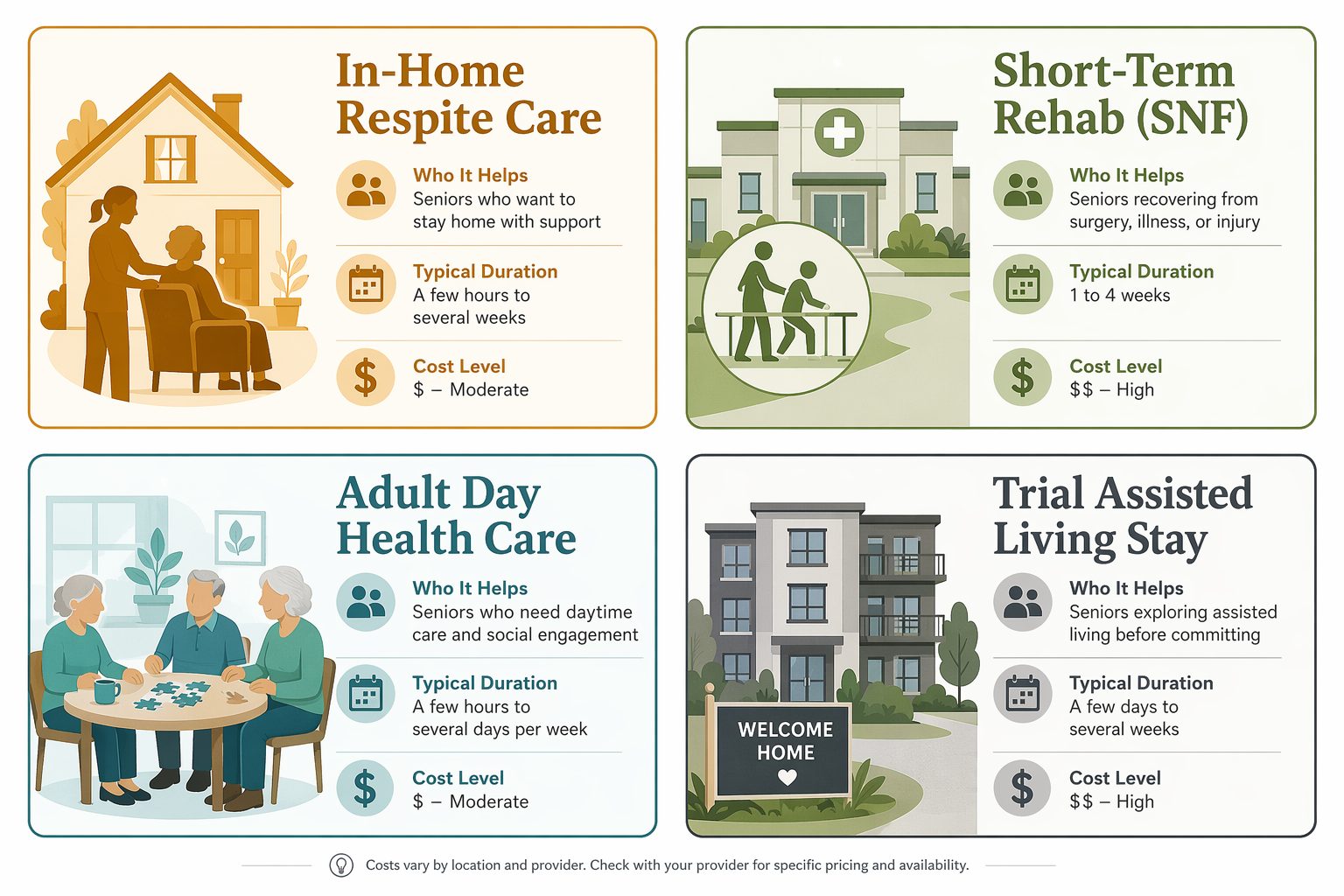
Each of the four options below serves a fundamentally different purpose. Matching your parent's actual need to the right category is the single most important decision you will make.
| Option | What It Is | Typical Duration | Level of Care | Best For |
|---|---|---|---|---|
| In-Home Respite Care | A professional aide comes to your parent's home to provide personal care, companionship, meal preparation, and light housekeeping while the family caregiver takes a break. | A few hours to several weeks | Non-medical (ADL assistance, supervision, companionship) | Caregivers who need a break but whose parent is stable at home and does not need daily skilled medical care. |
| Short-Term Rehab / Skilled Nursing Facility (SNF) | A Medicare-certified facility providing daily skilled nursing care, physical therapy, occupational therapy, and medical supervision after a hospitalization. | 2–3 weeks (up to 100 days with Medicare coverage) | Skilled medical and therapy services (PT, OT, speech, wound care, IV medications) | Seniors recovering from surgery, stroke, fall, or serious illness who need daily therapy and nursing oversight before returning home. |
| Adult Day Health Care | A daytime program offering personal care, social activities, meals, medication management, and some health services in a supervised group setting. Participants return home each evening. | Several hours per day, several days per week (ongoing or short-term) | Supervision, social engagement, ADL assistance, medication management | Seniors with mild to moderate dementia or chronic conditions who need supervision during the day while the caregiver works or rests. |
| Trial Assisted Living Stay | A short-term (often 1–4 week) stay in an assisted living community, providing room, meals, personal care, and social activities — essentially a test run of full-time assisted living. | 1–4 weeks | Personal care, meals, activities, medication management (not skilled nursing) | Families considering a permanent move to assisted living who want to test the fit before committing, or caregivers who need an extended break. |
A critical distinction: in-home respite care and adult day health care are primarily about giving the caregiver a break while keeping the senior in a familiar environment. Short-term rehab (SNF) is about active medical recovery — your parent needs skilled therapy and nursing to regain function after a hospital stay. Trial assisted living is a transitional option for families who are not sure whether a permanent move is right.
For a deeper look at each type of respite care and how to access it, see our full guide to respite care options.
What Just Happened? A Decision Flowchart for Your Situation
The right short-term care option depends entirely on what triggered the need. Use the scenarios below to find your path.
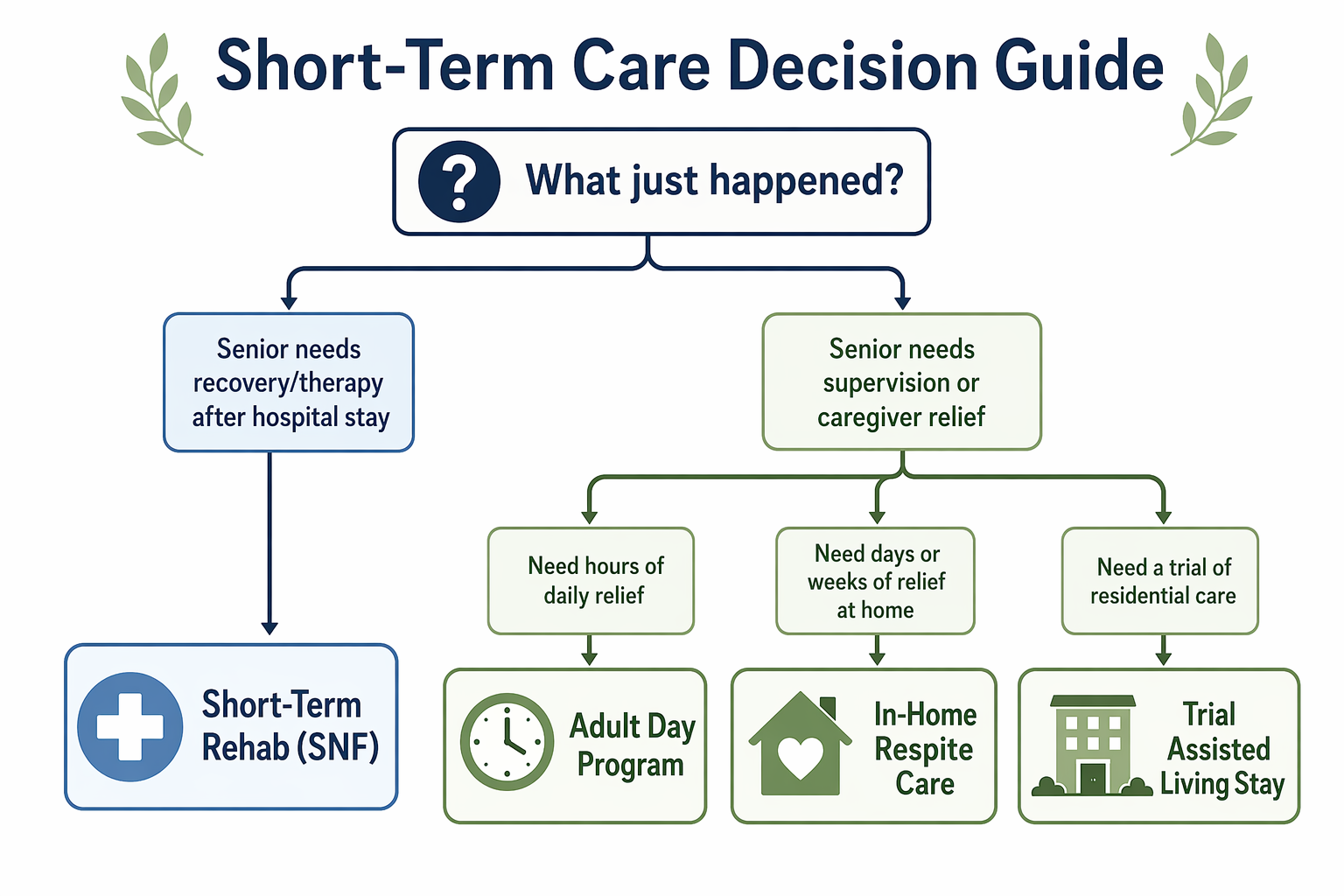
Scenario 1: Your parent was just hospitalized for surgery, a fall, a stroke, or a serious illness.
If the hospital says your parent needs "rehab" or "skilled nursing" before they can go home, the appropriate option is short-term rehab in a skilled nursing facility (SNF). This is not optional — if your parent needs daily physical therapy, occupational therapy, or skilled nursing (wound care, IV medications, feeding tube management), they cannot get that level of care at home or in an assisted living community. Medicare Part A will cover the first 20 days in full and days 21–100 with a daily copay of $204 (2025 rate), provided your parent had a qualifying three-day inpatient hospital stay.
For a deeper comparison of long-term care settings and how they match to actual needs, see our guide to home care vs. assisted living vs. nursing homes.
Scenario 2: Your parent is stable at home, but you are burning out and need a regular break.
If your parent can safely be left with a trained aide for a few hours or a few days, in-home respite care is the right choice. A home health aide or personal care aide comes to the home to help with bathing, dressing, meal preparation, medication reminders, and companionship. This option keeps your parent in their familiar environment and gives you time to rest, travel, or focus on work and other family responsibilities.
If your parent has mild to moderate dementia and needs supervision and social engagement during the day but is safe at home overnight, adult day health care may be a better fit. These programs provide structured activities, meals, medication management, and some health services in a group setting. Our complete guide to evaluating adult day care programs can help you decide if this option fits your parent's needs.
Scenario 3: You are considering a permanent move to assisted living but are not sure.
A trial assisted living stay (often called a "respite stay" or "short-term stay" by communities) lets your parent live in an assisted living community for one to four weeks. This is a low-risk way to test whether the environment, staff, meals, and activities are a good fit before making a permanent and expensive commitment. Many communities offer these stays at a daily rate, and some will apply the cost toward the first month's rent if you decide to move in permanently.
Scenario 4: You are the one who needs care — you are physically or emotionally unable to continue.
If you are experiencing signs of caregiver burnout — exhaustion, irritability, sleep disruption, weight changes, feeling overwhelmed — you need to arrange care for your parent so you can recover. This is not selfish. A 2018 outcome evaluation of the National Family Caregiver Support Program (NFCSP) found that caregivers who received four or more hours of respite care per week experienced a measurable decrease in self-reported burden over time, while caregivers who did not receive respite saw their burden increase. In this scenario, in-home respite care or a short-term facility stay (trial assisted living or adult day care) can provide the break you need to recover and continue caregiving sustainably.
What It Costs: National Median Prices for 2025–2026
Cost is often the deciding factor in a crisis. The figures below are national medians from the CareScout/Genworth 2025 Cost of Care Survey and SeniorLiving.org 2026 estimates. Your actual costs will vary significantly by state and region — urban areas and the Northeast and West Coast tend to be substantially higher.
| Option | National Median Cost | Typical Monthly Equivalent | Annual Cost (if used full-time) |
|---|---|---|---|
| Home Health Aide (in-home respite) | $35 per hour | $6,160 (44 hrs/week) | $80,080 |
| Adult Day Health Care | $95 per day | $2,088 (22 days/month) | $25,056 |
| Assisted Living (trial stay) | $200 per day | $6,200 per month | $74,400 |
| Nursing Home Semi-Private (SNF rehab) | $315 per day | $9,581 per month | $114,975 |
| Nursing Home Private Room | $355 per day | $10,798 per month | $129,575 |
The key takeaway: adult day health care is by far the most affordable option at roughly $95 per day, while a semi-private nursing home room for short-term rehab costs more than three times that amount. If your parent does not need skilled nursing or daily therapy, choosing adult day care or in-home respite instead of a facility stay can save thousands of dollars per week.
Paying for Short-Term Care: Medicare, VA, Medicaid, and Other Options
Understanding who pays for what is the difference between a manageable expense and a financial crisis. Here is how the major payment sources apply to short-term care.
Medicare Part A: Skilled Nursing Facility (SNF) Coverage
Medicare Part A covers up to 100 days of care in a Medicare-certified skilled nursing facility per benefit period, but only if your parent meets all of these conditions:
- They had a qualifying inpatient hospital stay of at least three consecutive days (not counting the day of discharge).
- They are admitted to a Medicare-certified SNF within 30 days of leaving the hospital.
- They need daily skilled nursing care or therapy services that can only be provided in a facility.
If these conditions are met, Medicare pays 100% of the covered costs for the first 20 days. For days 21 through 100, your parent pays a daily copay of $204 (2025 rate). After day 100, Medicare pays nothing. Importantly, Medicare does not cover custodial care (help with bathing, dressing, eating) if that is the only care needed — it only covers skilled nursing and therapy.
For more detail on what changed in 2026 and what families need to know, see our Medicare home health care guide.
Medicare Hospice Respite: 5 Days of Coverage
If your parent is enrolled in Medicare hospice care, Medicare will cover most of the cost for up to five consecutive days of inpatient respite care in a hospital or skilled nursing facility. This is intended to give the family caregiver a short break. It can be used on an occasional basis.
VA Benefits: Up to 30 Days Per Year
Veterans who qualify for VA health benefits may be eligible for up to 30 days of respite care per year in a VA facility or through a VA-contracted provider. The VA also offers a Veteran-Directed Care program that allows veterans to manage their own respite budget. Contact your local VA medical center or call the VA Caregiver Support Line at 1-855-260-3274 to check eligibility.
Medicaid Waivers and State Programs
Medicaid does not typically cover respite care as a standard benefit, but many states offer Home and Community-Based Services (HCBS) waivers that include respite as a covered service. Eligibility is based on income, assets, and functional need. Because waiver programs vary significantly by state, the fastest way to find out what is available is to contact your local Area Agency on Aging or state Medicaid office.
National Family Caregiver Support Program (NFCSP)
The NFCSP, administered by the Administration for Community Living (ACL), provides grants to states and territories to fund a range of caregiver support services, including respite care. Services are typically accessed through your local Area Agency on Aging. The program is not an entitlement — funding is limited and may have waiting lists — but it is worth exploring, especially if your income is modest.
Long-Term Care Insurance
Some long-term care insurance policies include a respite care benefit. The coverage varies widely — some policies pay a daily or weekly benefit for a set number of days per year, while others require a waiting period before benefits begin. Review the policy carefully or call the insurance company to ask specifically about respite coverage.
Out-of-Pocket Costs
For many families, short-term care is paid entirely out of pocket. If you are paying privately, the most cost-effective options are adult day health care ($95/day) and in-home respite care ($35/hour). Even a few hours of in-home respite per week can make a significant difference in your ability to continue caregiving without burning out.
What to Look for in 24 Hours: A Rapid Facility Evaluation Checklist
When you are choosing a facility under time pressure — often within 24 to 48 hours of a hospital discharge — you need a rapid evaluation framework. Adapted from guidance from the National Institute on Aging and care.com, here is a checklist you can use to assess a facility quickly.
Before You Visit
- Confirm the facility is Medicare- and/or Medicaid-certified (if you plan to use those benefits).
- Check the facility's rating on Medicare's Care Compare tool (medicare.gov/care-compare).
- Ask the hospital discharge planner if they have a list of preferred or recommended facilities.
- Call ahead to confirm they have an available bed and accept your parent's insurance.
During Your Visit
- Observe the staff-to-resident ratio. Are call lights answered promptly? Do residents who need help getting to meals or activities receive it in a reasonable time?
- Look at the residents. Do they appear clean, comfortable, and engaged? Are they interacting with staff and each other?
- Check cleanliness and safety. Are hallways clear of clutter? Are grab bars present in bathrooms? Does the facility smell clean?
- Ask about therapy services. For short-term rehab, confirm that physical therapy, occupational therapy, and speech therapy are available on-site seven days a week.
- Ask about staff training and turnover. High turnover is a red flag for quality of care.
- Ask about the discharge planning process. How will the facility prepare your parent to return home safely?
- Consider location. Is the facility close enough for you to visit regularly? For short-term rehab, family involvement in therapy sessions can improve outcomes.
After Your Visit
- Make a second unannounced visit at a different time of day (e.g., evening or weekend) to see if the atmosphere changes.
- Read the admission contract carefully. Look for hidden fees, discharge policies, and what happens if Medicare coverage ends before your parent is ready to leave.
- Trust your instincts. If something feels wrong during the visit, it probably is.
The Emotional Side: You Are Not a Bad Person for Taking a Break
If you feel guilty about arranging short-term care for your parent, you are not alone. A 2025 caregiver survey by A Place for Mom (n=1,029) found that 59% of caregivers experience guilt, and 78% report experiencing feelings of burnout, with many describing it as a weekly or daily occurrence. The same survey found that 87% of caregivers experience stress or anxiety, 84% feel overwhelmed, and 68% experience at least some financial strain.
These numbers are not a sign of weakness. They are a sign that the caregiving system places an enormous burden on individual families — a burden that no one was designed to carry alone. The National Alliance for Caregiving and AARP estimate that there are 63 million family caregivers in the United States, providing 33 billion hours of unpaid care per year with an estimated economic value of $1 trillion (AARP Valuing the Invaluable, March 2026). You are part of a vast, invisible workforce, and you are allowed to need a break.
Caregivers who received 4 or more hours of respite care per week had a decrease in self-reported burden over time, while comparison caregivers experienced an increase.
That finding comes from the 2018 outcome evaluation of the National Family Caregiver Support Program (NFCSP), conducted by the Administration for Community Living. It is not a theory — it is a measured result. Taking a break does not make you a worse caregiver. It makes you a more sustainable one.
If you are juggling care for both aging parents and children, you are part of the "sandwich generation" — nearly half of caregivers in the A Place for Mom survey are caring for children under 18 while also caring for an older adult. Our guide to the sandwich generation offers strategies for managing both responsibilities without breaking.
Your Next Steps: Resources and Action Items
You do not have to figure this out alone. Here are the most important resources and actions you can take right now.
- Call the Eldercare Locator at 1-800-677-1116 (Monday–Friday, 9 a.m. to 8 p.m. ET). This free, nationwide service connects you to your local Area Agency on Aging, which can help you find respite care, adult day programs, and other support services in your community.
- Use the ARCH National Respite Locator to find respite care providers in your area, including state-sponsored programs, adult day care centers, and services for veterans.
- Talk to the hospital discharge planner or case manager before your parent leaves the hospital. They can tell you whether Medicare will cover a skilled nursing facility stay and help you find a facility that accepts your parent's insurance.
- Contact your local Area Agency on Aging to ask about NFCSP-funded respite services, Medicaid waiver programs, and other state-specific support.
- If your parent is a veteran, call the VA Caregiver Support Line at 1-855-260-3274 to ask about respite benefits.
- If you are brand-new to caregiving and feeling overwhelmed, our step-by-step framework for new family caregivers can help you go from crisis to confidence.
Short-term care is not a sign that you have failed. It is a tool that allows you to continue providing care over the long term — for your parent and for yourself. You deserve the break. Take it.
Questions to bring to a clinician or OT
This is not medical, legal, or a family's final decision — only a framework. Bring these questions to a clinician, occupational therapist, or your local Area Agency on Aging.
Find Local HelpRelated reading
Noticed something outdated or inaccurate on this page? Flag a correction. We review every report against CDC, NIA, and AARP HomeFit guidance before updating a page.