
Caregiver decision guide
The Emotional Realities of Caring for Aging Parents: Role Reversal, Anticipatory Grief, and the Guilt No One Talks About
This article validates the emotional weight of caring for aging parents — role reversal grief, anticipatory loss, and caregiver guilt — and offers a self-compassion framework grounded in research, along with boundary-setting scripts and guidance on when to seek professional support.
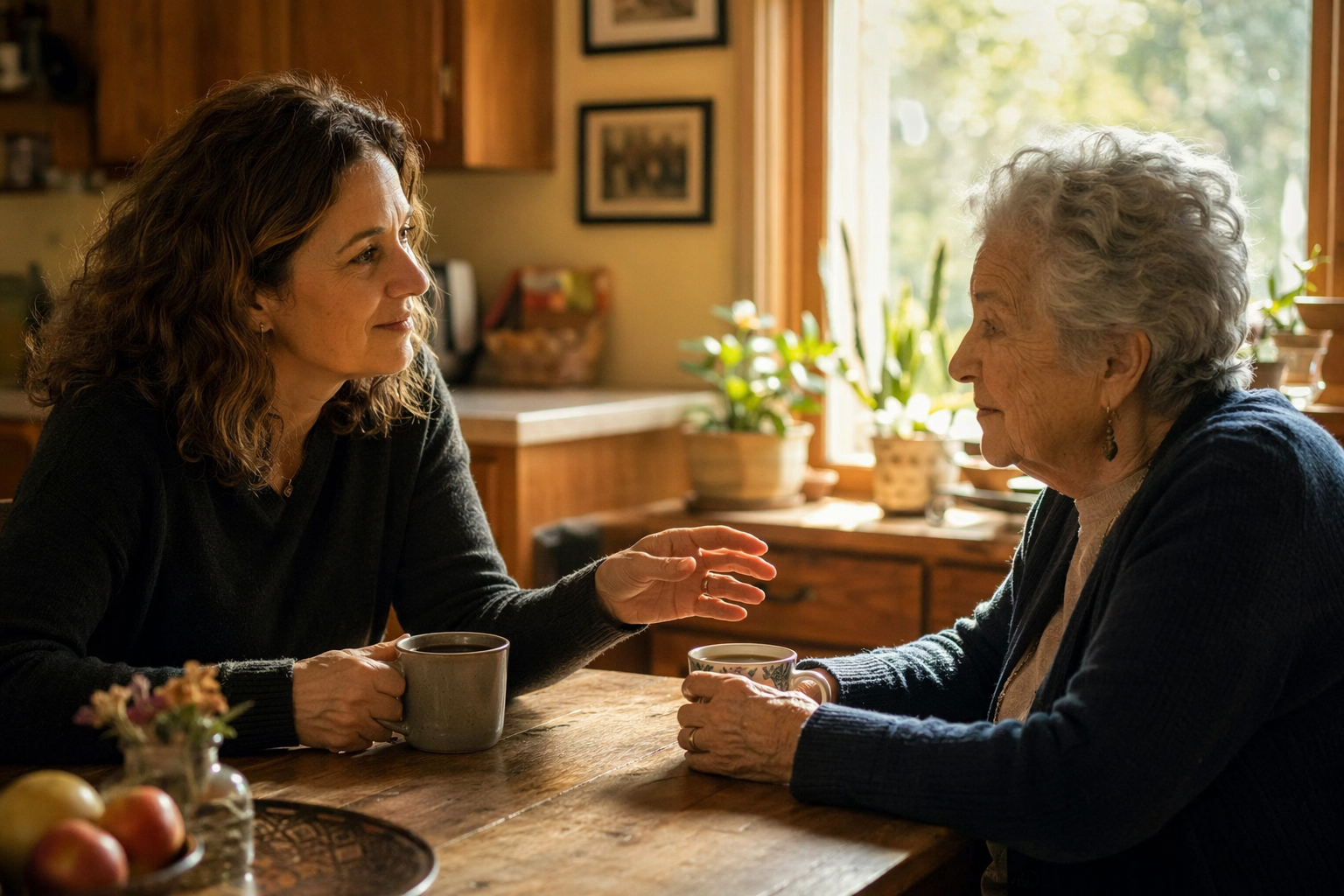
The Moment You Become Your Parent's Parent
It rarely arrives with a formal announcement. One day you are helping with a grocery order. The next, you are sitting in a doctor's office hearing a diagnosis you were not prepared for, or sorting through a pile of unopened bills that your parent can no longer manage. The line between "helping out" and "caregiving" blurs so gradually that by the time you recognize the shift, you are already deep inside it.
What no one tells you is that this transition is not just a logistical rearrangement of tasks. It is a seismic emotional event. The person who once held your hand through every crisis now needs you to hold theirs. The parent who taught you how to navigate the world now depends on you to navigate theirs. And underneath the practical demands — the medication schedules, the insurance calls, the bathroom modifications — runs a current of grief, guilt, and confusion that most caregiving resources simply skip over.
This article is not a checklist. It is a place to name what you are feeling, to see that those feelings are not a sign of failure, and to find a way through them that does not require you to abandon yourself in the process.
Three Emotional Realities Caregivers Face — But Rarely Name
Most caregivers carry a private emotional burden that they hesitate to speak aloud, worried that admitting it means they are ungrateful, weak, or failing. But these feelings are not personal defects. They are predictable, well-documented responses to a situation that is inherently painful. Three distinct grief experiences emerge again and again in the accounts of adult children caring for aging parents.
Role Reversal Grief: Mourning the Parent You Knew
There is a specific ache that comes the first time you have to remind your parent to take their medication, or when they look to you for a decision they would have made independently a year ago. The Family Caregiver Alliance describes this as the unsettling shift from child to caregiver, and it carries a real sense of loss. You are not just taking on new responsibilities — you are losing the relationship you had. The parent who gave advice, who was the stable point of reference, is being replaced by someone who needs you in a fundamentally different way.
This grief is complicated because it happens while your parent is still alive. There is no funeral, no ritual, no socially sanctioned space to mourn. You are expected to be grateful that they are still here, and you are — but that gratitude coexists with a quiet, confusing sadness that can feel disloyal to name.
Anticipatory Grief: The Sadness of Watching Decline Unfold
Anticipatory grief is the sorrow you feel for losses that have not fully arrived but are clearly visible on the horizon. It is the pang you feel when your parent struggles to remember a grandchild's name, or when you notice they are walking more slowly, or when you realize that the future you imagined for their later years will not match the reality unfolding in front of you.
The ElderLife Financial resource on emotional realities names this directly: it is a deep sadness mourning the parent while still caring for them. Unlike the grief that follows a death, anticipatory grief has no clear endpoint. It stretches out over months or years, ebbing and flowing with each new sign of decline. It is exhausting precisely because it never fully resolves.
Caregiver Guilt and Resentment: The Feeling No One Wants to Admit
Then there is the guilt. The voice that says you should be doing more, should be more patient, should not feel annoyed that your mother called for the fourth time today. And underneath the guilt, often hidden even from yourself, is resentment — resentment toward the siblings who do not help, toward the parent for needing so much, toward a life that no longer feels like your own.
These feelings are profoundly uncomfortable, but they are also profoundly normal. The Mayo Clinic notes that common caregiver emotions include anger, frustration, exhaustion, and loneliness — and that these feelings are not signs of a bad person, but signs of a person under sustained pressure. The guilt comes from the gap between who you think you should be as a caregiver and who you actually are on a tired Tuesday evening.
What the Data Says: The Emotional Toll Is Real — and Unequal
If you have ever wondered whether your emotional struggle is "normal," the data offers a clear answer: it is not only normal — it is widespread. The Pew Research Center's 2026 survey of 8,750 U.S. adults found that 39% of all caregivers who regularly help an aging parent say the experience has a more negative than positive impact on their emotional well-being. That is nearly two out of every five caregivers — a silent majority who are struggling but rarely saying so out loud.
The gender gap in these numbers is striking and deserves attention.
| Caregiver Group | Percentage Reporting Negative Emotional Impact | Source |
|---|---|---|
| Women caring for an aging parent | 47% | Pew Research Center, 2026 |
| Men caring for an aging parent | 30% | Pew Research Center, 2026 |
| All caregivers of aging parents | 39% | Pew Research Center, 2026 |
These figures are not abstract statistics. They represent millions of adult children who are navigating the same emotional terrain you are. The fact that nearly half of women caregivers report a negative emotional impact is not a commentary on women's coping abilities — it is a reflection of the unequal distribution of caregiving labor and the emotional load that comes with it. Knowing this can lift some of the shame. You are not failing. You are responding to a situation that would challenge anyone.
Why Self-Compassion, Not Self-Care, Is the Research-Backed Antidote
When caregivers hear "take care of yourself," the advice often lands as one more item on an already overflowing to-do list. Take a bath. Go for a walk. Meditate. These are not bad suggestions, but they treat the symptom rather than the root cause. The root cause is not a lack of bubble baths. It is a lack of permission to be human in the face of an impossible situation.
A growing body of research points to a different, more effective approach: self-compassion. A study published in the journal Aging & Mental Health (2018) examined dementia caregivers and found that those who practiced greater self-compassion reported significantly lower levels of burnout. Not marginally lower. Significantly lower. The mechanism is straightforward: self-compassion replaces the harsh inner critic — the voice that says "you should be doing more" — with a kinder, more realistic inner voice that says "you are doing your best in an extraordinarily difficult situation."
Self-compassion has three components, and each one directly addresses a dimension of caregiver grief.
- Self-kindness vs. self-judgment: Instead of berating yourself for feeling resentful, you acknowledge that resentment is a natural response to an overwhelming load. You speak to yourself the way you would speak to a close friend in the same situation.
- Common humanity vs. isolation: Instead of believing you are the only one struggling, you recognize that millions of caregivers feel exactly what you feel. The Pew data proves it. You are not alone; you are part of a shared human experience.
- Mindfulness vs. over-identification: Instead of being swallowed by guilt or grief, you observe the feeling without letting it define you. "I am feeling guilty right now" replaces "I am a guilty person." The distinction matters.
This is not about adding another task to your day. It is about changing the internal conversation that runs alongside every task you already do. For a deeper look at how burnout is driven by systemic factors — not personal failure — see our article on what the 2025-2026 data says about the real causes of caregiver exhaustion.
Setting Boundaries with Love: Practical Scripts for Saying No and Asking for Help
Boundaries feel impossible when guilt is running the show. The fear — "if I say no, I am a bad daughter or son" — is so powerful that many caregivers simply never try. But boundaries are not walls you build against your parent. They are structures that protect the relationship so it can survive the long haul of caregiving.
The key is to frame boundaries through the lens of love and sustainability, not rejection. Here are three common scenarios and scripts that honor both your limits and your parent's dignity.
When a Sibling Is Not Helping
Resentment toward siblings who are absent is one of the most common — and most isolating — caregiver emotions. The JFS Care resource on role reversal suggests assigning specific roles and defining expectations clearly rather than hoping someone will step up.
Script: "I have been managing Mom's medical appointments and finances, and I am reaching my limit. Could you take over the weekly grocery delivery and prescription pickups? I can write down exactly what is needed. If that does not work for you, let's figure out together what you can take on so this is sustainable."
When Your Parent Resists Help
Resistance from a parent can trigger deep frustration and guilt. The Family Caregiver Alliance advises maintaining respectful communication even when parents are stubborn or embarrassed. The goal is to preserve their autonomy while addressing the need.
Script: "Dad, I know you do not want anyone coming into the house to help with cleaning. I hear that. At the same time, I am worried about you slipping in the bathroom, and I cannot be here every day. Would you be willing to meet someone from the agency just once, with me here, and decide after that? If it does not feel right, we will find another option."
When You Need to Say No to Additional Requests
The National Institute on Aging offers a simple but powerful script for asking others for help: be specific about what you need and direct about your limits.
Script: "I would love to help with that, but I am already stretched thin. I cannot take on anything else right now without putting my own health at risk. Let me help you find someone who can."
When Normal Caregiver Stress Crosses into Depression or Anxiety
There is a difference between the normal sadness and frustration of caregiving and clinical depression or anxiety that requires professional support. Knowing the difference can help you recognize when it is time to reach out — not as a last resort, but as a responsible step in protecting your ability to care for your parent and yourself.
The Mayo Clinic identifies several signs that caregiver stress may have crossed into a more serious territory. The National Institute on Aging adds additional context on when these signs warrant attention.
| Sign | What It Looks Like in Caregiving | When to Consider Professional Support |
|---|---|---|
| Persistent sadness or hopelessness | Feeling that nothing will get better; crying frequently without a clear trigger | Lasts most of the day, nearly every day, for two weeks or more |
| Loss of interest in activities | No longer enjoying hobbies, time with friends, or activities that used to bring pleasure | Persistent disengagement that feels different from ordinary tiredness |
| Significant sleep changes | Unable to fall or stay asleep despite exhaustion, or sleeping excessively to escape | Disrupts daily functioning for more than a few weeks |
| Irritability or anger | Snapping at your parent, partner, or children over small things; feeling a short fuse | Happening regularly and leaving you feeling ashamed or out of control |
| Difficulty functioning | Missing your own medical appointments, unable to concentrate at work, neglecting basic self-care | Interferes with your ability to meet your own basic needs or job responsibilities |
| Using alcohol or medication to cope | Needing a drink to get through the evening or relying on sleep aids regularly | Any regular use of substances to manage caregiver emotions |
If you recognize several of these signs in yourself, please reach out to a licensed mental health professional. Your primary care doctor can also provide a referral. This is not an admission of failure — it is an acknowledgment that you have been carrying something very heavy for a very long time.
Permission to Feel It All — and Where to Go from Here
If you take only one thing from this article, let it be this: you are allowed to feel everything you are feeling. The grief, the guilt, the resentment, the love, the exhaustion, the moments of unexpected tenderness — they all belong in the same heart. You do not have to choose between being a devoted caregiver and being a person with limits and needs. You get to be both.
The National Institute on Aging puts it plainly: caregivers are less likely to get preventive health services and have a higher risk of mental health issues, sleep problems, and chronic conditions. The system is not designed to support you. That is why self-compassion is not indulgence — it is survival. And boundaries are not rejection — they are the only way to sustain a relationship over the long arc of caregiving.
When you are ready to move from emotional validation into practical planning — building a schedule, coordinating with siblings, finding community resources — our guide to building a sustainable family caregiving plan can help you take the next step. You do not have to figure this out alone, and you do not have to do it perfectly. You just have to keep showing up — for your parent and for yourself.

Questions to bring to a clinician or OT
This is not medical, legal, or a family's final decision — only a framework. Bring these questions to a clinician, occupational therapist, or your local Area Agency on Aging.
Find Local HelpRelated reading
- Setting Caregiving Boundaries Without the Guilt: A Practical Guide for Family Caregivers
- The Hidden Emotional Toll of Caring for Aging Parents: Why Guilt, Resentment, and Grief Are Normal — and What Research Says Actually Helps
- The Mental Health Toll of Caring for an Elderly Parent — and What Actually Helps
Noticed something outdated or inaccurate on this page? Flag a correction. We review every report against CDC, NIA, and AARP HomeFit guidance before updating a page.