
Glossary entry
Medicare Home Health Care in 2026: What Changed, What Stayed the Same, and What Families Need to Know
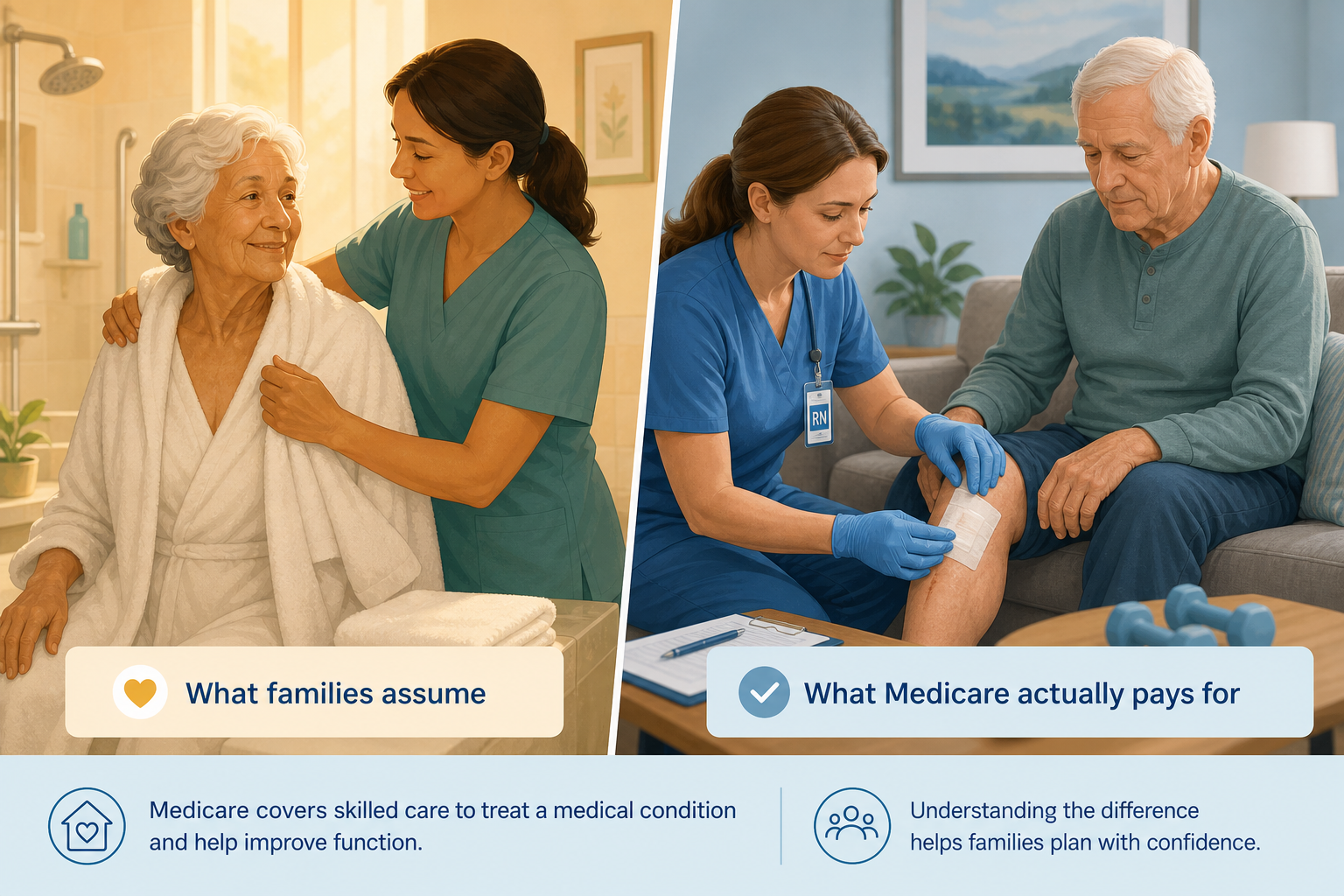
If you are a family caregiver trying to figure out whether Medicare will help pay for a parent or spouse to receive care at home, you are not alone — and you are asking the right question at the right time. 2026 is a year of significant Medicare policy shifts, but the core home health benefit rules have not changed. The challenge is that the policy landscape around the benefit has shifted in ways that directly affect what families can expect to receive, what they will pay for medications, and what supplemental benefits their Medicare Advantage plan may or may not offer.
This article is designed for families who already have a general sense of Medicare home health coverage and need to understand what specifically changed in 2026 — and what stayed exactly the same. If you are starting from scratch on eligibility basics, we recommend reading the full eligibility and coverage guide first, then returning here for the 2026-specific update.
What Stayed the Same: Core Home Health Eligibility and Coverage in 2026
Before we walk through the changes, it is important to establish the foundation that has not moved. The Medicare home health benefit's eligibility criteria, covered services, and cost-sharing structure are unchanged for 2026. If your loved one qualified for home health services in 2025, they will still qualify under the same rules in 2026.
Eligibility Requirements (Unchanged)
- The patient must be homebound: leaving home requires a considerable and taxing effort. Occasional outings for medical treatment, religious services, or adult day care are allowed, but the homebound standard remains the same.
- The patient must need part-time or intermittent skilled care: skilled nursing care, physical therapy, speech-language pathology, or occupational therapy (occupational therapy can continue coverage but cannot initiate it).
- A physician or authorized practitioner must certify the need for home health services and must have had an in-person visit with the patient within 90 days before or 30 days after the start of care.
- Care must be provided by a Medicare-certified home health agency.
Covered Services and Limits (Unchanged)
Medicare covers the following services when provided under a home health plan of care, and the cost-sharing structure is identical to 2025:
| Service | What Medicare Pays | What You Pay |
|---|---|---|
| Skilled nursing care (wound care, injections, patient education, monitoring) | 100% of Medicare-approved amount | $0 |
| Physical therapy, occupational therapy, speech-language pathology | 100% of Medicare-approved amount | $0 |
| Medical social services | 100% of Medicare-approved amount | $0 |
| Part-time or intermittent home health aide care (only when also receiving skilled care) | 100% of Medicare-approved amount | $0 |
| Durable medical equipment (DME) — walkers, wheelchairs, hospital beds | 80% of Medicare-approved amount | 20% coinsurance after Part B deductible |
| Medical supplies provided by the agency | 100% of Medicare-approved amount | $0 |
The coverage limits are also unchanged: up to 8 hours per day and 28 hours per week of combined skilled nursing and home health aide care, extendable to 35 hours per week for short periods if medically necessary. There is no fixed time limit on how long the benefit can last — coverage continues as long as the patient meets eligibility criteria and the physician recertifies the need.
What Medicare Still Will Not Cover
This is the most important unchanged rule for families to understand: Medicare does not cover custodial or personal care when that is the only care needed. Specifically excluded:
- 24-hour-a-day care at home
- Meal delivery services
- Homemaker services (shopping, cleaning, laundry)
- Custodial or personal care (bathing, dressing, toileting) when that is the only care needed and no skilled care is being provided
What Changed in 2026: Key Policy Shifts That Affect Home Care
While the core home health benefit is stable, several 2026 policy changes create a more complex landscape for families. Some of these changes affect out-of-pocket costs for medications, some affect the availability of supplemental benefits through Medicare Advantage, and one directly affects home health agency payments.
1. Part D Out-of-Pocket Cap Increased to $2,100
The Medicare Part D out-of-pocket spending cap rose from $2,000 in 2025 to $2,100 in 2026 — a 5% increase. This means that once a beneficiary's out-of-pocket drug costs reach $2,100 in a calendar year, they will pay no further cost-sharing for covered Part D drugs for the rest of the year. The maximum Part D deductible also increased to $615 in 2026, up from $590 in 2025.
For families managing a loved one's medications at home, this cap provides important predictability. However, the increase from $2,000 to $2,100 means slightly higher potential out-of-pocket exposure before catastrophic coverage kicks in.
2. Medicare Advantage V-BID Pilot Terminated
The Medicare Advantage Value-Based Insurance Design (V-BID) Model pilot was terminated effective January 1, 2026. This pilot had allowed Medicare Advantage plans to offer additional supplemental benefits — such as reduced cost-sharing and extra services — to enrollees with certain chronic conditions. The pilot was ended due to excessive costs, which reached $2.3 billion in 2021 and $2.2 billion in 2022. The termination affects more than 7 million Medicare Advantage enrollees who were receiving benefits through V-BID plans.
The practical impact for families: if your loved one is enrolled in a Medicare Advantage plan that was part of the V-BID pilot, they may lose access to supplemental benefits they previously received — such as reduced copays for certain services or additional coverage for chronic condition management. It is essential to check the plan's 2026 Evidence of Coverage document to understand exactly what changed.
3. Home Health Payment Cut Finalized at -1.3% (Much Smaller Than Proposed)
CMS initially proposed a 6.4% reduction ($1.135 billion) to home health payments for 2026, which would have been a significant blow to agency finances and potentially reduced access to care. However, after public comment and advocacy, the finalized cut is much smaller: a -1.3% reduction, amounting to about $220 million in total Medicare home health spending compared to 2025. This translates to roughly $19 less per 30-day episode of care.
While the finalized cut is far less severe than what was proposed, it still represents a reduction in payments to home health agencies. For families, the concern is that continued payment pressure may lead some agencies to reduce service hours, limit geographic coverage, or close entirely — particularly in rural areas where margins are already thin.
4. CMS Limited Allowable SSBCI Benefits
CMS has limited the types of Special Supplemental Benefits for the Chronically Ill (SSBCI) that Medicare Advantage plans can offer in 2026. Specifically excluded from allowable SSBCI benefits are: alcohol, cannabis, tobacco, certain cosmetic procedures, funeral planning, life insurance, and unhealthy foods. This change affects the range of supplemental benefits available to chronically ill enrollees through Medicare Advantage plans.
5. Part B Premium Increased to $202.90/Month
The standard Medicare Part B monthly premium for 2026 is $202.90, up from $185.00 in 2025. The Part B deductible also increased to $257 in 2026. While this does not directly affect home health cost-sharing (home health services have $0 copay), it does increase the overall cost of Medicare coverage for beneficiaries.
Medicare Advantage Supplemental Benefits in 2026: What's Shrinking and What's Growing
For the more than 34 million Medicare beneficiaries (54% of all eligible) enrolled in Medicare Advantage plans, the 2026 plan year brings notable changes in supplemental benefit offerings. According to the Kaiser Family Foundation's December 2025 analysis, several common supplemental benefits are declining in availability:
| Supplemental Benefit | Share of Plans Offering in 2025 | Share of Plans Offering in 2026 | Change |
|---|---|---|---|
| Over-the-counter (OTC) item allowance | 73% | 66% | -7 percentage points |
| Meal benefit (post-discharge or chronic condition) | 65% | 57% | -8 percentage points |
| Remote access technologies (telehealth devices, monitoring) | 53% | 48% | -5 percentage points |
| Transportation benefit (medical and non-medical) | 30% | 24% | -6 percentage points |
Among Special Needs Plans (SNPs), which serve beneficiaries with specific chronic conditions or dual-eligible status, the declines are even steeper in some categories: transportation benefits dropped from 81% to 67% of plans, meal benefits from 73% to 66%, bathroom safety devices from 54% to 47%, and remote access technologies from 50% to 44%.
However, there are two areas of growth among SNPs: in-home support services increased from 17% to 25% of plans, and caregiver support benefits increased from 5% to 16% of plans. These increases are small but meaningful for families who need help at home.
The Home Health Aide Gap: Why Access Continues to Shrink Despite Unchanged Rules
One of the most frustrating realities for families is that even when a loved one qualifies for Medicare home health services and the rules say home health aide care should be available, the actual access to aide services has been shrinking dramatically for years — and 2026 is no exception.
According to the Center for Medicare Advocacy, home health aide utilization has declined by almost 94% over the past two decades. In 1997, home health aide visits represented 48% of all home health visits. By 2021, that figure had fallen to just 5%. The average number of aide visits per 30-day episode dropped from 6.7 in 1998 to less than half a visit per month in 2022.
This decline is not due to a change in the law — the Patient-Driven Grouping Model (PDGM), which was implemented in 2020, did not change eligibility or coverage criteria. Rather, the payment model creates a vicious cycle: because agencies provide fewer aide services, the payment model anticipates fewer aide services in future payment calculations, which encourages agencies to continue shrinking the benefit.
What Medicare Still Won't Cover: The Custodial Care Gap
It bears repeating because it is the most common source of confusion and financial surprise for families: Medicare does not cover custodial care when that is the only care needed. This gap is unchanged in 2026 and remains the primary reason families pay out of pocket for home care.
- If your loved one needs help with bathing, dressing, toileting, eating, or transferring — but does not need skilled nursing or therapy — Medicare will not pay for that care.
- If your loved one needs both skilled care (e.g., wound care after surgery) and personal care (e.g., help bathing), Medicare will cover the home health aide portion only while the skilled care is also being provided.
- Once the skilled care ends, the home health aide benefit ends with it — even if the need for personal care continues.
For families facing this gap, several options exist — though each has its own eligibility requirements and limitations. These include Medicaid Home and Community-Based Services (HCBS) waivers (which vary dramatically by state), VA benefits for eligible veterans and surviving spouses, long-term care insurance policies, and private pay. For a comprehensive overview of all payment options, see How to Pay for Senior Home Care: A Family's Guide to Financial Assistance Programs, Insurance Coverage, and Hidden Benefits.
How to Verify Coverage and Find a Medicare-Certified Home Health Agency
Knowing the rules is one thing; actually finding and securing services is another. Here are the actionable steps families should take in 2026:
- Use Medicare.gov's Home Health Compare tool to find and compare Medicare-certified home health agencies in your area. The tool provides quality ratings, patient survey results, and information about the types of services each agency provides.
- Confirm that the agency accepts Medicare assignment. This means the agency agrees to accept the Medicare-approved amount as full payment for covered services.
- Ensure the physician's order specifies the type and frequency of skilled care needed. The order must be specific enough for the agency to create a plan of care.
- For Medicare Advantage enrollees: check the plan's provider network to confirm which home health agencies are in-network, and verify any prior authorization requirements for home health services.
- Contact your local State Health Insurance Assistance Program (SHIP) for free, unbiased counseling. SHIP counselors can help you understand your specific plan's benefits, compare options, and navigate appeals if coverage is denied.
For a broader action plan that covers what to do now, next week, and next month when arranging care for a loved one, see the Senior Care Assistance Triage: What to Do Now, Next Week, and Next Month guide.
The Bottom Line for Families in 2026
The core Medicare home health benefit is stable. If your loved one qualifies, they will receive the same covered services with the same $0 cost-sharing as in previous years. The eligibility rules, coverage limits, and excluded services have not changed.
However, the 2026 policy landscape is more complex. The Part D out-of-pocket cap rose to $2,100. The V-BID pilot termination may reduce supplemental benefits for millions of Medicare Advantage enrollees. Home health payment cuts, while smaller than proposed, continue to pressure agency finances. And Medicare Advantage plans are reducing several supplemental benefits that families have come to rely on.
The most important takeaway for families: verify your specific plan's benefits, understand the custodial care gap, and plan for uncovered costs. The rules on paper are one thing — what actually happens when you call an agency and ask for services may be another. Start early, ask specific questions, and do not assume that what is covered in theory will be available in practice.
Browse more in the Glossary.