
Clinical term
Hospice vs. Palliative Care: A Family Caregiver’s Decision Framework

If you are an adult child managing care for a seriously ill parent, you have likely heard the terms palliative care and hospice used almost interchangeably. Clinicians, social workers, and well-meaning friends may toss them out as if the difference is obvious — but for a family trying to make real decisions, the distinction is anything but. The confusion is understandable: both models share a philosophy of comfort-focused, whole-person care. But the single difference in timing and eligibility changes everything about what is available, what it costs, and what it asks of you as a caregiver.
This guide is built around that one difference. It is not a glossary of terms — you can find that in our Hospice and Palliative Care Glossary. Instead, it is a decision framework: when does each type of care start, what shifts for your family at the transition, and how do you recognize when it is time to have the conversation? The goal is to help you act with clarity rather than urgency — because the data shows most families wait too long.
What Hospice and Palliative Care Have in Common
Before examining the differences, it helps to understand the shared foundation. Both hospice and palliative care are built on the same core principles: symptom relief, whole-person support, and family involvement. Neither is about "giving up" — both are active, skilled approaches to improving quality of life when a serious illness is present.
Both models use an interdisciplinary team that typically includes physicians, nurses, social workers, chaplains, and pharmacists. The team works together to manage pain, nausea, breathlessness, anxiety, and other symptoms that erode daily life. Both also place a strong emphasis on educating the family about what to expect — not just clinically, but practically and emotionally.
- Symptom management: Both focus on relieving pain, dyspnea, fatigue, and other distressing symptoms rather than targeting the underlying disease.
- Interdisciplinary teams: Both involve doctors, nurses, social workers, and chaplains working as a coordinated unit.
- Family education: Both teach caregivers how to recognize changes, administer medications, and provide daily comfort.
- Emotional and spiritual support: Both address the psychological and existential dimensions of serious illness, not just the physical.
Because the two models share so much, families often assume they are the same thing — and that assumption leads to delayed hospice enrollment. Understanding where they diverge is the critical step.
The Critical Difference: Timeline and Eligibility
The single most important distinction for family caregivers is not about the type of care provided — it is about when each model can begin and what it requires of the patient and family.
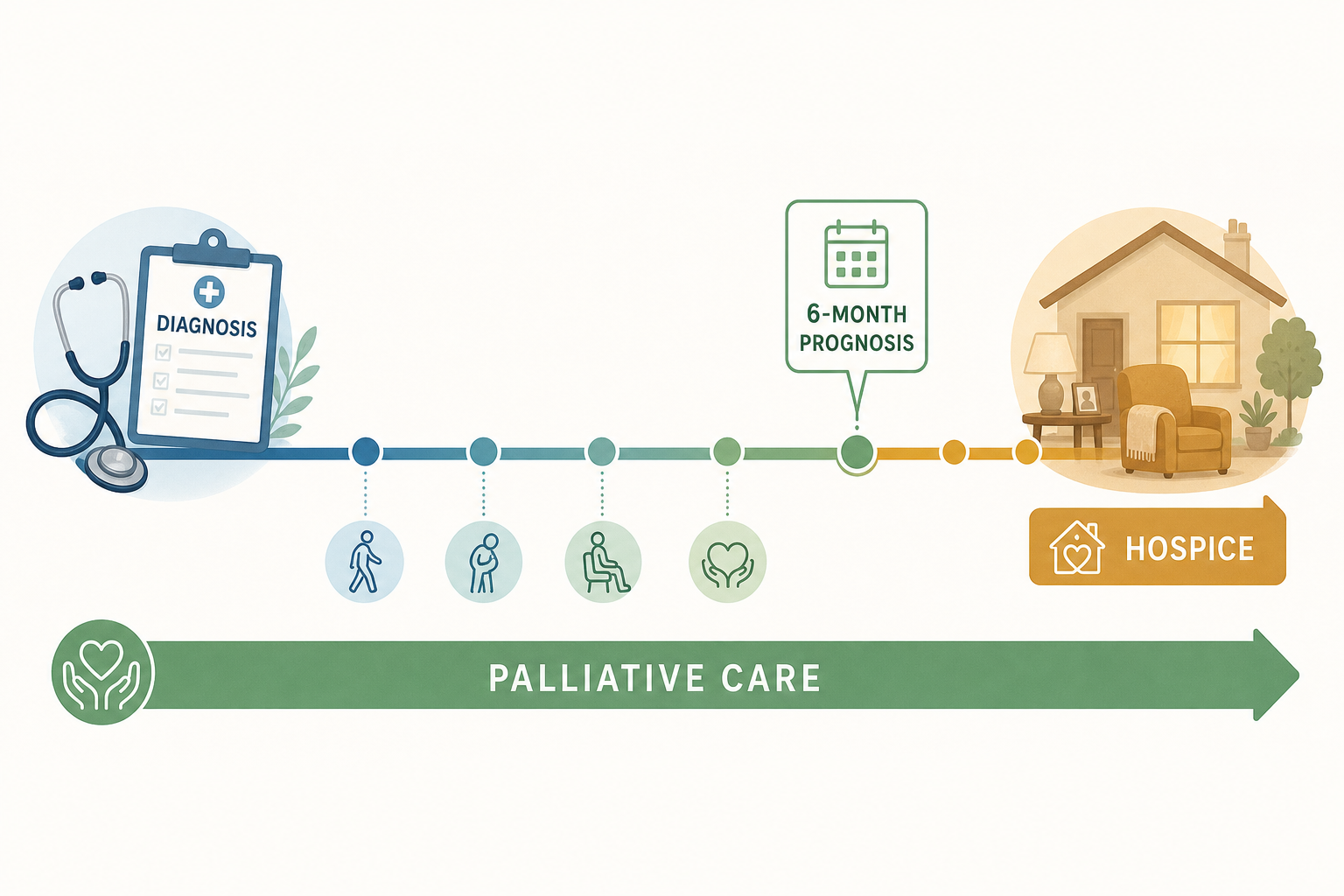
Palliative care is appropriate at any stage of a serious illness, from the moment of diagnosis onward. It can be delivered alongside curative treatments such as chemotherapy, dialysis, or surgery. A patient with advanced lung cancer can receive palliative care to manage pain and shortness of breath while still pursuing radiation. A person with early-stage heart failure can receive palliative support to optimize function and quality of life while continuing cardiac medications. There is no time limit and no requirement to stop treatment.
Hospice, by contrast, is a specific form of palliative care reserved for patients whom physicians have certified as likely to have six months or less to live if the disease runs its normal course. Once a patient elects hospice, they agree to forgo curative treatments and instead focus entirely on comfort and dignity. The hospice benefit is structured in benefit periods — 90 days, then 60 days, then unlimited 60-day periods — and can be extended indefinitely as long as a physician recertifies the prognosis.
| Dimension | Palliative Care | Hospice Care |
|---|---|---|
| When it starts | Any stage of serious illness, from diagnosis onward | When prognosis is 6 months or less (physician-certified) |
| Curative treatment | Can continue alongside curative treatment | Curative treatment stops; focus is comfort only |
| Duration | No time limit; continues as long as needed | Benefit periods (90, 60, 60+ days); renewable with recertification |
| Setting | Hospitals, clinics, home, nursing facilities | Primarily at home (~95% of care days); also nursing facilities, inpatient hospice units |
| Insurance coverage | Varies by service and plan; most insurance, Medicare, and Medicaid cover all or part | Medicare hospice benefit covers 100% of hospice-related costs (Part A) |
The practical implication is clear: if your parent has a serious illness, palliative care should be on the table now — not later. It does not commit you to anything. It simply adds a layer of support. Hospice, on the other hand, is a decision point that requires a clear-eyed conversation about prognosis, goals, and what your family is ready for.
What Changes for the Family Caregiver at the Transition
When a patient transitions from palliative care to hospice, the change is not just philosophical — it is structural. The services available, the financial model, and the level of support for the family all shift in ways that directly affect the caregiver's daily experience.
Insurance and Cost Coverage
Palliative care costs vary widely depending on the setting, the services used, and the patient's insurance plan. Most private insurance, Medicare, and Medicaid cover at least part of palliative care, but copays, deductibles, and service limits can apply. This variability creates financial uncertainty for families at a time when they are already stretched.
Hospice, by contrast, is the only Medicare benefit that covers virtually all hospice-related costs at 100% under Medicare Part A. The benefit includes:
- All medications related to the terminal diagnosis and symptom management
- Medical equipment (hospital bed, oxygen, wheelchair, walker)
- Nursing care and social services
- Chaplain visits and spiritual counseling
- Short-term inpatient care for symptom crises or caregiver respite
- Grief and bereavement support for the family for 13 months after the patient's death
For a detailed breakdown of how Medicare Parts A, B, C, and D interact with these services, see our Medicare Definition for Caregivers guide.
24/7 On-Call Support
One of the most tangible differences for caregivers is the shift in availability. While palliative care teams are typically available during business hours with after-hours coverage varying by program, Medicare-qualified hospices are required to provide a 24/7 call service. This means that at 2 a.m., when your parent is restless, in pain, or struggling to breathe, you can call a hospice nurse who knows the case and can talk you through it — or come to the home if needed.
Respite Care and Bereavement Support
Hospice also offers two services that palliative care generally does not: short-term inpatient respite care and bereavement support. Respite care allows the patient to stay in a Medicare-approved facility for up to five days at a time, giving the family caregiver a break to rest, attend to other responsibilities, or simply recover from the physical and emotional demands of care. Bereavement support continues for 13 months after the patient's death, providing counseling and support groups to help family members navigate grief.
| Service | Palliative Care | Hospice (Medicare Benefit) |
|---|---|---|
| Pharmaceuticals | Covered by insurance; copays may apply | 100% covered for hospice-related medications |
| Medical equipment | Covered by insurance (DME); copays may apply | 100% covered (bed, oxygen, wheelchair, etc.) |
| 24/7 on-call support | Varies by program; not guaranteed | Required by Medicare; always available |
| Inpatient respite care | Not typically included | Up to 5 days per stay for caregiver relief |
| Bereavement support | Not typically included | 13 months of grief counseling for family |
| Chaplain visits | May be available; varies | Included as part of the interdisciplinary team |
Three Clinical Scenarios: COPD, Cancer, and Dementia
The decision framework looks different depending on the disease trajectory. Here is how the palliative-to-hospice arc plays out across three common diagnoses.
COPD: The Slow Decline with Acute Exacerbations
Chronic obstructive pulmonary disease follows a pattern of gradual decline punctuated by sudden, severe exacerbations that often require hospitalization. A palliative care consult early in the disease — even while the patient is still on oxygen and pulmonary rehabilitation — can help manage breathlessness, anxiety, and fatigue. The palliative team can also help the family understand the disease trajectory and prepare advance directives.
Hospice becomes appropriate when the patient experiences frequent hospitalizations, significant weight loss, increasing oxygen needs, and declining functional status despite optimal medical management. The transition is often triggered by a hospitalization from which the patient does not fully recover. Respiratory illness (including COPD) accounts for about 10% of hospice admissions nationally.
Cancer: The Clearer Trajectory
Cancer has the most predictable trajectory of the three, which is one reason it accounts for about 30% of hospice admissions. The American Society of Clinical Oncology (ASCO) recommends a palliative care consult within 8 weeks of an advanced cancer diagnosis. This early integration improves quality of life and, in some studies, extends survival.
The transition to hospice typically occurs when the patient stops responding to disease-modifying treatments — chemotherapy stops working, clinical trials are exhausted, or the patient chooses to stop treatment due to side effects. Because the cancer trajectory is more linear, families often have more time to plan the transition, yet the 17-day median hospice stay suggests many still wait until the final weeks.
Dementia: The Most Commonly Missed Opportunity
Dementia follows a long, unpredictable decline that makes hospice eligibility harder to recognize. Alzheimer's and other dementias account for about 20% of hospice admissions, but many dementia patients who could benefit from hospice never receive it because their families and physicians do not recognize that the six-month prognosis criterion has been met.
For dementia patients, hospice eligibility typically requires: significant functional decline (loss of ability to walk, dress, bathe independently), limited speech (fewer than six intelligible words), urinary and fecal incontinence, and a significant weight loss or recurrent infections. The FAST scale (Functional Assessment Staging) is often used to determine eligibility, with Stage 7C or higher generally meeting the criteria.
For a detailed daily-care guide covering this stage, see our Late-Stage Alzheimer's Care Guide, which includes a section on when to consider hospice.
Five Questions to Evaluate Readiness for Hospice
If you are unsure whether your parent might be ready for a hospice conversation, these five questions can help you assess the situation objectively. They are not a substitute for a physician's clinical judgment, but they can give you the confidence to start the discussion.
- Has your parent had two or more hospitalizations or emergency department visits in the past six months related to their chronic illness? Frequent acute events often signal that the body is struggling to maintain stability.
- Has your parent experienced unintentional weight loss of more than 10% of their body weight in the past six months? Significant weight loss is a key prognostic indicator across multiple disease types.
- Is your parent's functional status declining — are they losing the ability to walk, transfer from bed to chair, dress, or bathe independently? Loss of multiple activities of daily living (ADLs) is a strong signal.
- Is your parent's symptom burden increasing despite optimal medical management — more pain, more breathlessness, more confusion, or more frequent infections? When symptoms are not well-controlled, hospice's 24/7 support can make a real difference.
- Are you, the caregiver, experiencing significant physical or emotional exhaustion? Caregiver burnout is not just a personal issue — it is a clinical signal that the current care arrangement may not be sustainable. Hospice's respite care and 24/7 support can reduce this burden.

How to Start the Conversation with a Physician
For many adult children, the hardest part is not recognizing that hospice might be appropriate — it is actually saying the words out loud to a doctor. The fear is that asking about hospice will be interpreted as giving up, or that the physician will think you are not doing enough. In reality, physicians are trained to have these conversations, and most are relieved when a family initiates them.
Here are three concrete ways to frame the conversation:
- "We are struggling to manage Mom's pain and breathlessness at home. Can we talk about whether palliative care or hospice might help us provide better comfort?" — This frames the request around symptom management, not prognosis.
- "Dad has been hospitalized three times this year, and each time he comes home weaker. I am worried about what the next few months look like. Can we discuss what hospice might offer if his condition continues to decline?" — This opens the door to a prognostic conversation without demanding an immediate decision.
- "I am feeling overwhelmed and I do not think I can keep providing this level of care alone. Are there hospice services that could help us at home?" — This acknowledges caregiver strain, which is a legitimate clinical concern that physicians take seriously.
If the emotional weight of this conversation feels familiar, our guide on Navigating Role Reversal with an Aging Parent addresses the deeper challenge of shifting from child to caregiver and decision-maker.
The Caregiver's Own Well-Being: A Downstream Effect
One of the less discussed but critically important aspects of this decision is its impact on you, the caregiver. Research on early palliative care has documented a positive downstream effect on family caregivers: those whose loved ones received palliative care showed improved stamina, better social functioning, and fewer symptoms of depression compared to caregivers who did not have that support.
Hospice extends this effect further. The built-in respite care, 24/7 on-call support, and 13 months of bereavement counseling are designed specifically to sustain the caregiver through the most intense period of care and into the grief that follows. The data bears this out: 81% of caregivers rate hospice 9 or 10 out of 10, and 84% say they would definitely recommend the hospice they used.
If you are feeling the strain of caregiving, you are not alone — and you do not have to wait until a hospice transition to get support. Our Respite Care Options Guide and Caregiver Burnout Guide offer practical strategies for sustaining yourself through the caregiving journey, regardless of what stage you are in.
Browse more in the Glossary.