
Glossary entry
Medicare Definition for Caregivers: What Parts A, B, C, and D Actually Cover

Why Medicare Literacy Is a Caregiver Skill
Most adult children learn Medicare from the wrong angle. They learn it as something their parent enrolled in at 65 — a background fact about retirement, not a system they themselves need to navigate. Then a parent has a fall, a hospitalization, or a new diagnosis, and suddenly the caregiver is on the phone with a hospital billing department trying to understand why a skilled nursing facility stay isn't covered, or why a home health aide visit was denied.
Medicare's four parts each cover a distinct slice of healthcare. Knowing which part applies in a given caregiving scenario is what separates accessing available benefits from being blindsided by unexpected bills. This reference covers each part in plain language, anchored to caregiving decisions rather than enrollment mechanics. A quick-reference table and FAQ section serve readers who need an immediate answer; the part-by-part sections serve caregivers building a working understanding they can return to as care needs evolve.
What Medicare Is
Medicare is federal health insurance for adults age 65 and older and for certain younger individuals with qualifying disabilities or conditions. It is administered by the Centers for Medicare and Medicaid Services (CMS) and funded through payroll taxes, premiums, and general federal revenue.
There are two ways to receive Medicare benefits. Original Medicare consists of Part A (hospital insurance) and Part B (medical insurance) administered directly by the federal government. Medicare Advantage (Part C) is an alternative delivery path through private insurers that must cover at least all Original Medicare benefits. Most people with Part C also receive Part D drug coverage bundled in. These are not additional layers on top of Original Medicare — they are two different ways to access the same program.
Medicare Part A: Hospital Insurance
Part A is the portion of Medicare that covers institutional care — primarily inpatient hospital stays, skilled nursing facility care, hospice, and some home health services. Most people do not pay a monthly premium for Part A if they or their spouse paid Medicare taxes for at least 10 years.
Inpatient Hospital Stays
Part A covers inpatient hospital care after your parent is formally admitted. The 2026 deductible is $1,736 per benefit period — not per year. A benefit period begins when your parent enters a hospital or skilled nursing facility and ends after they have gone 60 consecutive days without receiving inpatient care. If they are readmitted after that 60-day gap, a new deductible applies.
After the deductible, coinsurance applies for longer stays: $434 per day for days 61–90, and $868 per day for lifetime reserve days (days 91 and beyond, up to a 60-day lifetime limit). Days 1–60 after the deductible are covered at $0 coinsurance.
Skilled Nursing Facility Care
Part A covers up to 100 days of skilled nursing facility (SNF) care per benefit period, but only when specific conditions are met. The 2026 cost structure:
- Days 1–20: $0 (after the Part A deductible has been met)
- Days 21–100: $217 per day coinsurance
- Day 101 and beyond: Full cost, no Medicare coverage
Hospice Care
Part A covers hospice care for patients certified as terminally ill with a life expectancy of six months or less who choose comfort-focused care over curative treatment. Coverage includes two 90-day benefit periods followed by an unlimited number of 60-day periods. Covered services from a Medicare-approved hospice provider cost nothing, except up to $5 per outpatient prescription for pain and symptom management.
Caregivers have access to one benefit that is easy to overlook: inpatient respite care. Medicare covers short-term inpatient care specifically to give the family caregiver a break, at 5% coinsurance capped at the inpatient deductible amount. This is a formal Medicare benefit — not a favor — and caregivers should ask the hospice team about it when needed. For a broader look at caregiver relief options, see the guide on respite care options for family caregivers.
Home Health Under Part A
Part A can cover home health services following a qualifying hospital or SNF stay. In practice, home health is most often billed under Part B (see below). The eligibility rules are the same regardless of which part pays: the patient must be homebound, must require skilled care, and must receive services from a Medicare-certified home health agency.
Medicare Part B: Medical Insurance
Part B covers outpatient medical services — the ongoing care that happens outside a hospital admission. Unlike Part A, Part B requires a monthly premium. The 2026 standard premium is $202.90 per month (up from $185 in 2025), with an annual deductible of $283. After the deductible, Medicare pays 80% of approved costs and your parent pays the remaining 20% coinsurance for most services.
Part B covers a wide range of services relevant to caregiving:
- Physician and specialist visits (outpatient)
- Outpatient hospital and clinic services
- Durable medical equipment (DME) — including wheelchairs, walkers, hospital beds, and oxygen equipment. Note that personal emergency response systems (PERS) are generally not covered as DME under standard Medicare; see the PERS definition and coverage guide for details.
- Preventive screenings (annual wellness visits, cancer screenings, diabetes prevention)
- Mental health services (outpatient therapy, psychiatry)
- Home health care (when the patient is homebound and requires skilled nursing or therapy)
- Caregiver training services (see dedicated section below)
The Medicare Caregiver Training Benefit: What Most Families Don't Know
Starting in 2025, Medicare Part B covers formal caregiver training services when a healthcare provider determines training is appropriate for the patient's treatment plan. This benefit is underused and poorly understood — most caregivers do not know to ask for it.
Key details for caregivers:
- Training can be delivered individually or in a group setting.
- The caregiver can attend without the patient present — the session does not require your parent to be there.
- Eligible providers include physicians, nurse practitioners, clinical nurse specialists, certified nurse-midwives, physician assistants, clinical psychologists, and physical, occupational, and speech-language therapists.
- Training topics can cover medication administration, safe patient movement and transfers, wound care, preventing bedsores and infections, and providing emotional support.
- Cost: 20% coinsurance after the Part B deductible — the same cost-sharing as other Part B services.
To access this benefit, ask your parent's physician or care team to include caregiver training in the treatment plan. The provider must document that training is appropriate for the patient's condition. For practical guidance on medication management — one of the trainable skills covered under this benefit — see the guide on medication management for older adults.
Home Health Under Part B
Part B covers home health services when the patient is homebound and requires part-time or intermittent skilled nursing care, physical therapy, occupational therapy, or speech-language pathology services from a Medicare-certified agency. There is no cost-sharing for covered home health services. Home health aide care is covered only when skilled care is also being received under an approved plan — it is not a standalone covered benefit.
Medicare Part C: Medicare Advantage
Medicare Advantage is a private-plan alternative to Original Medicare. Insurers offering these plans must cover at least everything Part A and Part B cover, but they deliver those benefits through their own network and cost-sharing structures rather than through the federal program directly. Many plans bundle Part D drug coverage and may offer extra benefits such as dental, vision, or hearing.
The 2026 in-network out-of-pocket maximum for Medicare Advantage plans is $9,250 — a slight decrease from 2025. Once your parent reaches that limit, the plan covers 100% of in-network costs for the rest of the year.
Caregiver-Specific Tradeoffs to Evaluate
Medicare Advantage plans introduce variables that can complicate home-based caregiving in ways that Original Medicare does not:
- Network restrictions: Most MA plans limit coverage to in-network providers. If your parent's preferred physician, home health agency, or specialist is out of network, costs can be significantly higher or uncovered.
- Prior authorization requirements: MA plans frequently require prior authorization for home health visits, therapy, and specialist referrals. These requirements can delay care and create administrative burdens for caregivers who must manage appeals.
- Visit caps: Some plans limit the number of home health or therapy visits covered per year, which may result in earlier discharge from services compared to Original Medicare.
- Copays for home health: Unlike Original Medicare — which covers home health services at no cost-sharing — some MA plans charge copays per home health visit.
Medicare Part D: Prescription Drug Coverage
Part D covers outpatient prescription drugs. It is delivered through private insurance companies — either as a stand-alone Prescription Drug Plan (PDP) added to Original Medicare, or bundled into a Medicare Advantage plan with drug coverage (MA-PD). Each plan maintains its own formulary — a list of covered drugs organized into tiers that determine cost-sharing. Formularies change annually, so a drug covered this year may be on a higher tier or removed next year.
Key 2026 Part D figures:
- Maximum annual deductible: $615 (up from $590 in 2025)
- Out-of-pocket spending cap: $2,100 (up from $2,000 in 2025). Once your parent reaches this limit, they pay $0 for covered drugs for the rest of the calendar year.
Ten high-cost prescription drugs now have Medicare-negotiated lower prices effective January 1, 2026 — covering medications for arthritis, blood clots, cancer, and diabetes. These negotiated prices are expected to save beneficiaries an estimated $1.5 billion in 2026. If your parent takes any of these medications, confirm with the plan that the negotiated price applies to their specific drug and dosage.
The Coverage Gap Caregivers Must Know: What Medicare Does Not Cover
The most consequential misconception caregivers hold about Medicare is that it covers ongoing help with daily living — bathing, dressing, feeding, household tasks. It does not. This gap is not a technicality. It is a fundamental boundary of the program, and families who plan long-term home care around Medicare coverage routinely find themselves with uncovered bills and no backup plan.
Medicare explicitly does not cover:
- Custodial care — assistance with activities of daily living (bathing, dressing, grooming, toileting, transferring, feeding) when that is the only care needed
- 24-hour-a-day home care of any kind
- Home meal delivery (e.g., Meals on Wheels-type services)
- Homemaker services unrelated to a medical care plan (housekeeping, laundry, grocery shopping)
- Long-term residential care in assisted living or memory care facilities
- Home health aide services as a standalone benefit — aide visits are only covered when skilled nursing or therapy is also being received under an approved home health plan
Medicare Parts at a Glance: Quick-Reference Table
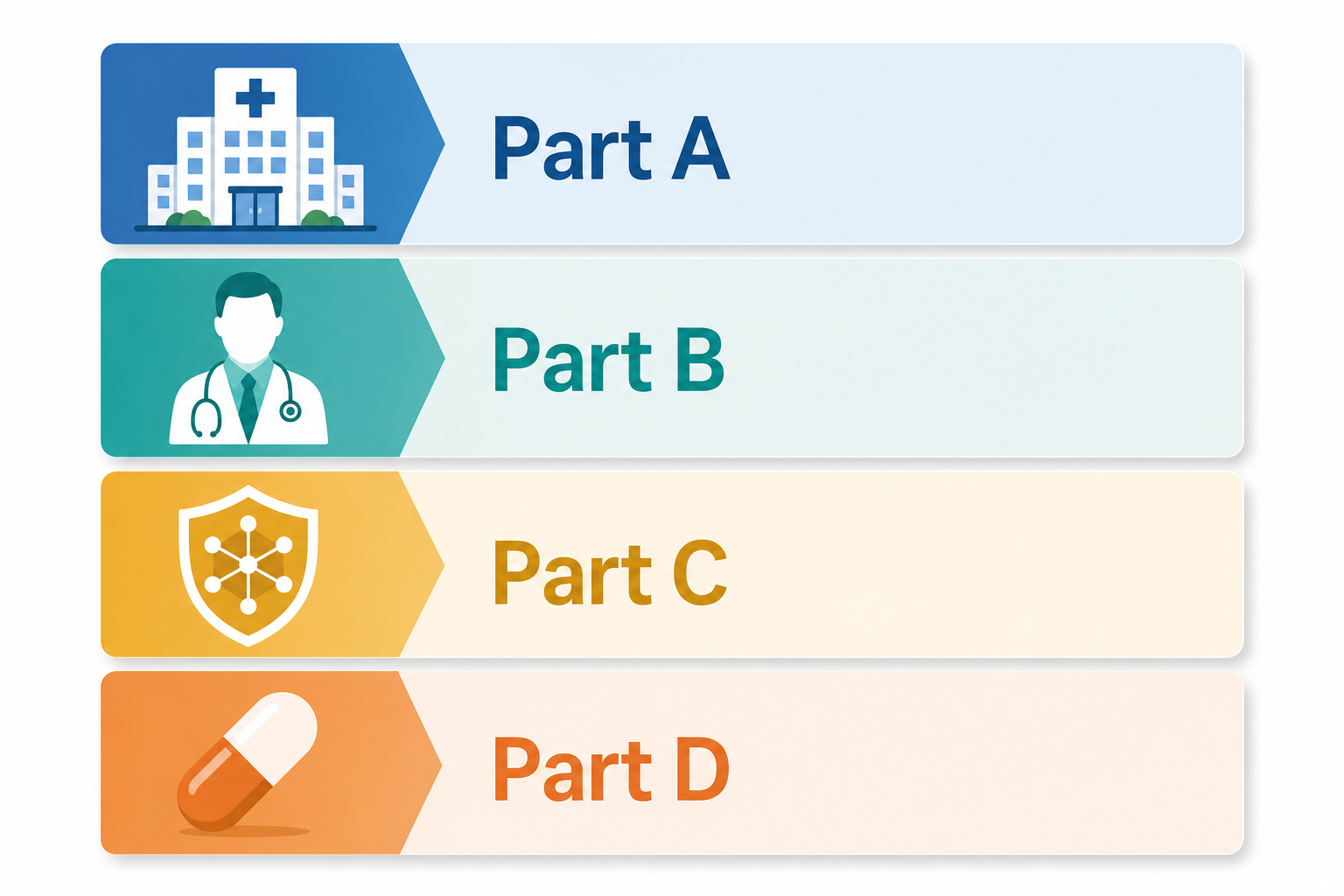
| Part | Common Name | What It Covers | Primary Caregiving Scenario | Key 2026 Cost Figures |
|---|---|---|---|---|
| Part A | Hospital Insurance | Inpatient hospital stays; skilled nursing facility care (up to 100 days/benefit period); hospice care including caregiver respite; some home health | Parent hospitalized; discharge to rehab/SNF; end-of-life hospice planning | Deductible: $1,736/benefit period; SNF days 21–100: $217/day; hospice respite: 5% coinsurance |
| Part B | Medical Insurance | Outpatient physician visits; durable medical equipment; preventive screenings; home health (when homebound + skilled care needed); caregiver training services | Ongoing outpatient care; home health after hospitalization; requesting caregiver training | Premium: $202.90/month; deductible: $283/year; coinsurance: 20% after deductible |
| Part C | Medicare Advantage | All Part A and B benefits delivered through a private insurer; often includes Part D and extras (dental, vision); may impose network and authorization rules | Evaluating plan options at enrollment; navigating prior authorization for home health or therapy | In-network out-of-pocket max: $9,250 in 2026; premiums and copays vary by plan |
| Part D | Prescription Drug Coverage | Outpatient prescription drugs through private stand-alone plans or MA plans with drug coverage; formulary varies by plan | Managing multiple prescriptions; reviewing formulary at annual enrollment; high-cost specialty drugs | Max deductible: $615; out-of-pocket cap: $2,100; 10 drugs at negotiated lower prices |
Caregiver FAQ: Common Medicare Confusion Points
What is the difference between observation status and inpatient admission, and why does it matter?
When your parent is in the hospital, they are either formally admitted as an inpatient or placed under observation status. Observation status is classified as outpatient care and billed under Part B, not Part A. This distinction has a major downstream consequence: only formal inpatient days count toward the 3-consecutive-day qualifying stay required for Part A to cover a subsequent skilled nursing facility admission. If your parent spent three nights in the hospital but was under observation status the entire time, they do not qualify for Part A SNF coverage — and a post-hospital SNF stay would be paid entirely out of pocket. Always ask the admitting team to clarify your parent's status and request a formal review if they are placed on observation.
Why does SNF coverage end, and can it be extended?
Part A SNF coverage ends when one of three things happens: your parent reaches day 100 of the benefit period, a physician determines that daily skilled care is no longer medically necessary, or your parent no longer meets the definition of requiring skilled care (nursing, physical therapy, occupational therapy, or speech therapy ordered by a physician). Coverage is tied to the ongoing need for skilled services — not to your parent's functional limitations. If your parent still needs help with daily activities but no longer requires skilled care, Medicare will not continue the SNF stay. At that point, options include private pay, Medicaid (for those who qualify), or transitioning to home-based care.
When is a home health aide covered by Medicare?
Medicare covers part-time home health aide services only when the patient is also receiving skilled nursing care, physical therapy, occupational therapy, or speech-language pathology services under an approved home health plan from a Medicare-certified agency. The aide visits must be part of the same plan of care. If your parent's skilled care ends — because they have met their therapy goals or no longer require nursing visits — Medicare will no longer cover the aide visits, even if your parent still needs help with bathing and dressing.
How do I request caregiver training under Part B?
Ask your parent's physician, nurse practitioner, or specialist to include caregiver training in the patient's treatment plan and to document that training is appropriate for the patient's condition. The provider can then refer you to an eligible provider for individual or group training sessions. Eligible providers include the same clinicians who deliver Part B services: physicians, NPs, PAs, clinical psychologists, and physical, occupational, and speech-language therapists. You can attend without your parent present. The training is billed to Part B at 20% coinsurance after the annual deductible. If your parent's care team is unfamiliar with this benefit, reference the Medicare.gov caregiver training services page and ask them to verify coverage before your next appointment.
How does home health access differ under Medicare Advantage vs. Original Medicare?
Under Original Medicare, home health services from a Medicare-certified agency are covered at no cost-sharing when the patient is homebound and needs skilled care — no prior authorization is required, and there is no visit cap. Under Medicare Advantage, the plan must cover the same services, but it can require prior authorization before each episode of care, limit the number of covered visits, restrict coverage to in-network agencies, and charge copays per visit. In practice, this means MA beneficiaries may experience more administrative friction, earlier service termination, and higher out-of-pocket costs for home health than Original Medicare beneficiaries with the same clinical needs. This is one of the most important variables to evaluate when comparing plan options during enrollment.
How does the Part D formulary affect my parent's medication access?
Each Part D plan maintains its own formulary — a tiered list of covered drugs. A drug on Tier 1 (preferred generics) may cost a few dollars per month; the same drug on Tier 4 or 5 (specialty drugs) may cost hundreds. Formularies change annually, so a drug your parent takes today may be on a different tier or removed entirely next year. Review the Annual Notice of Change your parent receives in September and compare it against their current medications. If a key drug has moved to a higher cost tier, you can switch plans during the Annual Enrollment Period (October 15 – December 7) or request a formulary exception from the current plan if a lower-cost alternative is medically inappropriate.
What should I do if Medicare denies a claim I believe should be covered?
Every Medicare denial comes with an explanation and a formal appeals process. The process differs slightly between Original Medicare and Medicare Advantage, but both require you to act within specific timeframes — typically 60 to 120 days from the date of the denial notice. Start by requesting the Medicare Summary Notice (for Original Medicare) or the Explanation of Benefits (for MA plans) to understand the specific reason for the denial. Common appealable reasons include observation status classification, medical necessity determinations for SNF or home health, and prior authorization denials. Your parent's State Health Insurance Assistance Program (SHIP) offers free, unbiased counseling and can help you navigate the appeals process without cost.
Browse more in the Glossary.