
UnitedHealthcare for Seniors: What Plans Cover and What They Don't
insuranceThis reference explains what UnitedHealthcare offers seniors — including Medicare Advantage, Medigap, and Part D plans — the AARP endorsement arrangement, and the critical coverage boundaries that leave long-term custodial care uncovered.
UnitedHealthcare for seniors usually means one of four Medicare products: Medicare Advantage, Medicare Supplement Insurance, Part D prescription drug coverage, or a Medicare plan designed for people with specific health or financial circumstances. It does not mean long-term care insurance. That boundary matters more than the logo on the card, because the costs that often overwhelm families later — help bathing, dressing, toileting, supervision for dementia, assisted living, memory care, and non-medical home care — generally sit outside what these Medicare plans pay for.
UnitedHealthcare is a major Medicare name for a reason. It had about 9.9 million Medicare Advantage enrollees, and its 2026 Medicare Advantage plans were available to 94% of Medicare-eligible people in the United States.[1] But size does not change the coverage rules. A big carrier can make doctor visits, prescriptions, hospital bills, and some supplemental benefits easier to manage. It does not turn ongoing custodial care into a covered medical service.

The coverage boundary families need first
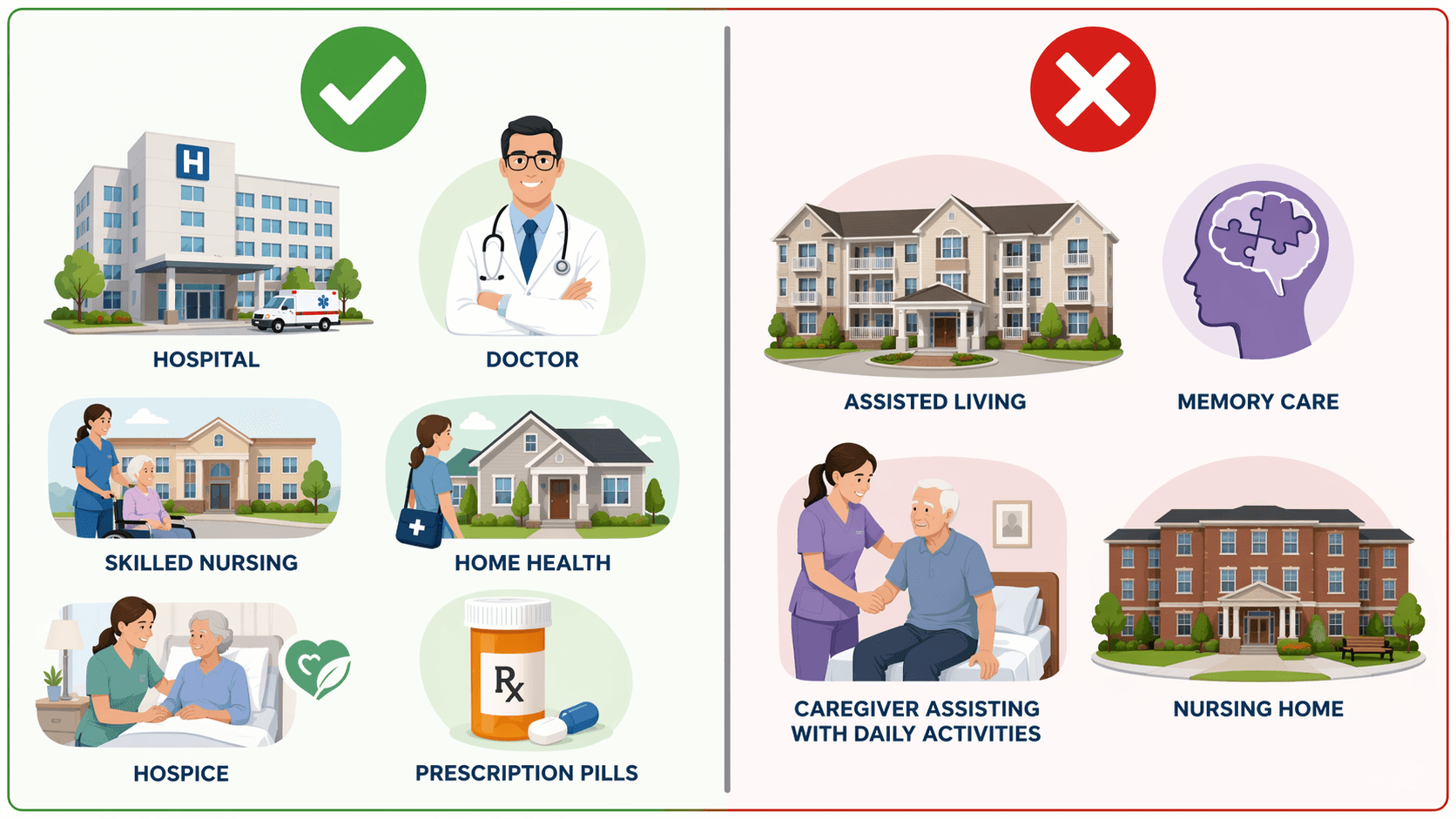
Before comparing premiums or dental allowances, separate medical care from custodial care. Medicare-based coverage is built around medically necessary care, skilled services, prescriptions, preventive care, and time-limited recovery. Long-term senior care is often built around daily help and supervision. Those are different payment worlds.
| Care need | How UnitedHealthcare Medicare coverage usually treats it |
|---|---|
| Hospital, doctor, outpatient, preventive care | Covered according to the rules of the specific Medicare Advantage plan, or through Original Medicare with a Medigap policy helping with cost-sharing. |
| Prescription drugs | Covered through many Medicare Advantage plans with drug coverage, or through a stand-alone Part D plan. |
| Skilled nursing facility after a hospital stay | Medicare may cover up to 100 days when requirements are met, including a qualifying 3-day hospital stay; this is not open-ended nursing home coverage.[2] |
| Home health care | May be covered when the person is homebound, has a doctor’s plan of care, and needs intermittent skilled care; it is not the same as daily non-medical home care.[2] |
| Hospice | Covered through Original Medicare Part A; Medicare Advantage members keep Part A hospice coverage rather than receiving hospice through the MA plan itself.[2] |
| Assisted living | Generally not covered as a room, board, or custodial-care expense.[2] |
| Memory care | Generally not covered as long-term residential supervision or custodial care.[2] |
| Non-medical home care | Generally not covered when the need is help with daily activities rather than intermittent skilled care.[2] |
| Long-term custodial nursing home care | Generally not covered as an ongoing custodial stay.[2] |
The hard part is that real life does not divide as neatly as a table. A parent may come home from the hospital needing a nurse for wound care, a physical therapist twice a week, and someone every morning to help with bathing and breakfast. The skilled pieces may fit Medicare rules. The morning aide may not. That is the phone call where families discover that “covered” was never one word.
What UnitedHealthcare offers seniors
UnitedHealthcare’s senior products mainly sit inside the Medicare system. The names can sound interchangeable when a family is moving quickly, but they solve different problems.
| UnitedHealthcare product type | What it is for | What it does not solve |
|---|---|---|
| Medicare Advantage | An alternative way to receive Medicare Part A and Part B benefits, often with drug coverage and extras such as dental, vision, hearing, fitness, OTC allowances, or care-management features depending on the plan. | It does not remove network rules, prior authorization, or out-of-pocket exposure, and it generally does not cover assisted living or long-term custodial care. |
| Medicare Supplement Insurance, also called Medigap | A policy that works with Original Medicare to help pay Medicare cost-sharing such as deductibles, copays, or coinsurance, depending on the standardized plan letter. | It does not add broad new benefits such as assisted living, memory care, routine non-medical home care, or long-term custodial nursing home care. |
| Part D prescription drug plans | Stand-alone prescription drug coverage for people using Original Medicare, often paired with Medigap. | It covers medications according to the formulary and plan rules; it is not coverage for hands-on care. |
| Special needs-style Medicare plans | Medicare Advantage options designed for people who meet certain eligibility categories, such as chronic conditions or dual Medicare-Medicaid eligibility, where available. | They may coordinate benefits more closely, but they still do not automatically become long-term care coverage. |
Medicare Advantage: broad reach, useful extras, real constraints
UnitedHealthcare’s Medicare Advantage footprint is the first reason many families encounter it. For 2026, the company described itself as offering Medicare Advantage plans available to 94% of Medicare-eligible consumers, with about 9.9 million Medicare Advantage members.[1] That scale can matter when a parent wants a familiar insurer, a local plan option, or a plan that bundles medical and drug coverage.
The attractive part is easy to see. UnitedHealthcare Medicare Advantage plans may include $0 premiums, dental, vision, hearing benefits, over-the-counter allowances, fitness memberships, and other supplemental benefits, depending on the plan and region.[3] Some plans also include UnitedHealthcare’s HouseCalls program, an annual in-home preventive visit at no additional cost.[2] For an older adult on a fixed income, those are not decorative benefits. A dental allowance or hearing benefit can affect whether care happens at all.
The tradeoff is management. Medicare Advantage plans operate with plan networks, plan rules, and prior authorization requirements. The plan may also set an annual out-of-pocket maximum; reported ranges for UnitedHealthcare Medicare Advantage plans include roughly $4,000 to $8,000, depending on the plan.[3] A low or $0 premium does not mean a year of care will be low-cost if hospitalizations, specialists, imaging, rehab, or expensive medications enter the picture.
Star ratings help, but they do not answer the family’s whole question. UnitedHealthcare Medicare Advantage plans had an average CMS star rating of 4.1 stars in the cited comparison material.[3] That gives a general quality signal. It does not tell you whether your parent’s cardiologist is in network, whether a preferred hospital is included, whether a prior authorization request will move quickly, or whether next year’s service area will still include the same plan.
The 2026 availability changes are not just fine print
Plan availability can move under a family’s feet. In 2026, UnitedHealthcare reduced its Medicare Advantage service area by 109 counties and 1 state, while also expanding HMO plan designs to reach 92% of eligible beneficiaries, according to Healthcare Dive’s reporting on 2026 Medicare Advantage changes.[4] That combination is worth reading carefully: the company can be both widely available and unavailable in a particular county, or available through a more managed network design than a family used before.
For caregivers, the practical question is not whether UnitedHealthcare is large nationally. It is whether the exact local plan covers the parent’s doctors, hospital, prescriptions, pharmacies, mobility needs, and likely follow-up care. A plan that looks generous in one ZIP code may not be the same plan across a county line.
Medigap: standardized benefits, nonstandard prices
UnitedHealthcare also sells Medicare Supplement Insurance, commonly called Medigap, under the AARP-branded arrangement discussed below. Medigap works with Original Medicare. It does not replace Medicare the way Medicare Advantage does. Instead, it helps pay some of the deductibles, coinsurance, or copayments left after Original Medicare pays its share.
This is where families need to slow down. Medigap plan letters are standardized in most states. A Plan G from one carrier must provide the same federally standardized Plan G medical benefits as a Plan G from another carrier. The insurer can differ in premium, underwriting approach where allowed, household discounts, customer service, rate history, and administrative experience. But the standardized benefit package itself is not richer because a familiar organization’s name appears on the brochure.
The pricing examples show why that distinction matters. In one benchmark comparison for a 65-year-old non-smoker in Orlando, Florida, AARP UnitedHealthcare Plan G was listed at about $160 to $230 per month, while Mutual of Omaha Plan G was listed at about $110 to $165 per month for the same standardized Plan G benefit category.[5] That is a ZIP-code-specific example, not a national price guarantee. Still, it asks the right consumer question: if the benefits are standardized, what exactly is the higher premium buying?
Sometimes the answer may be acceptable to the person paying. A senior may value brand familiarity, a particular enrollment experience, household history with the carrier, or confidence that customer service will be easier to reach. Those preferences are real. They just should not be confused with extra coverage for assisted living, daily aides, or memory care.
Part D and special-needs-style plans
UnitedHealthcare also offers prescription drug coverage through Part D, either built into many Medicare Advantage plans or sold as stand-alone drug plans for people staying with Original Medicare. The plan’s formulary, pharmacy network, tiers, and medication rules matter more than the carrier name in the abstract. A good Part D fit for one parent can be a poor fit for another if their prescriptions differ.
Some UnitedHealthcare Medicare options are designed for people with specific circumstances, including special needs-style Medicare Advantage plans where available. These plans may be relevant for people with certain chronic conditions or people who qualify for both Medicare and Medicaid. They can help coordinate medical benefits, but they should still be checked against the same long-term care boundary. Eligibility for Medicaid, not the UnitedHealthcare brand by itself, is often what changes the payment conversation for long-term custodial services.
What the AARP name means — and what it does not
The AARP name can be reassuring. For many older adults, it signals senior-focused advocacy, familiarity, and a sense that someone has vetted the product. In a stressful enrollment season, that can lower the temperature in the room.
But the AARP relationship with UnitedHealthcare is an endorsement and licensing arrangement. UnitedHealthcare pays royalty fees to AARP for the use of AARP’s intellectual property. AARP does not underwrite or insure the plans; consumers are buying UnitedHealthcare insurance with AARP branding, not a separate AARP-insured product.[6]
That distinction is not a technicality. If a family assumes the AARP name adds a layer of coverage, advocacy, or long-term care protection, they may stop asking the questions that actually determine risk: Is the benefit standardized? Are local premiums competitive? Are doctors in network? Are prescriptions covered affordably? What services require prior authorization? What happens if the parent later needs daily supervision rather than skilled care?
The services most often mistaken for covered care
The biggest misunderstanding usually comes after a health change. A parent falls, has surgery, completes rehab, and comes home weaker. The family hears “home health” and imagines someone coming every day to cook, bathe, supervise medications, and prevent another fall. Medicare’s home health benefit is narrower. It is tied to homebound status, a doctor’s plan of care, and intermittent skilled services, not open-ended household help.[2]
Skilled nursing facility coverage is also narrower than many families expect. Medicare may cover up to 100 days after a qualifying 3-day hospital stay, but that is a recovery benefit with conditions, not a promise to pay for permanent nursing home residence.[2] Once the need becomes long-term custodial care, families are usually looking at private pay, Medicaid if the person qualifies, VA-related benefits for some veterans or spouses, long-term care insurance if already purchased, or other family resources.
Assisted living and memory care create the same problem in a different setting. A plan may cover a doctor visit, medication, physical therapy, or medically necessary care connected to a resident’s condition. That does not mean it pays the assisted living rent, dementia supervision, meals, housekeeping, or daily personal care that make the placement necessary.
How to compare UnitedHealthcare options without letting one decision do every job
A Medicare decision can protect a parent’s medical care. It cannot be asked to solve every future care need. When comparing UnitedHealthcare with other options, keep the questions separated.
- For Medicare Advantage, check the local network, hospitals, specialists, drug coverage, prior authorization rules, out-of-pocket maximum, and whether supplemental benefits are actually available in the parent’s ZIP code.
- For Medigap, compare the same standardized letter plan across carriers. If Plan G is the target, compare Plan G to Plan G, not Plan G to a different benefit design.
- For Part D, run the parent’s actual prescriptions through the plan comparison process each year, including dosage, pharmacy, and formulary tier.
- For long-term care, build a separate payment plan for assisted living, memory care, non-medical home care, and custodial nursing home care. Do not assume a Medicare card, Medigap policy, or AARP logo will cover those costs.
UnitedHealthcare can be a reasonable fit for some seniors. Its Medicare Advantage reach is large, its supplemental benefits may be useful, and its AARP-branded Medigap policies may feel familiar to families who want a known name. The careful move is to treat that familiarity as one factor, not as proof of broader coverage. Compare local premiums, networks, drugs, authorization rules, and standardized Medigap pricing. Then plan separately for the daily care needs Medicare-based products generally do not cover.
References
- UnitedHealthcare UCard® to offer enhanced benefits, simplicity for people with Medicare Advantage plans in 2026, UnitedHealthcare, October 2025.
- UnitedHealthcare Medicare Advantage Review, SeniorLiving.org.
- UnitedHealthcare Medicare Advantage plans: What to know, Medical News Today.
- Medicare Advantage plans 2026: UnitedHealthcare, Humana, Aetna cut offerings, Healthcare Dive, October 2025.
- AARP UnitedHealthcare Medicare Plans 2026 Review, The Big 65.
- AARP and UnitedHealthcare update, UnitedHealthcare.
See This Term in Context
- How to Choose Senior Care: A Step-by-Step Guide for First-Time Family Caregivers
A structured, five-step action plan for adult children who need to make a senior care decision after a crisis. Learn how to assess functional ability, match needs to the right care level, determine your budget, evaluate facilities, and plan a smooth transition.
- When Aging in Place Is No Longer Safe: A Five-Domain Framework for Recognizing the Warning Signs
This article provides family caregivers with a structured five-domain framework to identify observable warning signs that an aging parent may no longer be safe living at home, helping turn anxious observation into proactive decision-making without triggering unnecessary transitions.
- Senior Health Services by Care Need: Matching Services to Your Parent's Actual Situation
A scenario-based guide for crisis-driven caregivers. Instead of organizing services by facility type, this guide helps you match the right service — home health, adult day care, respite, PACE, or memory care — to your parent's specific situation, whether it's a recent fall, a dementia diagnosis, or caregiver burnout.
Comments
Join the discussion with an anonymous comment.