
Clinical term
Senior Health Services by Care Need: Matching Services to Your Parent's Actual Situation
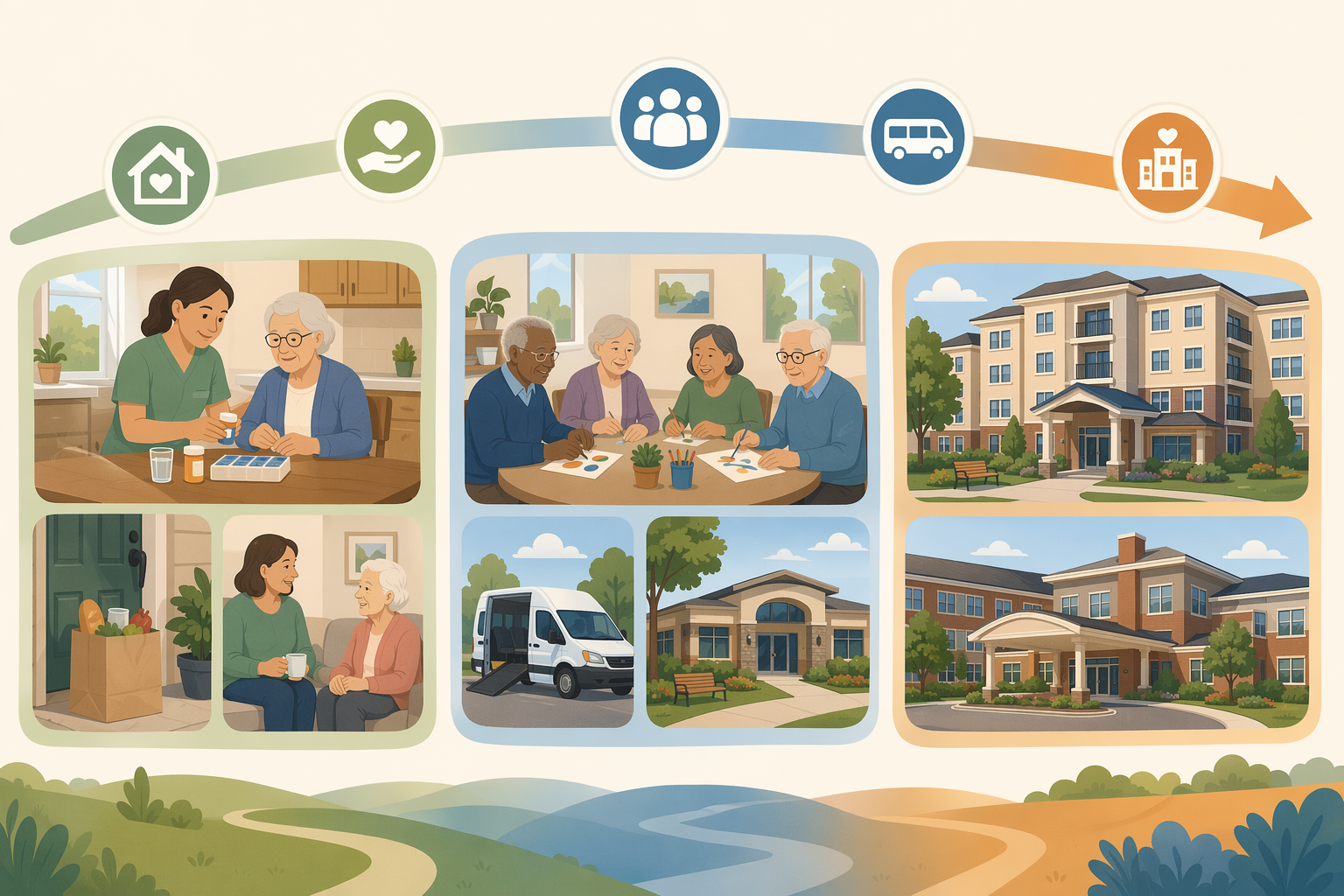
Introduction: Why Starting With the Crisis, Not the Facility, Gets You Faster Answers
When your parent falls, gets a dementia diagnosis, or is discharged from the hospital, the last thing you need is a taxonomy of facility types. You need to know what to do right now. Yet most guides on senior health services organize information by building name — assisted living, nursing home, independent living — which assumes you already know what level of care is needed. That assumption fails the moment a crisis hits.
This guide takes a different approach. It is organized by the five most common care scenarios that drive families to search for help: a parent coming home from the hospital, dementia behaviors that can no longer be managed alone, high fall risk at home, caregiver burnout, and social isolation. For each scenario, you will find the specific service types that match that problem, how to get started, typical costs, and clear warning signs that the current setup is not enough.
The urgency is real. Nearly 1 in 4 adults — 63 million Americans — provided unpaid care for an adult in the past year, a 20 million increase since 2015, according to AARP. And 48% of older adults turning 65 will pay for some long-term care entirely out of pocket. Getting the right service match quickly is not just about convenience; it directly affects your parent's safety and your own ability to sustain caregiving over the long haul.
Scenario 1: Your Parent Just Fell and Is Coming Home From the Hospital
Your mother fell, broke her hip, and spent four days in the hospital. Now she is being discharged with a walker, a list of new medications, and instructions for physical therapy. She cannot drive, cannot cook for herself, and needs help getting to the bathroom. You live 45 minutes away and work full-time. What do you do?
This is the most common crisis scenario families face, and it requires immediate action because the transition from hospital to home is when errors — medication mistakes, falls, missed follow-up appointments — are most likely to occur. The services that fit this situation are short-term and recovery-focused.
Matching Services for Post-Hospital Recovery
| Service Type | What It Does | Typical Cost | Payment Source |
|---|---|---|---|
| Home health care (skilled) | Nurses or therapists provide wound care, physical therapy, medication management at home. Requires a doctor's order. | Covered by Medicare Part A/B for short-term skilled needs | Medicare covers 100% for the first 20 days of skilled nursing; ~80% for days 21–100; ends after day 100 |
| Home care (non-medical) | Aides help with bathing, dressing, meal preparation, light housekeeping, and companionship. No medical skills required. | $35 per hour (national median, CareScout 2025) | Out-of-pocket, Medicaid HCBS waivers (state-dependent), long-term care insurance |
| Adult day care | Structured daytime program with supervision, meals, and activities. A lower-cost option for supervision during recovery. | $95 per 8-hour day (national median, CareScout 2025) | Out-of-pocket, Medicaid may cover (state-dependent) |
How to Get Started
- Before discharge, ask the hospital's discharge planner for a home health referral. Medicare-covered home health requires a doctor's order and a face-to-face meeting within 90 days before or 30 days after the start of care.
- Call the Eldercare Locator (eldercare.acl.gov) or your local Area Agency on Aging to find home care agencies and adult day centers in your area.
- Ask home care agencies: Are your aides bonded and insured? Do you provide a written care plan? What is your backup plan if an aide calls in sick?
- Check whether your parent has long-term care insurance or qualifies for a Medicaid Home and Community-Based Services (HCBS) waiver, which can cover home care costs.
Warning Signs That Current Services Aren't Enough
- Your parent falls again within 30 days of discharge despite home health visits.
- They are not eating or taking medications as prescribed.
- The home health aide is not enough to prevent wandering or confusion at night.
- You are missing work repeatedly to fill gaps in care.
Scenario 2: Your Parent Has Dementia and Is Wandering or Having Behavioral Changes
Your father, who has Alzheimer's disease, left the house at 2 a.m. in his pajamas last week. A neighbor found him three blocks away, confused and shivering. He has also become agitated in the afternoons, sometimes yelling at your mother when she tries to help him dress. Your mother is exhausted and afraid. You need help now.
Dementia-related behaviors — wandering, sundowning, agitation, repetitive questioning — are among the most distressing challenges for families. They also pose serious safety risks. The services that match this scenario are designed to provide structured supervision, specialized care, and caregiver relief.
Matching Services for Dementia Wandering and Behavioral Changes
| Service Type | What It Does | Typical Cost | Payment Source |
|---|---|---|---|
| Memory care (specialized assisted living) | A secured, dementia-specific living environment with 24/7 supervision, structured activities, and staff trained in behavioral management. | $7,645 per month (national median, CareScout 2025) | Out-of-pocket, long-term care insurance, Medicaid may cover in some states |
| Adult day care | Structured daytime program with supervision, meals, and activities. Can provide a safe environment during the day while the primary caregiver rests or works. | $95 per 8-hour day (national median, CareScout 2025) | Out-of-pocket, Medicaid may cover (state-dependent) |
| In-home respite care | A trained aide comes to the home to provide supervision and care, giving the family caregiver a break. Can range from a few hours to several days. | $350 per day (national median, CareScout 2025) | Out-of-pocket, Medicare covers up to 5 consecutive days when hospice-eligible, Medicaid may assist |
How to Get Started
- Contact your local Area Agency on Aging or the Alzheimer's Association 24/7 Helpline (800-272-3900) for referrals to memory care facilities and adult day programs that specialize in dementia.
- Ask adult day centers: Do you have staff trained in dementia care? What is your staff-to-participant ratio? How do you handle wandering or agitation?
- For in-home respite, ask agencies: Do your aides have experience with dementia behaviors? What is your protocol if the person becomes agitated or tries to leave?
- If your parent is eligible for hospice (prognosis of 6 months or less), Medicare covers up to 5 consecutive days of respite care in a facility.
Warning Signs That Current Services Aren't Enough
- Wandering continues despite door alarms, locks, and supervision.
- The primary caregiver (often a spouse) is showing signs of exhaustion, depression, or declining health.
- Agitation or aggression is escalating and cannot be managed with non-pharmacological strategies.
- Your parent is losing weight, not taking medications, or has had a fall.
Scenario 3: Your Parent Is at High Risk of Falling but Still Wants to Live at Home
Your 82-year-old father lives alone in the two-story house where you grew up. He uses a cane but has had two near-falls in the past month — once on the stairs, once getting out of the shower. He is adamant about staying at home, but you worry every time the phone rings. He is otherwise healthy and cognitively sharp.
Falls are the most frequent problem sending older adults to the emergency room, and the consequences — hip fractures, head injuries, loss of independence — are severe. The goal in this scenario is to layer services that reduce fall risk while supporting independent living.
Matching Services for Fall Risk at Home
| Service Type | What It Does | Typical Cost | Payment Source |
|---|---|---|---|
| Home safety assessment and modification | An occupational therapist or CAPS-certified contractor evaluates the home and recommends grab bars, non-slip flooring, stair lifts, lighting upgrades, and other modifications. | Assessment: $150–$500. Modifications vary widely (e.g., grab bars $50–$200, stair lift $3,000–$10,000) | Out-of-pocket, VA grants, Medicaid HCBS waivers (state-dependent) |
| PERS / medical alert system | A wearable button or pendant that connects to a monitoring center. Some include automatic fall detection. | $20–$50 per month; some require an equipment fee | Out-of-pocket (Medicare does not pay; Medicaid may cover in some states) |
| Home care (non-medical) | An aide provides daily supervision, assistance with bathing and dressing, meal preparation, and companionship. Reduces the time your parent is alone and at risk. | $35 per hour (national median, CareScout 2025) | Out-of-pocket, Medicaid HCBS waivers, long-term care insurance |
| Adult day care | Structured daytime program with supervision, activities, and meals. Reduces isolation and provides monitoring during the day. | $95 per 8-hour day (national median, CareScout 2025) | Out-of-pocket, Medicaid may cover (state-dependent) |
How to Get Started
- Request a home safety assessment from an occupational therapist. Medicare Part B may cover this if it is ordered by a doctor as part of a plan of care.
- Contact your local Area Agency on Aging for information on fall prevention programs and home modification resources.
- Research PERS devices. Ask: Does the device have automatic fall detection? What is the battery life? Is there a monthly monitoring fee? What is the response time?
- If your parent is a veteran, check eligibility for VA Home Improvements and Structural Alterations (HISA) grants, which can cover up to $6,800 for home modifications.
Warning Signs That Home Is No Longer Safe
- A fall occurs despite home modifications and a PERS device.
- Your parent cannot get to the bathroom safely at night.
- They are skipping meals because they cannot stand long enough to cook.
- They are confused about how to use the PERS device or forget to wear it.
Scenario 4: You Are the Caregiver and You Are Burning Out
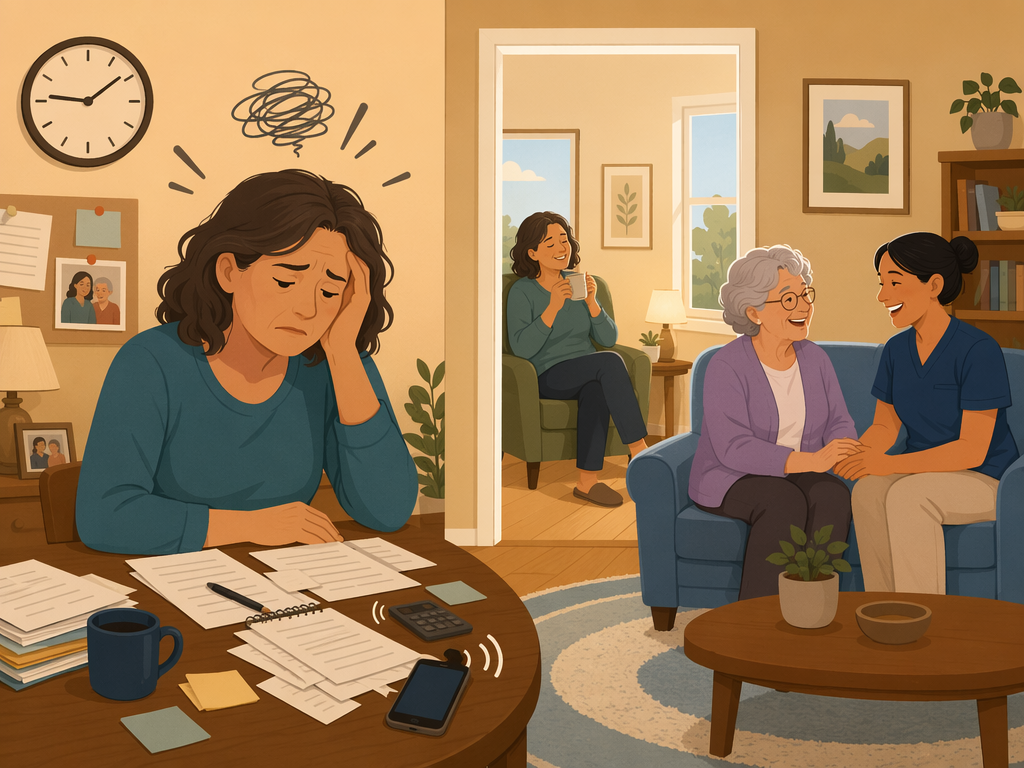
You have been caring for your mother for two years. You work full-time, have two teenagers at home, and spend every weekend driving her to doctor's appointments, managing her medications, and cleaning her house. You have not had a full night's sleep in months. You are irritable, forgetful, and your own blood pressure is climbing. You feel guilty even thinking about taking a break.
Caregiver burnout is not a sign of failure — it is a predictable consequence of sustained, unpaid care work. According to AARP, 63% of family caregivers experienced at least one major financial impact from caregiving, and the emotional toll is equally severe. The services that match this scenario are designed to give you a break, not to replace you.
Matching Services for Caregiver Burnout
| Service Type | What It Does | Typical Cost | Payment Source |
|---|---|---|---|
| Respite care (in-home or facility-based) | A trained aide provides care in your home, or your parent stays at a facility for a short period. Gives you a break from a few hours to several weeks. | $350 per day (national median, CareScout 2025) | Out-of-pocket, Medicare covers up to 5 consecutive days when hospice-eligible, Medicaid may assist, some nonprofits offer sliding-scale respite |
| Adult day care | Your parent attends a structured daytime program, giving you a predictable break during the day. Often the most affordable option for working caregivers. | $95 per 8-hour day (national median, CareScout 2025) | Out-of-pocket, Medicaid may cover (state-dependent) |
| Friendly visitor / companion services | A volunteer or paid companion visits your parent for conversation, games, or a walk. Provides social connection and a short break for you. | Often volunteer-based and free; paid companions $15–$25 per hour | Out-of-pocket, some nonprofit programs offer free services |
How to Get Started
- Call the Eldercare Locator (eldercare.acl.gov) to find respite care providers and adult day centers in your area.
- Ask adult day centers: Do you accept drop-in or part-time attendance? What is your cancellation policy? Can you accommodate my parent's specific needs (dementia, mobility issues)?
- For in-home respite, ask agencies: What is the minimum number of hours per visit? Do you provide overnight care? Are your aides trained in dementia care if needed?
- Check with local faith-based organizations, senior centers, and nonprofit groups for volunteer-based friendly visitor programs.
Warning Signs That Burnout Is Affecting Your Health
- You are experiencing persistent fatigue, irritability, or difficulty sleeping.
- You have withdrawn from friends, hobbies, or activities you used to enjoy.
- Your own health conditions (high blood pressure, diabetes, anxiety) are worsening.
- You find yourself snapping at your parent or feeling resentful toward them.
Scenario 5: Your Parent Is Socially Isolated and Declining at Home
Your mother lives alone in a suburban house. She stopped driving two years ago. Her closest neighbor moved away. She spends most days watching television and eating frozen meals. She has lost weight, seems forgetful, and tells you she feels "invisible." You call every day, but you live in another state and cannot visit more than once a month.
Social isolation is a serious health risk for older adults. Research shows it is associated with higher rates of depression, cognitive decline, and even mortality. The services that match this scenario focus on connection, engagement, and basic support.
Matching Services for Social Isolation
| Service Type | What It Does | Typical Cost | Payment Source |
|---|---|---|---|
| Adult day care | Structured daytime program with social activities, meals, and supervision. Reduces isolation and provides a predictable daily routine. | $95 per 8-hour day (national median, CareScout 2025) | Out-of-pocket, Medicaid may cover (state-dependent) |
| Senior centers | Community-based centers offering meals, exercise classes, games, and social events. Often the most affordable option. | Low-cost or free; some charge a small annual membership fee | Out-of-pocket, some programs are subsidized by local governments |
| Friendly visitor / companion services | A volunteer or paid companion visits for conversation, games, or a walk. Provides one-on-one social connection. | Often volunteer-based and free; paid companions $15–$25 per hour | Out-of-pocket, some nonprofit programs offer free services |
| Transportation services | Rides to medical appointments, grocery stores, senior centers, and social events. Some services are free or donation-based. | Some free; Medicaid covers emergency and doctor visit transportation; Medicare covers ambulance for emergencies and limited non-emergencies | Medicaid, Medicare (limited), out-of-pocket, local nonprofit programs |
How to Get Started
- Call the Eldercare Locator (eldercare.acl.gov) to find senior centers, adult day programs, and transportation services in your parent's area.
- Contact the local Area Agency on Aging for information on friendly visitor programs and volunteer-based companionship services.
- Ask senior centers: Do you offer transportation to and from the center? What is the schedule of activities? Is there a meal program?
- Check whether your parent qualifies for Meals on Wheels (888-998-6325), which delivers meals and provides a daily wellness check.
Warning Signs That Isolation Is Accelerating Decline
- Your parent is losing weight or not eating regular meals.
- They are missing medical appointments because they have no transportation.
- Their home is becoming cluttered or unsanitary.
- They are expressing hopelessness or talking about death frequently.
How to Get Started: A Quick-Reference Action Plan for Any Scenario
No matter which scenario you are facing, the same five-step process will get you from crisis to action faster than trying to navigate the system alone.
- Identify the primary care problem. Is it post-hospital recovery? Dementia behaviors? Fall risk? Caregiver burnout? Social isolation? Be specific about what is happening right now.
- Match it to the service type using the tables above. Each scenario has a clear set of services that fit. Do not start by searching for "assisted living" — start with the problem.
- Call the Eldercare Locator (eldercare.acl.gov) or your local Area Agency on Aging. These are the single best entry points for finding local services. They are free, confidential, and staffed by people who know the local system.
- Ask the right questions. When you call a service provider, have a list ready: Are you licensed and insured? What are your staff qualifications? What is your backup plan if a staff member is sick? Do you have experience with my parent's specific condition (dementia, mobility issues, post-surgery recovery)? What are your rates and payment options?
- Check costs and payment options. Medicare covers home health (skilled, short-term) and hospice. Medicaid covers long-term care for those who qualify financially, but rules vary by state. VA benefits (Aid and Attendance) can provide up to $2,874 per month for a married veteran. Long-term care insurance may cover some services. Most other services are paid out-of-pocket.
For a detailed 30-day action plan that walks you through setting up services after a fall or diagnosis, see our From Crisis to Plan: A 30-Day Timeline.
When to Escalate: Warning Signs That Current Services Aren't Enough
Every scenario has a tipping point where home-based or community-based services are no longer sufficient. Recognizing these warning signs early can prevent a crisis.
| Warning Sign | What It Suggests | Next Level of Care to Consider |
|---|---|---|
| Repeated falls despite home modifications and a PERS device | Home environment is no longer safe even with supports | Assisted living or a board and care home with 24/7 supervision |
| Wandering that cannot be managed with alarms, locks, or supervision | Dementia has progressed to a point where constant monitoring is needed | Memory care (secured assisted living unit) |
| Caregiver's health is declining (hospitalization, severe depression, injury) | The caregiving arrangement is unsustainable and putting both people at risk | Skilled nursing facility or hospice (if prognosis is 6 months or less) |
| Rapid weight loss, dehydration, or missed medications | The older adult cannot manage basic self-care even with current services | Assisted living or a board and care home with meal and medication management |
| Unsafe living conditions (hoarding, fire hazards, extreme clutter) | The home environment has become hazardous despite support services | Assisted living, board and care home, or adult protective services evaluation |
Browse more in the Glossary.