
Clinical term
When Aging in Place Is No Longer Safe: A Five-Domain Framework for Recognizing the Warning Signs
The hard moment usually does not arrive as a clean announcement. It may be a parent insisting they are “fine” while gripping the back of a chair to cross the room. It may be expired food in the refrigerator, a pill organizer with Tuesday still full on Thursday, or a stack of unopened bills under the reading glasses. None of those signs, by itself, proves that aging in place has failed. The better question is narrower and more useful: is this home still safe under the current level of support?
Aging in place means continuing to live in one’s own home or community as needs change. For many older adults, that familiar setting protects privacy, identity, and daily rhythm. But the phrase can also become too comforting. A home that worked last year may not work this year if mobility, medication routines, nutrition, judgment, or isolation have shifted. If you need the basic definition first, see Aging in Place: Definition, Statistics, and What Families Need to Know. This guide starts at the next, more uncomfortable step: how to recognize when the current arrangement is no longer safe enough.
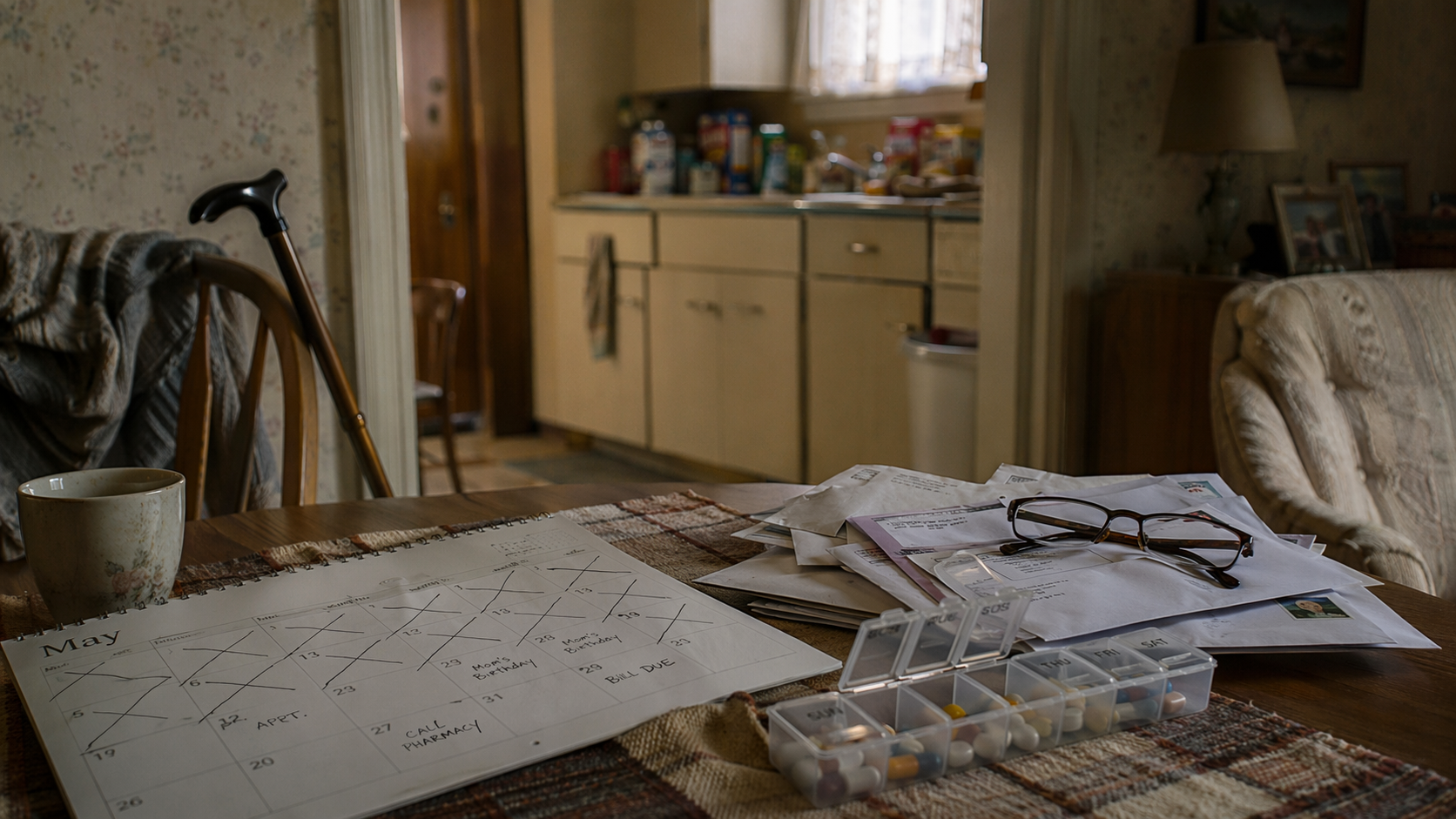
A five-domain way to look at home safety
Commercial safety checklists can be useful, but they should not be mistaken for a formal clinical assessment. The warning signs below synthesize the kinds of concerns found in caregiver-facing safety guidance—unexplained injuries, hygiene decline, spoiled food, medication problems, unsafe clutter, forgetfulness, social withdrawal, mobility difficulty, financial confusion, and mood changes—but they are not a validated diagnostic instrument.[1] Their value is practical: they help families stop arguing from feelings and start looking at observable patterns.
| Domain | What to observe | Why it matters |
|---|---|---|
| Physical safety | Falls, bruises, stair difficulty, clutter, furniture-walking, poor lighting, unsafe bathrooms | Falls and mobility problems are often the crisis doorway into a larger safety decision. |
| Medication management | Missed doses, duplicate doses, expired prescriptions, confusion about what each pill is for | Medication errors can quickly worsen chronic conditions or create dangerous interactions. |
| Nutrition and hygiene | Spoiled food, weight loss, dehydration concerns, laundry buildup, body odor, bathing or grooming decline | These signs show whether daily self-care is actually happening, not just intended. |
| Cognitive function | Stove or lock mistakes, missed appointments, unpaid bills, scams, repeated confusion, unsafe judgment | Daily-task failures may reveal risks that casual phone calls miss. |
| Social wellbeing | Withdrawal, depression symptoms, anxiety, irritability, loss of driving, fewer contacts | Isolation changes how quickly problems are noticed and how much help can arrive. |

Physical safety: the fall is rarely just about the fall
Falls deserve attention first because they are common, consequential, and easy to minimize after the immediate fear passes. Age Safe America cites the CDC baseline that one in four seniors falls each year and that falls are the leading cause of injury for adults age 65 and older.[1] That does not mean every fall ends independent living. It does mean a fall should open the door to a broader inspection of how the home and the person are now fitting together.
Look beyond the story your parent gives you in the moment. “I just tripped” may be true. It may also hide poor lighting, loose rugs, a bathroom without grab bars, dizziness, muscle weakness, unsafe footwear, or a new habit of using furniture as a walking aid. Unexplained bruises matter, especially when the explanation changes or sounds vague. So does hesitation at the stairs, sleeping in a recliner because the bedroom is upstairs, or avoiding the shower because stepping over the tub edge feels risky.
The important distinction is whether the risk has a realistic fix. A loose rug can be removed. A dark hallway can be lit. A bathroom can be modified. A cane or walker can be reassessed by a clinician. Families who are seeing mostly environmental hazards may want to start with an aging-in-place home modification review. But if your parent is falling repeatedly, cannot safely transfer, forgets to use assistive devices, or cannot summon help afterward, the problem has moved beyond rearranging furniture.
If a fall just happened, the first task is not to solve the whole living-arrangement question in the hallway. It is to check for injury, seek appropriate medical care, and preserve enough information to understand what happened. For that immediate sequence, use From Crisis to Control: First 24 Hours After a Fall. Then come back to the broader pattern.
Medication management: “I have a system” needs evidence
Medication problems are easy to miss because they often happen quietly. The pill bottles may be lined up neatly. The organizer may be filled. Your parent may know the names of some prescriptions and still be taking them incorrectly. Missed doses, double doses, old prescriptions kept “just in case,” or confusion between morning and evening medications can all create immediate danger.
The risk is not theoretical. StatPearls notes that adverse drug events account for 5% to 28% of acute geriatric medical admissions, and polypharmacy increases the chance of drug interactions, nonadherence, and prescribing cascades.[2] That range is wide, but even the low end is enough to make medication management a central safety domain rather than a housekeeping detail.
The practical check is simple: compare what is prescribed with what is actually happening. Are the right pills missing from the organizer on the right days? Are refills picked up on time? Are there multiple prescribers who may not know about one another? Does your parent understand which medications are essential and which are as-needed? Are pill bottles mixed with supplements, old antibiotics, or someone else’s medication?
If the answer is unclear, do not rely on reassurance alone. A pharmacist review, primary care visit, simplified dosing schedule, blister packaging, medication dispenser, or daily in-home support may solve the problem. The warning sign becomes more serious when your parent resists any verification, cannot explain recent changes, takes medications based on memory despite mistakes, or has already had symptoms that may be tied to missed or incorrect doses.
Nutrition and hygiene: the house tells you what phone calls do not
A parent can sound composed on the phone while daily care is slipping. The refrigerator, trash, laundry, bathroom, and pantry often give a more honest report. Spoiled food, little fresh food, repeated takeout containers, unexplained weight loss, dirty dishes, strong odors, unchanged sheets, or laundry piling up can mean shopping, cooking, cleaning, or bathing has become too hard to manage consistently.
These signs do not all point to the same cause. Arthritis can make opening containers painful. Low vision can make food labels hard to read. Depression can flatten appetite and motivation. Cognitive changes can make cooking unsafe. Limited transportation can turn an empty refrigerator into a logistics problem rather than a refusal to eat. The cause matters because it determines whether support can keep the person safely at home.
Meal delivery, grocery delivery, adaptive kitchen tools, bathing assistance, laundry help, or a few hours of weekly in-home care may be enough when the problem is specific and the parent accepts help. The concern grows when nutrition and hygiene problems recur after help is arranged, when your parent denies obvious conditions, or when these signs appear alongside falls, medication mistakes, or confusion about money and appointments.
Cognitive function shows up in ordinary failures before it shows up as a diagnosis
Families often wait for a clear memory diagnosis before treating cognitive changes as safety concerns. Daily life rarely waits that politely. A burned pan, unlocked door, missed appointment, duplicate bill payment, unpaid utility notice, repeated confusion about dates, or susceptibility to scams can all show that the home now requires more executive function than your parent can reliably provide.
Financial confusion deserves particular respect. Unopened mail and late notices are not just paperwork. They may signal that your parent is overwhelmed, forgetting steps, avoiding tasks they no longer understand, or becoming vulnerable to fraud. A parent who was once meticulous with money may feel embarrassed and defend the system long after the system has stopped working.
Cognitive warning signs are not limited to dementia, and they should be assessed medically. Medication side effects, infection, poor sleep, grief, depression, alcohol use, sensory loss, or metabolic issues can all affect thinking. But while the cause is being evaluated, the safety problem still has to be managed. If stove use is unsafe, bills are going unpaid, or the door is left unlocked, the plan needs more than “call me if you need anything.”
If your parent already has a dementia diagnosis, use a more specific transition lens. When Home Is No Longer Safe addresses dementia-related crisis planning, and 10 Signs It’s Time for Memory Care can help when memory care is becoming part of the conversation.
Social wellbeing is a safety issue, not a nicety
Isolation changes the math of aging in place. A parent who sees neighbors, attends appointments, answers calls, and has regular visitors has more opportunities for problems to be noticed early. A parent who is withdrawing may have the same fall risk, medication confusion, or nutrition problem—but fewer people close enough to see it.
The National Institute on Aging identifies loneliness and social isolation as meaningful health concerns for older adults and recommends practical ways to stay connected, including maintaining regular contact, joining activities, volunteering, and using technology where appropriate.[3] In a safety review, the question is not whether your parent is cheerful enough. It is whether the social structure around them is strong enough to detect decline, reduce risk, and bring help when needed.
Driving often becomes the visible break in that structure. Giving up driving is not only a transportation problem; HealthInAging reports that driving cessation nearly doubles depression symptoms in older adults and may accelerate physical and cognitive declines.[4] Some families focus only on whether the parent can get to the grocery store. The larger question is what disappears when the car keys do: medical access, friendships, worship, errands, exercise, choice, and the small daily proof that life still belongs to the person living it.
Alternate transportation, ride services, senior center programs, adult day programs, faith community support, and scheduled family visits may restore enough connection for home to remain workable. But if your parent stops going out, stops answering calls, becomes unusually anxious or irritable, or loses the only practical way to get food and care, social wellbeing has become part of the safety picture.
The decision turns on accumulation, not one frightening sign
One fall, one missed bill, or one spoiled carton of milk may have an explanation. A pattern across domains is different. The parent who has fallen twice, missed medication refills, stopped bathing regularly, left the stove on, and stopped attending church is not facing five separate small issues. The arrangement itself is being tested from multiple sides.
A useful review separates isolated incidents from repeated evidence:
- Is the sign new, repeated, or escalating?
- Is there a clear cause that can be addressed?
- Does your parent recognize the problem and accept help?
- Does the support plan actually cover the risk, or does it only make the family feel better?
- Are problems appearing in more than one domain?
- Who is responsible if the plan fails at night, on weekends, or when the usual caregiver is unavailable?
That last question is not meant to assign blame. Caregiver capacity is part of the safety equation. A plan that depends on an adult child leaving work three times a week, sleeping with the phone on the pillow, managing every refill, and guessing whether the parent ate is not a stable care plan just because the parent remains at home. If the family cannot reliably provide what the home now requires, the mismatch belongs in the decision—not in someone’s private guilt.
Unsafe living alone is not the same as “must move today”
This distinction matters. Many warning signs mean the parent is no longer safe living alone without additional support. They do not automatically mean the parent must leave home immediately. The next step is to test whether enough support can be added quickly, consistently, and affordably to bring the risk down.
The National Institute on Aging emphasizes planning ahead, reassessing needs, and considering services and home changes that can support aging in place; Medical News Today summarizes these strategies as part of evaluating suitability, benefits, and risks.[5] The timing is the hard part. These supports work best before a crisis becomes the only decision-maker.
Depending on the pattern, intermediate support may include:
- A medical visit to review falls, dizziness, cognition, mood, sleep, pain, vision, hearing, and medications
- A pharmacist-led medication review or packaging system
- Occupational therapy or a home safety assessment
- Home modifications such as grab bars, better lighting, stair solutions, or bathroom changes
- Meal delivery, grocery support, laundry help, or housekeeping
- In-home assistance for bathing, dressing, transfers, medication reminders, or supervision
- Adult day programs or structured social activities
- Transportation alternatives after driving becomes unsafe or unavailable
- Monitoring technology, with a clear understanding of what it can and cannot do
For families considering hands-on help, 10 Signs Your Aging Parent Needs In-Home Assistance can help translate warning signs into support needs. If you are weighing sensors, cameras, medication devices, or emergency alert systems, read Is Monitoring Enough? Deciding Between Technology and Professional Care. Technology can alert someone to a problem. It cannot lift a person from the floor, make them take the right medication, or notice every quiet decline.
If added support still cannot cover the risks, then it is time to compare living arrangements rather than keep stretching the old one. Is It Time for a Senior Retirement Home? can help with that next-stage matching after the safety question has become clearer.
How to document what you are seeing before the conversation
A vague accusation—“You’re not safe anymore”—will usually sound like an attack. A domain-based record is harder to dismiss and easier to act on. Write down dates, what you observed, what your parent said happened, what support was tried, and whether the issue repeated. Keep the language plain: “Found three unpaid utility notices on May 4,” “Thursday and Friday pills still in organizer on Saturday,” “Bruise on left forearm; explanation unclear,” “No fresh food in refrigerator during last two visits.”
Bring the record to the parent’s clinician when appropriate. Ask for medical, cognitive, medication, mobility, vision, hearing, mood, and occupational safety input rather than trying to make the whole call from the kitchen table. Professional assessment also protects against a common family mistake: overlooking adaptive strategies that are working simply because they are not visible to you.
The conversation with your parent still may be painful. Resistance is not proof that your concern is wrong; it may reflect fear, pride, grief, or the very real loss attached to changing a home-centered life. If the emotional side is becoming the barrier, use How to Talk to Parents About Moving to Senior Living and The Hidden Emotional Toll of Caring for Aging Parents alongside the practical planning.
Start with the five domains. Look for repetition. Look for spread across domains. Ask what support can realistically be added, who will provide it, and what happens when that person is unavailable. Aging in place becomes unsafe not because one frightening thing happened, but because the home, the parent’s needs, and the available support no longer match.
References
- 10 Warning Signs Your Aging Parent May No Longer Be Safe Living Alone — Age Safe America
- Polypharmacy — StatPearls/NCBI
- Loneliness and Social Isolation — Tips for Staying Connected — National Institute on Aging
- Tip Sheet: Becoming a Non-Driver? Find Alternate Transportation Options — HealthInAging
- Aging in place: Suitability, benefits, and risks — Medical News Today
Browse more in the Glossary.