
Clinical term
What Is Elderly Care? A Comprehensive Glossary for New Family Caregivers
What Is Elderly Care?
Elderly care — often called eldercare — is not a single service you purchase or a single facility you choose. It is an umbrella term covering the full spectrum of medical, personal, and social support designed to help older adults maintain dignity, safety, and quality of life as their needs change. For a new family caregiver, understanding this spectrum is the first step toward making informed decisions.
At one end of the spectrum, care may mean a family member stopping by twice a week to pick up groceries and manage medications. At the other end, it may mean round-the-clock skilled nursing in a facility or end-of-life hospice support at home. Between those poles lies a wide range of services: non-medical home care, adult day programs, assisted living, memory care units, and more.
The National Institute on Aging (NIA) describes long-term care as a variety of services that help people meet their health or personal needs over a period of time. The key point is that elderly care is a continuum, not a destination. Most older adults move through several levels of care over the years, and the right choice at any given moment depends on their current functional status, medical needs, and personal preferences.
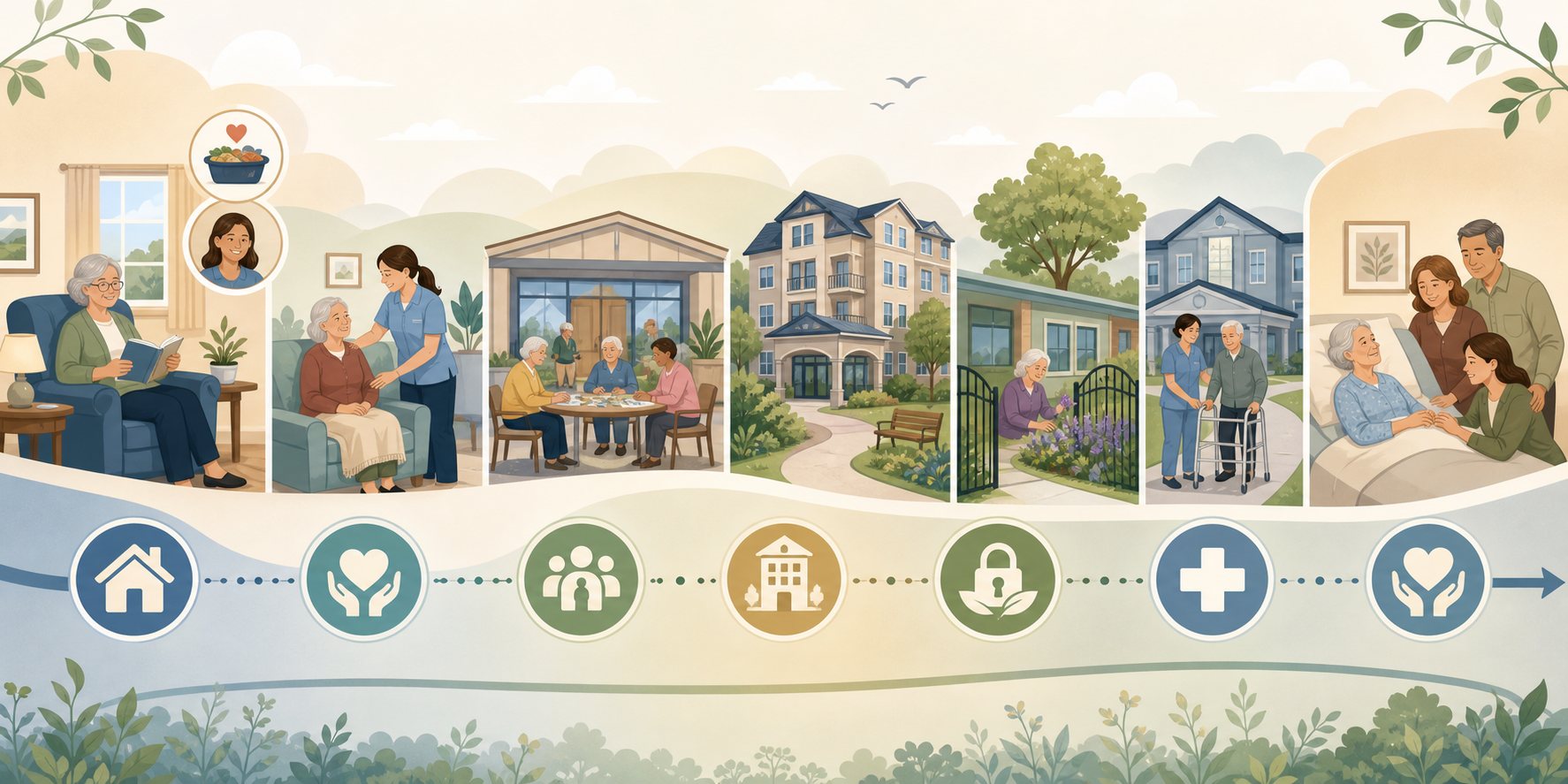
The Care Continuum: Types of Elderly Care Services
Each type of care serves a different purpose and fits a different stage of need. Understanding the distinctions helps you match services to your family member's actual situation — and avoid paying for more care than is needed or choosing a setting that cannot provide enough support.
- Home Care (Non-Medical): Also called companion care or personal care. A home health aide or caregiver assists with bathing, dressing, meal preparation, light housekeeping, and companionship. No medical services are provided. This is the most common entry point for families who want a loved one to age in place.
- Home Health Care (Skilled): Licensed medical professionals — nurses, physical therapists, occupational therapists — provide care at home under a doctor's orders. This is typically short-term and focused on recovery after a hospitalization or illness. Medicare Part A and Part B cover home health care under specific conditions.
- Adult Day Care: A structured daytime program in a community setting that provides social activities, meals, and some health services. It offers respite for family caregivers who work during the day or need a break. Some centers specialize in dementia care.
- Assisted Living (ALF): A residential facility for seniors who need help with daily activities but do not require 24-hour skilled nursing. Residents typically have their own apartment or room and receive help with medications, meals, and personal care. Assisted living is generally paid out-of-pocket or through long-term care insurance; Medicare does not cover it.
- Memory Care: A specialized type of assisted living designed for individuals with Alzheimer's disease or other dementias. These units have enhanced security to prevent wandering, staff trained in dementia care, and structured activities that reduce confusion and agitation.
- Skilled Nursing Facility (SNF): Often called a nursing home. Provides 24-hour skilled nursing care for individuals with complex medical needs. SNF care is covered by Medicare for a limited time after a hospital stay (up to 100 days under certain conditions) and by Medicaid for long-term custodial care for those who qualify.
- Continuing Care Retirement Community (CCRC): A campus that offers independent living, assisted living, and skilled nursing all in one location. Residents move between levels as their needs change. CCRCs require a large upfront entrance fee plus monthly payments.
- Respite Care: Short-term, temporary care designed to give family caregivers a break. It can be provided at home, in an adult day center, or in a facility. Respite stays range from a few hours to several weeks.
- Palliative Care: Specialized medical care focused on relieving symptoms, pain, and stress for people with serious illness. It is appropriate at any age and any stage of illness, and it can be provided alongside curative treatment.
- Hospice Care: A specific type of palliative care for individuals in the final months of life when curative treatment is no longer pursued. Hospice focuses on comfort, dignity, and quality of life. It is covered by Medicare Part A, Medicaid, and most private insurance.
How Care Needs Are Assessed: ADLs and IADLs
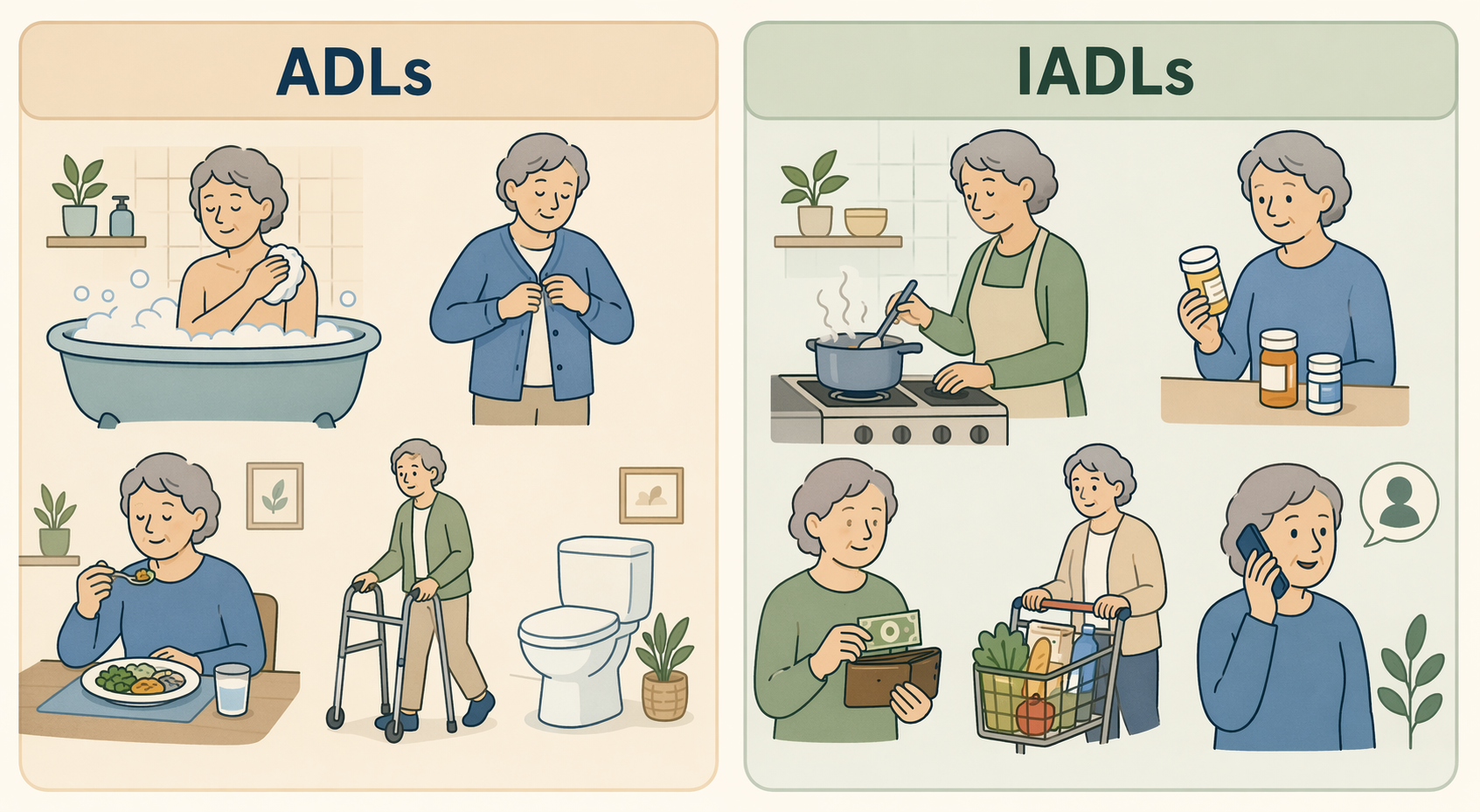
When you speak with a doctor, a care manager, or an admissions coordinator at a facility, they will almost certainly ask about your family member's ability to perform Activities of Daily Living (ADLs) and Instrumental Activities of Daily Living (IADLs). These two frameworks are the standardized language of functional assessment. Knowing them will help you describe needs accurately and understand what level of care is appropriate.
Activities of Daily Living (ADLs)
ADLs are the basic self-care tasks that people typically learn in childhood. The six core ADLs are:
- Bathing: The ability to wash the entire body independently.
- Dressing: The ability to select appropriate clothing and put it on without assistance.
- Eating: The ability to feed oneself (not including meal preparation).
- Toileting: The ability to get to and from the toilet, use it, and clean oneself.
- Transferring: The ability to get in and out of a bed or chair.
- Continence: The ability to control bladder and bowel function.
A senior who needs help with two or more ADLs typically qualifies for custodial care services, such as a home health aide or admission to an assisted living facility. The number of ADLs requiring assistance is a primary factor in determining Medicaid eligibility for long-term care in many states.
Instrumental Activities of Daily Living (IADLs)
IADLs are more complex tasks that support independent living in the community. Difficulty with IADLs often appears before difficulty with ADLs and can be an early warning sign of cognitive decline. The eight IADLs are:
- Meal Preparation: Planning and cooking meals safely.
- Medication Management: Taking the correct doses at the correct times.
- Managing Finances: Paying bills, budgeting, and handling bank accounts.
- Housework: Cleaning, laundry, and basic home maintenance.
- Transportation: Driving or arranging alternative transportation.
- Shopping: Purchasing groceries, household items, and personal supplies.
- Using the Telephone: Making and receiving calls, using a smartphone.
- Laundry: Washing, drying, and folding clothes.
Common Acronyms Every Caregiver Encounters
Senior care is dense with acronyms. You will see them on medical forms, facility brochures, and insurance documents. Here is a quick-reference list of the most common ones:
- AAA: Area Agency on Aging. A local public or non-profit agency that provides information, referrals, and services for older adults and their caregivers. Every community in the U.S. has an AAA.
- ALF: Assisted Living Facility.
- SNF: Skilled Nursing Facility (nursing home).
- CNA: Certified Nursing Assistant. Provides hands-on personal care under the supervision of an RN or LPN.
- HHA: Home Health Aide. Provides personal care and some health-related services in the home.
- RN / LPN: Registered Nurse / Licensed Practical Nurse. RNs have more advanced training and can perform assessments and administer medications; LPNs provide basic nursing care under an RN's direction.
- CDP: Certified Dementia Practitioner. A credential for professionals who complete specialized training in dementia care.
- CSA: Certified Senior Advisor. A professional who has completed training on the medical, social, and financial aspects of aging.
- PACE: Program of All-Inclusive Care for the Elderly. A Medicare and Medicaid program that provides comprehensive medical and social services to frail older adults who qualify for nursing home care but prefer to live at home.
- POA / DPOA: Power of Attorney / Durable Power of Attorney. A legal document that authorizes someone to make financial or healthcare decisions on another person's behalf.
- DNR: Do Not Resuscitate. A medical order that instructs healthcare providers not to perform CPR if the person's heart stops or they stop breathing.
- APS: Adult Protective Services. A government agency that investigates reports of abuse, neglect, or exploitation of older adults.
Paying for Care: Medicare vs. Medicaid and Other Funding
The single most common source of confusion for new caregivers is the difference between Medicare and Medicaid. Both are government health programs, but they serve different populations and cover different types of care. Understanding the distinction can save you from costly mistakes.
| Feature | Medicare | Medicaid |
|---|---|---|
| Who qualifies | Adults 65+ or those with certain disabilities (federal program) | Low-income individuals of any age who meet state income and asset limits (joint federal-state program) |
| Covers long-term custodial care | No — covers only medically necessary skilled care (short-term) | Yes — covers nursing home care and some home-based long-term care for eligible individuals |
| Covers assisted living | No | Varies by state; some states cover assisted living through Medicaid waivers |
| Covers home health care | Yes — but only skilled care ordered by a doctor (part-time, intermittent) | Yes — some states cover personal care and home health aide services through waivers |
| Covers hospice | Yes — Medicare Part A covers hospice for terminal illness | Yes — most states cover hospice |
| Covers prescription drugs | Yes — through Medicare Part D (stand-alone plan) | Yes — each state's Medicaid program covers prescriptions |
| Income and asset limits | No income or asset limits for Part A (if you paid Medicare taxes); Part B and Part D have monthly premiums | Strict income and asset limits that vary by state; applicants must typically "spend down" assets to qualify |
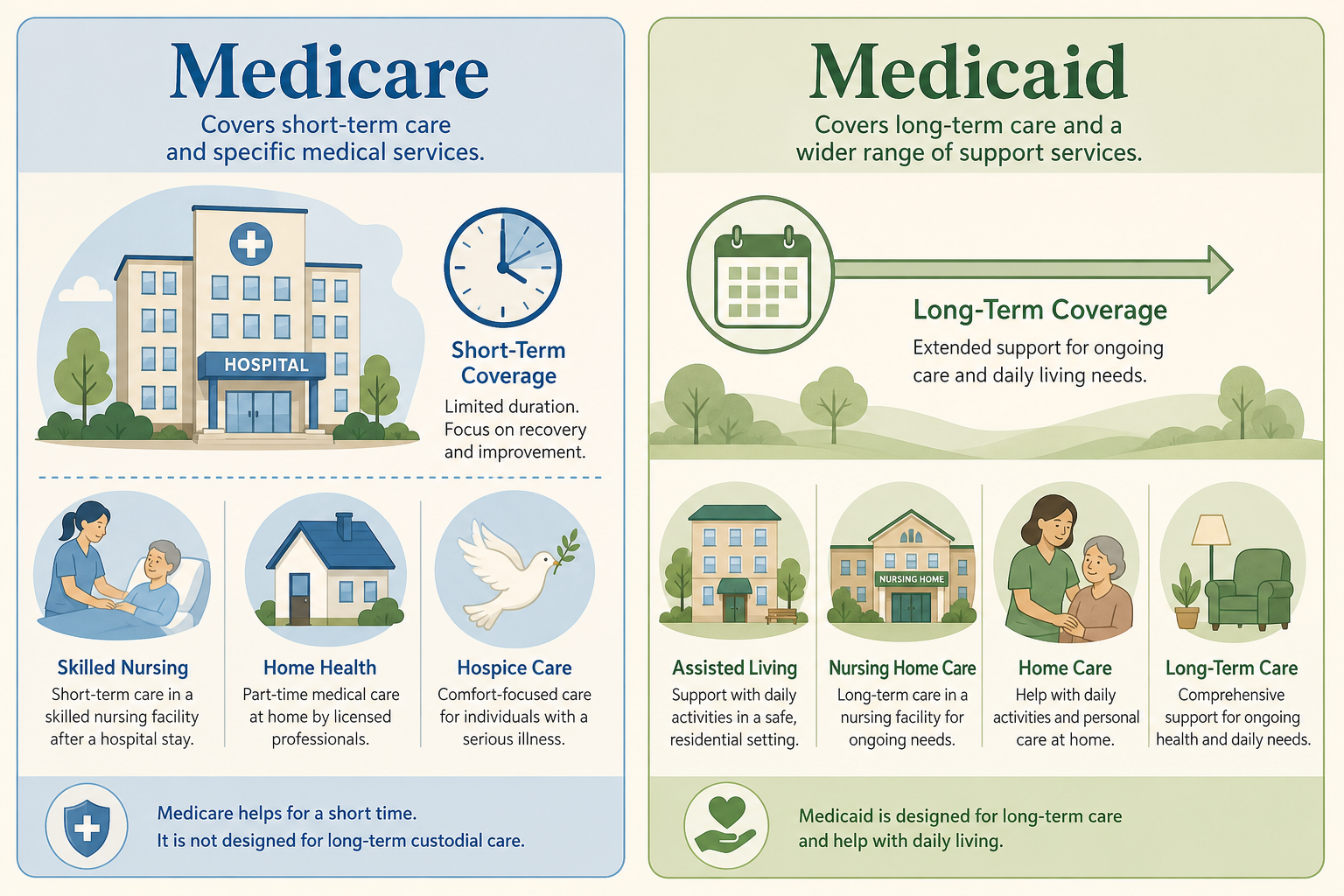
Beyond Medicare and Medicaid, several other funding sources may help pay for care:
- Long-Term Care Insurance: A private insurance policy that covers some or all of the costs of long-term care, including home care, assisted living, and nursing home care. Policies vary widely in what they cover and how much they pay. Most people purchase this insurance before they need care.
- VA Aid & Attendance: A monthly pension benefit for qualifying veterans and their surviving spouses who need help with daily activities. The benefit can be used to pay for home care, assisted living, or nursing home care.
- Programs of All-Inclusive Care for the Elderly (PACE): A combined Medicare and Medicaid program that provides comprehensive care coordination and services for frail older adults who meet nursing home level of care but live at home.
- State and Local Programs: Many states offer home and community-based services (HCBS) waivers, non-Medicaid assistance programs, and property tax relief for older adults. Contact your local Area Agency on Aging (AAA) for a list of programs in your area.
Key Legal and Financial Documents
Caregiving decisions often intersect with legal and financial planning. These documents are essential for ensuring that your family member's wishes are respected and that you have the authority to act on their behalf.
- Advance Directive: A general term for legal documents that specify a person's healthcare preferences in advance, in case they become unable to communicate. It typically includes a living will and a healthcare proxy.
- Living Will: A written document that states a person's wishes about life-sustaining medical treatments (such as mechanical ventilation, feeding tubes, or resuscitation) if they are terminally ill or permanently unconscious.
- Healthcare Proxy (Medical Power of Attorney): A legal document that appoints someone to make healthcare decisions on the person's behalf when they cannot speak for themselves.
- Durable Power of Attorney for Finances: A legal document that authorizes someone to manage the person's financial affairs — paying bills, managing investments, filing taxes — even if the person becomes incapacitated.
- Guardianship / Conservatorship: A court-appointed role for someone who is authorized to make decisions for an individual who has been deemed legally incapacitated. This is a more restrictive arrangement than a power of attorney and requires a court hearing.
- Medicaid Spend-Down: The process of reducing countable assets to meet Medicaid's financial eligibility limits. This may involve paying for medical expenses, home modifications, or other allowable expenditures. Improper spend-down can result in a penalty period of ineligibility.
Professional Roles in Elderly Care
As you navigate the care system, you will encounter several professionals whose roles may not be immediately clear. Here is what each one does and when you might need them.
- Geriatric Care Manager (Aging Life Care Professional): A professional who assesses a senior's needs, develops a care plan, coordinates services, and monitors the situation over time. They are especially valuable for long-distance caregivers who cannot be on-site regularly. They typically charge by the hour and are not covered by insurance.
- Case Manager: Often employed by an insurance company, hospital, or government agency. Their role is to coordinate the services covered by that specific payer. For example, a hospital discharge planner is a type of case manager who arranges post-hospital care.
- Ombudsman: A state-appointed advocate for residents of long-term care facilities (nursing homes and assisted living). They investigate complaints, mediate disputes, and work to protect residents' rights. Their services are free and confidential.
- Home Health Aide (HHA): A trained worker who provides personal care (bathing, dressing, toileting) and some health-related tasks (checking vital signs, reminding about medications) in the home. HHAs work under the supervision of a nurse.
- Certified Nursing Assistant (CNA): Similar to an HHA but typically works in a facility setting (nursing home, assisted living). CNAs provide hands-on personal care and are certified by the state after completing a training program.
Building Your Caregiving Vocabulary: Next Steps
Learning the vocabulary of elderly care is not an academic exercise. It is a practical tool that reduces stress, improves communication with professionals, and helps you make decisions with confidence rather than confusion. Every term you learn is one less barrier between you and the care your family member needs.
Use this glossary as a starting point. Bookmark it. Return to it when you encounter an unfamiliar term on a form or in a conversation. The more fluent you become in this language, the more effectively you can advocate for your family member.
For deeper reading, explore our guides on specific topics: understanding ADL and IADL assessments, comparing home care versus assisted living, navigating Medicare coverage for home health, and planning for long-term care costs. Each guide builds on the vocabulary introduced here.
Browse more in the Glossary.