
Glossary entry
When to Hire an Aging in Place Specialist: A Decision Guide for Family Caregivers
My mother's first fall was in the bathroom. The grab bar we'd installed six months earlier was right where it should be — she just didn't use it, because she couldn't reach it from the floor. That's when I learned the difference between a modification and a plan.
Three years and two remodels later, I know this: the families who call a Certified Aging-in-Place Specialist (CAPS) before a crisis spend less money and get a safer home. The families who wait until after a fall? They spend the same money and still have to start over.
The most common trigger for a home modification is a fall. One in three adults 65 and older falls each year, and two-thirds of those falls happen inside or around the house. After the fall, a rushed decision: install grab bars, add a shower seat, maybe widen a doorway. The family calls a contractor, points at the bathroom, and says "fix it." The contractor installs what you asked for. That's their job. But the toilet may still be three inches too low for the new hip replacement. The shower threshold you didn't mention is now a tripping hazard. The hallway is still too narrow for a walker. The problem isn't the contractor. It's that no one asked the right questions before the work started. A CAPS assessment costs $500. A do-over remodel costs $3,000 to $15,000.
Here's the number that changed my mind: less than 10% of U.S. homes are estimated to be "aging ready" (step-free entry, first-floor bedroom and bath, at least one accessible bathroom feature). Some estimates put it as low as 4%. Both are guesses from different methodologies, but they agree on one thing: almost no homes are ready. And only 34% of adults aged 50–80 say their home definitely has the features they need to age in place. Waiting for a fall is not a neutral strategy. It's an expensive gamble that the next crisis won't reveal a hazard you didn't see coming.

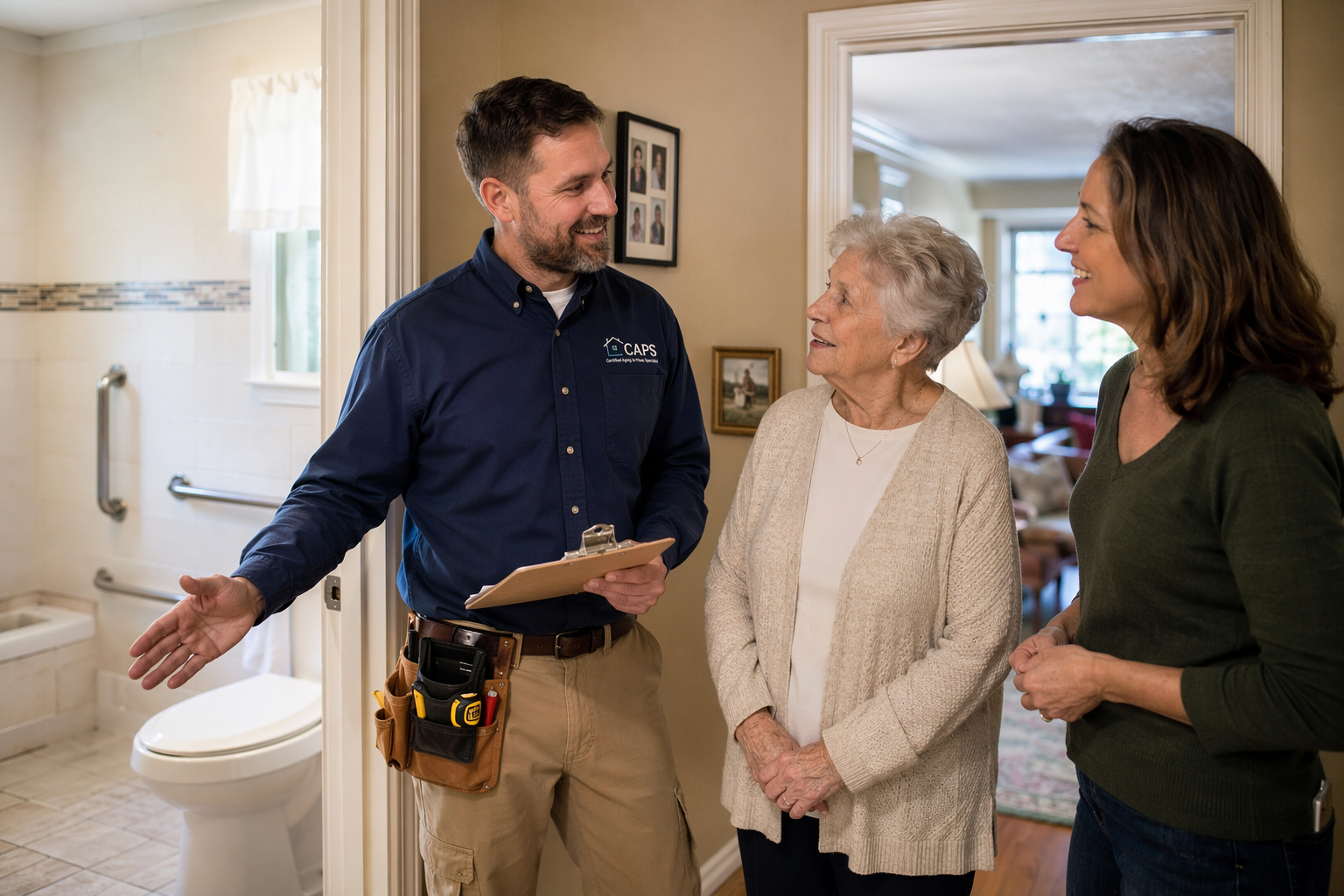
A CAPS evaluation is not an inspection. It's a systematic walk-through of the home, the person's daily routines, and — this is the critical part — the trajectory of their health. Will mom be able to climb stairs six months from now? What if she needs a wheelchair next year? One framework many CAPS professionals use is the "five-legged table": home design, financial ability, healthcare services, transportation, and social engagement. A contractor covers one leg. A CAPS is supposed to assess all five. That means measuring the turning radius in the bathroom, checking the threshold height, asking about the person's gait, and requesting permission to talk to the physical therapist. The deliverable is a written report with visuals, typically costing around $500. For that, you get a prioritized plan based on risk, budget, and the person's actual functional needs.
Does every CAPS actually do that? No. The credential teaches the framework, but execution depends on the individual. I've seen reports that were just a list of products with prices — not a real assessment. That's why you need to vet them, not just hire from a directory.
I mentioned my mother's grab bar failure. Here's a more common version: a family installs grab bars and a shower seat after a first fall, no specialist involved. Six months later, a stroke leaves the parent needing a wheelchair. The bathroom is three inches too narrow for the chair to turn around. Now they're looking at a full demolition to widen the room — and the grab bars they installed are now in the wrong place. That's not a contractor problem. That's a planning problem. The contractor did what they were asked. Nobody asked what happens if needs change. The numbers tell the story: 93% of remodelers in 2023 installed a grab bar — it's the most requested modification. But a grab bar alone doesn't make a bathroom safe. The doorway needs to be at least 32 inches wide for a walker or wheelchair. The room needs a 5-foot by 5-foot turning radius. The commode height matters. The shower threshold matters. A CAPS coordinates with occupational therapists, physical therapists, and sometimes the primary care doctor. They don't just redesign the room; they design it around the person's likely future. That's the difference between a list of products and a plan.
| Option | Typical cost | Notes |
|---|---|---|
| CAPS home assessment | $500 | Full report with visuals, prioritized plan |
| Aging-in-place remodel | $3,000 – $15,000 | Average around $9,500; varies by region and scope |
| Assisted living (monthly) | $3,000 – $9,000 | Some states higher; NY average $4,580/month |
| Nursing home (monthly) | $5,000 – $13,000 | Private room over $158,000/year in parts of New York |
The $500 evaluation is the cheapest insurance you can buy. If it prevents even one costly mistake — a bathroom that needs to be redone, a stair lift installed a week before mom decides she can't manage the stairs at all — it's paid for itself many times over. But the cost comparison isn't just about the remodel. Assisted living runs $3,000 to $9,000 a month, and nursing homes $5,000 to $13,000. A well-executed remodel that lets someone stay home an extra two years saves $72,000 to $216,000 in facility costs alone — not counting quality of life. Of course, a CAPS plan doesn't guarantee a perfect outcome. The credential is necessary but not sufficient. Some CAPS are primarily salespeople for their own contracting business. The assessment is only as good as the follow-through.
Five Signs It's Time to Call — Before You Think You Need To
- A recent fall — even if there was no injury. Falls are the single strongest predictor of another fall.
- Difficulty using the bathroom — sitting down, standing up, reaching the toilet paper, stepping into a shower.
- A doctor or physical therapist has mentioned home safety. That's not a casual comment; it's a warning.
- Family members disagree about whether the home is safe. Disagreement usually means someone is seeing hazards that others have learned to ignore.
- A new mobility diagnosis — Parkinson's, stroke recovery, hip replacement, arthritis progression — that changes the trajectory.
If you're checking off any of these, you don't need to wait for a crisis. Call a CAPS now. If a fall has already happened, call a CAPS after you've dealt with the immediate medical issues — our post-fall triage guide can help you prioritize immediate modifications while you wait for the full assessment.
How to Find a CAPS Who Actually Earns the $500
Nearly 9,500 individuals have earned the CAPS designation since the program began in 2002. That's a lot of professionals. It does not mean all of them are good. The NAHB directory is a starting point, not an endorsement. Here's what to ask before you hire:
- Can I see a sample assessment report? If the report is just a list of products with prices, it's not a real assessment. You want a report that includes measurements, photos, prioritized recommendations, and links to relevant professionals.
- Will you coordinate with my parent's occupational therapist or physical therapist? A good CAPS does. If they say "I don't need to," move on.
- Can you provide references from previous clients? Not just recent projects — ask about projects that are a year old. Did the modifications hold up? Did needs change and the plan adapt?
- Do you also do the construction, or do you work with separate contractors? Both models work, but you need to know which one you're getting. If they do both, ask how conflicts of interest are handled. If they only assess, ask about their contractor vetting process.
The honest picture on payment: the majority of families pay for CAPS assessments and modifications out of pocket. Medicare does not cover home modifications. Medicaid waivers and VA grants exist, but they have waiting lists, strict eligibility requirements, and often limit the scope of work. That said, it's worth exploring all options. How to Pay for Aging in Place Home Modifications covers HUD programs, PACE, Area Agencies on Aging, and state-specific grants. Start there, but don't let the search for free money delay the assessment. The $500 spent now could save you $5,000 in avoidable mistakes.
The Honest Bottom Line
Sometimes a fall is the first sign. You can't always hire before a crisis — I get that. But even if you're reading this after the fall, a CAPS consult is still better than going it alone. The assessment will catch the hazards you didn't see, and the plan will prevent the next crisis.
The credential alone doesn't guarantee quality. A CAPS who doesn't coordinate with your parent's healthcare team, doesn't produce a detailed report, or doesn't have references — pass. But a good CAPS, one who treats the assessment as a holistic planning exercise, is the best investment you can make for aging in place.
My mother's first fall taught me that grab bars are not a plan. The second fall taught me that a plan is not enough if you don't follow through. If you're reading this and wondering whether it's time to call, it's time.
Browse more in the Glossary.