
Glossary entry
What Medicare Actually Pays For When an Elderly Parent Needs Care at Home: A Complete, Honest Breakdown of the Home Health Benefit in 2026

The Most Common Misconception Families Bring to This Decision
Your mother is home from the hospital after a hip replacement. The surgeon says she needs daily help with bathing, dressing, and walking to the bathroom for the next six weeks. Your first thought, understandably, is: "Medicare will pay for someone to come help her." It is the most natural assumption in the world — and it is also the most common source of financial shock for families navigating elder care.
The reality is more specific. Medicare's home health benefit is generous for what it covers, but it was never designed to provide full-time, long-term assistance with daily activities. It covers skilled medical care at home — nursing, physical therapy, occupational therapy — and it will pay for a home health aide to help with bathing and dressing, but only when that aide is part of a skilled-care plan. If your parent only needs help with the activities of daily living (ADLs) and does not require skilled nursing or therapy, Medicare will not pay a dollar toward that care.
Nearly 2.9 million Medicare beneficiaries used home health services in 2020, according to a Commonwealth Fund report cited by AARP. Total Medicare spending on home health is approximately $15.7 billion annually — less than 2% of the total Medicare budget. That is a relatively small slice of the pie, and it reflects the program's narrow focus: skilled, intermittent, medically necessary care delivered in the home, not custodial care for chronic needs.
This article walks through the entire benefit — the four eligibility gates, what is covered and what is not, the hour limits, the costs, how Medicare Advantage changes the rules, and what to do when coverage falls short. If you are reading this in the days after a parent's hospitalization or fall, start with the eligibility gates below. That is where every family's journey through the Medicare home health system begins.
The Four Gates: How Medicare Decides Whether Your Parent Qualifies
Medicare does not approve home health care based on a doctor's recommendation alone. The patient must pass through four non-negotiable eligibility gates. If any one of them is not met, Medicare will not pay for home health services — even if the patient clearly needs help at home.
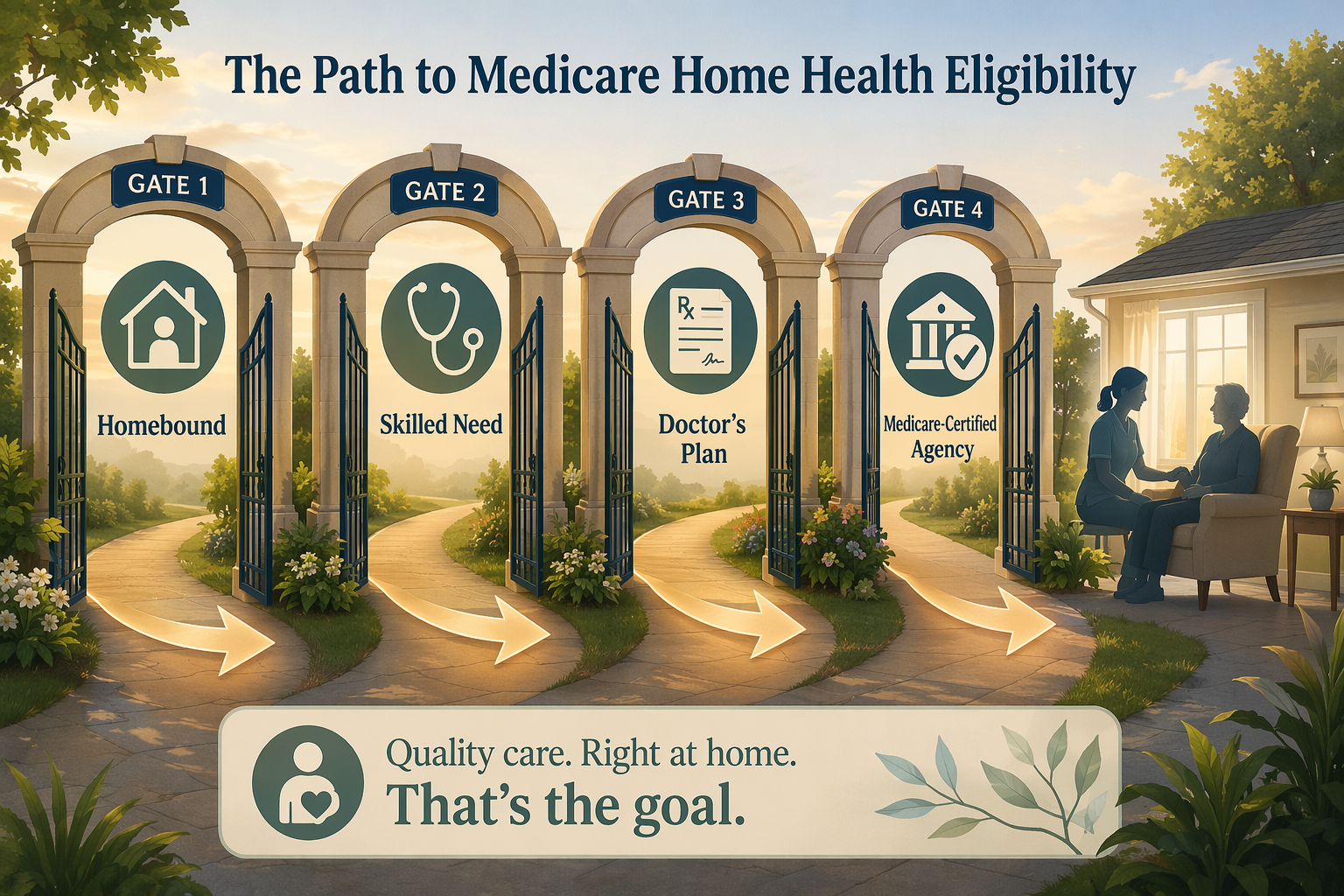
Gate 1: The Patient Must Be Homebound
This is the most misunderstood criterion. "Homebound" does not mean the patient can never leave the house. According to CMS criteria, a patient is homebound if they have a condition that makes it difficult to leave home without help from another person or medical equipment (such as a walker, wheelchair, or oxygen), or if a doctor recommends against leaving home because leaving would be medically contraindicated.
Crucially, attending adult day care, religious services, or medical appointments does not disqualify a patient from being considered homebound. The key is the effort and assistance required to leave home, not the frequency of leaving.
Gate 2: The Patient Must Need Intermittent Skilled Care
Medicare covers home health only when the patient needs skilled nursing care (such as wound care, injections, IV therapy, or patient and caregiver education) or therapy services (physical therapy, occupational therapy, or speech-language pathology) on a part-time or intermittent basis. The care must be provided by a licensed professional — a registered nurse, a physical therapist, or an occupational therapist.
This is the gate that most often blocks coverage for families seeking help with daily activities. If your parent only needs help with bathing, dressing, toileting, and meals — and does not need skilled nursing or therapy — they do not qualify for Medicare home health, regardless of how homebound they are.
Gate 3: A Doctor Must Certify the Need and Establish a Plan of Care
A physician (or certain other providers, such as a nurse practitioner or clinical nurse specialist) must certify that the patient needs skilled care at home. The doctor must have had an in-person visit with the patient within the 90 days before care starts or within 30 days after the first home health visit. The doctor then establishes a written plan of care that specifies the type, frequency, and duration of services needed.
This plan of care is reviewed and recertified every 60 days. As long as the patient continues to meet the eligibility criteria, coverage can continue indefinitely — there is no fixed time limit on the benefit.
Gate 4: Care Must Come From a Medicare-Certified Home Health Agency
Not all home care agencies are created equal. To bill Medicare, an agency must be Medicare-certified. This means it meets federal health and safety standards and is approved to receive Medicare reimbursement. If you hire a private-duty home care agency that is not Medicare-certified, Medicare will not pay for any of its services — even if the patient meets all other eligibility criteria.
The hospital discharge planner or your parent's primary care doctor can usually provide a list of Medicare-certified agencies in your area. You can also search the Medicare.gov Care Compare tool to find certified agencies and compare their quality ratings.
What Medicare Does Cover — With Real-World Examples
When all four gates are passed, Medicare covers a specific set of services at $0 cost-sharing for Original Medicare beneficiaries. Here is what is included, with concrete examples of when each service applies.
- Skilled nursing care: Wound care (changing surgical dressings, monitoring for infection), injections (insulin, blood thinners), IV therapy or nutrition therapy, patient and caregiver education (teaching a family member how to administer medication or use a catheter), and monitoring of a serious illness (checking vital signs, assessing for complications). A registered nurse typically makes visits as ordered by the doctor.
- Physical therapy: After a hip replacement, a physical therapist visits the home to teach the patient how to safely use a walker, climb stairs, and perform prescribed exercises. The goal is to restore mobility and prevent falls.
- Occupational therapy: After a stroke, an occupational therapist helps the patient relearn how to dress, bathe, and prepare simple meals safely. The therapist may recommend adaptive equipment like a shower chair or a raised toilet seat.
- Speech-language pathology: For a patient recovering from a stroke or living with Parkinson's disease, a speech therapist addresses swallowing difficulties, communication challenges, and cognitive-communication deficits.
- Medical social services: A medical social worker can help the family navigate community resources, coordinate care, and address emotional or social challenges related to the illness.
- Part-time or intermittent home health aide services: A home health aide can help with hands-on personal care — bathing, dressing, grooming, toileting, and feeding — but only when the patient is also receiving skilled nursing or therapy. The aide's services are a supplement to the skilled care, not a standalone benefit.
For a deeper look at the specific services and how they work in practice, see our Medicare Home Health Care: What It Covers, What It Doesn't, and How to Qualify glossary entry.
What Medicare Does Not Cover — The Gap That Catches Most Families
The list of what Medicare does not cover for home health is shorter, but it is the part that matters most to families facing a real caregiving situation. Medicare explicitly excludes the following services from the home health benefit:

- 24-hour-a-day care: Medicare will not pay for round-the-clock nursing or aide coverage. The benefit is explicitly designed for part-time, intermittent care.
- Custodial or personal care when it is the only care needed: If your parent only needs help with bathing, dressing, toileting, eating, or transferring from bed to chair — and does not require skilled nursing or therapy — Medicare will not pay for that care. This is the single biggest coverage gap.
- Homemaker services: Medicare does not cover meal preparation, grocery shopping, light housekeeping, laundry, or other homemaker tasks. These are considered non-medical support.
- Home-delivered meals: Programs like Meals on Wheels are not covered by Medicare.
For a detailed analysis of this gap and strategies to plan for it, see our guide: The Medicare Home Health Care Gap: Why Families Pay Out of Pocket and How to Plan Ahead.
The Part-Time/Intermittent Rule: How Many Hours Will Medicare Pay For?
Even when a patient qualifies for Medicare home health, the amount of care is limited. The "part-time or intermittent" rule is the mechanism that keeps the benefit focused on short-term, medically necessary care rather than long-term custodial support.
| Dimension | Standard Limit | Extended Limit |
|---|---|---|
| Combined skilled nursing + home health aide per day | Up to 8 hours | Up to 8 hours |
| Combined skilled nursing + home health aide per week | Up to 28 hours | Up to 35 hours (short-term, if medically necessary) |
| Duration of coverage | No legal limit; recertification every 60 days | Same; can continue indefinitely if criteria are met |
| Coverage for chronic conditions | Not limited to conditions expected to improve (Jimmo v. Sebelius ruling) | Same |
Key nuance: There is no legal limit on the total duration of Medicare home health coverage. The benefit can continue indefinitely as long as the patient continues to meet the eligibility criteria. Recertification is required every 60 days, but this is a procedural step, not a hard stop. Under the Jimmo v. Sebelius settlement, Medicare coverage should not be denied simply because a condition is "chronic," "stable," or unlikely to improve. Skilled care is covered when it is needed to maintain the patient's condition or slow decline — not only when improvement is expected.
The Cost Breakdown: What You Pay and What You Don't
For Original Medicare beneficiaries, the cost structure for home health services is straightforward — and surprisingly affordable for the covered services.
| Service | What You Pay | Notes |
|---|---|---|
| Covered home health services (skilled nursing, therapy, home health aide) | $0 | No deductible, no coinsurance, no copay for covered services under Original Medicare |
| Durable medical equipment (DME) — e.g., walker, wheelchair, hospital bed, oxygen | 20% of Medicare-approved amount after the Part B deductible | 2025 Part B deductible was $257; 2026 figures may differ |
| Medicare Part B premium | Standard premium (2025: $185/month) | Required for all Part B enrollees; covers outpatient services including home health |
The $0 cost-sharing for covered home health services is a significant benefit. However, it applies only to the services listed in the plan of care from a Medicare-certified agency. If the patient needs additional hours of aide care beyond what Medicare covers, or if they need custodial care after skilled services end, those costs fall entirely on the family.
To put this in context: the national median cost of non-medical home care (custodial care) in 2026 is $34 per hour, according to A Place for Mom's 2026 Costs of Long-Term Care and Senior Living Report. At 20 hours per week of private-pay home care, that is roughly $2,720 per month — a cost that can quickly deplete savings if not planned for.
A 2023 analysis of Medicare Fee-for-Service claims found that beneficiaries who used home health cost Medicare 42% less ($3,600 per member per month) than similar patients who did not use home health. This suggests that the benefit, when properly utilized, is both clinically effective and cost-effective for the system.
Medicare Advantage: Different Rules, Different Risks
If your parent is enrolled in a Medicare Advantage (MA) plan rather than Original Medicare, the home health rules change in several important ways. While MA plans must cover the same home health services as Original Medicare, they can impose different conditions on how those services are accessed.
| Factor | Original Medicare | Medicare Advantage |
|---|---|---|
| Network restrictions | Any Medicare-certified agency | Must use in-network agencies; out-of-network care may not be covered |
| Prior authorization | Not required | Often required; services may be denied if authorization is not obtained in advance |
| Coverage scope | Standard home health benefit | Must cover same services, but some plans impose visit limits (e.g., 12 visits per year or four 4-hour shifts post-discharge) |
| Supplemental in-home support benefits | Not available | 17% of standard-plan enrollees and 31% of special-needs-plan enrollees had some in-home support coverage in 2023 (KFF) |
| Cost-sharing | $0 for covered services | May have copays or coinsurance for home health visits; varies by plan |
The risk with Medicare Advantage: A Center for Medicare Advocacy study found that some MA plans cover only 12 home health visits per year or four 4-hour shifts after a hospital discharge. This is far less than the 28 hours per week available under Original Medicare. Families should carefully review their parent's specific MA plan's home health coverage before assuming it matches Original Medicare's benefit.
On the positive side, some MA plans — particularly Special Needs Plans (SNPs) for dual-eligible beneficiaries — offer supplemental in-home support benefits that go beyond what Original Medicare covers. These may include additional home health aide hours, custodial care, or even 24-hour care options. However, these benefits are not universal and vary widely by plan and region.
What to Do When Medicare Won't Cover What You Need
For most families, the Medicare home health benefit covers a critical but limited window of care — typically the weeks or months after a hospitalization or acute illness. When that window closes, or when the patient's needs are primarily custodial from the start, families need a plan B. Understanding the Medicare boundary is the first step to building a realistic blended payment plan.
Here are the most common next-step options, each of which is covered in detail elsewhere on this site:
- Medicaid Home and Community-Based Services (HCBS) waivers: For low-income seniors, Medicaid may cover custodial care at home through state-specific HCBS waiver programs. Eligibility varies by state, with typical income limits around $2,901/month and asset limits of $2,000 (2025 figures).
- VA benefits: Veterans and surviving spouses may qualify for the VA's Homemaker and Home Health Aide program, Home-Based Primary Care, or the Program of Comprehensive Assistance for Family Caregivers. These programs can cover custodial care and caregiver support.
- Long-term care insurance: If your parent has a long-term care insurance policy, check whether it includes a home care rider. Many policies cover custodial care at home up to a daily or monthly benefit amount.
- Private pay: At the national median of $34/hour, families often pay out of pocket for a limited number of hours per week to supplement Medicare-covered services.
For a comprehensive overview of all payment sources, see our guide: How to Pay for Elderly Care: 7 Funding Sources to Cover the $34/HR Cost in 2026.
If you need help navigating the practical steps of setting up care, our step-by-step guide — How to Set Up In-Home Nursing Care for an Elderly Parent: A Step-by-Step Decision Guide — walks through the entire process from hospital discharge to ongoing care coordination.
For quick answers to specific eligibility scenarios, the Does Medicare Cover Home Health Care? A Caregiver's Guide to Eligibility, Costs, and Coverage Gaps in 2026 FAQ article covers common questions in a Q&A format.
Finally, for a focused look at the 2026 policy changes that may affect home health access and reimbursement, see Medicare Home Health Care in 2026: What Changed, What Stayed the Same. The final 2026 payment rule included a 1.3% aggregate reduction ($220 million less in reimbursements), which may affect agency availability and visit frequency.
Browse more in the Glossary.