
Air Quality Alerts Create a Hidden Fall Risk for Seniors
Most caregivers don't realize that poor air quality during alerts can directly increase an older adult's risk of falling through dizziness, reduced oxygen delivery, and cognitive fog. This article explains the connection and offers actionable steps beyond generic "stay indoors" advice.
Your parent stayed indoors like the alert said. They skipped the walk, kept the windows shut, and waited for the smoky or polluted air to pass. But by evening they seem off: a little lightheaded when they stand, slower getting to the bathroom, unusually tired, or foggy enough to forget the cane parked beside the chair.
That is where air quality alert safety for older adults has to become more specific than “stay inside.” Poor air can affect more than the lungs. Wildfire smoke and polluted air can be associated with headache, fatigue, and confusion in older adults, and those symptoms matter in a fall-prevention plan because they change how a person stands, transfers, judges distance, and reacts to a trip hazard.[1]
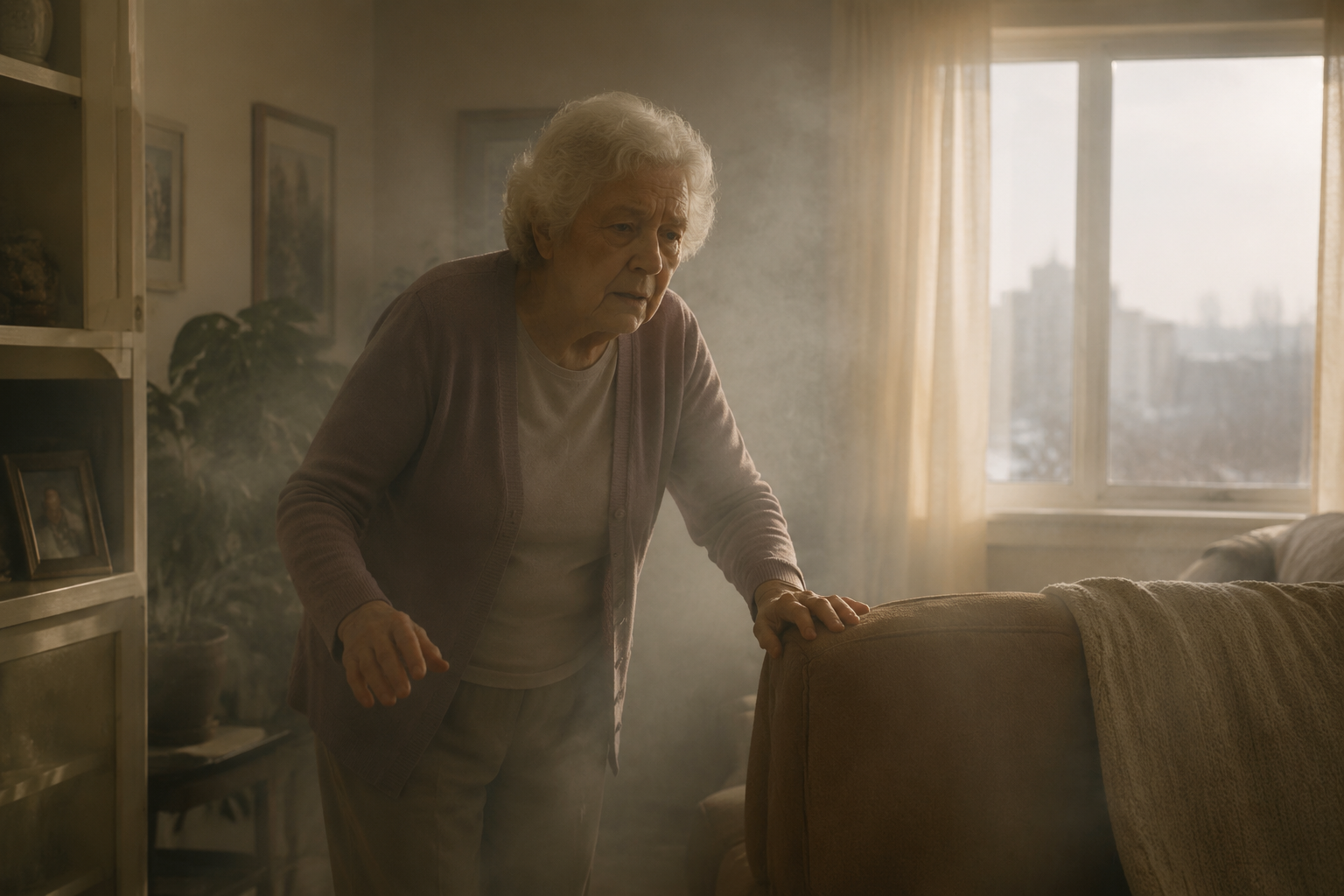
The evidence does not prove that every air quality alert causes falls. That direct endpoint — alert day to dizziness to fall incidence in older adults — is not established as a single causal study. But caregivers do not need courtroom-level proof before making the hallway safer. The practical chain is strong enough to act on: bad air can worsen symptoms that undermine balance and judgment, and dizziness itself is a major fall-risk signal in later life.
The Missing Link Is Dizziness
Dizziness is not a small complaint in an older adult. A 2024 Imperial College London meta-analysis of 29 studies, involving about 103,000 participants, found that older adults with dizziness were more than 60% more likely to fall. The same report notes that roughly 1 in 3 adults over 65 experiences dizziness.[2]
That matters because many falls do not begin with a dramatic collapse. They begin with a routine movement done on a worse-than-usual day: standing after a long time in a chair, turning toward the kitchen, stepping into a dim bathroom, reaching for a mug, or deciding the walker is not needed for “just a few steps.” If dizziness is already common and already linked with higher fall risk, any alert-day condition that makes dizziness more likely deserves attention.
Caregivers often look for coughing, wheezing, or shortness of breath on smoky days. Those are important. But a fall may be more likely to come from the quieter symptoms: the pause before standing, the hand searching for the wall, the missed edge of a rug, the decision to climb stairs while tired, or the moment of confusion about where the cane was left.
Why Older Adults Are More Vulnerable on Bad-Air Days
Older adults are not simply “sensitive” in a vague way. The CDC lists older adults among people at greater risk from air pollution, especially when they have heart or lung disease, and advises paying attention to the Air Quality Index and reducing exposure when air quality is unhealthy.[3] Johns Hopkins Medicine describes air pollution as a body-wide stressor, with possible effects beyond irritation of the airways, including cardiovascular strain.[4]
The scale is not rare or theoretical. The American Lung Association’s State of the Air 2026 report found that 44% of Americans live in places with unhealthy levels of ozone or particle pollution.[5] That number does not prove an individual fall risk on a particular Tuesday. It does mean caregivers should treat air quality as a recurring home-safety condition, not an exotic wildfire-only concern.
The home can also give a false sense of completion. Going indoors reduces exposure, but it does not automatically create clean air or safe movement. Smoke can enter through leaks, doors, windows, ventilation systems, or repeated in-and-out trips. A stuffy room can lead someone to open a window. A parent who feels confined may get up more often, pace, make tea, or try to “check outside.” The fall risk lives in those ordinary reactions.
How Poor Air Turns Into Fall Risk Inside the Home
The alert itself is not the fall mechanism. The mechanism is what the older adult feels and does after exposure starts affecting the body.
Lightheadedness When Standing
A parent who is already vulnerable to dizziness may become less steady when standing from a chair or getting out of bed. On a bad-air day, that first upright moment deserves more respect than usual. The practical change is simple: pause before walking. Feet on the floor, one hand on a stable surface, a few breaths, then movement. That pause can feel annoyingly slow to an independent parent, so it helps to frame it as an alert-day habit, not a new permanent rule.
Breathing Strain and Reduced Reserve
When breathing takes more effort, the body has less reserve for everything else: walking to the bathroom, carrying laundry, climbing stairs, or recovering balance after a stumble. A parent with COPD, asthma, heart disease, or a recent respiratory infection may look “just tired,” when the real issue is that normal household movement now costs more.
This is where caregivers should shorten the day’s routes. Put water, medications as directed, tissues, phone, charger, glasses, and the remote within reach of the main chair. The goal is not to keep someone motionless. It is to remove unnecessary trips while the air is bad and symptoms are more likely to interfere with balance.
Headache, Fatigue, and Confusion
AARP’s wildfire smoke guidance for older adults specifically calls out symptoms such as headache, fatigue, and confusion.[1] Those symptoms are easy to dismiss because they do not sound like classic fall hazards. But fatigue makes a person drag a foot. Headache narrows attention. Confusion makes someone forget the walker, misjudge a step, or open the door “just for a minute” during smoke.
For a caregiver, “Mom is foggy today” should become a safety observation. It belongs beside the usual fall-risk questions: Did she eat? Did she drink? Did she take a medication that can cause dizziness? Is the path to the bathroom lit? Is she trying to do stairs because the laundry is downstairs?
Cardiovascular Stress
Poor air quality can place stress on the heart and blood vessels, particularly for people with existing cardiovascular disease.[3][4] That does not mean every older adult needs emergency care during every alert. It does mean new chest discomfort, severe shortness of breath, fainting, new confusion, or sudden weakness should not be folded into “bad air day” and ignored.
It also means medication context matters. Blood pressure medications, diuretics, sedatives, sleep aids, and some pain medicines can already affect alertness, hydration, or standing balance. If dizziness or confusion is new, worsening, or repeated on alert days, that pattern is worth discussing with the clinician who knows the medication list.
Make One Cleaner Room Also a Safer Room
The most useful alert-day routine is not a house-wide overhaul. It is choosing one room where exposure is lower and movement is safer. EPA guidance for wildfire smoke recommends creating a clean room by selecting an appropriate indoor room, keeping windows and doors closed, and using filtration when available.[6] The American Lung Association also advises people to stay indoors, keep windows and doors closed, and use air filtration strategies when air quality is poor.[7]
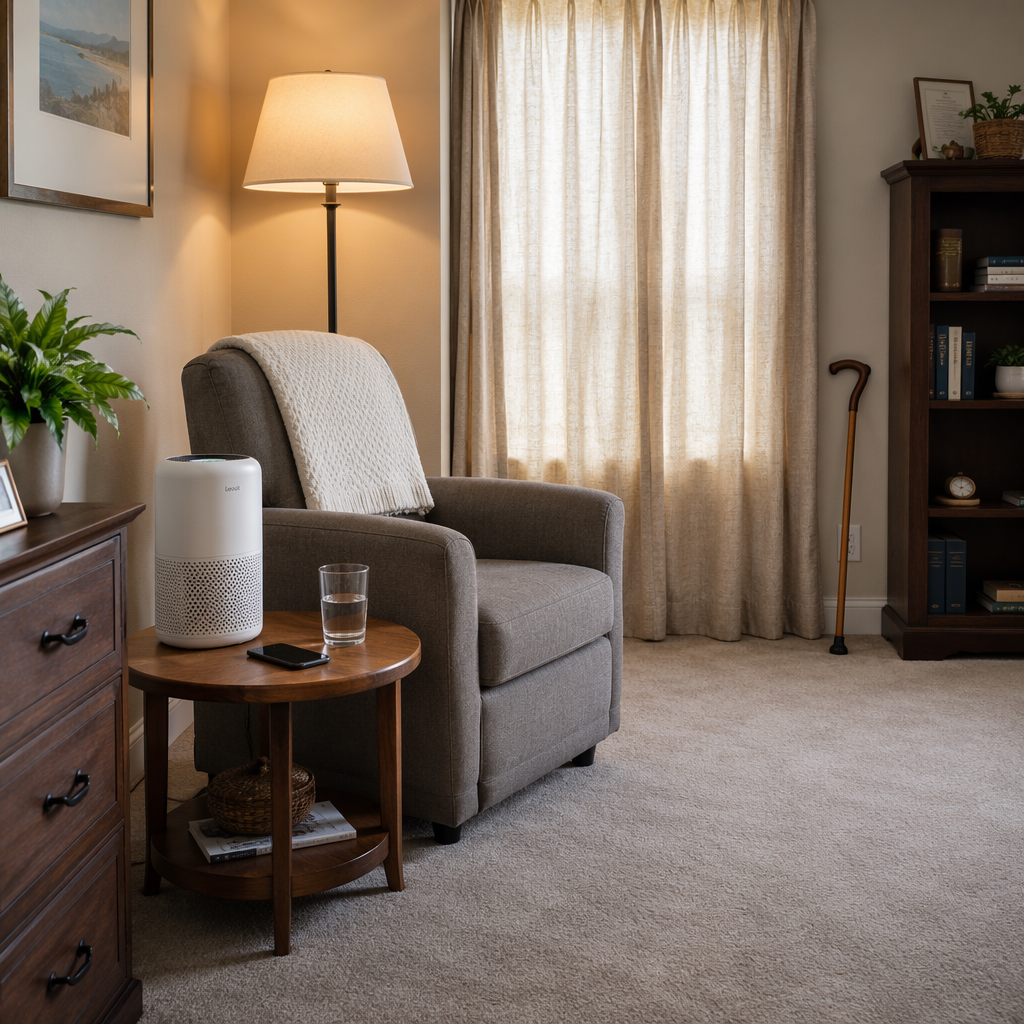
For fall prevention, the clean room should be set up before the parent feels unwell. Waiting until dizziness starts means the person is already walking around to find water, plug in a phone, close curtains, adjust a fan, or move a chair.
- Choose a room on the same level as the bathroom when possible, so stairs are not part of every trip.
- Keep windows and doors closed during smoke events unless local emergency guidance says otherwise.
- Use a portable air cleaner or effective HVAC filtration if available and appropriate for the home.
- Clear the walking path from chair to bathroom, removing cords, shoes, loose rugs, and low tables.
- Place water, phone, charger, glasses, hearing aids, tissues, and usual mobility aid within easy reach.
- Turn on steady lighting before evening, especially along the bathroom route.
This setup works best when it is presented as temporary: “Let’s make the living room the clean-air room until the alert lifts.” That wording protects dignity. It does not tell a parent they have lost the right to move around their own home. It says the air is temporarily making the home behave differently, so the routine changes temporarily too.
Use the AQI as a Fall-Prevention Prompt
The Air Quality Index is usually discussed as a breathing guide, but caregivers can also use it as a timing cue. The National Weather Service advises people to reduce time outdoors, avoid strenuous outdoor activity, and follow local guidance during air quality alerts.[8] The CDC similarly recommends checking the AQI and taking steps to reduce exposure when pollution is high.[3]
For an older adult with fall risk, the alert should trigger a short home reset: fewer stairs, fewer outdoor errands, slower standing, better lighting, clear walking paths, and closer watching for dizziness or confusion. The point is not to memorize every color category. The point is to connect the alert with the next eight hours of movement.
| If you notice this on a bad-air day | Treat it as this kind of fall cue | What to change right away |
|---|---|---|
| Lightheaded when standing | Higher transfer risk | Pause before walking; stand near a stable surface; keep the mobility aid beside the chair |
| Unusual fatigue | Lower foot clearance and slower reactions | Shorten walking routes; delay nonessential chores; avoid stairs when possible |
| Headache or fogginess | Missed obstacles or forgotten supports | Increase lighting; remove clutter; remind gently about cane, walker, or handrails |
| Shortness of breath with routine movement | Less reserve to recover from a stumble | Move essentials closer; reduce trips; contact a clinician if symptoms are new or concerning |
| New confusion, fainting, chest pain, or severe breathing trouble | Possible urgent medical issue | Seek medical guidance promptly or emergency help when symptoms are severe |
Humidity and heat can complicate this. Some practical air-quality guidance recommends keeping indoor humidity in a moderate range, often described as 30% to 60%, because overly dry or overly damp indoor air can create other comfort and health problems.[9] That detail is useful, but it should not distract from the bigger caregiving move: make the room breathable enough and safe enough that the parent is not wandering around to fix discomfort while already unsteady.
What to Watch for Before the Fall Happens
The caregiver’s advantage is pattern recognition. You may notice changes before your parent names them. On alert days, listen for softer clues: “I’m just tired,” “my head feels funny,” “I don’t need the walker,” “I’m going to open the window,” or “I’ll just run downstairs.” None of those statements proves danger by itself. Together with poor air quality, they justify a lower threshold for helping.
- Ask about dizziness directly, because some older adults describe it as weakness, wooziness, fog, or “not right.”
- Watch the first few steps after standing; they often reveal more than the answer to “Are you okay?”
- Check whether the cane or walker is actually within reach, not across the room.
- Make hydration easy, especially if the person is reluctant to get up or is avoiding fluids to reduce bathroom trips.
- Delay chores that combine exertion and balance demands, such as carrying laundry, taking out trash, or watering plants outdoors.
This is also a good time to make the bathroom route boring. Boring is safe: lights on, floor dry, handholds available, no towel on the floor, no pet bed in the path, no last-minute search for slippers. Many falls happen during ordinary tasks precisely because no one treats them as risky until the person is already halfway there.
When to Bring in a Clinician
Air quality can be part of the pattern without being the only cause. New dizziness, repeated near-falls, fainting, new confusion, chest pain, severe shortness of breath, sudden weakness, or symptoms that do not improve when exposure is reduced deserve medical guidance. This is especially true for a parent with heart disease, lung disease, diabetes, recent infection, medication changes, or a prior fall.
The National Council on Aging advises older adults to monitor local air quality, reduce exposure when pollution is high, and take extra precautions if they have chronic health conditions.[10] For a caregiver, “extra precautions” should include both respiratory protection and fall prevention. If a clinician already tracks blood pressure, oxygen levels, medications, or balance problems, ask how alert days should change the plan.
Bring concrete observations rather than a general worry: “She is more confused on smoke days,” “He gets lightheaded when standing during AQI alerts,” or “She stopped using the walker when she was fatigued and nearly fell.” Those details help separate medication effects, dehydration, infection, blood pressure changes, respiratory strain, and environmental triggers.
The Alert-Day Mental Checklist
If your parent is suddenly unsteady on a bad-air day, you do not have to prove pollution caused it before acting. Treat the day as higher risk. Reduce exposure. Reduce unnecessary movement. Watch for dizziness, fatigue, headache, breathing strain, and fogginess. Make one cleaner room safer to move through. Keep the bathroom route lit and clear. Put the cane, walker, water, and phone where they will actually be used.
An air quality alert is not only an outdoor warning. For an older adult, it is also a fall-prevention prompt.
References
- How Wildfire Smoke Affects Older Adults, AARP, July 17, 2026.
- Dizziness in older adults linked to higher risk of falls, Imperial College London.
- Air Quality, Centers for Disease Control and Prevention.
- Air Quality and Health, Johns Hopkins Medicine.
- Key Findings, American Lung Association.
- Create a Clean Room to Protect Indoor Air Quality During a Wildfire, U.S. Environmental Protection Agency.
- Frequently Asked Questions: How to Protect Yourself from Poor Air Quality, American Lung Association.
- Air Quality Safety, National Weather Service.
- Air Quality Alerts: What Older Adults and Families Need to Know to Stay Safe, LTC News.
- Protecting Yourself From Poor Air Quality, National Council on Aging.
Related reading
Noticed something outdated or inaccurate on this page? Flag a correction. We review every report against CDC, NIA, and AARP HomeFit guidance before updating a page.
Part of the Fall Prevention section.