
STEADI: intervene
For Older Adults, Air Quality Precautions Start at AQI 101
When air quality turns unhealthy for sensitive groups, precautions for an older adult start at AQI 101 (orange) — well before a red alert. The caregiver's playbook: check the AQI, seal and filter indoor air, keep a clean room ready, use an NIOSH-approved respirator if going out is unavoidable, and know which symptoms warrant a doctor's call or 911.
If you check the AQI for a parent or spouse and see orange, the household is already in action mode. For an older adult, air quality precautions start at AQI 101, the beginning of “Unhealthy for Sensitive Groups” in the U.S. AQI system. Adults 65 and older are explicitly included in that sensitive group, so orange is not a “watch and wait” color for this household; it is the point where outdoor plans change and indoor air control starts. [1][2]

The AQI categories are public-health guidance, not individualized medical orders. A 72-year-old who walks two miles daily, an 88-year-old with COPD, and a spouse recovering from a cardiac procedure do not all carry the same risk. But the orange threshold does one useful thing: it ends the family debate about whether the day is “bad enough” to prepare.
On an orange-or-worse day, the caregiver’s job is not to become an air pollution expert. It is to keep the older adult out of the smoke, make one indoor space cleaner, and know when symptoms have moved beyond home management.
The quick decision path when the AQI turns orange
- Check the current AQI for the older adult’s location, not just the nearest big city.
- At AQI 101 or higher, move the day indoors and limit prolonged outdoor activity for the older adult.
- Close windows and doors; set air conditioning or HVAC to recirculate if available.
- Run a portable air cleaner or filtered HVAC, and use MERV 13 or higher filtration only where the system allows.
- Set up or activate a clean room where the older adult can spend most of the day.
- Use a NIOSH-approved N95 or P100 respirator only if going outside is unavoidable.
- Watch for new or worsening breathing, heart, or lightheadedness symptoms.
- If smoke overlaps with heat, power loss, or evacuation risk, switch to the matching emergency plan instead of improvising.
That sequence matters. The respirator is not the plan. The plan is to reduce the need to go outside at all.
Read the AQI as a starting line, not a weather opinion
The AirNow AQI scale runs from “Good” through “Hazardous,” but caregivers do not need to memorize every pollutant category during an alert. The useful household rule is simpler: orange starts precautions for an older adult; higher bands tighten restrictions.
| AQI band | What it means for an older adult’s day |
|---|---|
| 101–150, orange: Unhealthy for Sensitive Groups | Start precautions. Older adults should limit prolonged outdoor activity. |
| 151–200, red: Unhealthy | Tighten the plan. Keep the older adult indoors as much as possible and avoid unnecessary trips. |
| 201–300, purple: Very Unhealthy | Avoid all physical activity outdoors. |
| 301+, maroon: Hazardous | Everyone should avoid outdoor activity. |
The practical consequence at AQI 101 is immediate. The walk can wait. The trash can stay at the curb a little longer. The pharmacy trip gets reassigned, delayed, or moved to delivery if that is possible. If someone must step out, make it the person with the lower medical risk and the steadier footing.
This is also where fall prevention belongs in the air-quality conversation. Smoke days can bring coughing, trouble breathing, stinging eyes, fast heartbeat, and lightheadedness; any one of those can turn a rushed errand, stair trip, or late evacuation into a more dangerous event. [3]
Make the indoor air plan before arguing about the sky
On smoke or high-AQI days, the first useful move is boring: close the house. Close windows and exterior doors. If there is central air conditioning or HVAC, set it to recirculate or close the outdoor air intake damper if the system has one. CDC wildfire-smoke guidance also advises running a portable air cleaner or a filtered HVAC system and using MERV 13 or higher filters where the system allows. [4]
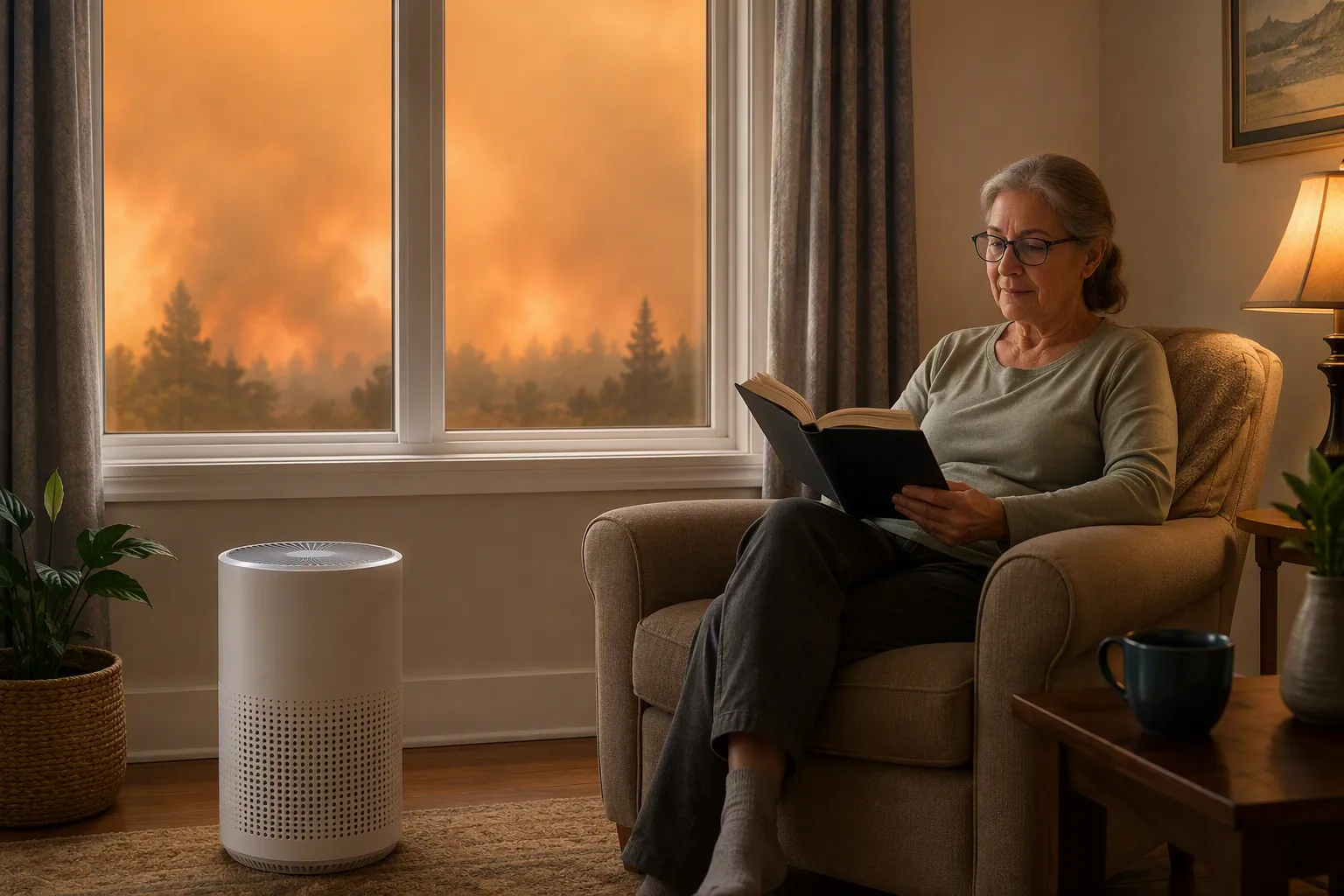
That “where the system allows” phrase is not decorative. A filter that is too restrictive for an HVAC system can create its own household problem. If you do not know what the system can handle, do not turn an alert day into a mechanical experiment. Use the cleanest compatible filter already recommended for the system, run a portable air cleaner if available, and ask the HVAC professional or building manager before changing filter ratings.
For many households, the fastest version of the plan looks like this: one person checks AirNow, one person closes windows and doors, one person changes the HVAC setting, and one person gets the older adult settled away from exterior doors. If there is only one caregiver, do those tasks in that order and skip anything that sends you scrambling outside unnecessarily.
Fans deserve a little caution here. A fan can move air around a room, but it does not make smoky indoor air clean by itself. If windows are open or outside air is being pulled in, the fan may simply help distribute the problem. Close and recirculate first; then filter.
If the high-AQI day is also a heat day, do not treat the problems separately. A closed-up house can become unsafe if cooling is lost, and an overheated older adult may become weak, dizzy, or confused. Use the site’s red-alert heat safety playbook and heatwave fall-prevention guide when smoke and heat arrive together.
Set up a clean room, not just a closed house
“Stay inside” is too vague when an older adult has to get through a long smoke day. A clean room gives the household one protected target: a room with closed windows and doors, filtration if available, and fewer indoor particle sources.
The American Lung Association’s clean-room instructions point toward a practical setup: choose a bedroom with an attached bathroom if possible, seal the door gap with a towel, run a portable air cleaner, and avoid adding indoor pollution from candles, vacuuming, or smoking. [5]
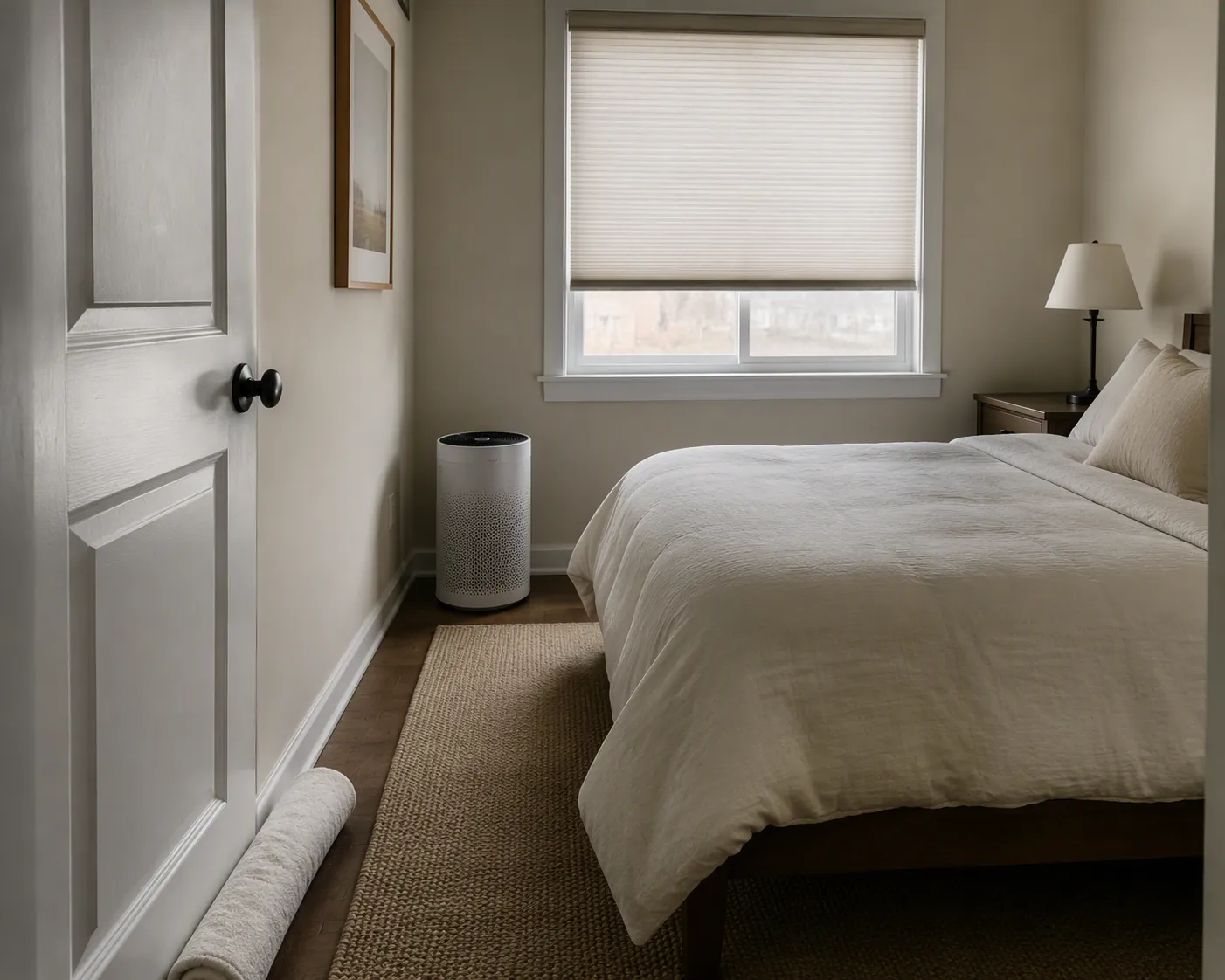
The room choice should be practical, not perfect. Pick the room where the older adult can safely spend time without repeated trips through the house. A bedroom with a nearby bathroom is often better than a living room near the front door. A room with space for the walker, medication organizer, water, phone charger, glasses, hearing aids, and a stable chair is better than the room with the prettiest window.
- Close the window and blinds or curtains.
- Keep the door closed as much as possible.
- Place a towel along the bottom of the door if smoke or drafts are a problem.
- Run the portable air cleaner in that room if one is available.
- Do not burn candles, smoke, or vacuum in or near the room during the alert.
- Move essentials into the room before the older adult becomes tired or short of breath.
The clean room is also a mobility plan. If the older adult normally crosses the house for medications, water, tissues, or the bathroom, the setup has failed at the point where it matters. Put the day’s essentials within safe reach early, while everyone is calm.
If the power goes out, the indoor-air plan changes quickly because filtration, cooling, lighting, phones, and medical devices may all be affected. Move from the smoke plan to your power-outage first checks and the room-by-room outage checklist rather than trying to preserve a clean-room setup that no longer has cooling or filtration.
Use a respirator only for the trip that cannot wait
If the older adult must go outside during wildfire smoke, CDC guidance points to a NIOSH-approved N95 or P100 respirator. [4] That does not make the outing a good idea; it only gives a better option when the trip is unavoidable.
A loose mask, a respirator worn under the nose, or a mask pulled down for talking is not the protection families imagine it to be. If the older adult cannot tolerate a respirator, cannot get a seal, or becomes more short of breath while wearing it, the safer question is usually whether the trip can be canceled, delayed, delegated, or handled by delivery.
Symptoms that should change the plan
Smoke and poor air quality can irritate the eyes and airways, but caregivers need to watch for more than coughing. CDC lists symptoms including coughing, trouble breathing, wheezing, chest pain, fast heartbeat, stinging eyes, and lightheadedness. The American Lung Association also advises people with lung disease to contact their doctor if symptoms worsen or do not improve. [3][6]
- Call the doctor or the older adult’s usual medical team if breathing symptoms are new, worsening, or not improving, especially in someone with COPD, asthma, heart disease, or another chronic condition.
- Call the doctor if wheezing, coughing, unusual fatigue, or lightheadedness changes what the older adult can safely do at home.
- Call 911 or get emergency help for chest pain, severe trouble breathing, fainting, or symptoms that feel urgent or rapidly worsening.
Do not ask an older adult to “push through” chest discomfort or dizziness because the AQI is only orange. If chest discomfort, dizziness, or a fast heartbeat is part of the picture, use the site’s guide to heart attack signs in elderly women as a companion resource, not as a reason to delay emergency care.
For caregivers, the important distinction is simple: the AQI tells you when to reduce exposure; symptoms tell you when the older adult may need medical help. Those are different decisions.
Why older adults do not wait for red
The reason to act at orange is not panic. It is that older adults have less room for avoidable exposure when the air is already officially unhealthy for sensitive groups.
A 2025 JAMA Network Open study of older Medicare beneficiaries found that wildfire-smoke PM2.5 exposure was associated with increased respiratory hospitalizations among adults 65 and older; pneumonia and COPD were the largest respiratory subcauses, accounting for 36.9% and 20.4% of those hospitalizations, respectively. [7]
EPA’s archived Science Matters summary of a 2017 New England Journal of Medicine study also reported that, among more than 60 million Medicare beneficiaries, a 10 µg/m³ increase in PM2.5 below national standards was associated with a 13.6% increase in mortality. [8]
Those findings do not tell you whether one specific parent will have trouble on one specific afternoon. They do explain why waiting for a red alert is a poor household standard for someone already named as sensitive under the AQI system.
When smoke overlaps with evacuation or severe weather
A clean room is not a shelter-in-place order for every situation. If local officials issue evacuation instructions, wildfire threat, road access, medical equipment, mobility, heat, and power all have to be weighed quickly. Smoke protection still matters, but it cannot outrank a direct evacuation order.
This is where families benefit from doing the unglamorous work before the alert: medication list, charger plan, mobility equipment, pet plan, transportation contact, and a destination that can handle the older adult’s needs. Use the severe-weather preparedness checklist and emergency evacuation checklist for seniors living alone before wildfire season if possible, and immediately if an evacuation warning is already nearby.
If the family has to move the older adult during poor air quality, reduce the number of transitions. Pack first, then move. Bring the respirator if the older adult can safely use it. Keep the walker, cane, oxygen supplies if prescribed, medications, glasses, hearing aids, phone, charger, and emergency contacts together rather than scattered across the house.
The household standard
Use one standard so nobody has to renegotiate it during the alert: if the AQI is orange or worse, start the indoor precautions for the older adult. Keep them inside as much as possible, close and recirculate, filter the air, and use the clean room. If going outside cannot be avoided, use a NIOSH-approved N95 or P100 respirator if it can be worn correctly. If symptoms are new or worsening, call the doctor. If emergency symptoms appear, call 911 or get emergency help.
Last verified: August 3, 2026. This article is for education and household planning; it is not a medical diagnosis or a substitute for a clinician’s advice.
References
- Older Adults and Air Quality — AirNow
- AQI Basics — AirNow
- How Wildfire Smoke Affects Your Body — CDC
- Safety Guidelines: Wildfires and Wildfire Smoke — CDC
- How to Create a Clean Room at Home — American Lung Association
- Protecting Yourself from Poor Air Quality — American Lung Association
- Wildfire Smoke Exposure and Cause-Specific Hospitalization in Older Adults — JAMA Network Open, 2025
- Study Shows Low Levels of Air Pollution Pose Risk for Older Adults — EPA Science Matters
Related reading
Noticed something outdated or inaccurate on this page? Flag a correction. We review every report against CDC, NIA, and AARP HomeFit guidance before updating a page.
Part of the Fall Prevention section.