
STEADI: Intervene
Extreme Heat Safety Checklist for Older Adults
This article presents a three-phase extreme heat safety checklist for older adults: steps to take before a heat event, actions during the heat, and how to respond when symptoms appear. It includes exact temperature thresholds, hydration guidelines, medication cautions, and clear signs that require emergency care — all connected to the increased fall risk that heat can cause.
Extreme heat safety for older adults belongs in a fall-prevention plan because heat does not have to become heat stroke to become dangerous. Dehydration, weakness, low blood pressure, dizziness, fainting, confusion, and medications that increase heat risk can turn a normal trip from the bedroom to the bathroom into a fall. Adults 65 and older accounted for about 40% of heat-related deaths in the United States from 2004 through 2018, but the home-level problem often starts much smaller: a warm room, a missed drink, a water pill, a throw rug, and someone standing up too fast. [1][2][3][4]
The three-phase extreme heat safety checklist
| Phase | Do this | Why it matters for falls |
|---|---|---|
| Before heat arrives | Confirm how the home will stay cool; identify a backup cooled place; plan for power loss; set twice-daily check-ins; review medications and fluid limits with a clinician; clear paths between bed, bathroom, kitchen, and cooling area. | The goal is to prevent the weak, dizzy, rushed hour. Heat-related medication effects, dehydration, and hypotension can increase fainting and fall risk. [2] |
| During the heat | Stay in air conditioning when possible; drink before thirst; follow medical fluid limits; avoid alcohol and overexertion; use fans only when indoor temperature is below 90°F; keep checking for 72 hours after the heat event. | Heat danger can begin before a formal alert, and fans can become unsafe in hot indoor air. CDC says electric fans should not be used as the main cooling method when indoor temperatures are 90°F or higher. [5] |
| When symptoms appear | Move to a cooler place; stop activity; cool the body; watch for cramps, exhaustion, syncope, and heat stroke; call 911 for confusion, fainting that does not quickly resolve, very high body temperature in the 103°F–104°F range, hot/red skin, or a fast strong pulse. | Symptoms are decision points. A person who is confused, faint, or overheated should not be walking unassisted to “see if it passes.” [3][6][7] |
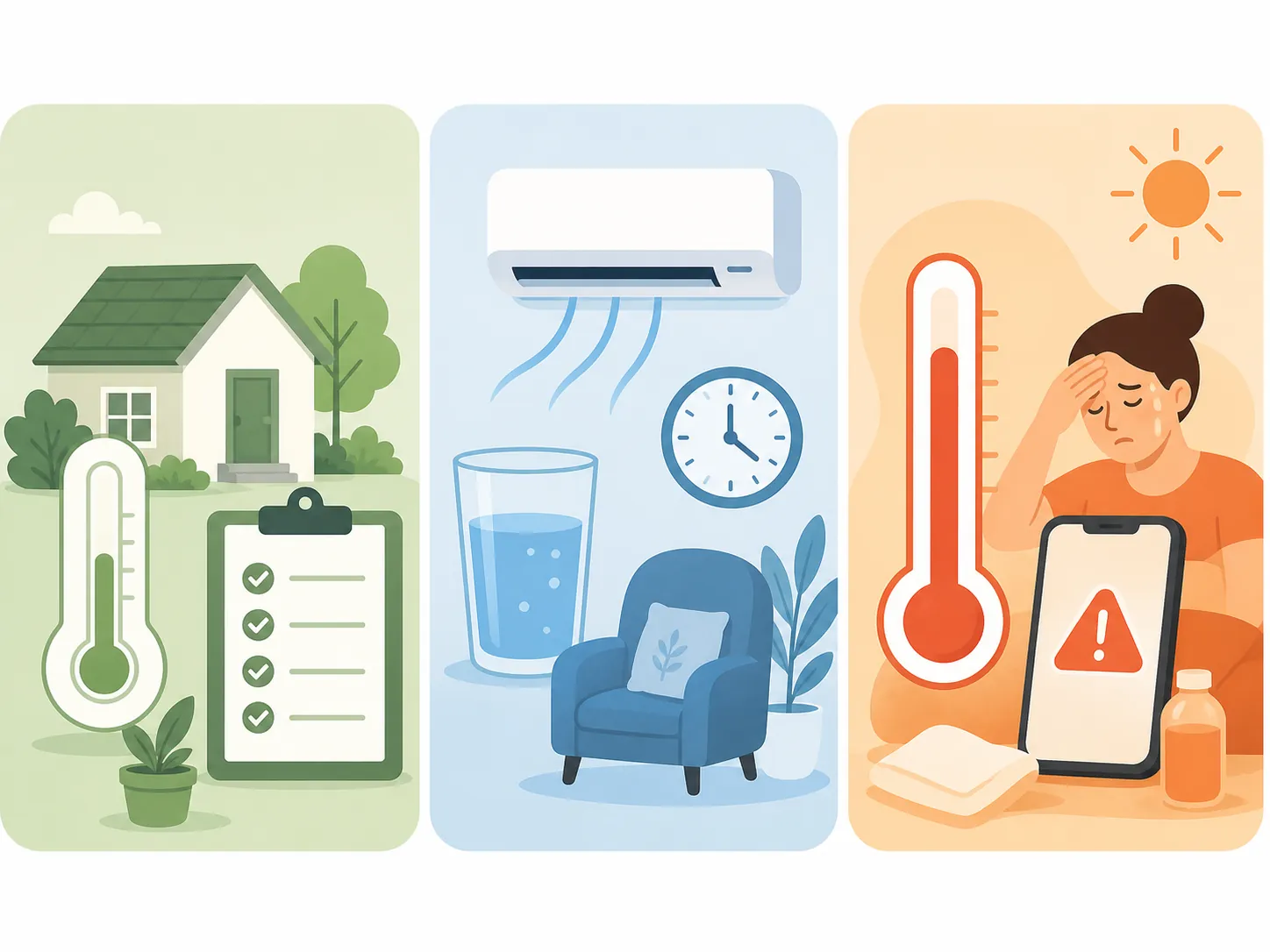
Before heat arrives: make the plan while everyone can still think clearly
A useful heat plan is not “Mom will stay cool.” It says where she will sit at 3 p.m., who checks whether that room is actually cool, what happens if the power fails, and whether her medications or fluid restrictions change the usual advice.
Start with the room, not the forecast. Pick the coolest usable room in the home and make it easy to reach. If the only working air conditioner is in a bedroom with a laundry basket, oxygen tubing, a dog bed, and a throw rug in the path, that is not a cooling plan yet. Move the chair, phone charger, water, glasses, cane, walker, medication list, and emergency contacts into or near that room before the hot stretch begins.
- Test the air conditioner or window unit before the first very hot day. Do not assume it works because it turns on.
- Put a simple indoor thermometer in the main sitting or sleeping area. Outdoor temperature does not tell you what the body is experiencing inside the home.
- If there is no reliable air conditioning, identify a cooled place ahead of time: a relative’s home, senior center, library, shopping center, community cooling center, or other public cooling location. Local health departments and 2-1-1 services may help locate cooling centers where available.
- Plan the route. A cooling center that requires a long walk from a parking lot may not be realistic for someone who is already light-headed.
The fan rule deserves its own line because it is the opposite of what many families assume. CDC guidance says electric fans may provide comfort, but when the indoor temperature is 90°F or higher, they should not be used as the main way to cool down; blowing hot air across the body can increase body temperature rather than protect it. [5] The American Red Cross similarly cautions that fans may not prevent heat-related illness when temperatures are in the high 90s. [6]
Build the power-outage version of the plan
Heat plans fail quickly when the power goes out. If an older adult depends on air conditioning, a stair lift, powered recliner, oxygen equipment, refrigerated medication, electric bed, or charged phone, the outage plan should be written down before the heat event.
- Charge phones, medical alert devices, backup batteries, and power banks before the hot period.
- Keep flashlights where they are reached without walking through a dark room.
- Decide who will provide transportation if the home becomes unsafe.
- Use a printed medication list in case a phone battery dies.
- If the home already has fall hazards during normal weather, use a power-specific checklist such as the senior power-outage fall-prevention checklist before the heat arrives.
Set a twice-daily check-in that asks real questions
CDC’s caretaker guidance for older adults during heat includes checking on them at least twice a day and asking about water intake, access to air conditioning, whether they know how to keep cool, and signs of heat stress. [5] Twice a day does not have to mean twice in person if that is not possible, but the check-in should be specific enough to catch trouble.
A useful phone call sounds less like “Are you okay?” and more like this:
- What room are you in right now?
- Is the air conditioner running, and what does the indoor thermometer say?
- How many glasses of fluid have you had since breakfast or since lunch?
- Have you felt dizzy, weak, unusually tired, nauseated, confused, or light-headed when standing?
- Have you urinated today, and is it much darker than usual?
- Do you need help getting to a cooler place?
For an older adult living alone, put the check-in times on paper and place the paper by the phone. For an adult child checking from work, assign backup coverage. The dangerous gap is the late afternoon call everyone meant to make but nobody owned.
Review medications before the first hot day, not during symptoms
Medication review is part of heat safety, but it has a firm boundary: do not stop, skip, or change prescribed medication on your own. Ask the prescribing clinician or pharmacist what to watch for during extreme heat, especially if the older adult takes medicines that affect fluid balance, blood pressure, sweating, heart rate, kidney function, alertness, or coordination.
CDC clinician guidance identifies several medication classes that can contribute to volume depletion, hypotension, reduced cardiac output, or increased risk of fainting and falls during heat, including diuretics, beta blockers, ACE inhibitors, angiotensin II receptor blockers, calcium channel blockers, tricyclic antidepressants, laxatives, and NSAIDs. [2] That list is not a reason to panic or stop treatment. It is a reason to ask better questions before the weather turns dangerous.
- Ask whether any medication increases heat sensitivity, dehydration risk, dizziness, or low blood pressure.
- Ask what symptoms should trigger a same-day call.
- Ask whether fluid advice changes because of heart failure, kidney disease, low sodium, or water pills.
- Bring the medication list to the next visit and connect the conversation to fall risk. A Medicare wellness visit fall-prevention review is one practical place to do that.
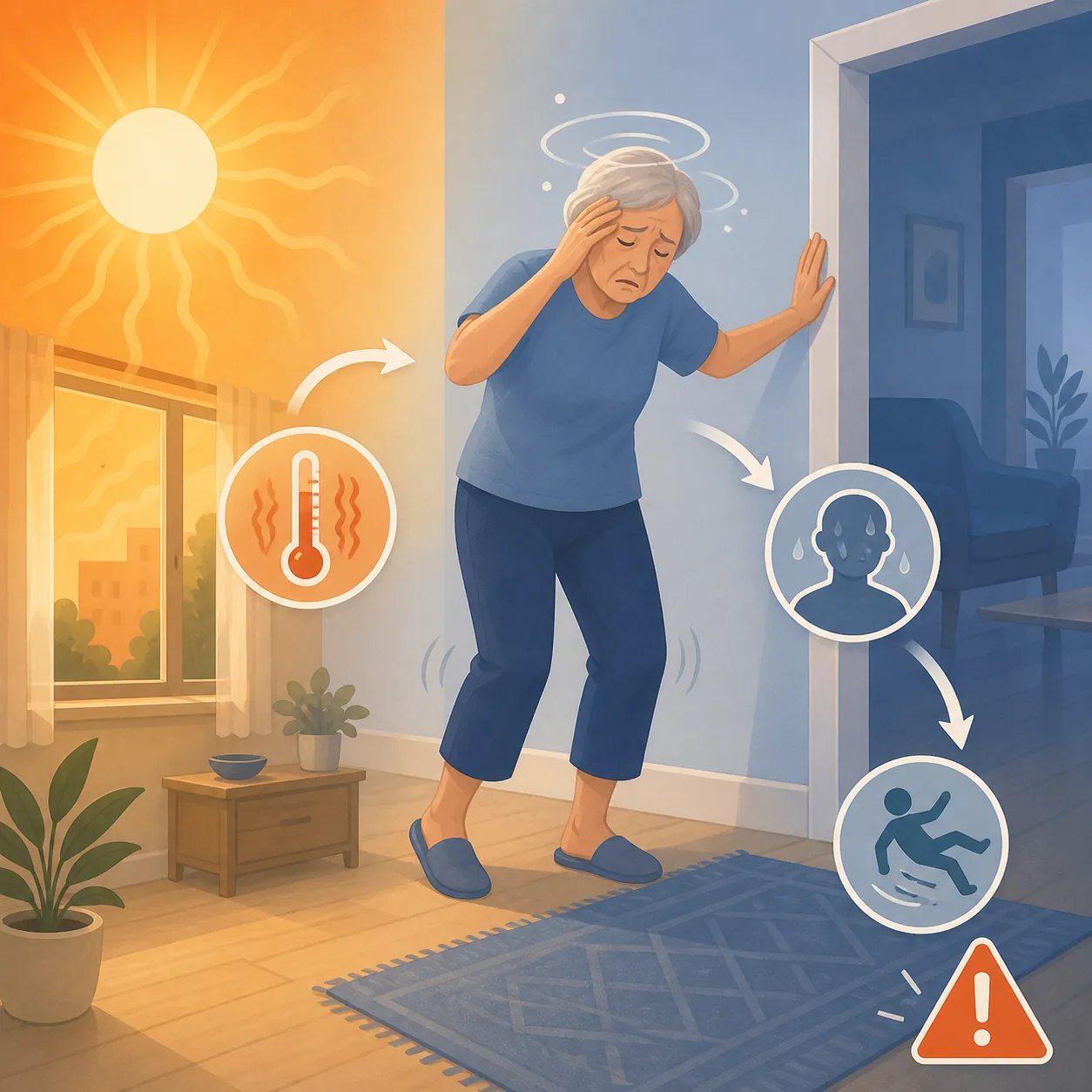
Make the home easier to cross when someone is weak
Heat-related falls are often ordinary-looking. Someone gets up from a chair, feels light-headed, reaches for a wall, catches a slipper on a rug, or hurries to the bathroom because they drank more fluids. The physiology is real: heat can contribute to dehydration, fatigue, slower reaction time, vasodilation, lower blood pressure, light-headedness on standing, and medication-related heat intolerance. [4]
- Clear the path from the main cooling area to the bathroom, bedroom, kitchen, and front door.
- Remove or secure throw rugs, loose cords, low baskets, and fans with cords stretched across walking paths.
- Place water where it can be reached without standing on tiptoe or crossing the room repeatedly.
- Keep the walker or cane within arm’s reach of the cooling chair, not parked by the door.
- Use night-lights for the bedroom-to-bathroom route. Heat does not stop being a fall risk after sunset.
- For a broader printable fall-risk review, use a fall-prevention handout alongside this heat checklist.
During the heat: run the plan, do not wait for thirst or dizziness
Once the hot period starts, the checklist gets simple: cool the person, replace fluids safely, reduce exertion, and keep checking. CDC advises older adults not to wait until they feel thirsty to drink. [5] The National Academy of Medicine’s general daily fluid intake guidance, cited by the National Council on Aging, is about 13 cups per day for men 51 and older and about 9 cups per day for women 51 and older, from water, other beverages, and food. [8] New York State’s extreme heat guidance gives a higher short-term range during extreme heat: 2 to 4 glasses of water per hour. [9]
Those numbers are not safe for every person. Anyone who has been told to restrict fluids, has heart failure or kidney disease, takes diuretics or “water pills,” or has a history of low sodium should ask a clinician for a heat-specific fluid plan before the event. The instruction is not “drink as much as possible.” It is “know your safe range before the room gets hot.”
| Action | Checkable version |
|---|---|
| Use air conditioning when available | Spend the hottest hours in the coolest room or a cooled public place. Do not stay in a hot home to protect property or avoid inconvenience. |
| Do not rely on thirst | Drink on a schedule unless a clinician has set a different fluid limit. Keep a visible glass or bottle near the chair. |
| Use fans carefully | Use a fan for comfort only when the indoor temperature is below 90°F. At 90°F or higher indoors, switch to air conditioning, a cooler location, cool showers, wet cloths, or other cooling steps. [5] |
| Avoid alcohol and heavy exertion | Skip yardwork, long walks, heavy cleaning, and alcohol during the hottest part of the day. Heat plus exertion is a common setup for weakness and dizziness. |
| Keep checking after the worst day | Continue check-ins and cooling attention for 72 hours after a heat event, especially if the home stayed warm or sleep was poor. [9] |
Light clothing, shade, and cool showers can help, but they are not substitutes for a room that is actually cool. If the home is hot and the person is tired, confused, nauseated, or light-headed, treat that as a change in condition, not as normal summer discomfort.
When symptoms appear: sort mild warning signs from 911 signs
When an older adult starts feeling unwell in heat, the first fall-prevention step is to stop the walking. Have the person sit or lie down in a cooler place. Do not send a dizzy person down the hall alone for water, a thermometer, or a change of clothes.
Heat cramps
Heat cramps are painful muscle cramps or spasms, often after heat exposure or exertion. Stop activity, move to a cooler place, and sip fluids if the person is alert and allowed to drink. Get medical advice if cramps are severe, persistent, or occur in someone with significant heart, kidney, or fluid-balance concerns.
Heat exhaustion
Heat exhaustion is more serious. Watch for heavy sweating, weakness, cold or clammy skin, nausea or vomiting, headache, dizziness, or fainting. Move the person to a cooler place, loosen clothing, apply cool wet cloths, and give sips of water only if the person is awake, not vomiting, and safe to swallow. If symptoms worsen, last longer than an hour, or include confusion, call 911. [6][7]
Heat syncope
Heat syncope means sudden dizziness or fainting in hot weather. The National Institute on Aging advises resting in a cool place, putting the legs up, and drinking water. [3] In a home, also think like a fall-prevention caregiver: keep the person seated or lying down until fully steady, use the walker or another person for support, and do not let them rush to the bathroom or bedroom alone right after the episode.
Heat stroke: call 911
Heat stroke is an emergency. Call 911 if the person has confusion, loss of consciousness, a seizure, a very high body temperature, hot red skin that may be dry or damp, or a fast strong pulse. The exact temperature cutoff is not written the same way in every source: the Red Cross and Cleveland Clinic use 104°F or higher as a heat-stroke threshold, while some medical references use 103°F or higher. At home, do not wait for the thermometer to settle the debate. A temperature in the 103°F–104°F range with confusion, collapse, or hot red skin is an emergency. [6][7]
While waiting for emergency help, move the person to a cooler place if you can do so safely, remove excess clothing, and cool the body with wet cloths, misting, fanning with cooler air, or a cool bath if it can be done without creating another fall or drowning risk. Do not give fluids when heat stroke is suspected. [6]
| If you see this | Do this |
|---|---|
| Mild cramps, alert, safe to swallow | Stop activity, move to a cooler place, sip fluids if medically allowed, and monitor. |
| Dizziness, weakness, nausea, heavy sweating, or faintness | Sit or lie down in a cool place, cool the body, do not walk unassisted, and get medical advice if symptoms persist or worsen. |
| Fainting, sudden severe weakness, or light-headedness on standing | Treat as a fall risk immediately. Keep the person down, elevate legs if appropriate, cool the room, and do not let them walk alone. |
| Confusion, collapse, seizure, hot red skin, fast strong pulse, or body temperature around 103°F–104°F | Call 911. Cool the person while waiting. Do not give fluids if heat stroke is suspected. |
A compact evidence note on urgency
Heat-death counts are difficult because heat often worsens existing medical problems rather than appearing neatly as the only cause. That uncertainty should make families more careful, not less. CDC’s analysis of U.S. heat-related deaths from 2004 through 2018 found that adults 65 and older had the highest age-group death rate and made up about 40% of heat-related deaths. [1] The household takeaway is narrower and more useful than a national statistic: older adults need a working cooling plan before symptoms appear.
Before the next hot day, assign the next action
A heat checklist works only when it names the person who will carry it out. Print it or save it where it will be used. Write down the twice-daily check-in times. Confirm the cooled room and the backup place. Ask the clinician or pharmacist about medications, water pills, blood pressure, and safe fluid intake. Clear the path to the bathroom before anyone is weak.
The rule to remember is practical: if heat causes dizziness, weakness, confusion, fainting, or unsafe walking, it has already become a fall-prevention issue. Do the cooling and hydration work early, and know the 911 signs before the bad hour starts.
References
- Heat-Related Deaths — United States, 2004–2018, CDC MMWR, June 19, 2020.
- Heat and Medications – Guidance for Clinicians, CDC.
- Hot Weather Safety for Older Adults, National Institute on Aging.
- Beat the Heat This Summer, Injury Matters.
- Heat and Older Adults Aged 65+, CDC.
- Extreme Heat Safety, American Red Cross.
- Heat Exhaustion vs. Heat Stroke: What’s the Difference?, Cleveland Clinic.
- How to Stay Hydrated for Better Health, National Council on Aging.
- Extreme Heat Resources, New York State Office for the Aging.
Related reading
Noticed something outdated or inaccurate on this page? Flag a correction. We review every report against CDC, NIA, and AARP HomeFit guidance before updating a page.
Part of the Fall Prevention section.