
STEADI: Intervene
Wildfire Evacuation Checklist for Older Adults
Standard wildfire checklists assume able-bodied evacuees who can leave on short notice. This aging-specific guide builds your plan around four pillars—medication supply, assistive-device exits, power-dependent equipment, and a named support network—so that when the alert sounds, the only decisions left are "go now" and "take this bag."
Most evacuation lists quietly assume that leaving is one clean motion: hear the alert, grab the kit, get in the car. That is not how evacuation works when the person leaving uses a walker, wakes slowly, takes daily medication, cannot hear a standard alarm, or depends on powered equipment to breathe or move safely.
A wildfire evacuation safety checklist for older adults has to remove decisions from the emergency moment. Before fire season, the plan should already answer four questions: where are the medications, which exits actually work with the mobility device, what happens if the power fails, and who is coming or calling if the older adult cannot leave alone.
The risk is not theoretical, though the best national number is broader than wildfire. USFA/FEMA reported that in 2023, the fire death rate for adults 65 and older was 33.0 per million, 2.5 times the general population’s rate; adults 85 and older had a relative risk 3.4 times that of the general population. Those are all-fire figures, not wildfire-specific figures, but they are enough to justify a checklist that treats age, mobility, hearing, medications, and support as safety issues rather than footnotes. [1]
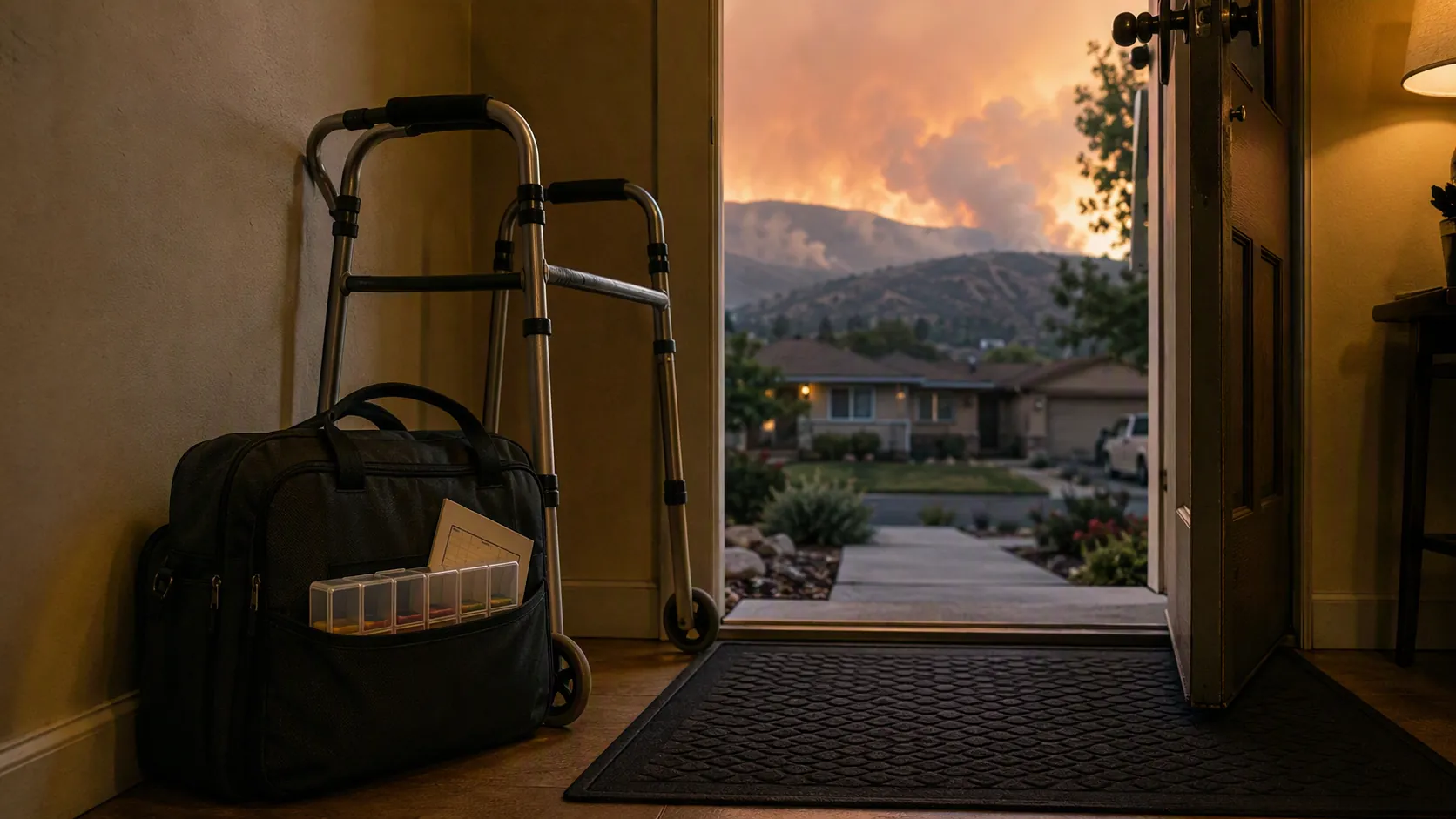
Start with the ordinary kit, then correct it for aging
Ready.gov’s basic emergency kit is still the floor: water, non-perishable food, a battery-powered or hand-crank radio, flashlight, first aid kit, extra batteries, whistle, dust mask, phone chargers, and related supplies. Its water guidance is specific: 1 gallon per person per day for several days. Ready.gov also notes that about half of all Americans take a prescription medicine every day, which is the line that should move medication from “remember later” to “built into the kit.” [2]
For an older adult, the go-bag should be small enough for the person or helper to move, but complete enough that no one has to search through drawers while smoke, alarms, or pain are making thinking harder. If a walker basket, wheelchair pouch, or rollator bag is part of the escape route, use it deliberately. The same device-attached logic appears in other fast-evacuation planning, including flash flood evacuation steps for seniors living alone and earthquake preparedness checklists for seniors.
| Layer | What to pack or stage | Why it matters for an older adult |
|---|---|---|
| Basic evacuation kit | Water, non-perishable food, flashlight, radio, batteries, first aid, dust mask, whistle, chargers, copies of key documents | These are the baseline supplies, but they do not solve medication, mobility, hearing, or power needs by themselves. |
| Medication and health information | Daily prescriptions, current medication list, allergies, diagnoses, pharmacy and clinician contacts, copies of insurance cards, eyeglasses, hearing-aid batteries, and spare assistive items when possible | The person may not be able to reconstruct medication names, doses, or refill sources after evacuation. |
| Mobility and exit support | Walker, cane, wheelchair, rollator, transfer belt if used, sturdy shoes, spare tips or small repair items, and a tested route through each exit | A doorway that works for a standing adult may fail when a walker, wheelchair, oxygen tubing, or caregiver assistance is added. |
| Power-dependent equipment | Chargers, backup batteries, written operating instructions, supplier contacts, utility information, and a failure plan | A power outage can turn a medical or mobility device into an evacuation deadline. |
| Support network | Named people, phone numbers, alert responsibilities, transportation plan, extra key, and exact location of supplies | Someone must know when to check in, how to enter, and what to take. |
Medication supply: write the plan before asking anyone to remember it
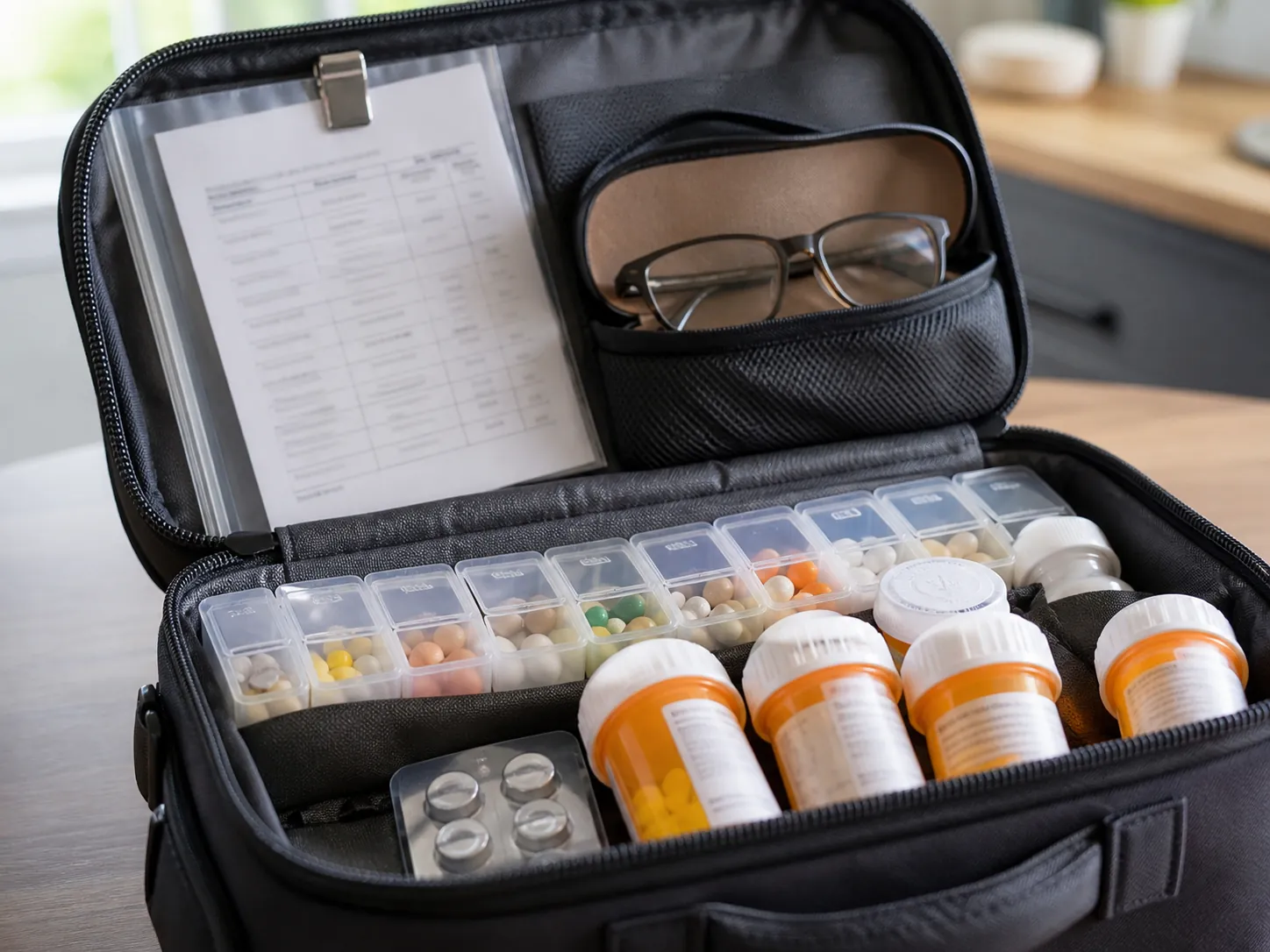
Medication is where generic wildfire lists become too thin. The older adult’s bag needs more than “prescriptions.” It needs a current medication list with dose, timing, prescribing clinician, pharmacy, allergies, and the reason each medicine is taken if that is known. Keep a printed copy in the bag and a second copy with the support person who is most likely to help. If the older adult uses a phone medication list, do not make the phone the only copy.
The supply target is not one-size-fits-all. The American Red Cross recommends that older adults keep at least 30 days of medications and medical supplies. [3] CDC wildfire guidance for people with chronic conditions says to have 7 to 10 days of prescription medicines available. [4] Those two instructions are not the same, and families should not smooth the difference away. Ask the clinician or pharmacist what reserve is realistic and safe for the specific medication, especially for refrigerated medicines, controlled substances, mail-order refills, inhalers, insulin supplies, oxygen-related prescriptions, or medications that cannot be abruptly stopped.
Pack the items that make the medication usable: pill organizer if appropriate, measuring device, glucose supplies if used, spare reading glasses, hearing-aid batteries, and written instructions for anything another person might have to set up. The Red Cross tells older adults to include extra assistive items such as canes and eyeglasses and to refresh emergency supplies every six months. [3] If the family already keeps a heat or outage kit, use the same medication-list discipline described in heat-wave power-outage planning for seniors, then add the wildfire-specific evacuation trigger and transportation plan.
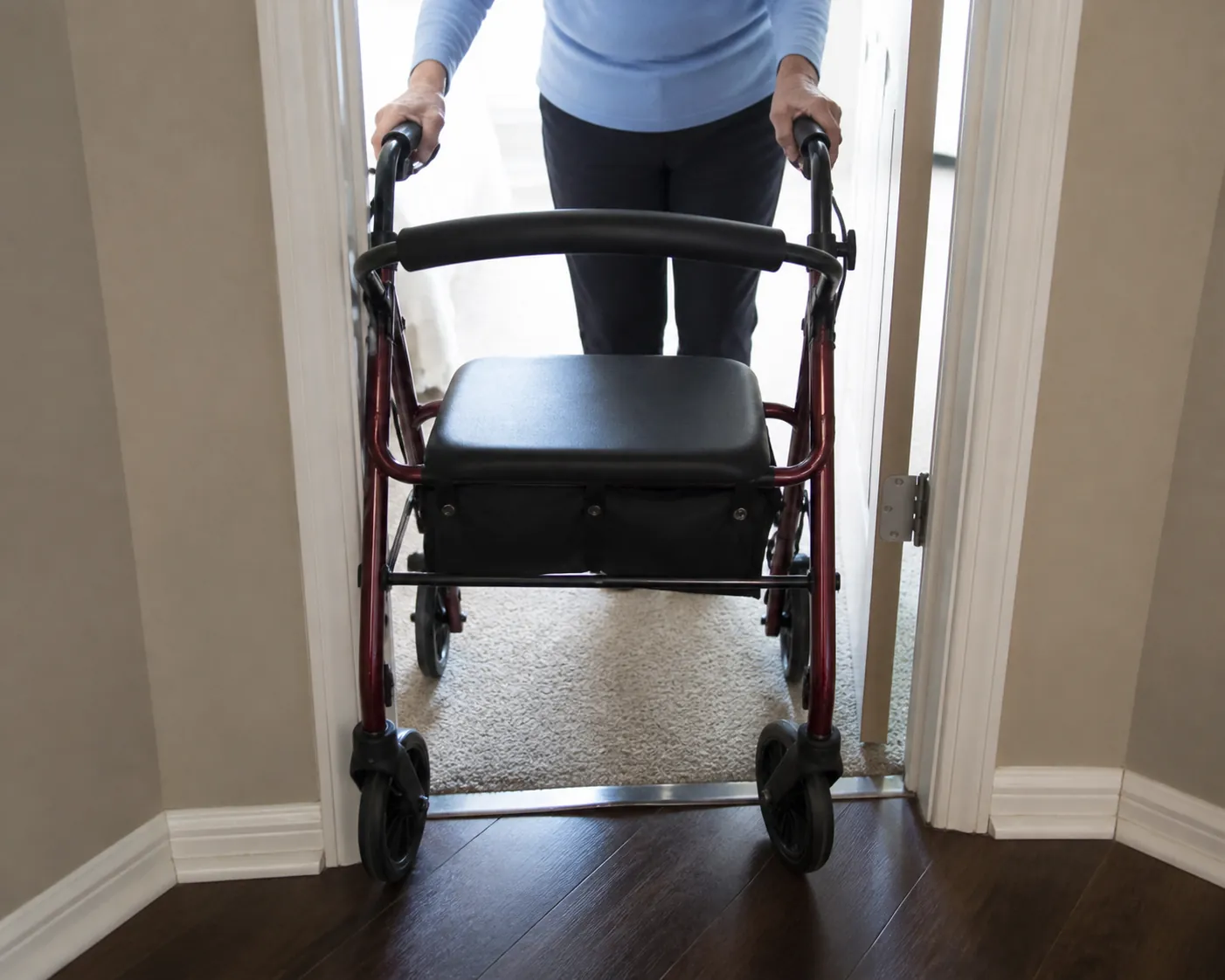
Walk the exits with the actual device
The most useful wildfire checklist item may be the least glamorous one: test whether the walker or wheelchair fits through every exit. USFA’s fire safety guidance for older adults says that if a person uses a walker or wheelchair, they should check all exits to make sure the device gets through the doorways. [5] Do not assume. Push the rollator through the front door, garage door, back door, bedroom path, and any threshold that would be used at night.
This check should include the awkward parts people skip when they are being polite: rugs that catch wheels, a lip at the sliding door, a storm door that closes too fast, shoes stored in the path, a walker that has to be folded to clear the frame, a wheelchair ramp that is blocked by patio furniture, or a car parked where the passenger door cannot open wide enough. A route is not tested until the older adult has tried it with the device and the helper has tried it while carrying the go-bag.
California Department of Aging tip sheets add several details that belong in this part of the plan: keep walking aids near the person at all times, keep extra aids in different rooms if possible, keep a security light in each room, keep a whistle nearby to signal for help, and replace extra hearing-aid batteries annually. [6] Those are small measures, but they move safety closer to the chair, bed, bathroom, and hallway where evacuation actually begins.
If the evacuation route starts with getting out of bed or crossing a dark hallway, borrow the same logic used to fall-proof a senior’s home before a power outage: light the path, clear the floor, remove trip hazards, and make sure the first mobility aid is reachable without standing unsupported.
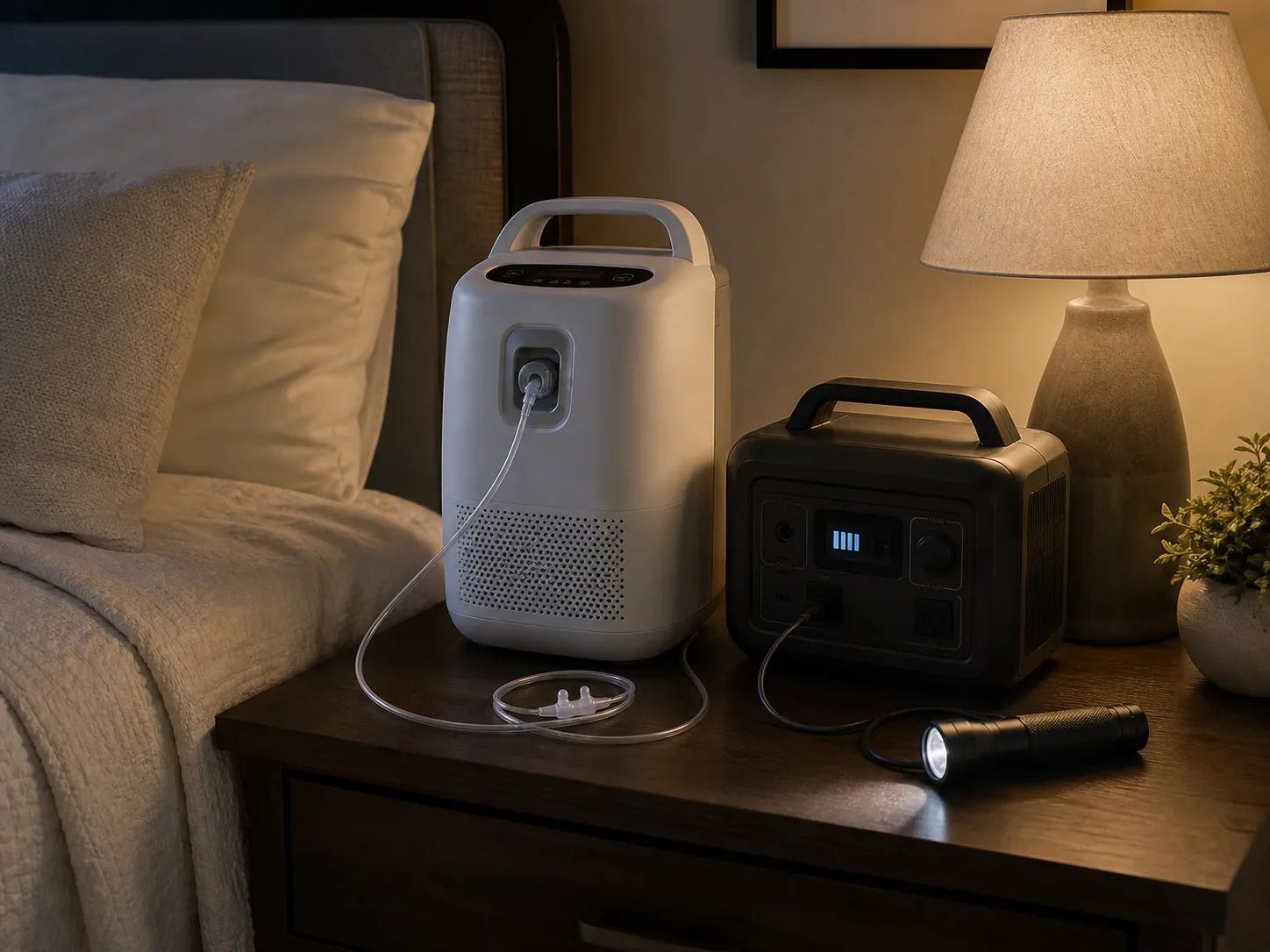
Treat power-dependent equipment as an evacuation clock
If an older adult uses electric life-sustaining equipment, powered mobility equipment, oxygen equipment, a hospital bed, a lift chair, a stair lift, a suction device, a nebulizer, or a device that must be charged to remain useful, the wildfire plan is also a power-outage plan. California Department of Aging guidance says that when life-sustaining equipment is electric, people should work out a power-outage plan with backup batteries or generators where appropriate and contact the utility company in advance. [6]
Write the failure plan in plain language and keep it with the device: how long the backup battery is expected to last under normal use, where the charger is, who knows how to connect it, when to leave earlier because charging is uncertain, and whom to call if the device stops working. Avoid instructions that depend on one tired person remembering a sequence under pressure.
For families already preparing for grid instability, the under-an-hour checks in what a power grid emergency order means for older adults are useful, but wildfire adds a harder edge: the backup plan must support leaving, not just sheltering at home. That means chargers packed, cords labeled, vehicle charging options tested if available, and a support person assigned to move equipment that the older adult cannot lift.
Name the people, not just the emergency contacts
An emergency contact list is passive. A support network is assigned work. One person checks alerts. One person calls the older adult. One person has an extra key. One person knows where the go-bag, medication list, mobility device, chargers, and power instructions are kept. One person knows whether the older adult can transfer into the car without help.
That distinction matters in wildfire evacuations. A 2023 scoping review on wildfires and older adults reported that older adults without social support were more likely to die during wildfires because they did not receive adequate warning or could not evacuate alone. [7] A named network is not a courtesy layer added after the “real” kit. It is part of the evacuation mechanism.
Ready.gov’s older-adult preparedness guidance uses a “Take Control in 1, 2, 3” structure and specifically includes building a support network; it also says one network member should have an extra key and know where emergency supplies are kept. The same guidance points older adults toward alerts such as NOAA Weather Radio, the FEMA app, and local alert systems. [8]
Alert planning has to match the person’s hearing, sleep, cognition, and phone habits. USFA notes that if a standard smoke alarm cannot be heard, an alarm with a different sound, bed shaker, or strobe may be needed. [5] For an older adult who silences unknown callers, forgets to charge a phone, or sleeps without hearing aids, the support network should not rely on a single phone notification.
If memory loss, confusion, or agitation is part of the household, build a separate version of the plan around recognition, calm instructions, and identification. The emergency-kit principles overlap with earthquake preparedness for dementia caregivers, but the wildfire plan also needs an earlier leave point so no one is trying to persuade, pack, and transfer at the edge of an evacuation order.
Make the checklist executable
A good checklist tells the helper what to do without requiring a family meeting in the driveway. Keep one printed copy on the refrigerator or inside a cabinet door, one in the go-bag, and one with the main support person. If the older adult is comfortable using a phone, keep a digital copy too, but do not make the phone the only version.
- Top line: “If evacuation is ordered, go now. Take this bag.”
- Medication page: prescriptions, doses, allergies, pharmacy, clinician, refill limits, and where the emergency supply is kept.
- Mobility page: best exit, backup exit, device location, transfer notes, ramp or threshold problems, and car-loading instructions.
- Power page: device list, backup battery location, charging instructions, supplier number, utility contact, and when to leave earlier.
- Support page: names, roles, phone numbers, who has the key, who receives alerts, who drives, and who checks if the first person is unavailable.
- Pet or service-animal page if relevant: carrier, leash, food, medication, vaccination records, and who can handle the animal during transfer.
For mobility-heavy plans, it can help to rehearse with the same seriousness used in other evacuation settings, such as mobility-aid evacuation planning. The point is not to turn home into a drill ground. The point is to discover, before smoke is in the air, that the walker does not fit past the laundry basket or that the oxygen tubing catches on the bed frame.
Refresh it every six months, and after anything changes
The Red Cross recommends refreshing emergency plans and supplies every six months. [3] Put the review on the calendar before fire season and again six months later. Also review it after a hospitalization, new diagnosis, medication change, move, new mobility device, fall, change in driving ability, utility shutoff notice, or change in the support network.
- Walk every exit again with the walker, cane, wheelchair, rollator, oxygen tubing, or helper support that will actually be used.
- Check medication dates, refill rules, printed medication lists, eyeglasses, hearing-aid batteries, chargers, and backup batteries.
- Test flashlights, radios, phone chargers, alert settings, and any alarm adaptations such as strobes or bed shakers.
- Confirm that the support person with the extra key still has it and still knows where supplies are stored.
- Ask the older adult what part of the plan feels hardest. Pain, fatigue, pride, fear of leaving home, or embarrassment about needing help can all change whether the plan works.
Have the medication portion reviewed by the person’s clinician or pharmacist, the powered-equipment portion reviewed by the clinician, supplier, or other qualified professional who understands the device, and the exit route reviewed by a local fire department, emergency manager, occupational therapist, or other credentialed reviewer when available. Write the reviewer’s name and review date on the checklist so the family knows whose guidance they are following.
This article is for preparedness education and is not medical advice. Medication reserves, oxygen use, powered medical equipment, evacuation timing, and transportation limits should be reviewed with qualified professionals who know the older adult’s health, home, and local wildfire risk.
When the plan is checked, shared, refreshed, and staged where people can actually reach it, the emergency moment gets smaller. The older adult does not have to solve the whole evacuation. The decision becomes the one the plan was built for: go now, and take this bag.
References
- Older Adult Fire Death Risk (2014-2023), USFA/FEMA
- Build A Kit, Ready.gov
- Older Adults Emergency Preparedness, American Red Cross
- Wildfire Smoke and People with Chronic Conditions, CDC
- Fire Safety for Older Adults, USFA
- Disaster Preparedness Tip Sheets for Seniors, California Department of Aging
- Wildfires and Older Adults, Melton et al., 2023
- Older Adults, Ready.gov
Related reading
Noticed something outdated or inaccurate on this page? Flag a correction. We review every report against CDC, NIA, and AARP HomeFit guidance before updating a page.
Part of the Fall Prevention section.