
What the AT&T landline phase-out means for senior emergency communication
AT&T is shutting down its copper landline network, directly threatening medical alert pendants and home phones that seniors still rely on for 911 calls after a fall. This article identifies the systems at risk and gives you a concrete, step-by-step transition checklist to prevent a gap in your parent's emergency communication.
The first question after an AT&T landline shutdown notice is not whether your parent still likes an old phone. It is what else is quietly using that line. In many homes, “the landline” is not just a handset in the kitchen. It may be the path a medical alert pendant uses to reach a monitoring center, the line a monitored alarm panel uses to report trouble, and the simplest way someone can dial 911 after a fall.
That is why the practical issue behind AT&T’s landline phase-out is continuity. If copper service ends and the replacement has different power, location, or device-compatibility rules, a family can lose coverage without realizing it until the next outage or emergency.
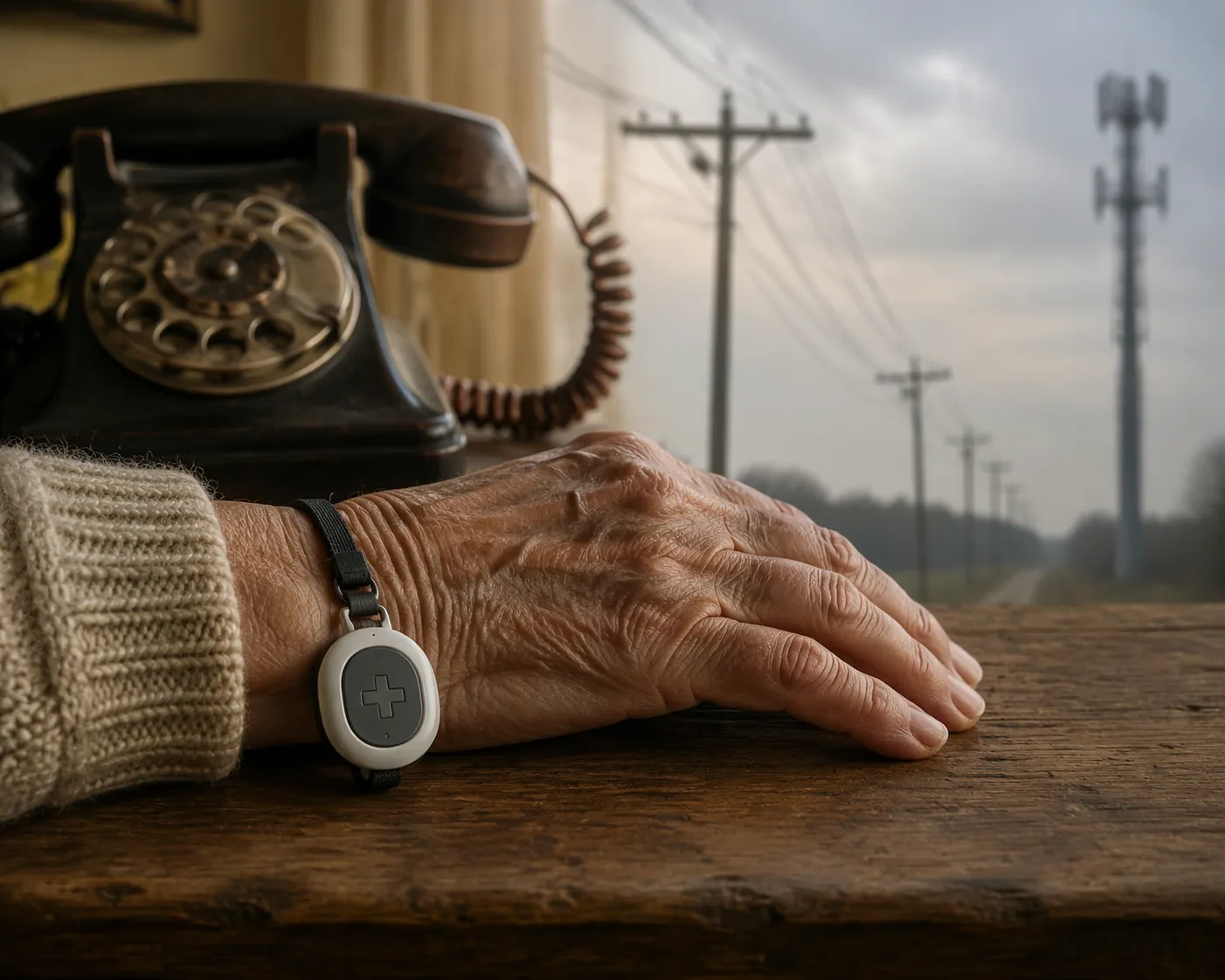
Illinois families have the clearest clock. AT&T sent letters in November 2025 and March 2026 telling affected Illinois customers that landline service ends March 15, 2027.[1] AT&T has also described a broader copper-retirement effort across its 21-state footprint, with full retirement targeted by 2029, but deadlines vary by state and regulatory approval.[2] California is the major reminder not to treat this as one national schedule: the California Public Utilities Commission rejected AT&T’s phase-out proposal there, even as public objections continue around emergency service and earthquake scenarios.[3][4]
There is another reason not to wait for a stack of reminders. On March 26, 2026, the FCC voted to reduce the required copper-retirement notice period from 180 days to 90 days.[5] That does not mean every state will move on the same date. It does mean a household that depends on copper for emergency communication should not build its plan around long warning periods.
Start With The Devices, Not The Phone Bill
Before comparing replacement services, make a list of everything that touches the landline. Walk the house if you can. Ask the medical alert company, the alarm company, and your parent what is actually plugged in. Do not rely on the phrase “we only use it for emergencies,” because that can mean several different systems.
| System to check | What can break during a copper transition | What to confirm |
|---|---|---|
| Medical alert base station or pendant | Some older systems send the emergency call through the copper phone line | Whether the exact model works over cellular, VoIP, or AT&T Phone-Advanced |
| Fall detection pendant | Fall detection may still trigger locally, but the alert path may not reach the monitoring center | Whether a test fall alert reaches the center and supports two-way communication |
| Monitored security or fire alarm | The panel may use the landline to report alarms or trouble signals | Whether the alarm company has moved it to cellular, IP, or another monitored path |
| Home phone for 911 | Cordless phones, gateways, and modems may fail in an outage unless backup power covers them | Whether 911 location is registered correctly and which phone works during backup power |
The small size of the remaining copper population should not make families casual about this. The FCC says about 5% of households still use legacy copper, and that remaining group is disproportionately elderly and rural.[6] A smaller group can still be the group with fewer backup options, longer emergency response routes, or less appetite for troubleshooting new equipment.
Transition Checklist
A safe handoff is not complete when a replacement box is installed. It is complete when every emergency path has been named, converted if needed, and tested under the conditions your parent is likely to face. Use this as the working checklist, then spend extra time on the compatibility and power steps.
- Identify every device using the copper line: medical alert base, pendant, alarm panel, fax-like health equipment if present, and every phone your parent would reach for in an emergency.
- Call each provider with the exact model number and ask whether it works over cellular, VoIP, or AT&T Phone-Advanced.
- Compare AT&T’s replacement option with a dedicated cellular medical alert system, especially if fall response is the real reason the landline stayed.
- Test the pendant, fall detection, and two-way voice connection with the monitoring center after the change.
- Test backup power with the actual phone setup in the house, not the setup described in a brochure.
- Update and verify the 911 service address for any replacement phone or cellular emergency system that requires location registration.
- Write down the retest date, account numbers, provider phone numbers, backup-battery limits, and the shutdown window.
When You Call The Medical Alert Company, Ask Narrow Questions
“Compatible with most medical monitoring devices” is not enough. The word “most” leaves room for your parent’s model to be one of the exceptions, and “compatible” may only describe normal power, normal signal, or a base station sitting near the right outlet. The call should be tied to the equipment in the home.
- Give the representative the base-station model, pendant model, and fall-detection model if separate.
- Ask whether the system has already been tested on AT&T Phone-Advanced, VoIP, and cellular, not just “new phone service.”
- Ask whether fall detection still sends an alert automatically after the line change.
- Ask whether two-way voice works through the base station after the change, and where your parent needs to be in the house for the microphone and speaker to work.
- Ask whether the company requires a technician visit, a new base unit, a SIM-based cellular unit, or a full account migration.
- Ask how long the pendant and base station batteries last, and which low-battery alerts go to the older adult versus the family.
If the answer is “it should work,” keep going. Ask the representative to describe the tested connection path from pendant to base station to monitoring center. If that cannot be confirmed, treat the system as unverified until a live test proves otherwise.
Do A Real Test, Not A Courtesy Ping
A meaningful medical alert test has a beginning and an end. The older adult presses the pendant from the places where a fall is plausible: bedroom, bathroom doorway, hallway, kitchen, and the chair where they sit most often. The monitoring center answers. Two-way voice is understandable. The operator sees the correct name, address, and emergency contacts. The family writes down the date, time, and result.
Fall detection needs its own confirmation. Do not create an unsafe test fall. Ask the provider for its approved fall-detection test procedure, then confirm that an automatic fall alert travels through the new connection path. A pendant that detects motion but cannot reach the monitoring center is not a working emergency system.
The Power-Outage Detail Families Miss
Copper landlines had one boring advantage that mattered in a crisis: they carried power from the phone company, so a corded phone could often keep working when household electricity was out. Replacement services change that dependency. VoIP, fiber-based phone service, cellular base units, Wi-Fi gateways, modems, cordless phones, and backup batteries all have their own failure points.
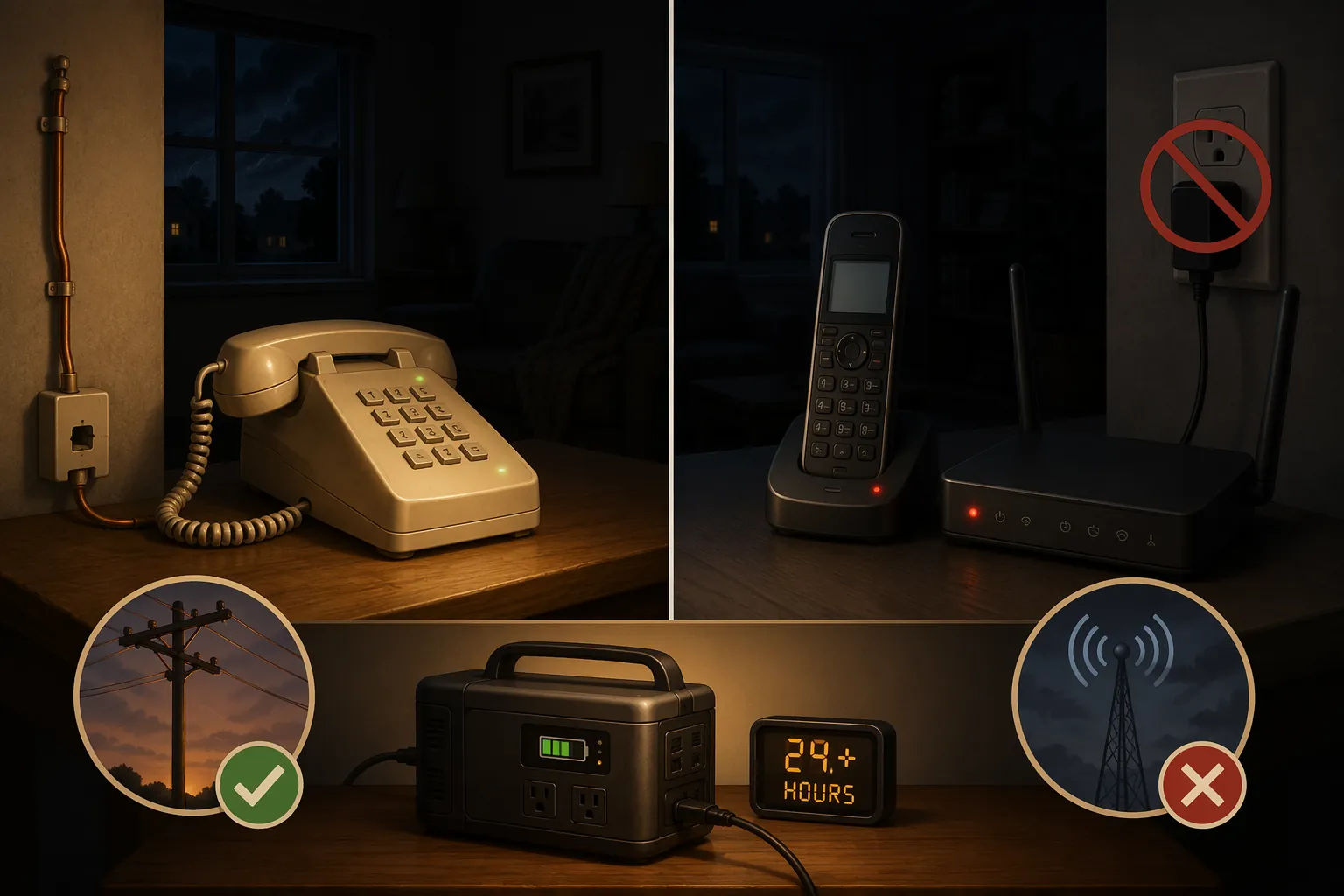
AT&T Phone-Advanced, as described by the Citizens Utility Board, costs about $45 to $50 per month, includes a 24-hour battery backup, and is compatible with most medical monitoring devices.[1] The same guidance includes the caveat families need to underline: the backup battery powers a corded phone, not a cordless phone, Wi-Fi gateway, or modem.[1]
That means a parent who normally answers a cordless handset beside the bed may still be stranded during an outage if the only backed-up device is a corded phone across the room. A family can install a replacement service, keep the old phone number, and still fail the hallway-at-night test.
Outage resilience is not a theoretical objection. During the 2012 derecho in the Washington, D.C., region, reporting cited cases where Verizon Fios customers lost phone service when power failed while copper landline customers could still call 911.[7] In California, critics of AT&T’s phase-out have raised similar concerns around earthquake scenarios, where household electricity and network equipment may be disrupted at the same time.[4]
How To Test Backup Power At Home
Do the power test after installation, while the provider and family still have time to fix the setup. You do not need to simulate a disaster. You need to know which emergency pathway survives when the normal house power is unavailable.
- Plug in the equipment exactly where your parent will use it, including the actual phone, alert base station, gateway, and backup battery.
- Confirm which device the backup battery powers and which devices it does not power.
- During a planned test, disconnect normal power to the supported equipment according to provider instructions.
- Place a test call from the phone your parent would actually use, not the phone that happens to be easiest for the installer.
- Run a medical alert test with the monitoring center while on backup power.
- Write down the rated backup time, the date the battery was installed, and who will replace it.
If the backup plan requires a corded phone, put that phone where a fallen or frightened person can realistically reach it. If the plan depends on cellular, check signal strength in the room where the base unit will sit. If it depends on Wi-Fi, ask what happens when the gateway loses power. The weak point is often not the service itself; it is the one device nobody realized was outside the backup chain.
AT&T Phone-Advanced Or A Cellular Medical Alert System?
The right replacement depends on what the landline was doing. If your parent wants a familiar home-phone setup and has monitoring equipment confirmed to work on AT&T Phone-Advanced, that may be a reasonable bridge. If the main purpose of the line is fall response, a dedicated cellular medical alert system may fit the actual need better.
Mid-2026 pricing gives a rough sense of the decision, not a permanent quote. The Citizens Utility Board lists AT&T Phone-Advanced at about $45 to $50 per month.[1] NCOA’s 2026 reviews list examples such as Bay Alarm Medical SOS Home at $34.95 per month with a 32-hour backup battery, Medical Guardian MGHome Cellular at $38.95 per month plus $149 equipment with a five-day pendant battery, and LifeFone at $34.95 per month with a $5 fall-detection add-on and a 10-day pendant battery.[8] SeniorLiving.org lists MobileHelp at $25.95 per month with no equipment fee and notes that cellular in-home systems commonly cost about $5 to $10 more per month than landline equivalents.[9]
| Option | What it may preserve | What still needs testing |
|---|---|---|
| AT&T Phone-Advanced | A home-phone-like setup, existing number, and compatibility with many monitoring devices | Exact medical alert model compatibility, corded-phone access, 24-hour battery behavior, and 911 location |
| Dedicated cellular medical alert system | A medical-alert-first path that does not require a copper line | Cellular signal inside the home, pendant battery life, fall-detection behavior, monitoring-center account data, and backup power |
| VoIP or internet-based phone service | A replacement home phone line through internet equipment | Modem or gateway power, alarm compatibility, medical alert compatibility, and 911 location registration |
Those product examples are not endorsements. They show the tradeoff families are actually facing: a phone replacement may keep the household routine familiar, while a cellular medical alert system may put the emergency function on equipment designed for that job. Either choice can be unsafe if nobody tests it.
Do Not Forget 911 Location
A copper home phone was physically tied to an address in a way families rarely had to think about. Replacement services can require address registration or account updates so emergency services receive the correct location. This matters for older adults who live in apartments, accessory dwelling units, senior communities, rural routes, or homes where the billing address is not the service address.
After any conversion, ask the phone provider how the 911 address is registered and how to update it. Ask the medical alert company what address the monitoring center sees. Then read the address back slowly, including apartment number, gate code instructions if the provider accepts them, and emergency contacts. A working button with the wrong location is only partly working.
What To Do Based On Where Your Parent Lives
Illinois families should work backward from March 15, 2027, not from the month service disappears.[1] The safer deadline is earlier: enough time to replace equipment, schedule technician visits, wait for shipped devices, test the new path, and fix whatever fails.
Families in other AT&T states should verify the local timeline directly with AT&T, the state utility regulator, or consumer utility guidance for that state. AT&T’s broader copper-retirement target does not create one identical household deadline across all 21 states.[2]
California readers have a different immediate situation because regulators rejected AT&T’s phase-out proposal there.[3] That buys time; it does not make the inventory unnecessary. A parent’s medical alert system, alarm panel, and outage plan still need to be understood before a future transition notice, equipment failure, or provider change forces the issue.
The Risk Is Operational, Even Without A Fall-Response Study
There is no controlled study proving that AT&T’s copper phase-out will increase senior fall emergency response times. The evidence does not support that precise claim. What it does support is a narrower and still serious conclusion: some older adults still rely on copper-connected emergency systems, replacement services have different compatibility and power requirements, and a household that does not test the handoff can create a silent gap.
The endpoint is simple enough to write on one page: every device using the old line has been identified; every provider has confirmed the exact model and connection path; the pendant and fall-detection process have been tested; backup power has been tested with the real phone and base station; 911 and monitoring-center addresses are correct; and the family has a retest date before the shutdown window. That is the difference between accepting a transition notice and verifying that help can still be reached.
References
- CUB Q&A: AT&T landline service ending, Citizens Utility Board, March 2026.
- AT&T copper retirement coverage, USA Today, December 2024.
- California regulators reject AT&T landline phase-out proposal, CBS News Sacramento.
- AT&T landline phase-out earthquake concerns, NBC Palm Springs, July 2025.
- FCC shortens copper retirement notice period, Fusion Connect.
- Technology Transitions, Federal Communications Commission.
- 2012 derecho copper landline outage reporting, NewsNation.
- Best Medical Alert Systems of 2026, National Council on Aging, 2026.
- Best Cellular Medical Alert Systems, SeniorLiving.org.
Related reading
Noticed something outdated or inaccurate on this page? Flag a correction. We review every report against CDC, NIA, and AARP HomeFit guidance before updating a page.
Part of the Fall Prevention section.