
How to Build an Earthquake Kit for a Senior Living Alone
Standard earthquake kits miss critical needs for seniors who live alone. This guide explains the specific medication, mobility, and communication adaptations that turn a generic kit into a workable survival plan when you are the only person in the home.
A standard earthquake kit is a good start: water, food, flashlight, radio, first aid, batteries, sanitation supplies, important documents, and cash. For water, the California Earthquake Authority uses the familiar baseline of 1 gallon per person per day, with supplies planned for at least several days after a quake.[1] That list matters. It just does not answer the harder question for a senior living alone: can you reach the cane, hear the instructions, see the medication label, and get through a refill delay when nobody else is in the house?
That is the difference between an earthquake kit and an earthquake safety checklist for seniors living alone. The kit cannot be one bin in one closet. It has to be a small system: a fast go-bag near the exit, a larger stay-in-place supply where it can be reached safely, medications planned beyond the usual 72 hours, and backup mobility, hearing, vision, and signaling tools placed where daily life actually happens.
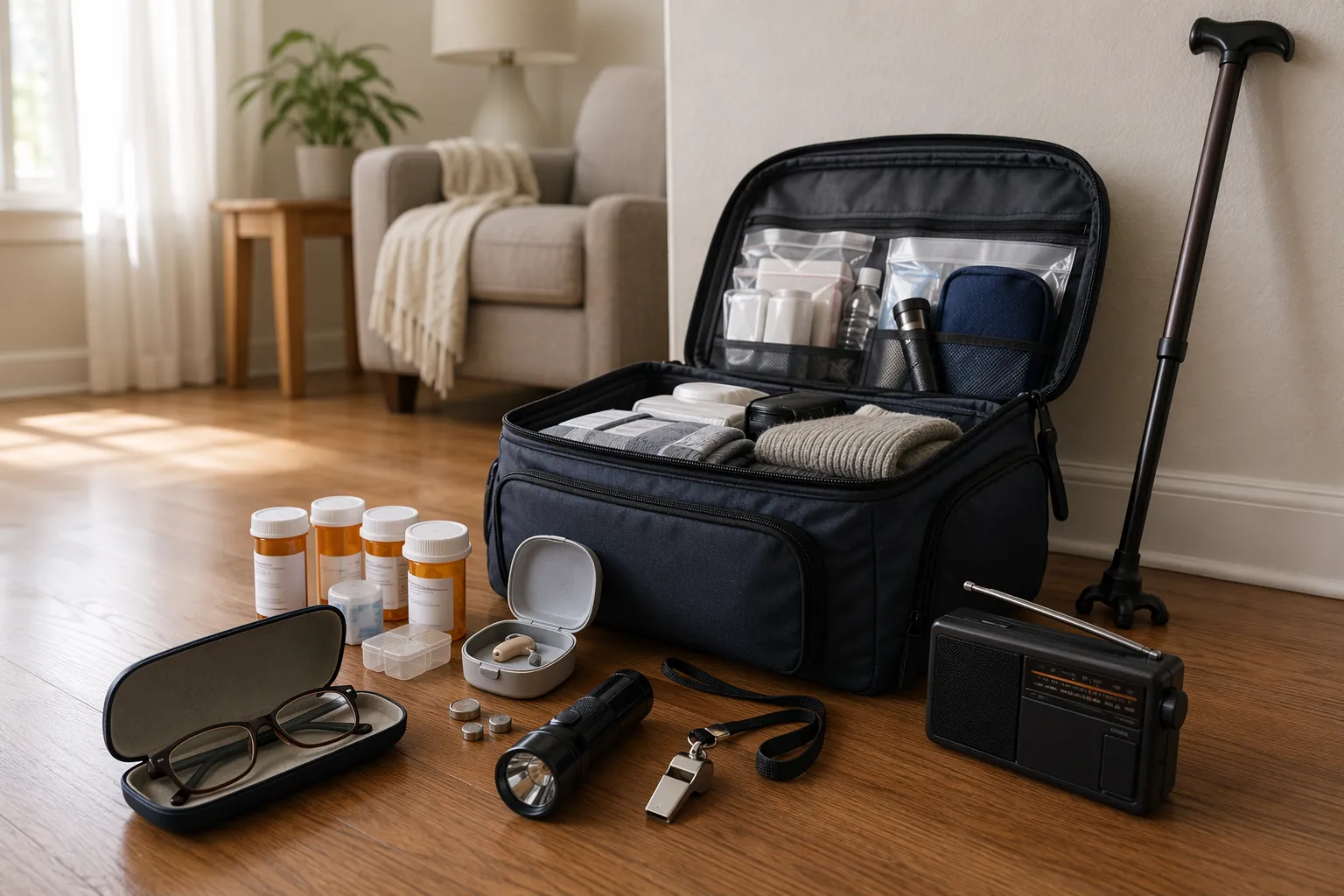
Start With Two Kits, Not One Heavy Bin
For a healthy adult, one large emergency bin may be inconvenient. For an older adult living alone, it may be unusable. If the bin is too heavy to lift, stored above shoulder height, or sitting in a garage that now has broken glass between the person and the door, the checklist only looked finished.
Build the supplies around two different moments: the few seconds when leaving is necessary, and the longer period when staying put is safer. The go-bag should be light enough to grab without strain and close enough to the main exit that it does not require a search. The stay-in-place supply can be larger, but it still needs to be reachable from the rooms the senior uses most.
| Supply area | Go-bag near the exit | Stay-in-place supply |
|---|---|---|
| Purpose | Leave quickly if the home is unsafe or evacuation is ordered | Remain at home through outages, aftershocks, closed roads, or delayed help |
| Medication | Current medication list, copies of prescriptions, and a small emergency supply approved by the prescriber | Larger medication reserve, aiming toward the physician-approved 30-day target when possible |
| Mobility | Folded cane, compact assistive item, or written note stating where the primary device is kept | Extra walking aids placed in rooms the senior actually uses |
| Vision and hearing | Backup eyeglasses, hearing aid batteries, hearing aid case | More batteries, marked replacement date, magnifier or label aids if used daily |
| Communication | Charged phone power bank, contact card, out-of-area contact, whistle | Radio, flashlight, security lights, phone charger, alert device or signaling plan |
| Basic supplies | Small water, snacks, flashlight, documents, cash, hygiene items | Water, shelf-stable food, first aid, sanitation, batteries, radio, pet supplies if needed |
This split also keeps the go-bag honest. If it becomes a packed duffel that cannot be lifted with one hand, it is no longer a go-bag. Put the heavier water, food, sanitation supplies, and backup batteries in the stay-in-place area instead.
Medication Is the Part a 72-Hour Kit Usually Underestimates
The medication question is where generic advice starts to feel too cheerful. Three days of food and water may be the standard starting point, but three days of medication is thin protection for someone who cannot drive to another pharmacy, cannot stand in a long disaster-assistance line, or has no one nearby to pick up a refill.
The American Red Cross recommends that older adults keep at least a 30-day supply of medications and medical supplies, along with extra assistive items such as a cane and eyeglasses.[2] The California Department of Aging recommends a 10-day supply of prescription medications as part of disaster preparedness.[3] Those recommendations are not identical, and it is worth noticing the gap instead of smoothing it over.
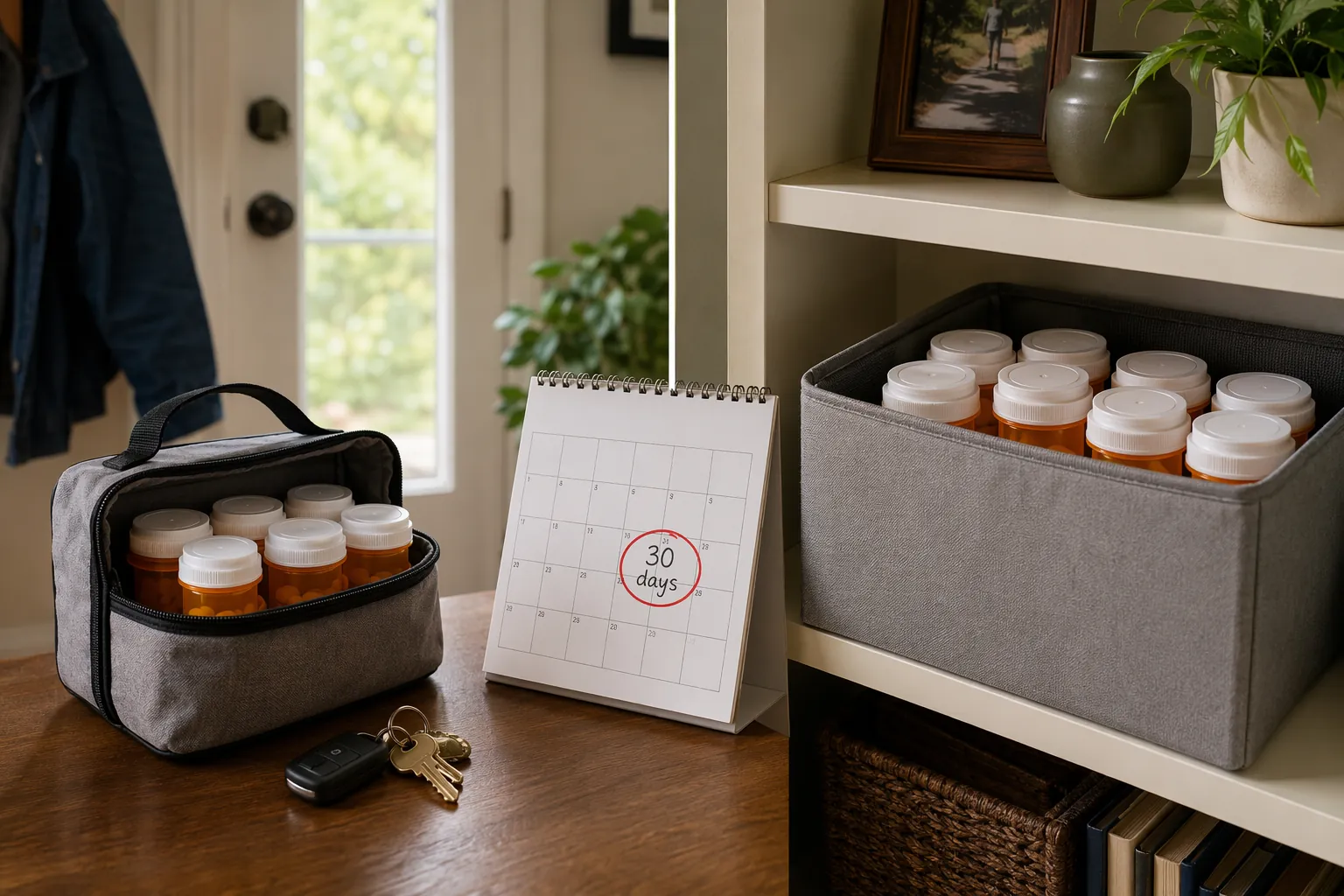
For a senior who may evacuate to a staffed shelter, a 10-day supply can be a meaningful buffer. For a senior sheltering alone after damaged roads, power outages, or pharmacy closures, the Red Cross 30-day target is the safer planning number. That does not mean quietly skipping doses to build a stash. It means asking the prescribing physician how to create an emergency reserve safely, whether prescriptions can be written with disaster planning in mind, and how insurance refill timing affects what is realistic.
Medication planning should be written down, not stored in one person’s memory. A useful medication packet includes the current medication list, dose schedule, prescribing doctors, pharmacy contact, allergies, medical conditions, copies of prescriptions if available, and a note about medications that require refrigeration or special handling. Keep one copy in the go-bag and one copy with the stay-in-place supply.
A workable medication rotation
- Ask the physician which medications are safe and appropriate to keep in an emergency reserve.
- Ask the pharmacist how early refills, emergency fills, storage temperature, and expiration dates should be handled.
- Store a small approved amount in the go-bag and the larger reserve in the stay-in-place supply.
- Put refill and expiration checks on a calendar, using the same day each month if possible.
- Keep the medication list with the kit even if the actual medications must stay in daily use.
Some families will not be able to reach a 30-day reserve right away. That is a practical obstacle, not a personal failure. The first improvement is to stop treating medication as a last-minute item and make the doctor, pharmacist, and refill schedule part of the earthquake plan.
Mobility Supplies Have to Be Where the Senior Sits, Sleeps, and Waits
One cane by the front door is not redundancy. It is a guess that the earthquake will happen while the person is standing near the front door. The Illinois Emergency Management Agency advises seniors to keep walking aids near them at all times and to place extras in different rooms.[4] That is the kind of small instruction that changes whether a plan works.
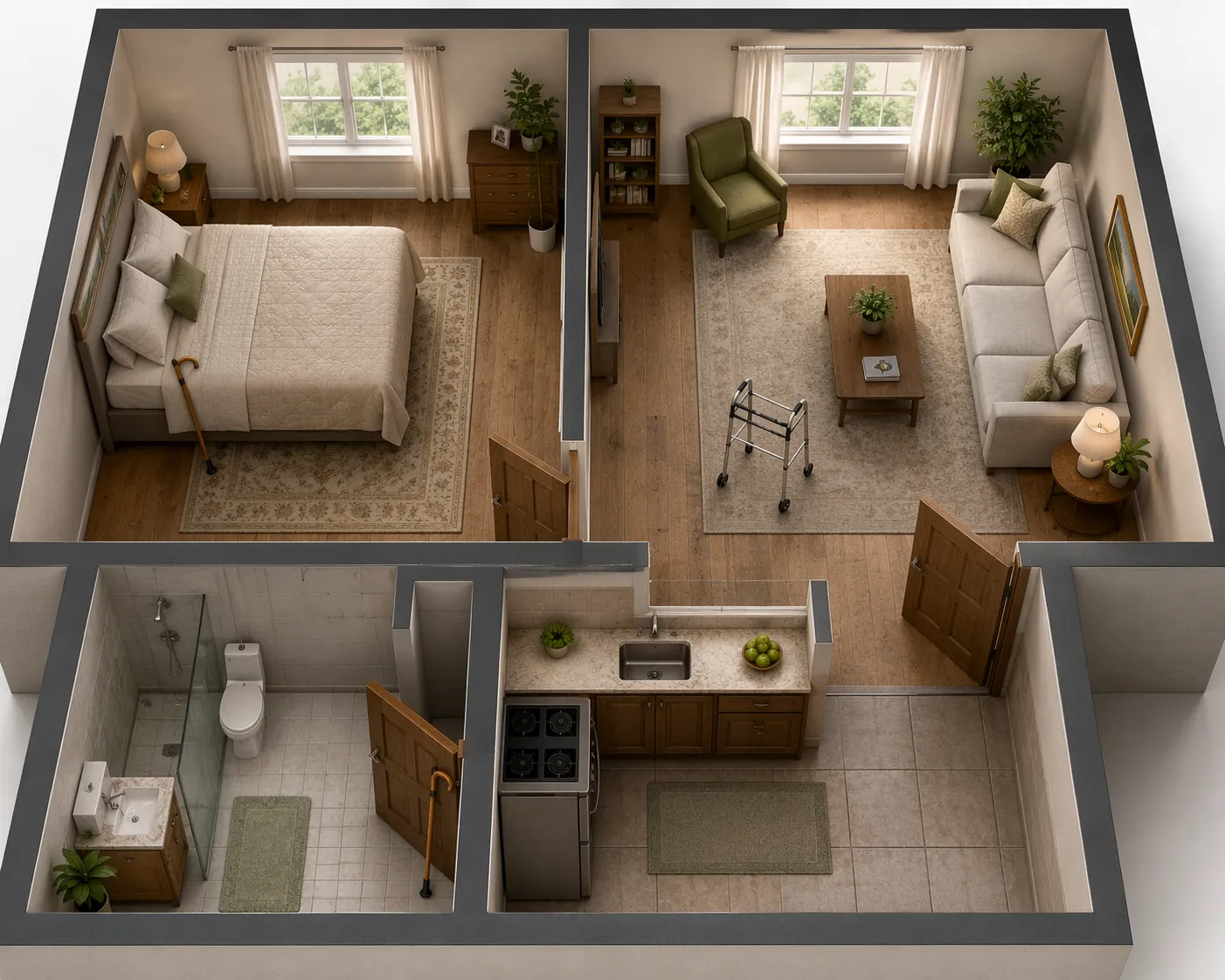
Walk through the home by routine, not by square footage. Where does the senior sit for television? Where do they sleep? Which bathroom do they use at night? Where do they take morning medication? Those are the rooms that need reachable support.
- Bedroom: cane, walker, sturdy shoes, flashlight, whistle, glasses, and phone charger within reach of the bed.
- Living room: walking aid near the usual chair, not across the room beside a wall.
- Bathroom route: clear path, night light or backup light, and a mobility aid positioned before the doorway if the room is too tight.
- Kitchen or medication area: chair, flashlight, water, and medication instructions reachable without climbing or bending.
- Main exit: go-bag low enough to lift and close enough that leaving does not require crossing the whole home.
This is also why fall prevention belongs in an earthquake kit article. After shaking, the floor may be dark, wet, or scattered with broken objects. Supplies that require a senior to walk unsupported across that floor are not truly available. For the same reason, any broader plan should match where the senior has been taught to protect themselves during shaking; our guide to earthquake safety for seniors with limited mobility explains that positioning piece in more detail.
If the senior uses a walker, do not assume a duplicate walker is realistic in every room. Sometimes the better plan is a folded cane in one location, a walker near the main chair, and a written note in the go-bag identifying where the primary mobility device is stored. The test is not symmetry. The test is whether the person can get stable support without searching.
Vision and Hearing Backups Are Not Optional Extras
A flashlight does not help much if the senior cannot find their glasses. A radio is less useful if the hearing aid batteries are dead. California Department of Aging disaster tip sheets recommend extra hearing aid batteries, replacing them annually with the calendar date marked, backup eyeglasses, and a whistle for signaling.[3]
Put backup eyeglasses in the go-bag, even if they are an older prescription. Add a hard case so they do not get crushed under heavier supplies. If the senior uses reading glasses for medication labels, include those too; disaster instructions often fail at exactly this level, where the bottle is in hand but the label cannot be read.
For hearing aids, store batteries in both the go-bag and the stay-in-place supply. Mark one annual replacement date on a paper calendar and a digital calendar if the senior uses one. Batteries sitting faithfully in a bag for years are not preparedness; they are a small future disappointment with packaging.
- Backup distance glasses in a hard case.
- Backup reading glasses or magnifier for medication labels and forms.
- Hearing aid batteries in two locations, replaced yearly.
- Hearing aid case labeled with the senior’s name and phone number.
- A small flashlight or headlamp placed where glasses are normally removed at night.
Communication Cannot Depend on Someone Else Being Home
A phone tree is useful until every local line is jammed, the phone battery is low, or the person who usually helps is on the wrong side of damaged roads. The Red Cross recommends choosing an out-of-area contact because local phone lines may be overloaded while long-distance calls can still go through.[2] Write that contact on paper and store it in the go-bag, by the bed, and near the main phone charging spot.
The communication plan should include three layers: call, signal, and be found. A charged phone and power bank are the call layer. A whistle is the close-range signal if calling is not possible; Illinois guidance includes a whistle for signaling.[4] The be-found layer is the part people skip: a neighbor who knows the senior lives alone, an out-of-area contact who knows whom to call locally, and a written note of medical conditions and mobility needs in the kit.
Medical alert devices, smartwatches, and similar tools can fit here, but the important decision is not the brand. The device or plan has to be charged, worn or reachable, and pre-programmed with the right contacts. If you are comparing device types for a parent, the practical tradeoffs are covered in our smartwatch vs. medical alert watch guide.
Lighting belongs in communication too, because a person who cannot safely cross a room may not reach the phone, door, or window. Illinois guidance recommends security lights that automatically activate during power loss and operate for 4 to 6 hours.[4] Place lights along the path from bed to bathroom, bed to phone, and main chair to exit.
What to Put in the Go-Bag
The go-bag is not the whole emergency supply. It is the bag a senior can grab when staying inside is no longer the safer choice. Keep it near the main exit, at a height that does not require bending deeply or reaching overhead.
- Medication list, copies of prescriptions if available, allergies, medical conditions, doctors, and pharmacy contact.
- Small physician-approved medication supply, plus any critical medical supplies used daily.
- Backup eyeglasses, hearing aid batteries, hearing aid case, and reading glasses if needed.
- Whistle, flashlight, phone power bank, charging cord, and written contact card.
- Out-of-area contact, nearby emergency contact, and a note that the senior lives alone.
- Light snacks, small water bottle, cash, copies of key documents, hygiene items, and spare house key if appropriate.
- Compact mobility support if usable, or a note stating where the walker, cane, wheelchair, or transfer equipment is kept.
Lift the packed bag after it is finished. If the senior cannot carry it, lighten it. Move duplicate or heavy items into the home supply. A bag that looks complete but stays on the floor is not ready.
What to Keep for Staying in Place
The stay-in-place supply is for the more likely stretch of waiting: waiting for power, roads, pharmacies, caregivers, elevators, building inspections, or aftershocks to settle. It can be larger than the go-bag, but it still needs to be stored where the senior can open it without help.
- Water planned from the 1 gallon per person per day baseline, stored in containers the senior can lift or pour safely.[1]
- Shelf-stable food that does not require complicated cooking, heavy lifting, or an electric can opener.
- Medication reserve planned with the physician and pharmacist, aiming toward the 30-day Red Cross recommendation when feasible.[2]
- Extra walking aids placed in different rooms, not only beside the emergency bin.[4]
- Extra hearing aid batteries, backup glasses, whistle, flashlight, radio, batteries, and written contacts.[3]
- First aid, sanitation supplies, gloves, masks, trash bags, wipes, toilet paper, and personal care items.
- Pet food, leash, carrier, medication, and vaccination information if the senior has an animal.
Choose smaller containers over one heroic tub. A few manageable bins in reachable places are better than one perfect container in a closet. Label them in large print. If the senior has low vision, use high-contrast tape or tactile markers so the supply can be identified by touch.
Place the Kit Around the First Hour After Shaking
During shaking, the Centers for Disease Control and Prevention advises people to drop, cover, and hold on; for people who use a cane or walker, the guidance adapts to getting as low as possible, covering the head and neck, and holding on until shaking stops.[5] The kit plan has to respect that starting position. If the senior is likely to be beside the bed, in a recliner, or near a walker when the shaking stops, the first reachable supplies should be arranged from there.
Do a slow, literal test. Sit in the usual chair. Lie in the bed. Stand where medications are taken. From each place, ask what can be reached without crossing a dark room: shoes, glasses, cane, flashlight, whistle, phone, water, medication instructions. This is where many tidy kits fail.
Aftershocks complicate the decision to move. The stay-in-place supply may be safer than trying to leave immediately, especially for someone who uses a mobility device. For that next-stage decision, see aftershock safety for seniors who use mobility devices.
A Printable Senior-Living-Alone Earthquake Kit Checklist
| Item | Go-bag | Stay-in-place supply | Placement note |
|---|---|---|---|
| Water | Small bottle if weight allows | 1 gallon per person per day baseline | Use containers the senior can lift or pour |
| Food | Light snacks | Shelf-stable meals and snacks | Avoid foods that require power or difficult opening |
| Medications | Small approved supply and medication list | Physician-approved reserve, aiming toward 30 days if feasible | Check refill timing and expiration dates |
| Prescriptions and medical information | Copies or written list | Second copy | Include allergies, doctors, pharmacy, and conditions |
| Cane, walker, or mobility aid | Compact aid if usable | Extras in rooms used most | Keep one near bed and one near main chair when possible |
| Shoes | Optional lightweight pair | Sturdy shoes by bed | Protect feet from broken glass before walking |
| Eyeglasses | Backup pair in hard case | Extra reading glasses or magnifier | Place one pair where glasses are removed at night |
| Hearing aid supplies | Batteries and case | Extra batteries | Replace annually and mark the calendar |
| Whistle | Yes | Yes, near bed and main chair | Use when calling is not possible |
| Phone and charging | Power bank and cord | Chargers at usual locations | Keep contacts written on paper too |
| Out-of-area contact | Written contact card | Copy near phone | Choose someone outside the local damage area |
| Lighting | Small flashlight | Flashlights, batteries, auto-activating lights | Place along bed, bathroom, phone, and exit routes |
| Radio | Optional compact radio | Battery or hand-crank radio | Store where it can be reached while seated |
| Documents and cash | Copies and small bills | Backup copies | Use waterproof pouch if possible |
| Sanitation and personal care | Small hygiene kit | Wipes, bags, gloves, toilet paper, incontinence supplies if used | Do not store everything in a hard-to-reach bathroom cabinet |
A broader household plan still matters: securing furniture, knowing safe places, and deciding when to leave or stay. If you are preparing for an older parent who lives alone, the companion guide on earthquake preparedness for an elderly parent living alone covers the wider plan. This kit is the part that makes the plan usable when the house is quiet and no one else is there to fetch the missing item.
The Final Test
When the kit is packed, do not judge it by how much it contains. Judge it by what the senior can do with it.
- Can they reach essential supplies from the bed, main chair, bathroom route, medication area, and exit?
- Can they maintain daily medications through a disrupted refill period without skipping doses or improvising?
- Can they see medication labels, written contacts, and emergency instructions?
- Can they hear alerts, radio information, calls, or instructions because batteries and hearing supplies are current?
- Can they signal for help without walking far?
- Can they contact someone outside the damaged local area, even if nearby helpers are delayed?
If the answer is yes, the earthquake kit has moved beyond a generic list. It has become something a senior living alone can actually reach, use, carry, hear, see, signal with, and manage through a refill delay.
References
- How to Make an Earthquake Emergency Kit, California Earthquake Authority.
- Older Adults Emergency Preparedness, American Red Cross.
- Disaster Preparedness Tip Sheets, California Department of Aging.
- Planning Guide for Seniors, Illinois Emergency Management Agency.
- Stay Safe During an Earthquake, Centers for Disease Control and Prevention.
Related reading
Noticed something outdated or inaccurate on this page? Flag a correction. We review every report against CDC, NIA, and AARP HomeFit guidance before updating a page.
Part of the Fall Prevention section.