
Why Salmonella Is More Dangerous for Seniors and When to Act
Nearly half of all older adults with lab-confirmed salmonella are hospitalized. This article explains why aging changes the body's response to the infection, what health and medication factors raise the risk, and when to see a doctor.
Salmonella is easy to file under “food poisoning”: diarrhea, cramps, fever, fluids, rest, a few miserable days. In an older adult, that picture can be badly incomplete. CDC says that nearly half of people 65 and older with lab-confirmed foodborne illness from Salmonella, Campylobacter, Listeria, or E. coli are hospitalized; Salmonella-specific studies put the hospitalization rate for older adults in roughly the same range, about 49% to 55%.[1][2][3]
That does not mean every senior with salmonella needs hospital care. It means the margin for error is narrower. The same infection that a younger adult may ride out at home can press harder on an older body because several protections have often weakened at once: immune response, stomach acid, chronic disease reserve, and medication effects.

Why the same symptoms can carry different stakes after 65
The usual salmonella symptoms are not mysterious: diarrhea, fever, stomach cramps, and sometimes nausea or vomiting. CDC describes most cases as self-limited and treated with fluids and other supportive care, not automatic antibiotics.[4] The harder question for families is why ordinary-sounding symptoms can become a hospital admission in an older parent.
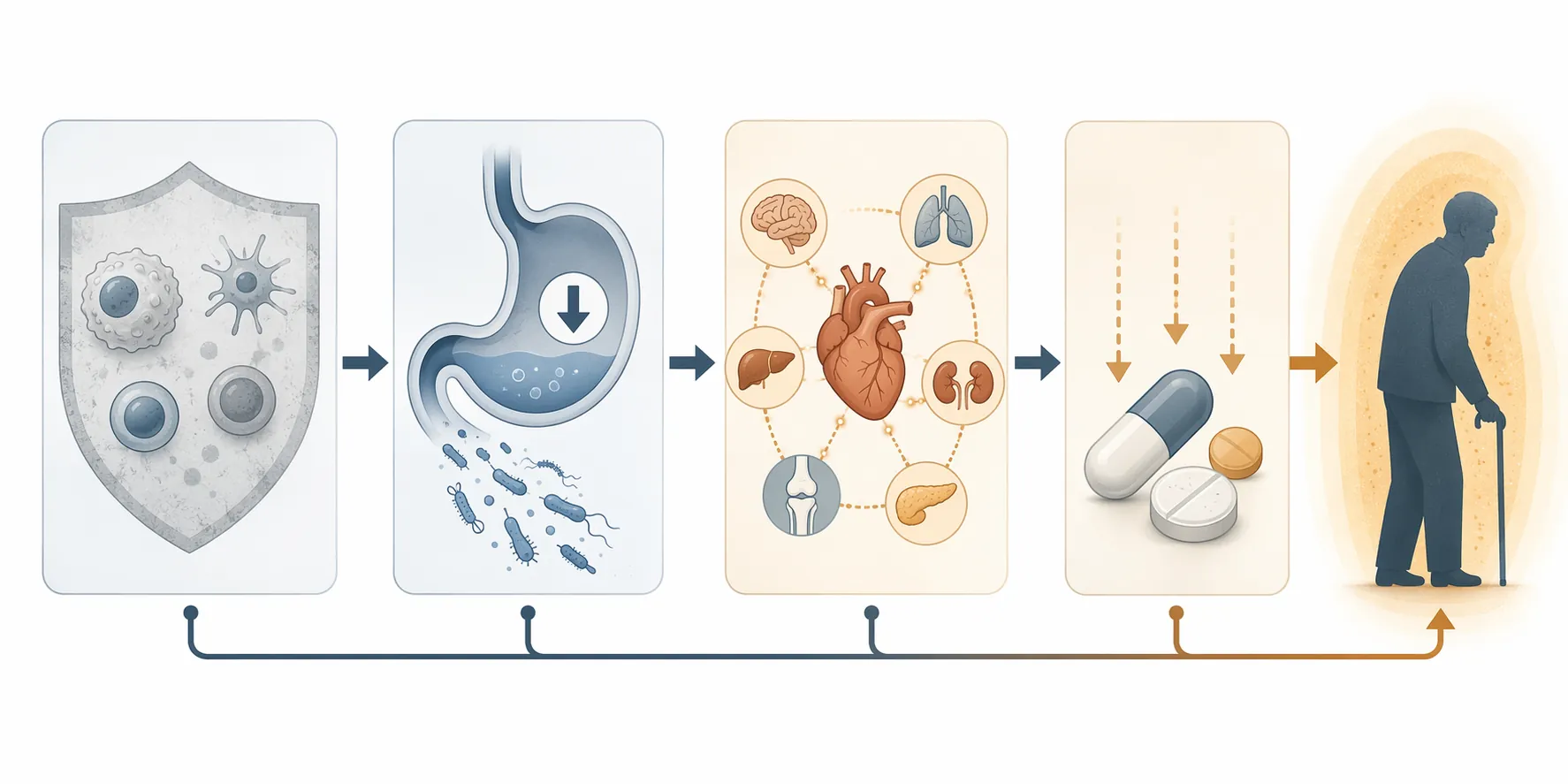
The answer starts before the diarrhea begins. Salmonella has to survive the trip through the stomach, reach the intestine, multiply, and then trigger an immune response. Aging can change each of those steps. None of the changes guarantees a severe case, but together they help explain why clinicians treat salmonella in older adults with more caution than the phrase “stomach bug” suggests.
A slower or less effective immune response
With age, the immune system does not simply become “weak” in one uniform way. A key issue is immunosenescence: the gradual decline in parts of immune function, especially adaptive immune responses. The body may be slower to recognize an invader, less efficient at clearing it, or less able to contain the infection before it causes wider stress.
For a caregiver, this matters because the outside signs may lag behind the inside burden. An older adult may not look dramatically ill at the start. They may still be talking, still insisting they are fine, still trying to get to the bathroom alone. But if the immune response is slower and fluid losses are building, the situation can change over hours rather than days.
Less stomach acid means fewer bacteria may be killed early
Stomach acid is one of the body’s first barriers against foodborne bacteria. It does not make infection impossible, but it can reduce how many organisms survive long enough to reach the intestine. Older adults are more likely to have reduced stomach acid, and many also take acid-reducing medicines. CDC lists people 65 and older among those at increased risk for food poisoning, and its clinical overview names decreased gastric acid and medications such as antacids as factors that can increase susceptibility to salmonellosis.[1][4]
That is one reason a shared meal can produce different outcomes. One person may get a short illness; another, older person may receive a larger effective dose because fewer bacteria were stopped at the stomach. The meal was the same. The first line of defense was not.
Chronic disease leaves less reserve
Chronic conditions are not side notes in salmonella risk. In a Canadian study of older adults with Salmonella infection, 60% of hospitalized seniors had at least one chronic condition, most commonly cardiovascular disease.[5] That finding does not prove that every chronic condition caused the hospitalization, and the data are Canadian rather than U.S.-specific. It does show how often severe salmonella occurs in people whose bodies are already managing other problems.
This is where a caregiver’s home observations matter. A parent with heart disease, kidney disease, diabetes, or other chronic illness may tolerate dehydration poorly. Diarrhea and fever can reduce fluid volume, disrupt usual eating, and make medication routines harder to maintain. Even a short interruption in normal intake can have consequences when the person’s baseline health is already tightly balanced.
Medications can change both infection risk and recovery
Medication effects deserve careful wording. The point is not that a caregiver should stop prescribed drugs during a stomach illness. The point is that some medications can change vulnerability, and the clinician needs to know about them.
- Antacids and acid-suppressing medicines can reduce the stomach acid barrier that normally helps kill Salmonella before it reaches the intestine.[4]
- Corticosteroids and other immunosuppressants can dampen immune responses, which may make it harder to control infection.[4]
- Recent antibiotics can disrupt the gut’s normal bacterial balance, another factor CDC lists among risks for Salmonella infection.[4]
When calling a doctor, the medication list is not paperwork; it is part of the risk picture. Include prescription drugs, over-the-counter acid reducers, recent antibiotics, steroid bursts, transplant or autoimmune medications, and any medicines that affect blood pressure, urination, balance, or alertness.
The complication families are often not warned about: infection can move beyond the gut
Most salmonella infections stay in the gastrointestinal tract. The serious cases are different because Salmonella can sometimes enter the bloodstream. CDC describes invasive infection as a concern especially for people at higher risk, including older adults.[4]
In the Canadian senior-focused analysis, bacteremia occurred in about 8% of lab-confirmed Salmonella cases and was most common in older adults. Mortality reached 5.3% among adults 80 and older with bacteremia. When septicemia developed, mortality was higher: 9.2% for adults 60 to 79 and 16.2% for adults 80 and older.[5]
Those numbers should not be used to assume that a parent with diarrhea is heading toward sepsis. They should change the threshold for attention. Fever that worsens, shaking chills, severe weakness, new confusion, very low energy, or a general sense that the person is becoming systemically ill belongs in a different category from “still uncomfortable but steadily improving.”
When to see a doctor for salmonella symptoms in an elderly adult
For an older adult, “wait and see” should be shorter and more deliberate. Medical contact is especially important when symptoms are worsening rather than easing, when hydration is slipping, or when the person has risk factors that make complications more likely.
A caregiver should contact a clinician promptly if an older adult with suspected or confirmed salmonella has any of the following:
- Signs of dehydration, such as very low fluid intake, dizziness, faintness, dry mouth, reduced urination, or inability to keep fluids down.
- Fever that is persistent, worsening, or paired with shaking chills or a marked decline in strength.
- Blood in the stool or diarrhea that is severe enough to cause rapid weakness.
- New confusion, unusual sleepiness, agitation, or a change from the person’s normal alertness.
- Severe weakness, trouble standing, or a fall during the illness.
- A high-risk medical history, including significant heart disease, kidney disease, diabetes, immune suppression, cancer treatment, transplant medications, or recent antibiotic use.
The reason to call is not only to ask, “Does this need antibiotics?” CDC notes that most people need supportive care, and antibiotics are reserved for certain severe infections or people at increased risk for invasive disease.[4] The call may be about fluids, lab testing, whether the person can safely stay home, whether medications need temporary review, and whether symptoms suggest bloodstream involvement.
Falls deserve a brief mention because illness changes balance. Dehydration, weakness, fever, hurried trips to the bathroom, blood pressure medicines, diuretics, sedating medications, and poor intake can all turn a stomach infection into a fall-risk event. If a fall or near-fall happens during a suspected foodborne illness, this related CareWise Guide resource on senior symptom monitoring during a Salmonella-related outbreak can help organize what to watch for alongside medical advice.
How serious is salmonella overall?
In the United States, CDC estimates that Salmonella causes about 1.35 million infections, 26,500 hospitalizations, and 420 deaths each year. CDC also identifies Salmonella as a leading cause of hospitalization and death among foodborne pathogens.[4]
The age pattern is the part that families often feel before they understand it. In the Canadian analysis, adults 60 and older accounted for 50% of adult Salmonella hospitalizations and 82% of adult deaths.[5] Because that study used Canadian surveillance data, it should not be treated as a precise U.S. breakdown. It does, however, support the same practical conclusion as CDC’s risk framing: older adults carry a disproportionate share of the severe outcomes.
What caregivers can do before the next exposure
Prevention is worth taking seriously, but it is not perfect. Food recalls are missed. Cross-contamination happens. Restaurant meals are not under a caregiver’s control. The practical goal is to lower exposure where possible and shorten the delay when symptoms appear.
CDC’s safer food guidance for adults 65 and older emphasizes avoiding higher-risk foods such as raw or undercooked meat, poultry, seafood, and eggs; unpasteurized milk and juices; raw sprouts; and certain refrigerated ready-to-eat foods unless handled according to safety guidance.[6] For households caring for an older adult, that advice belongs in the same mental folder as medication lists and emergency contacts: ordinary, slightly tedious, and useful when things go wrong.
It is also reasonable to ask a clinician, during a non-urgent visit, which conditions or medications would lower the threshold for calling if salmonella symptoms appear. The answer may differ for a healthy 68-year-old and an 86-year-old with heart disease, kidney disease, immune suppression, or recent antibiotics. A caregiver does not need a dramatic plan for every stomachache. They do need to know which changes in that particular person should end the waiting period.
Salmonella is more dangerous for seniors not because every case becomes severe, but because aging physiology, common chronic conditions, and common medications shrink the margin for error.
References
- People at Increased Risk for Food Poisoning — Centers for Disease Control and Prevention.
- Foodborne illness acquired in the United States—major pathogens — Emerging Infectious Diseases — 2011.
- Epidemiology of Salmonella enterica infections in the United States, FoodNet, 1996–2016 — Foodborne Pathogens and Disease — 2022.
- Clinical Overview of Salmonellosis — Centers for Disease Control and Prevention.
- Salmonella infections in older adults in Canada: a population-based analysis — PLOS ONE — 2017.
- Safer Food Choices for Adults 65 and Older — Centers for Disease Control and Prevention.
Related reading
Noticed something outdated or inaccurate on this page? Flag a correction. We review every report against CDC, NIA, and AARP HomeFit guidance before updating a page.
Part of the Fall Prevention section.