
Your Parent's First Fall: A 72-Hour Prevention Plan
A structured, time-sequenced guide for the 72 hours after an older adult's first fall — covering medical assessment, medication and sensory review, home hazard checks, and exercise planning to reduce the risk of another fall.
Once the immediate danger has passed, the question changes. It is no longer only, "Are they hurt?" It becomes, "What changed, and what do we do before this happens again?" That shift matters because an older adult who has fallen once has about twice the risk of falling again. In the United States, more than 14 million older adults fall each year, and 37% of those falls lead to an injury that requires medical treatment or restricts activity for at least a day.[1]
This is the prevention plan that follows stabilization. If your parent is still in pain, confused, unable to bear weight, newly weak, short of breath, fainting, bleeding, or not acting like themselves, stay with emergency or urgent medical guidance first. For the crisis-response window, use the companion guide From Crisis to Control: What to Do in the First 24 Hours After Your Elderly Parent Falls.
The 72-hour frame here is not a clinical deadline. It is a practical sequence for the first three days after your parent is home or medically stable: gather the fall story while it is still fresh, ask the right clinician questions, check medications and senses, reduce the most obvious home hazards, and start the conversation about strength and balance work.

The 72-Hour Flow
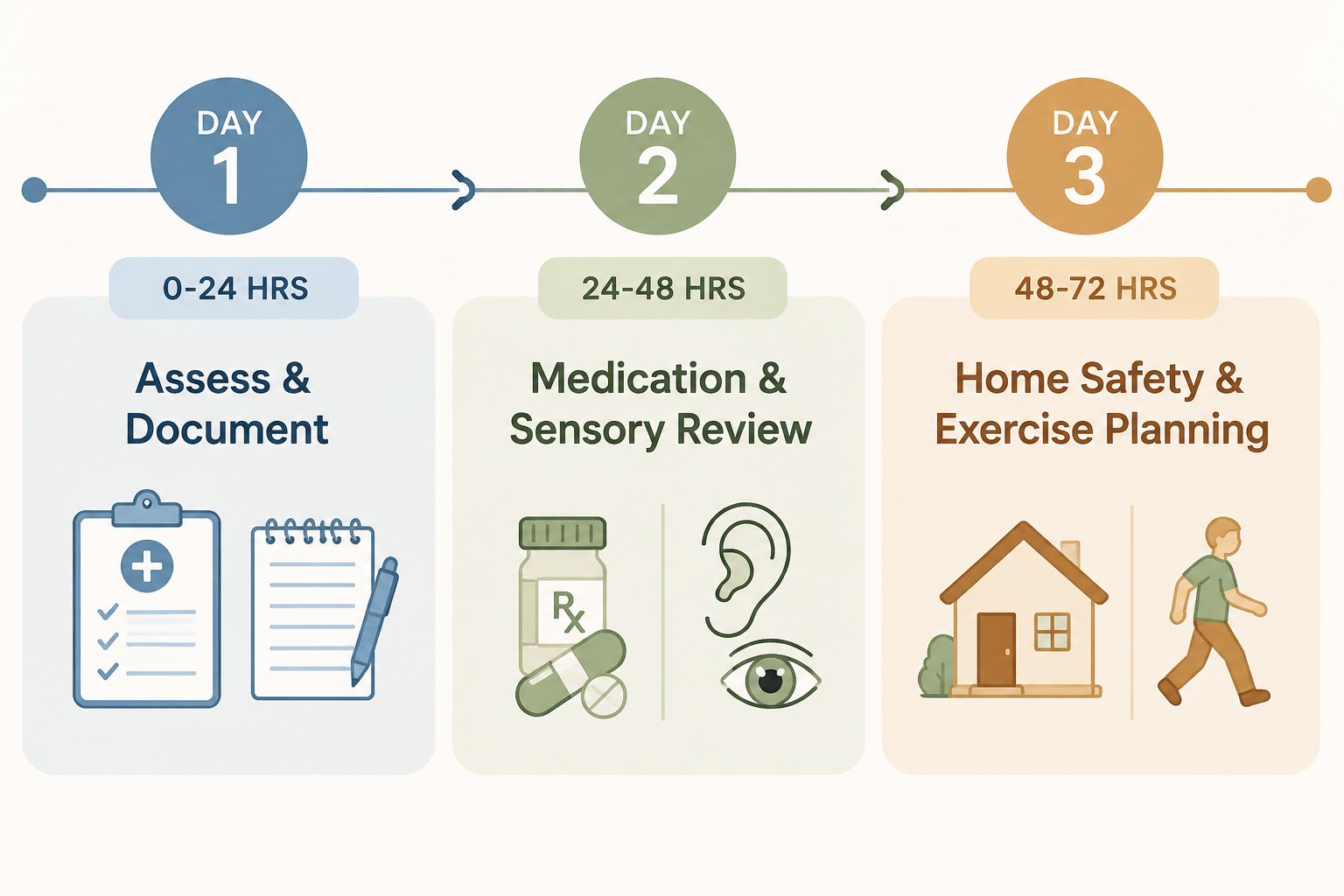
| When | Main job | What you should have by the end |
|---|---|---|
| 0-24 hours after stabilization | Document the fall and confirm whether medical assessment is needed | A clear fall description, symptom notes, and a list of clinician questions |
| 24-48 hours | Review medications, vision, hearing, dizziness, blood pressure symptoms, and other clinical risk factors | A medication list ready for review and appointments or messages sent to the right clinicians |
| 48-72 hours | Prioritize home hazards and start exercise or physical therapy planning | A short home fix list, safer walking paths, and a scheduled conversation about balance and strength |
| Next 30-90 days | Watch for fear-based activity restriction and follow through on evidence-based exercise | A repeatable plan instead of one rushed cleanup after the fall |
Hours 0-24: Write Down What Happened Before the Details Blur
A useful fall description is not a paragraph about blame. It is a clinical handoff. The doctor, nurse practitioner, pharmacist, or physical therapist needs to know what happened just before the fall, what your parent remembers, what changed afterward, and what conditions were present in the room.
- Where the fall happened: bathroom, bedroom, stairs, kitchen, driveway, curb, hallway, or another location.
- What your parent was doing: getting up from bed, turning, reaching, toileting, showering, carrying something, walking after sitting, or rushing to answer the door.
- What came first: dizziness, lightheadedness, weakness, pain, chest symptoms, shortness of breath, tripping, slipping, a knee giving way, or no warning at all.
- What happened afterward: confusion, new sleepiness, vomiting, headache, new pain, trouble walking, new bruising, fear of standing, or repeated near-falls.
- What was different that day: poor sleep, illness, alcohol, missed meals, dehydration, new medication, dose change, new glasses, different shoes, or a new walking route.
Do not wait for a perfect account. Older adults often remember only part of a fall, especially if it happened quickly or they were frightened. Write down what is known and mark what is uncertain. "Found on bathroom floor at 6 a.m.; says she was walking from toilet to sink; does not remember tripping; new left hip pain" is more useful than "fell in bathroom."
This is also the time to ask whether your parent should be seen again or sooner than planned. The CDC's STEADI approach treats fall prevention as a clinical process that can include screening for fall history, gait and balance problems, medication risks, vision issues, blood pressure concerns, and other modifiable factors.[2] A caregiver does not have to diagnose any of those. Your job is to bring clean observations to the people who can.
Questions to Bring to the Clinician
- Does this fall pattern suggest the need for an urgent visit, imaging, lab work, blood pressure check, gait assessment, or referral?
- Could dizziness, fainting, dehydration, infection, pain, low blood pressure, neuropathy, or another medical issue have contributed?
- Should any medication be reviewed before the next dose, especially sedating medications, sleep aids, anxiety medicines, blood pressure medicines, or medications recently started or changed?
- Is it safe for my parent to bathe, use stairs, walk outside, drive, or be alone until they are assessed?
- Should we ask for physical therapy, occupational therapy, or a fall-risk assessment?
If the answer to any of those questions is unclear, say that plainly. Families sometimes understate what happened because they do not want to sound alarmed. A first fall is enough reason to ask for a structured review.
Why One Fall Usually Has More Than One Cause
It is tempting to look for one culprit: a loose rug, a bad knee, a dark hallway. Sometimes the trigger is that simple. More often, the fall happened where several risks met at once: a nighttime bathroom trip, a new medication, poor lighting, mild dehydration, weaker legs after a quiet week, and glasses left on the bedside table.
That is why fall prevention in older adults has to move across domains. One clinical summary reports that estimated 1-year fall risk rises from 8% in older adults with no identified risk factors to 78% in those with four or more risk factors.[3] That number does not tell you which factor mattered most for your parent. It tells you why the response should not stop after one throw rug is removed.
Hours 24-48: Put Medications, Hearing, Vision, and Dizziness on the Same Page
The second day is when families often start cleaning the house. Do that, but not before you also line up the medical and sensory review. A clear path to the bathroom will not fix a medication that is making your parent lightheaded when they stand.
Make One Current Medication List
Gather every prescription bottle, over-the-counter medicine, sleep aid, allergy medicine, pain medicine, supplement, eye drop, patch, and as-needed pill. Do not rely on an old portal list. Put the actual dose, timing, and reason if known. Mark anything started, stopped, increased, decreased, or taken differently in the last few weeks.
Polypharmacy is not a small detail in fall risk. Taking four or more medications is associated with about twice the risk of falling, and benzodiazepine use is associated with a 44% increase in hip fracture risk.[3] That does not mean a caregiver should stop medication on their own. It means the medication list deserves a deliberate review by the prescribing clinician or pharmacist.
- Ask whether any medication could cause sedation, dizziness, slower reaction time, low blood pressure, confusion, or urgent nighttime toileting.
- Ask whether duplicate medicines are present, such as two products with similar sedating effects.
- Ask whether the timing of a dose could be changed to reduce risk during bathing, stairs, or nighttime bathroom trips.
- Ask before stopping or cutting back any prescribed medicine, especially medicines for sleep, anxiety, blood pressure, heart rhythm, seizures, or pain.
Check Hearing and Vision Without Treating Them as Side Issues
Hearing and vision belong in the fall conversation because balance depends on information coming in from the body, the eyes, and the environment. If your parent did not hear someone approaching, missed a verbal warning, misjudged a curb, avoided wearing glasses, or has trouble seeing contrast in the bathroom, that is part of the fall story.
The hearing piece is especially easy to miss. NCOA reports that hearing loss is linked with triple the risk of falling, while hearing aid use is associated with a 50% reduction in fall risk.[4] This does not prove that every fall in a person with hearing loss was caused by hearing. It does make hearing aid function, fit, batteries, and actual daily use worth checking in the first two days.
- Confirm whether glasses are current, clean, and worn during walking, stairs, and bathroom trips.
- Check whether bifocals or progressive lenses make stairs or curbs harder to judge.
- Make sure hearing aids work, have batteries or charge, and are worn during the parts of the day when walking risk is highest.
- Schedule overdue eye or hearing follow-up rather than assuming sensory loss is just part of aging.
Ask About Vitamin D, but Keep It in Proportion
Vitamin D is worth asking about, particularly if your parent has limited sun exposure, poor nutrition, osteoporosis concerns, or a known deficiency. A meta-analysis cited in StatPearls found that vitamin D supplementation of 700-1000 IU per day reduced falls by 19% after 2-5 months.[3] That time frame matters. Vitamin D is not a same-week fix for a hallway fall, and dosing should be discussed with a clinician who knows your parent's kidney function, calcium status, medications, and medical history.
Hours 48-72: Make the Home Safer Without Letting the House Become the Whole Plan
By the third day, you have enough information to walk through the home with more precision. Do not start with every room equally. Start with the route where the fall happened, then the bathroom, bedroom-to-bathroom path, stairs, kitchen, entryway, and the place where your parent usually gets up from a chair.
The National Institute on Aging recommends practical home changes such as removing tripping hazards, improving lighting, using grab bars, securing rugs, keeping frequently used items within reach, and making stairs safer.[5] The point is not to make the home look clinical by dinner. The point is to reduce the next predictable failure point before routine returns.
| Priority | What to look for | First action |
|---|---|---|
| Bathroom | No grab bar, slippery tub or floor, low toilet, towel rack being used for support | Add non-slip surfaces, stop using towel bars as handholds, and ask about grab bars or a shower chair |
| Bedroom-to-bathroom path | Dark route, cords, shoes, laundry, pets, furniture edges, loose rugs | Clear a wide path and add night lighting before the next overnight |
| Stairs and entry | Poor contrast, missing rail, clutter, wet leaves, uneven threshold | Improve lighting, keep one hand free, and arrange repair or rail support |
| Favorite chair | Seat too low, unstable arms, walker parked out of reach | Choose a stable chair that allows standing without rocking or pulling on furniture |
| Kitchen and daily storage | Frequently used items stored high or low | Move daily items between shoulder and waist height |
For a more detailed room-by-room tool, use the 30-Minute Family Safety Walkthrough as a printable companion. Keep the first pass practical: remove what can be removed today, mark what needs installation or repair, and write down what requires your parent's agreement.
Do Not Skip the Walking Plan
After a fall, many families quietly reduce movement. They bring meals to the chair, discourage walking outside, and take over chores. Some of that help is appropriate in the short term, especially if a clinician has placed restrictions. But if fear becomes the plan, strength, balance, confidence, and routine can all shrink together.
Exercise is one of the few fall-prevention interventions with broad evidence behind it. The USPSTF reviewed 29 trials and found that exercise interventions reduced the rate of falls in community-dwelling older adults at increased risk, with an incidence rate ratio of 0.85.[6] NCOA reports that the Otago Exercise Program, a strength and balance program often delivered over time by trained professionals, reduces falls by 35-40% in frail older adults.[7]
This does not mean you should start a difficult routine from an internet video three days after a fall. It means the third-day task is to get exercise onto the schedule in the right form: primary care referral, physical therapy evaluation, community fall-prevention class, or an evidence-based program matched to your parent's ability and medical status.
- Ask the clinician whether your parent needs physical therapy before starting a community class.
- Ask whether a cane, walker, or different assistive device should be evaluated rather than borrowed casually.
- Ask what movements are temporarily restricted because of pain, injury, surgery history, heart symptoms, dizziness, or blood pressure concerns.
- Look for programs that include balance and strength work, not only general activity.
- Use Evidence-Based Fall Prevention Programs to compare options before committing.
What to Take to the Next Appointment
A good appointment after a first fall is easier when the caregiver brings a short packet instead of a long story. One page is enough. The goal is to let the clinician see patterns quickly and decide what needs examination, medication review, referral, or monitoring.
- The fall description: where, when, activity, warning symptoms, landing, injuries, and what changed afterward.
- The current medication list: prescriptions, over-the-counter medicines, supplements, sleep aids, pain medicines, and recent changes.
- Sensory notes: glasses, vision changes, hearing aid use, hearing problems, dizziness, or balance complaints.
- Home hazards already fixed and hazards still waiting: rugs, lighting, bathroom supports, stairs, entryway, chair height, and walking paths.
- Three direct questions: What likely contributed? What should change now? What follow-up or therapy should be scheduled?
The Fall Prevention Handout can serve as a printable cover sheet if you want the same information in a cleaner format.
The 30- and 90-Day Checkpoints
The first three days are for setting the system. The next few months show whether it is working. At 30 days, look for unfinished referrals, unfixed hazards, medication questions that never reached the prescriber, and new avoidance: no stairs, no shower unless someone is home, no walking outside, no church, no store, no mailbox.
At 90 days, ask a narrower question: has your parent's world become smaller because everyone is afraid of the next fall? If the answer is yes, treat that as part of the fall plan, not as a personality change. The Fear of Falling Cycle can help you separate reasonable caution from activity restriction that may increase weakness and dependence.
By the end of the 72 hours, you should have four things in motion: a written fall description, a clinician-facing question list, a prioritized home hazard list, and an exercise or physical therapy conversation scheduled. That is the work that turns a frightening first fall into usable information.
References
- Older Adult Falls Data, CDC
- STEADI - Older Adult Fall Prevention, CDC
- Falls and Fall Prevention in Older Adults, StatPearls | NCBI
- Get the Facts on Falls Prevention, NCOA
- Preventing Falls at Home: Room by Room, National Institute on Aging
- Recommendation: Falls Prevention in Community-Dwelling Older Adults: Interventions, USPSTF, June 2024
- How the Otago Exercise Program Helps Older Adults Prevent Falls, NCOA
Related reading
Noticed something outdated or inaccurate on this page? Flag a correction. We review every report against CDC, NIA, and AARP HomeFit guidance before updating a page.
Part of the Fall Prevention section.