
STEADI: Intervene
How to Help Older Adults Enjoy the Beach Without Falling
This guide explains why the beach presents unique fall hazards for older adults — soft sand, slopes, long distances — and provides specific adaptations for mobility aids, footwear, seating, and trip planning so caregivers and seniors can enjoy the shore safely.
The hard part of a beach outing for an older adult usually starts before anyone sees the water. It starts at the edge of the parking lot, where pavement gives way to boards, packed dirt, loose sand, or a sloped ramp. Then comes the walk: dry sand that grabs at shoes, wet sand that can be slick, broken shells, a cane tip that disappears instead of supporting weight, a chair that sits so low that standing back up becomes its own event.
That is why beach safety tips for older adults need to be more specific than “take your time” or “be careful.” At home, you can remove throw rugs, improve lighting, add grab bars, and make the walking path predictable. At the beach, the walking surface changes every few feet.
One study of outdoor falls among middle-aged and older adults found that 73% of outdoor falls were precipitated by environmental factors such as uneven surfaces, tripping, or slipping, and 47.3% occurred while walking.[1] The study was not beach-specific, and its sample came from Northern California, so it should not be stretched into a precise prediction for every shoreline. But it confirms something caregivers often learn the uncomfortable way: outdoors, the ground itself is frequently the problem.
Falls are already the leading cause of injury for adults 65 and older, and about 1 in 4 older adults falls each year.[2] The point is not to turn the beach into a medical appointment. It is to make the ordinary pleasure of sitting by the water possible without pretending that sand behaves like a hallway.
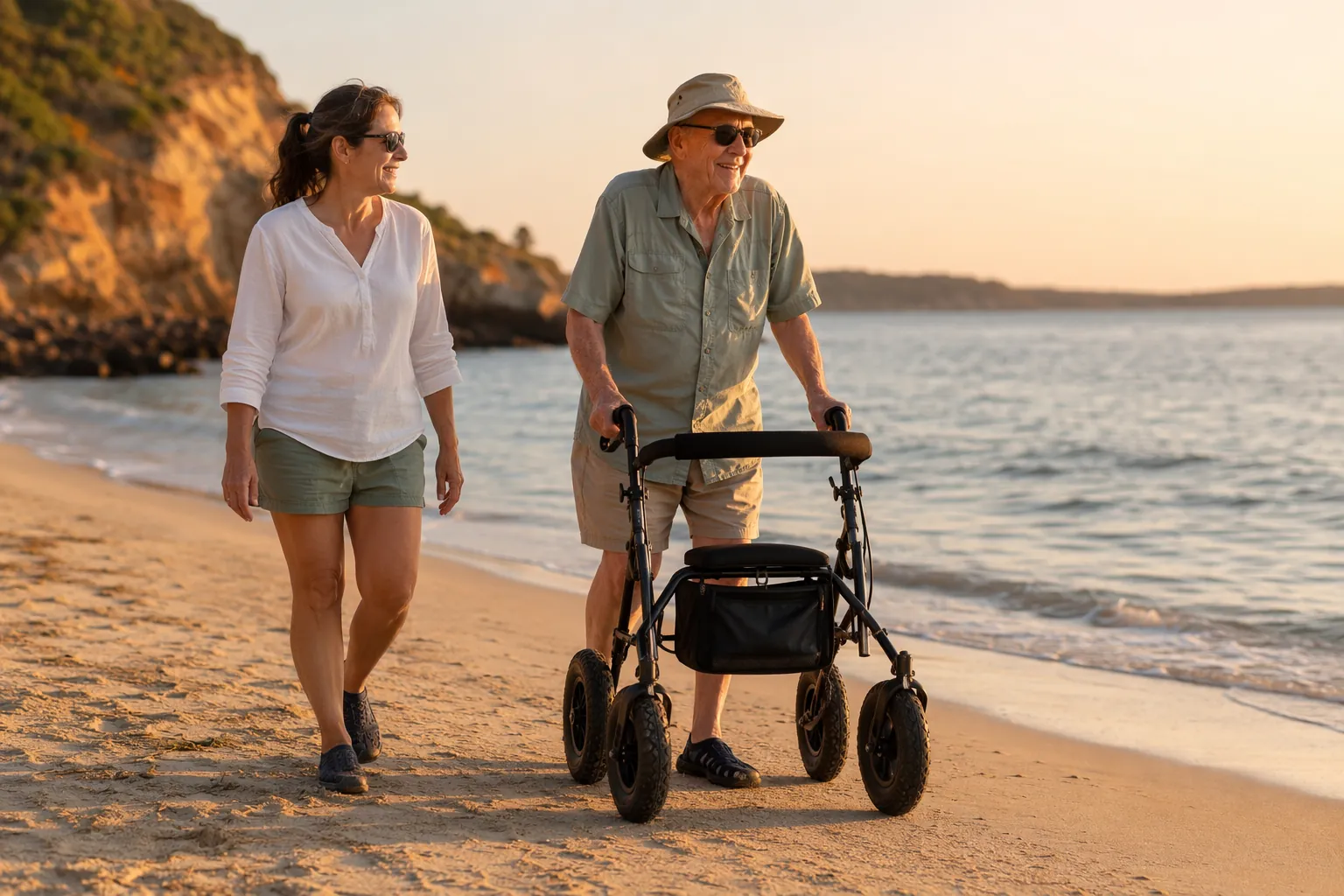
Plan the Route Before Choosing the Gear
The first decision is not which walker, cane tip, shoe, or chair to buy. The first decision is where the older adult will actually travel from the car to the place they want to sit.
A beach route has several separate fall surfaces. Treat them separately:
- Parking transition: curbs, uneven pavement, gravel, drop-offs, and the first step from stable ground to sand.
- Ramp, boardwalk, or access mat: width, slope, handrails, gaps, and whether the path continues far enough.
- Dry sand: soft, shifting, tiring, and often the place where standard mobility aids fail.
- Wet packed sand: usually firmer, but potentially slippery and uneven near the waterline.
- Slope: the side angle toward the water can pull the body, walker, or wheelchair off balance.
- Seating area: the final transfer into a chair and the later transfer back up, often after heat and fatigue have set in.
If that sounds overly cautious, picture the actual sequence. An older adult may manage the ramp well, then struggle in six yards of dry sand. Or they may walk down to a chair easily, then have trouble standing after an hour in the sun. The fall risk is not one single “beach risk.” It is a series of small transitions.
Why Standard Walkers and Canes Struggle on Sand
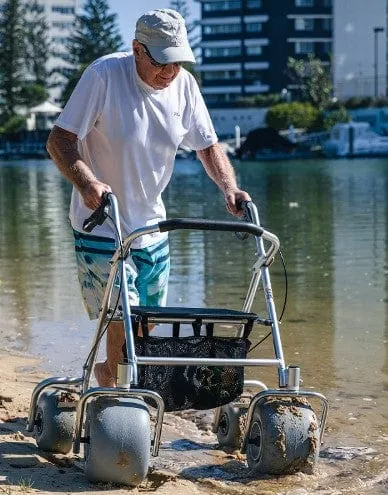
A standard rollator is built for hard, reasonably even surfaces. On soft sand, narrow wheels dig in. When the front wheels stop and the person’s body keeps moving, the walker can become a tripping point instead of a support. Even if no one falls, the extra pushing effort can drain energy before the beach visit has really begun.
All-terrain walkers are meant to solve that specific problem. Trionic describes beach walking as a situation where larger wheels and pneumatic tires matter, with its beach-walking guidance pointing to 12-inch or larger pneumatic tires for soft, uneven terrain.[3] That does not make any single walker a guarantee. It means the design change addresses the right failure: small hard wheels sinking and stopping in sand.
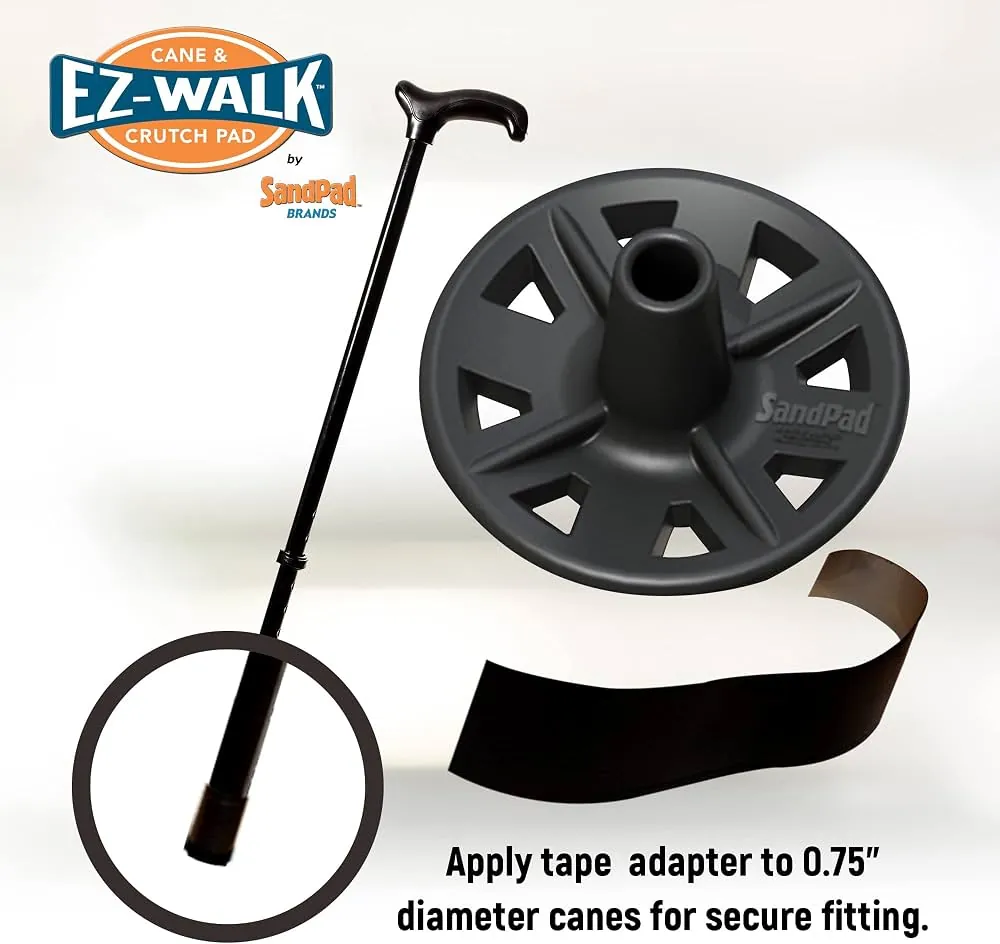
The same logic applies to canes. A narrow cane tip may be perfectly reasonable indoors and nearly useless in loose sand. A wide-base sand tip, such as a SandPad-style stabilizer, spreads pressure over more surface area so the cane is less likely to punch straight down. The useful feature is not the novelty of the attachment; it is the wider contact with the ground.
Before relying on any mobility aid at the beach, test it on sand similar to the sand at the destination if possible. A short trial near the access point is better than discovering halfway to the water that the walker pulls sideways or the cane tip clogs with wet sand.
When a Beach Wheelchair Is the More Respectful Choice
A beach wheelchair can feel like a bigger intervention than a cane or walker, so families sometimes delay considering it. But if the distance from parking to sitting area is long, the sand is deep, or the older adult tires quickly, renting or reserving a beach wheelchair may preserve more independence than a risky walk that ends with someone being grabbed under the arms.
Beach wheelchairs use large, wide tires designed to move over sand. Accessibility guides commonly describe beach wheelchairs, beach access mats, and accessible routes as important tools for getting across sand, but availability varies by location.[4] Treat local access claims as something to verify, not something to assume from a travel page.
The key question is not “Can Dad still walk?” It is “Which part of this outing should he spend his limited energy on?” For many older adults, the answer is sitting near the water, visiting with family, watching grandchildren swim, or taking a few supported steps on firm sand — not fighting through the softest stretch from the parking lot.
Footwear Should Grip, Drain, and Stay On
Bare feet can feel natural at the beach, but they leave an older adult exposed to hot sand, shells, pebbles, and sudden texture changes. Flip-flops are easy to put on, but they can slide, fold, or catch under the foot. Smooth-soled shoes can become slick on wet surfaces.
Beach safety guidance for seniors commonly recommends supportive water shoes or sandals with non-slip soles, and cautions against flimsy footwear such as flip-flops.[5] The best choice is usually a shoe that stays attached at the heel, grips on wet surfaces, protects the sole of the foot, and does not become heavy when wet.
Fit matters more than the label. A water shoe that is loose enough to twist around the foot can create the same problem as a flip-flop. A sandal with good tread but a weak back strap may come off at exactly the wrong moment. Have the older adult walk in the shoes before the trip, including on a damp surface if safe to do so.
The Chair Is Part of Fall Prevention
Beach chairs are often chosen by weight, color, cup holders, or how flat they fold. For an older adult with balance, hip, knee, or strength concerns, the more important question is how controlled the sit-to-stand transfer will be.
Very low beach chairs can require a deep squat to sit and a strong push to stand. Expert beach-day guidance for seniors points to higher chairs with sturdy armrests as a safer option than low chairs; as a practical target, look for a seat around 15 inches or higher with armrests, and be cautious with seats under 12 inches that demand a deep squat.[6]
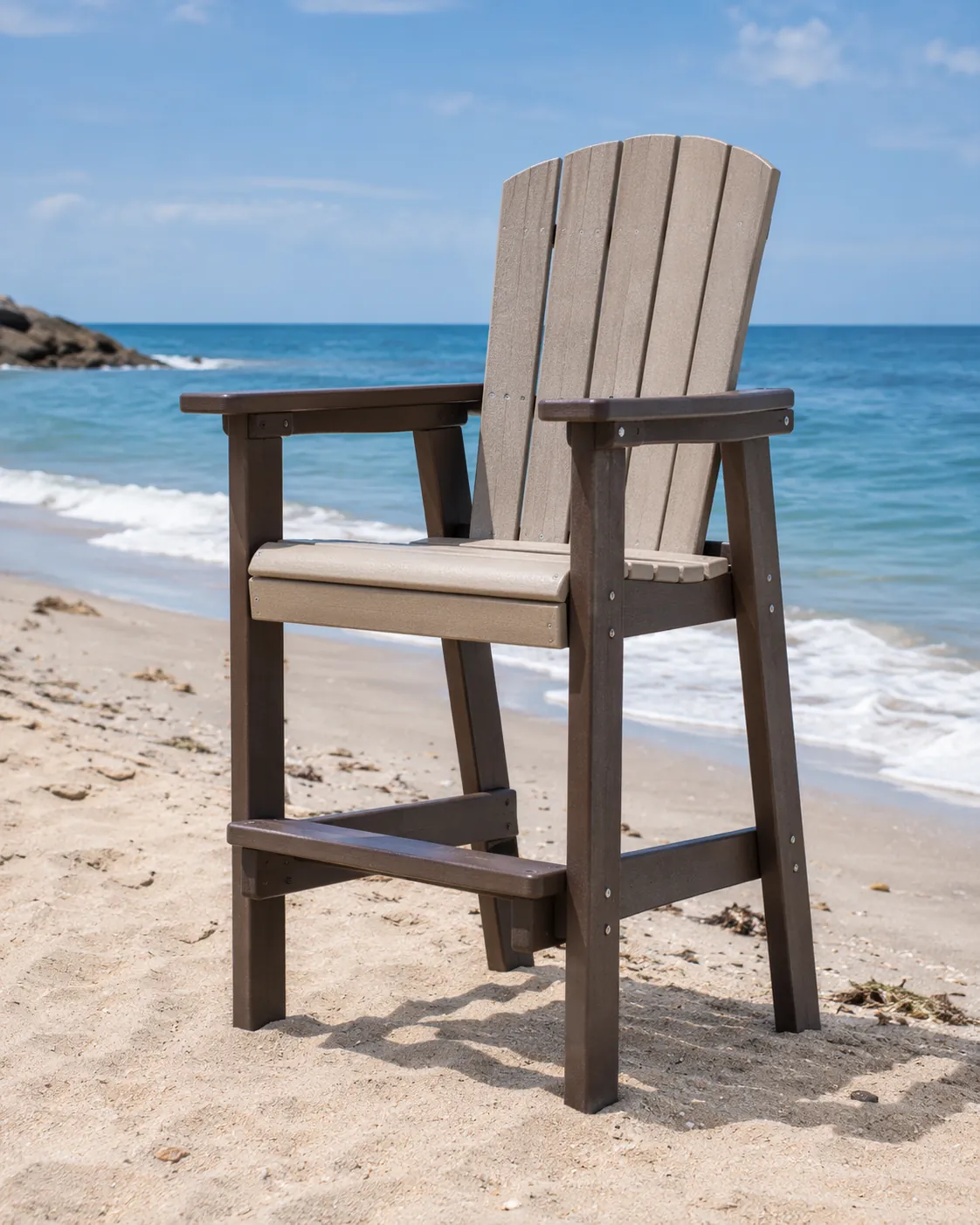
Armrests matter because they give the older adult a place to push evenly instead of reaching for a caregiver, a cooler, or the side of a flimsy chair. Seat height matters because standing from a low position asks more of the knees and hips. Stability matters because chair legs can sink unevenly into sand.
Set the chair before the older adult sits. Press the legs into the sand, check for wobble, and angle it so standing up does not require turning immediately on a slope. If the person uses a walker or cane, place it where they can reach it before they begin to rise, not several feet away behind a towel bag.
Call Ahead With Specific Questions
General accessibility language can hide the details that determine whether the outing works. “Beach access” might mean a ramp to the sand and nothing beyond it. “Wheelchair available” might mean first-come, first-served, limited hours, ID required, or a pickup point far from the parking area.
Free beach wheelchair programs do exist in some communities, including programs described for the Myrtle Beach area, but they are local resources rather than a universal beach feature.[7] Call the city parks department, beach patrol, visitor center, state park office, resort desk, or local disability-access nonprofit before building the day around one.
Ask questions that force practical answers:
- How far is the accessible parking from the beach access point?
- Is there a ramp, boardwalk, or beach access mat, and how close does it get to the sitting area or water?
- Are beach wheelchairs available, and can they be reserved?
- Where is the pickup location for the beach wheelchair?
- What are the hours, deposit rules, ID requirements, and return deadline?
- Is there a firmer-sand access area, and does tide timing affect it?
- Are restrooms close enough that the older adult can reach them without crossing deep sand again?
If the answers are vague, choose a different beach or shorten the plan. A beautiful stretch of shoreline may be a poor choice for an older adult who has to cross a long field of loose sand to enjoy it.
Match the Plan to the Older Adult’s Real Mobility Level
The safest plan still needs the older adult’s agreement. Equipment should not be presented as punishment for being unsteady. It is better framed as a way to keep the outing focused on the beach instead of on the struggle to reach it.
| If the older adult can... | Plan around... |
|---|---|
| Walk steadily on pavement but struggles on uneven ground | A route with mats or boardwalks, supportive water shoes, and possibly a sand-friendly cane tip |
| Use a rollator indoors or on sidewalks | An all-terrain walker for sand, or a beach wheelchair for the softest stretch |
| Walk short distances but tires quickly | Parking distance, a reserved beach wheelchair, a closer seating spot, and a shorter visit |
| Transfer safely but cannot walk across sand | A beach wheelchair, firm transfer area, and a higher chair with armrests |
| Need help rising from low seats | A taller beach chair, armrests, stable chair placement, and a clear path to the mobility aid |
This is also the point to be honest about fatigue. Heat, glare, crowds, uneven sand, and the pressure to keep up can all lead to rushed movement. Hydration, shade, and breaks matter because dizziness and exhaustion change how someone walks, turns, and stands. They are not separate wellness tips; they affect fall risk.
A shorter, well-planned beach visit is often better than a full-day plan that requires the older adult to push through the hardest walking conditions twice. The return trip counts. By then, the sand may be hotter, the tide may have changed the firm walking area, and the older adult may be more tired than they were on arrival.
A Practical Pre-Trip Check
Before committing to the outing, run through the plan in the order the day will actually happen:
- Choose the beach based on distance from parking, ramp or mat access, restroom location, and the availability of firm walking surfaces.
- Call ahead to confirm beach wheelchair availability, reservation rules, pickup location, and access-mat conditions.
- Decide whether the older adult will walk across sand, use an all-terrain walker, use a sand-friendly cane tip, or avoid walking the softest sand altogether.
- Choose supportive water shoes or sandals that grip, drain, and stay secured at the heel.
- Bring or rent a chair with enough height, armrests, and stability for controlled sitting and standing.
- Place the sitting area before fatigue starts, not after the older adult has already struggled through the sand.
- Keep the return route as protected as the arrival route.
Families who are still working through indoor fall risks may also find it useful to compare this beach plan with a home-focused checklist, such as a Parkinson’s home safety checklist. The contrast is the lesson: indoors, the work is often removing hazards from a familiar space; at the beach, the work is choosing the safest route through a changing one.
A beach outing becomes safer when caregivers stop treating the shore like a flat extension of home. Plan for sand, slope, distance, transfers, and fatigue. If the route is too long, rent adaptive equipment. If the beach has no usable access path, choose another beach. If soft sand is the hazard, do not make walking across it the price of enjoying the water.
References
- Outdoor Falls Among Middle-Aged and Older Adults: A Neglected Public Health Problem
- Facts About Falls | Older Adult Fall Prevention | CDC — CDC
- Which rollator is best for beach walking? — Trionic
- The Ultimate Guide To Accessibility at the Beach This Summer — ATC Mobility
- Beach Safety Guide for Seniors and Their Caretakers — FloridaPanhandle.com
- Plan a Safe, Enjoyable Beach Day for Seniors — Griswold Home Care
- Free Beach Wheelchairs Are Coming to Myrtle Beach in 2026
Related reading
Noticed something outdated or inaccurate on this page? Flag a correction. We review every report against CDC, NIA, and AARP HomeFit guidance before updating a page.
Part of the Fall Prevention section.