
STEADI: intervene
How Older Adults Can Prepare for a Fall-Safe Wildfire Evacuation
When a wildfire forces a rushed evacuation, the fall risks older adults face at home every day multiply. This guide covers the low-cost, high-impact steps to prepare your home for a safe, fall-free exit before fire season arrives.
The first wildfire preparedness question for many older adults is painfully practical: when someone says, “We need to leave now,” can the person get from the bed, recliner, bathroom, or kitchen chair to the car without falling?
That is where wildfire preparedness tips for older adults often need to begin. Not with the emergency bin in the garage. Not with a printed checklist in a drawer. With the route the body has to travel under pressure.
Los Angeles County’s review of the January 2025 wildfires reported that 26 of 31 wildfire deaths were people age 65 and older or people with disabilities. The same county article noted that the Eaton Fire burned at a rate of seven football fields per minute, a speed that leaves little room for searching for shoes, dragging a walker out of another room, or clearing boxes from a doorway after the order comes.[1]
The fall risk is not created by the wildfire. It is already in the house. A Safety Science study cited annual fall rates of 22% for adults ages 65 to 69 and more than 35% for adults age 80 and older. The same study modeled evacuation procedures for older adults and found that evacuation conditions can increase fall risk, though the evidence is modeled rather than direct observation from wildfire evacuations.[2]
So the job before fire season is not to build a perfect disaster system. It is to make the exit route boring, visible, wide, and rehearsed enough that an older adult can use it when the house no longer feels familiar.
Start With the Actual Path Out
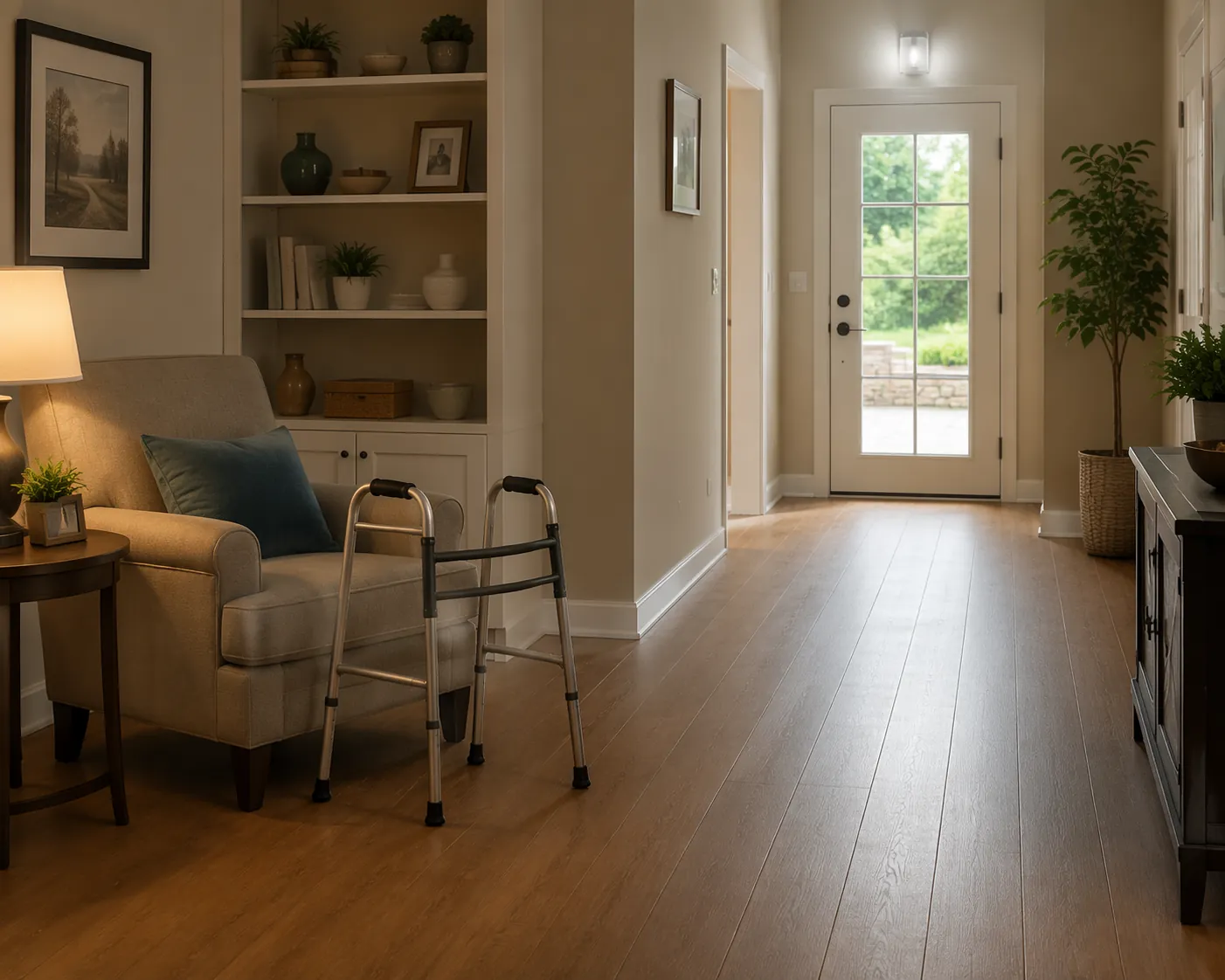
Walk the route from the places the older adult actually spends time: the bed, favorite chair, bathroom, kitchen table, and any room where they may be alone. Then continue all the way to the car, rideshare pickup spot, neighbor’s driveway, or accessible van loading area.
This is different from a normal cleaning pass. You are not asking whether the room looks tidy. You are asking whether a tired, frightened, possibly coughing person can move through it while using the same cane, walker, rollator, wheelchair, or caregiver support they would use in a real evacuation.
- Start at the bed and favorite chair, not at the front door.
- Move with the actual mobility aid, including the walker, cane, rollator, wheelchair, oxygen tubing, or transfer belt used at home.
- Check every turn, threshold, rug edge, cord, hallway table, pet bed, shoe pile, basket, and decorative item along the route.
- Open the exit door fully and confirm the device fits through without angling, lifting, or scraping.
- Continue outside to the car or pickup area, including porch steps, uneven pavers, gravel, hoses, gates, and driveway slope.
If the home has not had a recent fall-hazard review, do that first. A room-by-room fall prevention checklist catches everyday hazards; the wildfire layer asks whether those same hazards would block a fast exit. The CDC STEADI home checklist is also a useful clinical foundation for the basic fall-prevention work that evacuation planning builds on.
Measure the Route With the Device, Not Your Eyes
A hallway that looks wide enough to an adult child walking empty-handed may not work for a walker with tennis balls, a rollator with hand brakes, or a wheelchair with footrests. The U.S. Fire Administration advises older adults to make sure doorways can accommodate walkers or wheelchairs, and that matters before the exit door, not only at it.[3]
Do not guess. Put the device where the older adult starts, then move through the route at the pace they can realistically manage. Watch where the device catches. A wheel that clips the laundry basket in daylight will not become easier to steer during smoke, darkness, noise, or hurry.
| Mobility situation | What to test before fire season | Common failure point |
|---|---|---|
| Walks independently | Clear floor path, sturdy shoes, handholds at thresholds, outdoor surface to car | Rushing barefoot or stepping over clutter |
| Uses a cane | Cane staged at bed and main chair, clear side space for cane placement, no loose rugs | Cane left in another room |
| Uses a walker or rollator | Doorway width, turning radius, threshold height, path around furniture | Walker parked away from the person or blocked by furniture |
| Uses a wheelchair | Bedroom-to-exit route, ramp or no-step exit, door swing, car transfer location | Narrow doorways, tight turns, or inaccessible outdoor path |
This table is not a substitute for occupational therapy, home modification advice, or a disability-specific evacuation plan. It is a way to keep the first walkthrough honest: the route has to work for the person’s real body and real equipment.
Clear the Route Before It Becomes an Emergency
The cheapest wildfire evacuation improvement may be moving things that should not be in the route at all. Side tables, plant stands, baskets, extension cords, area rugs, stacked shoes, walkers stored sideways, oxygen tubing crossing a doorway, and boxes waiting to be donated all become more serious when time is short.
Use painter’s tape if it helps. Mark the route width on the floor for a week and see what keeps drifting into it. If family members keep placing packages, shoes, or laundry there, the route is not truly clear yet; it is only clear right after someone cleans.
- Remove loose rugs from the evacuation path, especially near the bed, bathroom, hallway, and exit.
- Route cords along walls instead of across walking areas.
- Move small furniture out of turning zones for walkers, rollators, and wheelchairs.
- Keep pet bowls, leashes, and food bins away from the main exit route.
- Make sure the path outside the door is as clear as the hallway inside.
If an older adult has already fallen, the evacuation route deserves a more serious look. A post-fall aging-in-place checklist can help identify whether the same spot that caused trouble in daily life would also slow or stop an evacuation.
Stage Mobility Aids Where Movement Begins
A walker by the front door is not helpful if the person is in bed when the alert comes. A cane leaning behind the sofa is not helpful if the person usually rises from a recliner on the other side of the room. The California Department of Aging advises keeping a mobility aid within reach at all times and having a backup in another room.[4]
That advice should be applied to the rooms where evacuation movement actually starts. For many older adults, that means the bedroom and the favorite daytime chair. For someone who spends long stretches in the bathroom because of bathing, toileting, or fatigue, it may also mean a device staged just outside the bathroom door.
- Keep the primary mobility aid close enough to reach before standing.
- Store the backup aid in a different room, not in the same closet.
- Do not let the backup aid block the route it is meant to support.
- Check rubber tips, walker glides, brakes, wheels, and height settings before fire season.
- If oxygen tubing is used, rehearse how it will move with the person instead of tangling at the doorway.
This is also where family habits matter. If a caregiver folds the walker and stores it behind a chair to make the room look neater, the room may look better and function worse.
Prepare for Night, Smoke, and Power Loss
Night evacuation is where ordinary fall-prevention habits become fragile. The person may be groggy. Glasses may be on the nightstand. Shoes may be under the bed. The hallway that is manageable at noon may become a guessing game if the power is out or smoke has changed visibility.
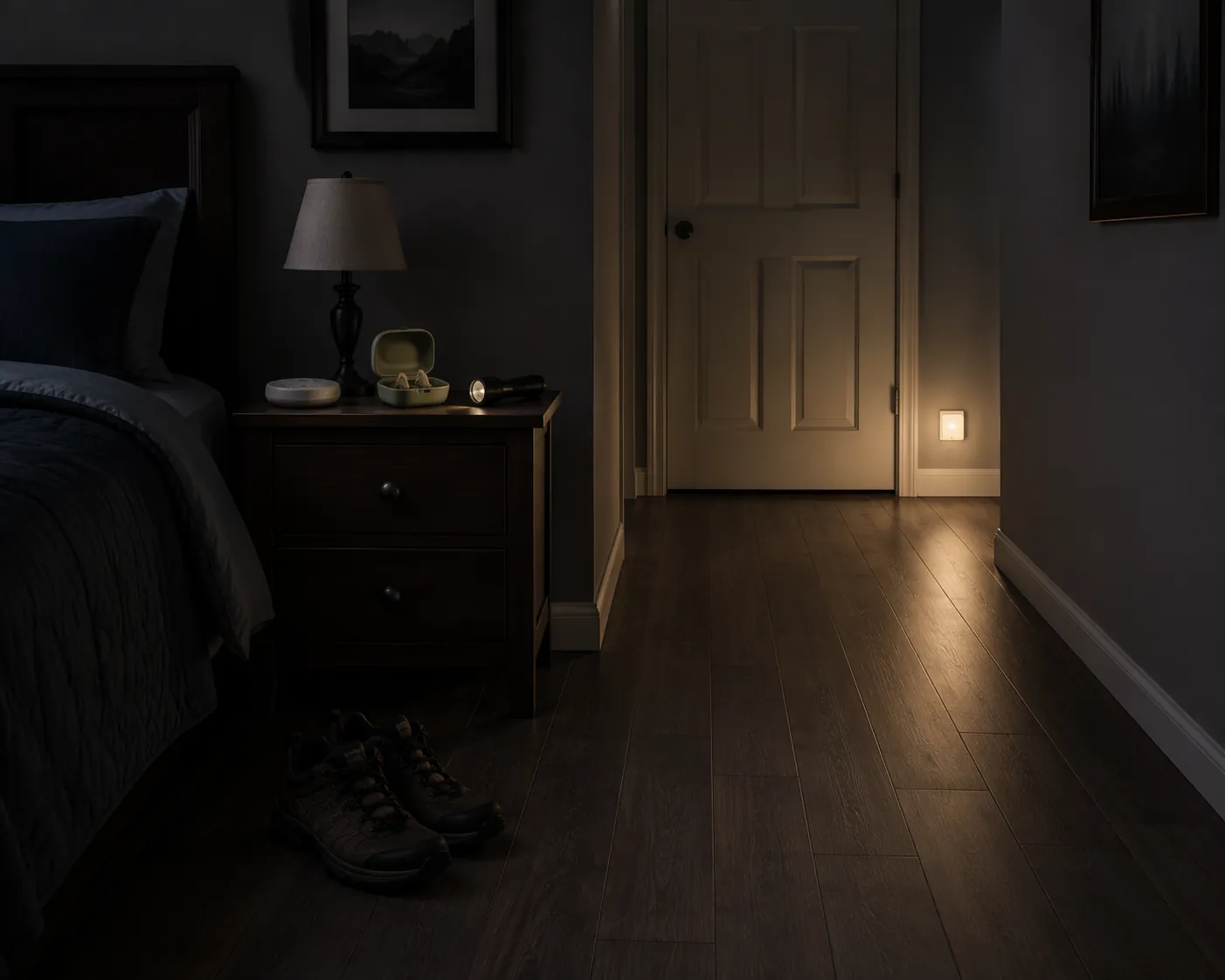
The U.S. Fire Administration recommends security lights that turn on when power fails and smoke alarms with bed shakers or strobes for people who are deaf or hard of hearing.[3] Those are not luxury upgrades if the older adult cannot reliably hear a standard alarm or find the doorway in the dark.
Set up the bedroom as if the evacuation begins there, because it often may. Sturdy shoes should live beside the bed, not in the closet. The path from the bed to the door should stay clear every night, not only after a planned cleanup. A flashlight should be reachable without standing. Backup lighting should illuminate the floor, not just the ceiling.
A bedroom-specific review can go deeper than a general evacuation checklist. The same details covered in a bedroom safety audit—bed height, night lighting, footwear, rugs, cords, and the first few steps after standing—become evacuation details when a wildfire warning arrives at night.
- Place sturdy, closed-back shoes where the person’s feet land when getting out of bed.
- Keep glasses, hearing aids, phone, flashlight, and mobility aid on the same side the person normally exits the bed.
- Use battery-powered lighting that activates during a power outage or is simple to turn on by touch.
- Test whether the smoke alarm can wake the person, including people with hearing loss.
- Keep the bedroom door path free of hampers, slippers, rugs, charging cords, and oxygen tubing loops.
Put Supplies Where They Do Not Create a New Hazard
Emergency kits matter. Los Angeles County’s article, citing a CCOA survey, reported that fewer than one in three adults ages 50 to 80 had any emergency kit at all.[1] But for an older adult with fall risk, a kit in the wrong place can become another obstacle or another reason to bend, reach, and rush.
The kit should travel with the mobility plan. If the person uses a walker, can a small bag attach without making the walker unstable? If the person uses a wheelchair, can supplies fit without interfering with brakes, wheels, or transfers? If a caregiver will carry the bag, can they still keep one hand free to steady the older adult?
NCOA, the American Red Cross, Ready.gov, and the California Department of Aging all emphasize planning ahead for medications, documents, communication, and personal needs in disasters.[4][5][6][8] For this evacuation route, the fall-safety question is narrower: can the essentials be reached without crossing clutter, bending low, climbing, or separating the person from their mobility aid?
| Item | Fall-safe placement question |
|---|---|
| Medication list and current medications | Can they be reached from the exit route without searching a bathroom cabinet? |
| Hearing aids and batteries | Are they beside the bed or daily chair, not buried in a drawer? |
| Phone and charger | Can the person reach them before standing or while using the mobility aid? |
| Oxygen or medical-device batteries | Are backups charged and stored where they do not block walking space? |
| Emergency bag | Can it be carried, attached, or loaded without changing the person’s balance? |
| Documents and contacts | Are copies in the bag so no one has to search file cabinets during evacuation? |
A 2026 Fire Help Center guide for seniors and caregivers also highlights backup batteries for oxygen equipment and hearing aids as part of wildfire preparedness.[7] Those backups are only useful if they are charged, known, reachable, and not stored behind the very supplies someone would have to step around.
Rehearse the Exit Without Turning It Into a Drill Day
A fall-safe evacuation route should be practiced, but the practice does not need to feel theatrical. Pick an ordinary afternoon. Ask the older adult to start where they usually sit. Use the real device. Put on the shoes that would be worn. Move to the exit, then outside to the car or pickup point.
Do not time the first attempt like a race. Watch instead for the moments where the body hesitates: standing from the chair, turning into the hallway, crossing a threshold, opening the door, stepping onto the porch, approaching the car, or transferring into the seat. Those pauses show where the route needs work.
- Practice once in daylight with lights on.
- Practice once with the backup lighting only, if it is safe to do so.
- Practice from the bed and from the main daytime chair.
- Practice with the person who is most likely to help during an evacuation.
- Change the home setup immediately after any point where the person stumbles, reaches for unstable furniture, or cannot turn the device easily.
The rehearsal standard is simple: nobody should need to move furniture, locate a missing device, explain where the shoes are, or decide in the moment which exit is safest. The house should already be answering those questions.
Know What This Guide Does Not Cover
This is a fall-prevention evacuation guide, not a complete wildfire survival manual. It does not cover every issue that matters in a wildfire: air quality, masks, insurance, pets, shelter logistics, transportation registries, backup caregivers, defensible space, or when to leave a wider area. Those deserve their own planning.
Ready.gov, the Red Cross, NCOA, and state aging agencies provide broader preparedness guidance for older adults, including communication plans, support networks, emergency supplies, and local alerts.[4][5][6][8] If your household also prepares for hurricanes or flooding, the same fall-prevention lens can be applied through a tropical storm preparedness checklist for seniors at home.
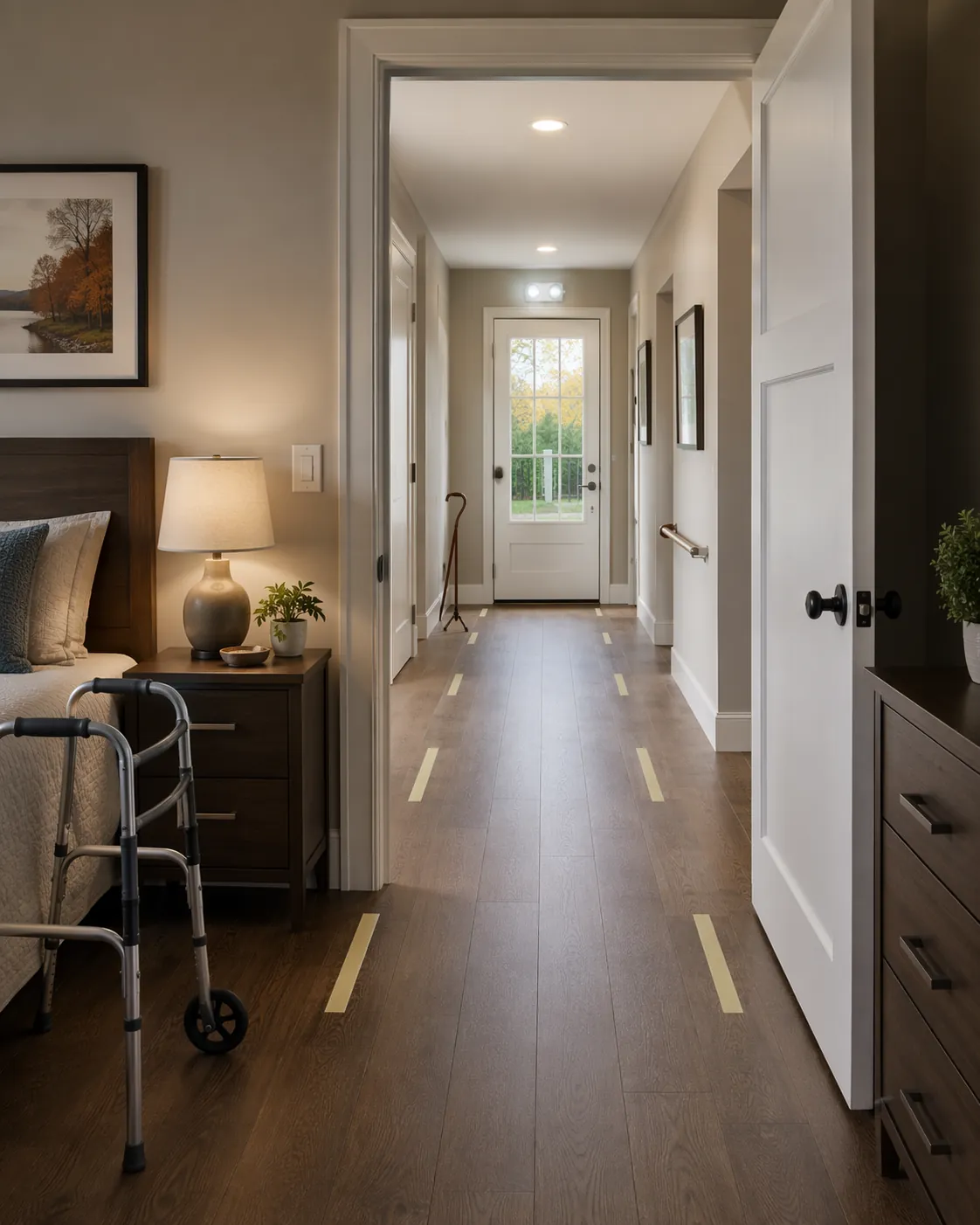
The narrow focus here is intentional. A plan that looks complete on paper can still fail in the first thirty feet if the walker is in the wrong room, the hallway is dark, the shoes are missing, or the person has to step over the emergency bag to reach the door.
Before fire season, the safest wildfire plan for many older adults begins as a fall-prevention walkthrough of the route they will actually use to leave home.
References
- Lessons from the January Wildfires: Why Preparedness Matters, Los Angeles County Aging & Disabilities, February 2026.
- Modeling fall risk of elderly people during the evacuation process, Safety Science, 2020.
- Fire Safety for Older Adults, U.S. Fire Administration.
- Disaster Preparedness Tip Sheets, California Department of Aging.
- What Older Adults Can Do If Disaster Strikes, National Council on Aging.
- Older Adults Emergency Preparedness, American Red Cross.
- Wildfire Preparedness Guide for Seniors & Caregivers, Fire Help Center, March 2026.
- Older Adults, Ready.gov.
Related reading
Noticed something outdated or inaccurate on this page? Flag a correction. We review every report against CDC, NIA, and AARP HomeFit guidance before updating a page.
Part of the Fall Prevention section.