
STEADI: intervene
How to Help Your Elderly Parent Evacuate Without Falling
Wildfire evacuations create serious fall risks for older adults that standard checklists ignore. This guide helps caregivers prepare a fall-prevention evacuation plan covering pre-season home audits, mobility aid readiness, and staged timing to reduce injury risk.
Wildfire safety tips for elderly parents usually start with alerts, prescriptions, insurance papers, pet carriers, and a go-bag. Those matter. But an evacuation is not a folder leaving a house. It is a person getting up from a bed, chair, bathroom, or recliner, finding shoes, reaching a walker, crossing thresholds, stepping over cords that were harmless yesterday, and getting into a car while everyone is trying not to sound frightened.
That movement deserves its own plan. The National Fire Protection Association reports that adults 65 and older are twice as likely to die in a home fire, and adults 85 and older are four times as likely.[1] The CDC’s STEADI fall-prevention materials note that one out of five falls causes a serious injury, such as a broken bone or head injury.[2] Those two facts do not prove a measured wildfire-evacuation fall rate. They do show why “leave quickly” is not a complete instruction for an older parent whose balance, vision, gait, stamina, or reaction time has changed.
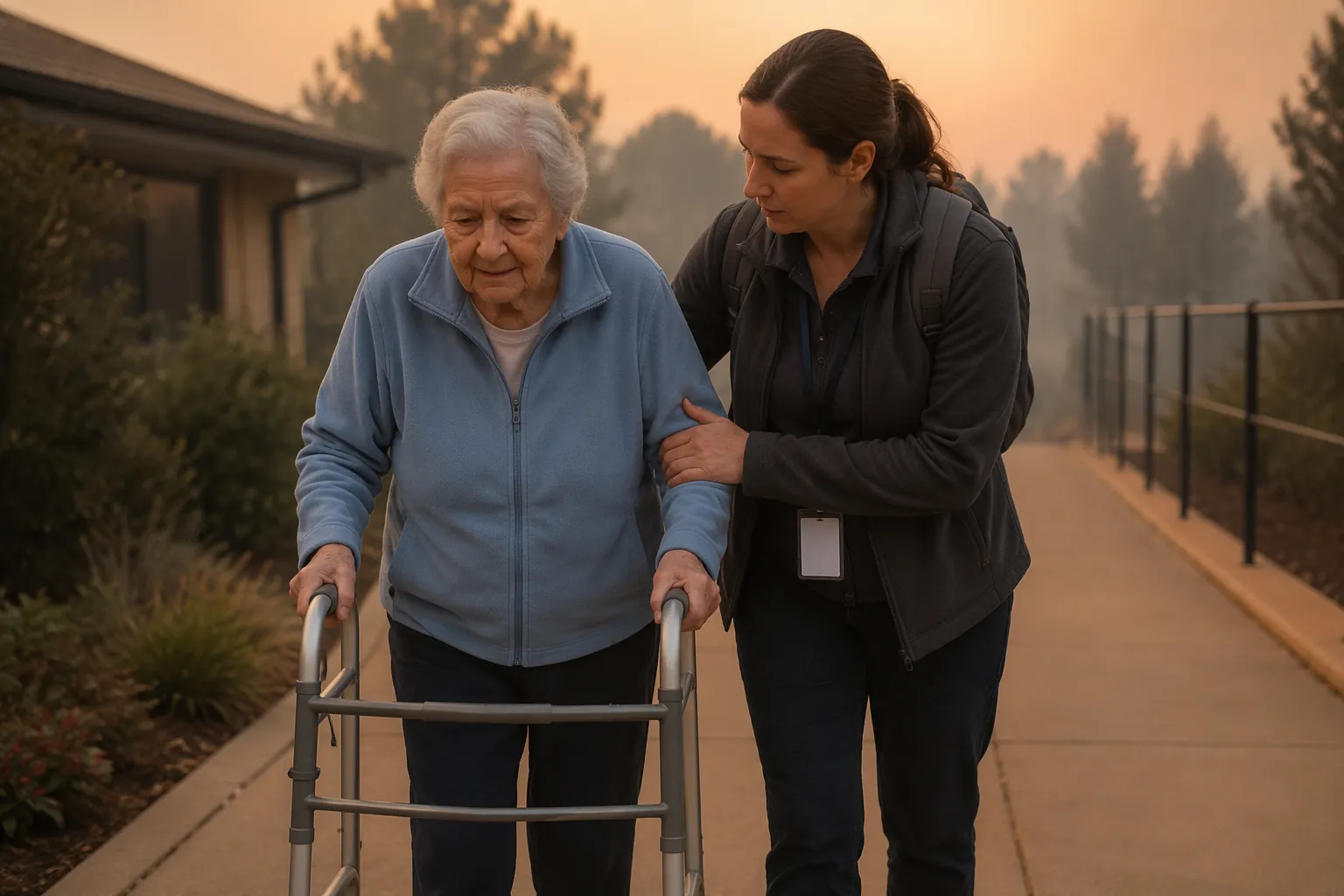
Just as tropical storms create hidden fall hazards, wildfire evacuation adds its own version of the same problem: smoke makes edges harder to see, poor light changes depth perception, urgency shortens steps, and a bag in one hand can turn a steady walker user into a wobbly furniture-grabber.
Start With The Route, Not The Binder
A useful wildfire plan for an older parent starts with one plain test: can they move from the places they actually sit, sleep, bathe, and eat to the vehicle without improvising?
That means the route cannot be judged only at noon, with the lights on, when the floor is dry and nobody is calling. Walk it as if the phone alert came before dawn. Start at the bed. Start at the recliner. Start in the bathroom. Start wherever your parent is most likely to be when the order comes. Then watch for the little failures that official checklists rarely name.
- A cane parked by the front door when your parent is usually in the bedroom.
- A walker stored in a hall closet because it looks tidier there.
- A throw rug that catches a toe only when someone is rushing.
- A step down to the garage that disappears in dim light.
- A go-bag heavy enough to steal the hand that should be holding a rail, walker, or car door.
For a broader room-by-room fire escape plan, use a separate home fire evacuation walkthrough for aging parents. For this plan, keep the focus narrower: what has to be true before the evacuation order so your parent can leave earlier, slower, supported, and with the equipment that keeps them upright?
Do The Pre-Season Walkthrough Before Smoke Is In The Driveway
The right time to solve a fall problem is when nobody is sweating through a mask, arguing about which papers to take, or deciding whether the road will stay open another hour. Before fire season, walk the whole exit route with your parent’s actual mobility limits in mind.
| Evacuation Point | What To Check | Fall-Prevention Fix |
|---|---|---|
| Bed | Can your parent sit up, stand, and reach the walker or cane without crossing the room? | Keep the mobility aid within arm's reach and place non-slip footwear beside the bed. |
| Bathroom | Is the path dry, well lit, and free of mats that slide? | Remove loose rugs and keep a night light or motion light available. |
| Hallway | Can a walker, rollator, or wheelchair pass without turning sideways? | Clear furniture, boxes, cords, baskets, and decorative stands from the evacuation path. |
| Exit | Does the path stay clear through the doorway, porch, garage, ramp, or steps? | Extend the clear route all the way to the vehicle, not just to the threshold. |
| Vehicle | Can your parent get in without twisting, stepping over clutter, or carrying a heavy bag? | Stage bags in the car when evacuation is likely and keep both of your parent's hands free. |
FEMA and U.S. Fire Administration guidance for older adults and people with access or functional needs points to exit pathways wide enough for walkers or wheelchairs, with 36 inches used as the practical clearance target, and it emphasizes keeping assistive devices accessible rather than stored out of reach.[3] In an ordinary week, a narrow turn around a laundry basket may be annoying. During evacuation, with smoke, low light, and a ringing phone, it becomes a decision point your parent should not have to negotiate.
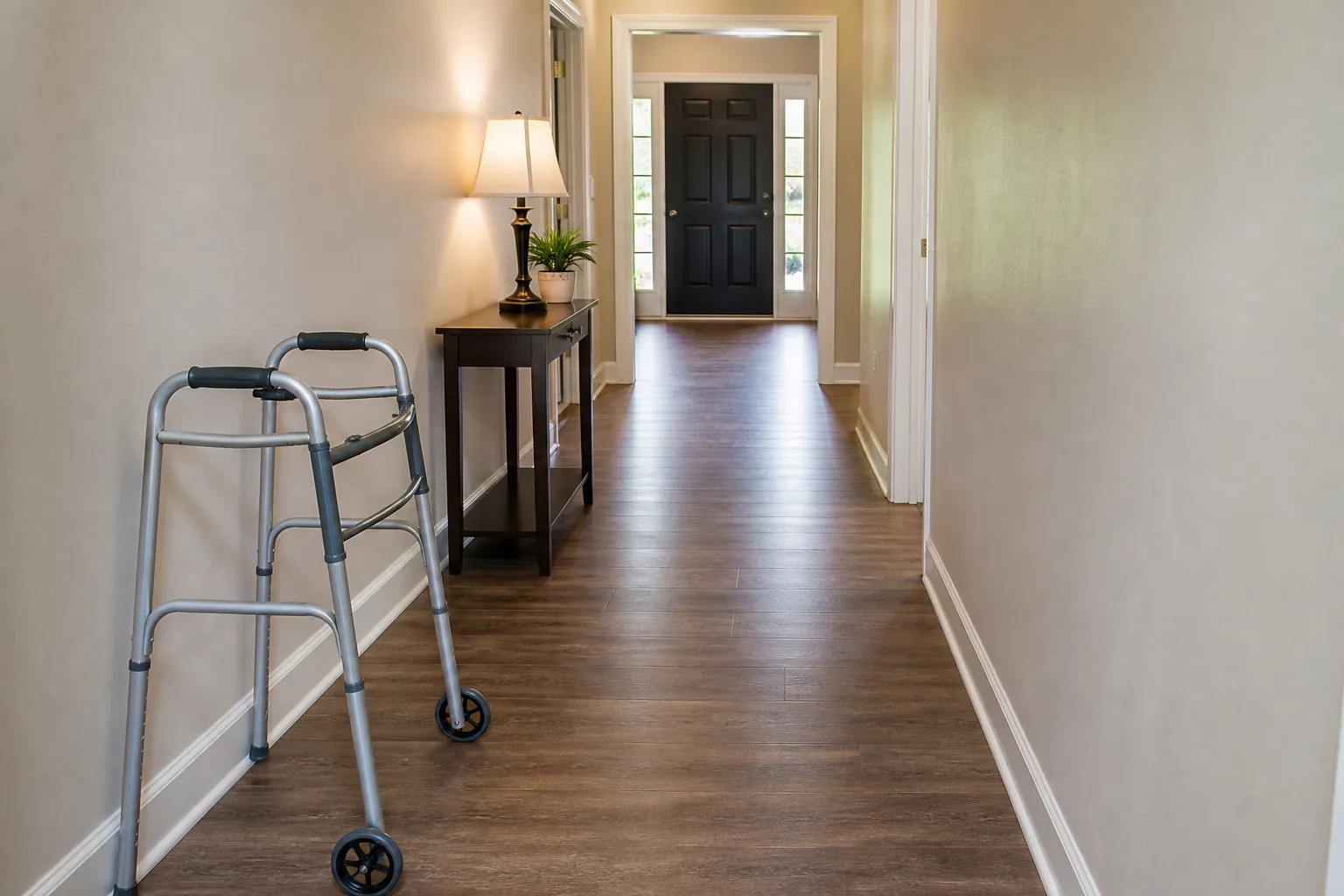
If your parent has Parkinson's disease, neuropathy, stroke-related weakness, low vision, or a history of freezing or shuffling, the walkthrough needs to be more exacting. A general decluttering pass is not enough. Use the same seriousness you would bring to a Parkinson's home safety checklist: turning space, lighting, grab points, trip edges, and the path your parent actually takes when tired.
The Clear Path Has To Reach The Car
Many homes have a beautiful clear hallway and a terrible final ten feet. The walker fits through the bedroom door, then the route narrows at the laundry area. The porch is clear, then the driveway slopes and has loose gravel. The garage has a safe handrail, then the car is parked too close to a shelf for the passenger door to open wide.
Treat the evacuation route as bed-to-seat, not room-to-door. If your parent uses a walker, practice where it will go when they reach the car. If they use a wheelchair, check whether the ramp angle, doorway lip, or gravel creates a problem. If a neighbor is the backup helper, make sure that person knows which door, which mobility aid, and which side of the car your parent can use most safely.
Keep The Walker Where The Emergency Will Find It
A mobility aid in the house is not the same as a mobility aid available during evacuation. If the walker lives in the front hall because that is where visitors see it least, it may be useless when your parent wakes to an alert in the bedroom. If the cane leans behind a chair, it may be invisible in low light. If the rollator is in the trunk because it is only used on outings, your parent may try to reach the car without the very thing that makes walking possible.
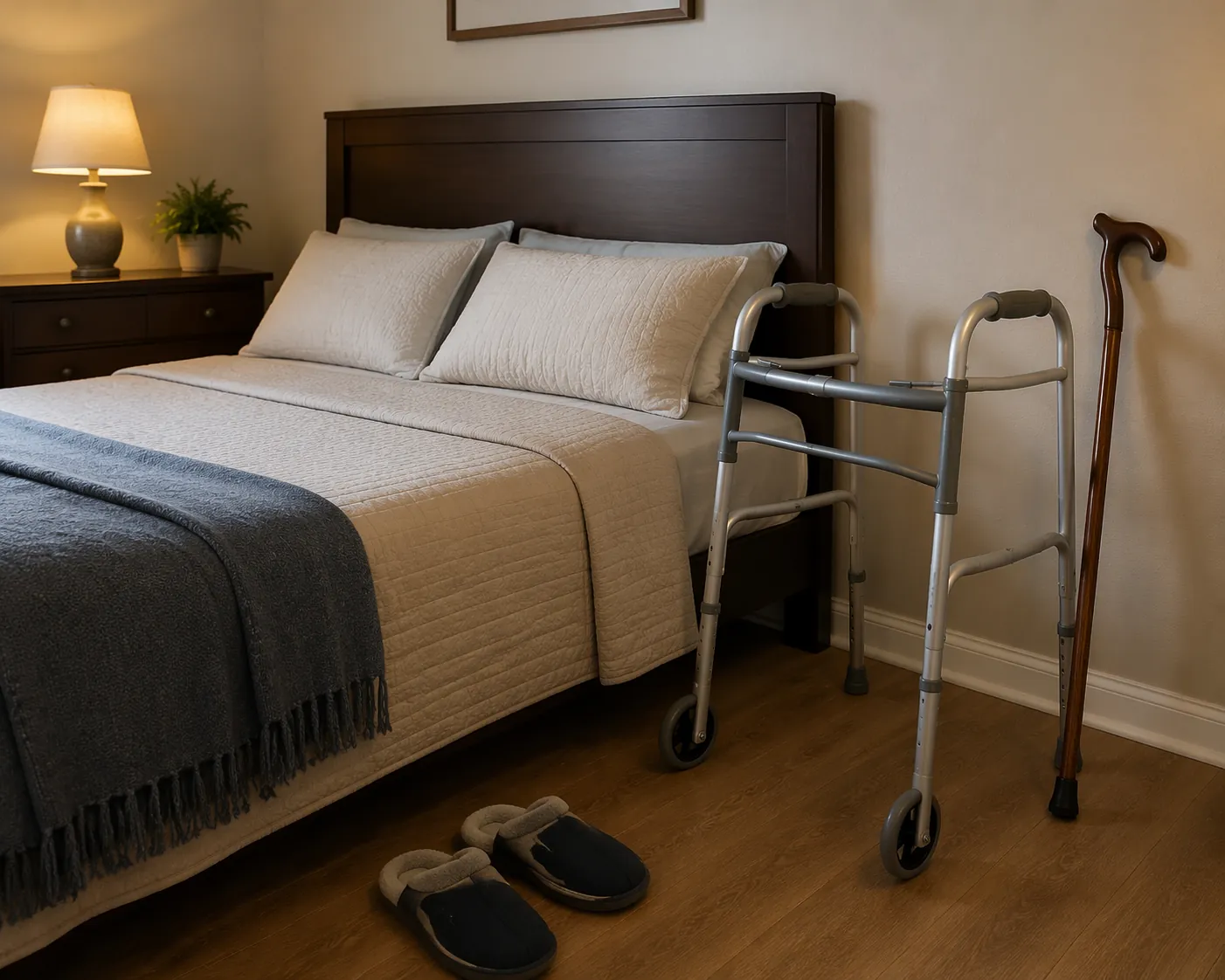
For wildfire season, think in pairs: one aid where your parent sleeps, one aid near the most likely daytime chair if they have more than one. If there is only one device, it should not be parked for neatness; it should be parked for the first step of the evacuation.
- Put the walker, rollator, cane, or wheelchair where your parent can reach it before standing.
- Add reflective tape or a bright tag if the device blends into the room in dim light.
- Keep the device clear of hanging coats, laundry baskets, pet beds, and closet doors.
- Label backup equipment if a neighbor, driver, or facility staff member may need to grab it.
- Do not make your parent choose between taking the walker and taking the documents.
This is also where footwear belongs. Non-slip shoes or slippers should be reachable from the bed and from the main sitting area. A parent who evacuates in loose slippers, socks, or backless house shoes may be technically “ready” by checklist standards and still be one bad step away from an injury.
Make The Go-Bag Light Enough To Leave Both Hands Useful
Ready.gov, the Red Cross, and senior-focused wildfire guidance all emphasize emergency supplies, alerts, evacuation planning, and documents.[4][5][6] The missing fall-prevention question is who carries what.
For an older adult with balance trouble, a heavy shoulder bag can be as dangerous as clutter on the floor. It changes posture, occupies a hand, and encourages the person to hurry because the bag is uncomfortable. If your parent uses a walker, the bag should not hang where it makes the walker tip, swing, or catch on furniture.
- Use a small, light personal bag for essentials your parent truly must keep on their body.
- Put heavier documents, spare clothing, bottled water, pet supplies, and chargers in a caregiver or vehicle bag.
- Keep medications organized, but do not make your parent carry the whole supply while walking to the car.
- If evacuation looks possible, load nonessential weight into the vehicle early.
- If a neighbor is the helper, write down which bag matters most and where it is stored.
Medication continuity still matters. About 80% of older adults have at least one chronic condition, and wildfire displacement can interrupt prescriptions, oxygen, refrigeration, charging, and routine care.[7] That subject can swallow the whole plan if you let it. For this evacuation route, the fall-prevention rule is simpler: organize medications so they can be retrieved without sending your parent back across the house or loading their hands while they walk.
If heat, dehydration, dizziness, or medication side effects are already a concern, treat them as fall risks too. Caregivers may want a separate plan for heat-related medication risks and why heat advisories raise fall risk in older adults, especially during long waits, power outages, or crowded evacuation routes.
Leave Early Enough For Your Parent's Actual Speed
Wildfire orders are written for communities. Your parent’s body runs on its own clock. If it takes ten minutes to stand safely, use the bathroom, put on shoes, reach the walker, get down two steps, and settle into the car on a normal morning, it will not take less time when smoke is visible and the phone keeps ringing.
Ready.gov advises people to know evacuation routes, follow instructions from local authorities, and leave when told to do so.[4] For an older parent with fall risk, the practical version is to treat “be ready” as a movement stage, not a mood. When the area is under a warning or conditions are deteriorating, shoes go on, the mobility aid comes beside the chair or bed, the car faces out if that is safe to arrange, and heavy bags move to the vehicle before the order becomes urgent.
| Fire Situation | Fall-Safe Action | Why It Helps |
|---|---|---|
| Fire weather, nearby smoke, or local concern | Confirm helper, vehicle, route, mobility aid location, and phone charging. | Prevents decision-making from starting when your parent already needs to move. |
| Evacuation warning or credible possibility of leaving | Put on non-slip footwear, clear pet items and cords, move bags to the car, and bring the walker to the parent. | Turns the eventual evacuation into a shorter, slower walk. |
| Evacuation order | Leave with the mobility aid, one light personal item, and direct support if needed. | Reduces rushed carrying, searching, and last-minute room-to-room trips. |
| Unable to reach parent immediately | Call the prearranged neighbor, facility desk, or local emergency contact with exact mobility instructions. | Gets help focused on movement, not just on checking whether your parent is home. |
The phone script matters. “Dad, get ready” can mean many things. “Put on your black shoes, sit back down, pull the walker next to your knees, and wait for Linda at the front door” is safer. It gives the person one movement at a time, and it keeps them from making extra trips while scared.
If Your Parent Lives In Assisted Living Or Senior Housing
Ask the front desk or administrator a fall-specific version of the evacuation question. Not only “Do you have a wildfire plan?” but “Who helps residents who use walkers get from bed to transport if the order comes before breakfast?” Ask whether mobility aids travel with residents, how medications are transferred, where families receive updates, and whether staff know which residents cannot safely hurry.
California caregiver guidance encourages families to prepare older adults ahead of fire season, including plans for evacuation, communication, documents, medications, and support contacts.[8] For fall prevention, add one more line to your parent’s file and to your own notes: what equipment must be in their hand or beside their body before anyone starts moving them out.
Smoke, Darkness, And Stress Change A Familiar House
A parent may know every inch of the house and still be unsafe moving through it during evacuation. Smoke can reduce visibility and irritate eyes. Poor air quality can worsen breathing for people with heart or lung disease, and the CDC specifically warns that wildfire smoke can be dangerous for people with chronic conditions.[9] Even when smoke exposure is not the immediate medical crisis, watery eyes, coughing, fatigue, and anxiety can make walking less steady.
Low light does the same thing more quietly. A black floor mat, a dark step edge, and a shadow at the threshold can disappear. If your parent has cataracts, macular degeneration, neuropathy, or poor depth perception, add lighting before you add another item to the emergency bin.
- Use plug-in night lights with battery backup where practical.
- Keep a flashlight attached to the walker or beside the bed, not buried in a kitchen drawer.
- Mark step edges or threshold changes with high-contrast tape if your parent has trouble seeing them.
- Clear outdoor hoses, planters, doormats, and uneven items from the path to the car before fire weather peaks.
This is not decoration. It is route engineering for a person who may be moving while frightened, tired, short of breath, or half awake.
The Fall Risk Continues After Arrival
Getting out of the fire area does not end the fall problem. A shelter, hotel, relative’s guest room, or temporary apartment is unfamiliar territory. The bed may be higher. The bathroom may be on the wrong side. The toilet may be lower. The path from bed to bathroom may cross cords, luggage, pets, air mattresses, or a rug that curls at the edge.
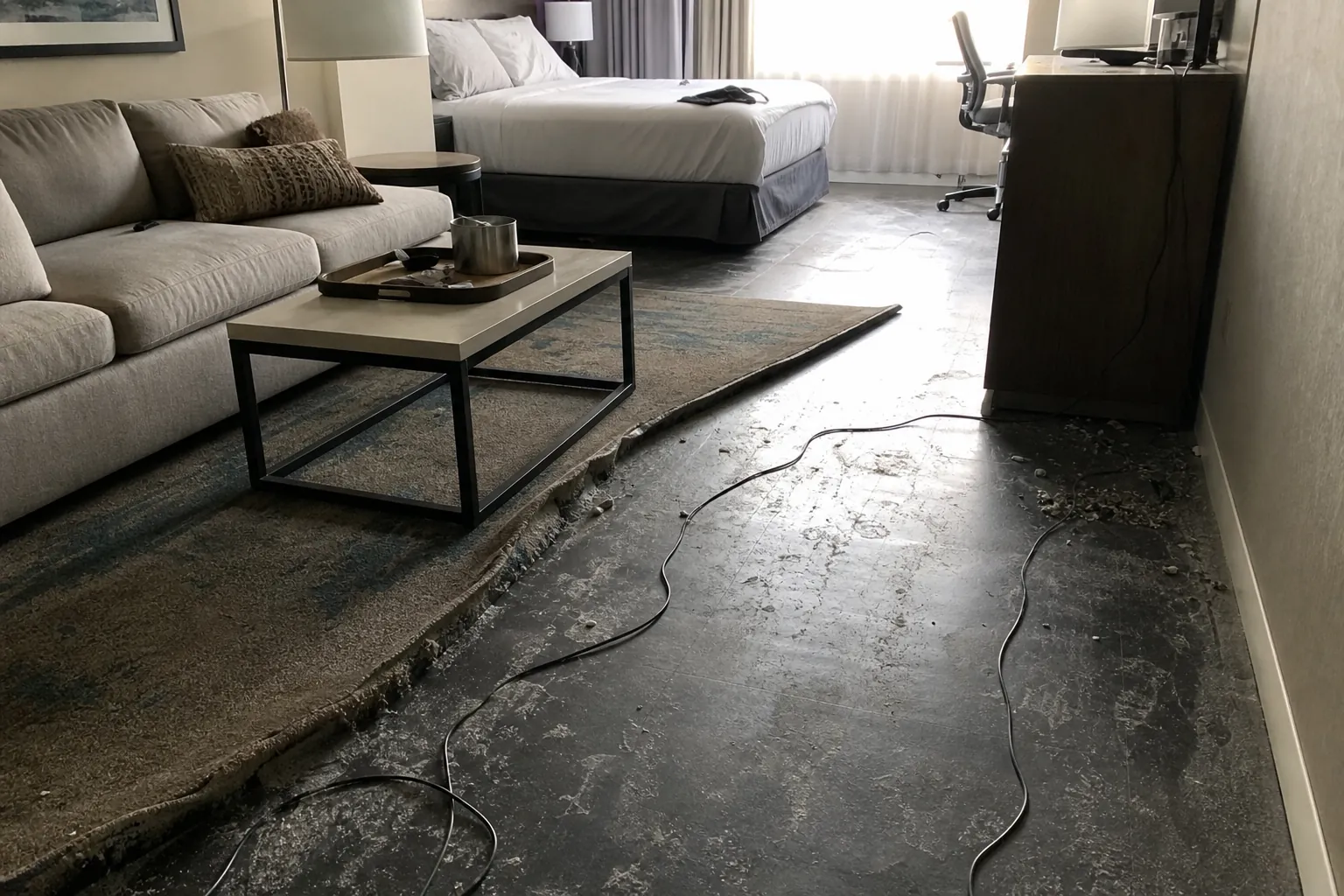
Before your parent walks around, do a two-minute arrival check. Put the walker or cane on the side of the bed they will actually use. Move cords. Lift or remove loose rugs. Turn on a bathroom light. Check the shower or tub before anyone is tired enough to take chances. If your parent is exhausted, dizzy, coughing, or newly confused, shorten the route and increase supervision.
Return-home trips deserve the same caution. Ash-slick surfaces, debris, damaged handrails, loose thresholds, and power outages can make a familiar house behave like a new one. If the home has been affected by smoke, heat, water, or firefighting activity, do not assume your parent can resume their normal path from car to kitchen to bathroom without a fresh look.
A Narrow Checklist For The Person Who Has To Move
This list is not a full wildfire preparedness plan. It sits beside the Red Cross, Ready.gov, local emergency alerts, medication planning, pet plans, insurance documents, and power-backup arrangements. Its job is smaller: reduce the chance that your parent falls while trying to do what every other checklist tells them to do.
- Walk the route from bed, bathroom, recliner, kitchen, and main chair all the way to the vehicle.
- Keep walkers, canes, rollators, wheelchairs, glasses, hearing aids, and non-slip shoes within practical reach.
- Clear a wide path that stays usable in smoke, low light, and stress, including the porch, garage, ramp, and driveway.
- Move heavy supplies early so your parent is not carrying weight during the evacuation walk.
- Arrange a helper who knows the mobility plan, not just the address.
- Check the shelter, hotel, or relative’s home for fall hazards before your parent makes the first tired trip to the bathroom.
Caregivers cannot remove wildfire urgency. They can remove several predictable fall traps before the urgency arrives: the cane across the room, the cluttered hallway, the too-heavy bag, the dark threshold, the walker left behind, and the unsafe bathroom at the destination. The safer evacuation is usually not faster. It is earlier, lighter, clearer, and built around the parent’s real route out of the home and into the next safe place.
References
- Older Adult Fire Safety, National Fire Protection Association
- STEADI: Older Adult Fall Prevention, Centers for Disease Control and Prevention
- Fire Safety for Older Adults and People with Disabilities, FEMA / U.S. Fire Administration
- Wildfires, Ready.gov, https://www.ready.gov/wildfires
- Wildfire Safety, American Red Cross, https://www.redcross.org/get-help/how-to-prepare-for-emergencies/types-of-emergencies/wildfire.html
- Wildfire Preparedness Guide for Seniors & Caregivers, Fire Help Center, 2026, https://www.firehelpcenter.com/wildfires/safety-preparedness-guide/seniors-caregivers/
- About Chronic Diseases, Centers for Disease Control and Prevention
- 13 Fire Season Tips for the Elderly and their Family Caregivers, California Caregiver Resource Centers, July 12, 2022, https://www.caregivercalifornia.org/2022/07/12/13-fire-season-tips-for-the-elderly-and-their-family-caregivers/
- Wildfire Smoke and People with Chronic Conditions, Centers for Disease Control and Prevention, https://www.cdc.gov/wildfires/risk-factors/wildfire-smoke-and-people-with-chronic-conditions.html
Related reading
Noticed something outdated or inaccurate on this page? Flag a correction. We review every report against CDC, NIA, and AARP HomeFit guidance before updating a page.
Part of the Fall Prevention section.