
Bedroom Safety Checklist for Older Adults Aging at Home
The bedroom is the single most dangerous room in the home for older adults, yet most safety guides treat it as a brief footnote in a whole-home list. This evidence-based checklist organizes bedroom hazards into six specific zones — floor pathways, lighting, bed height, nightstand setup, the bedroom-to-bathroom corridor, and closet access — giving caregivers and older adults an immediately scannable reference with cost-tiered fixes they can act on the same day.
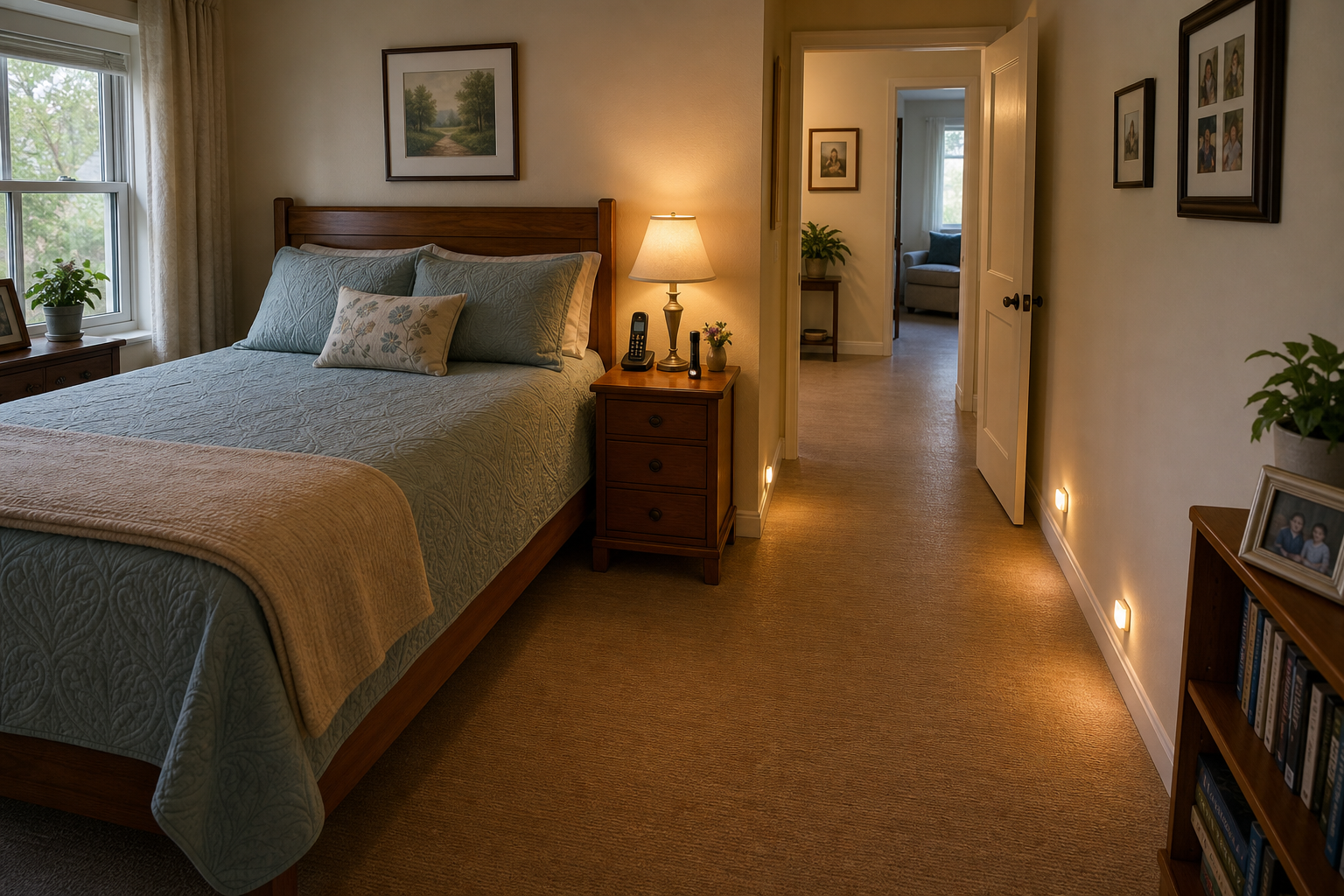
Why the Bedroom Is the Highest-Risk Room in the Home
Falls are the leading cause of injury among adults 65 and older in the United States. According to the CDC, the age-adjusted fall death rate increased 21% between 2018 and 2024, reaching 78.4 deaths per 100,000 older adults. More than 14 million older adults — roughly 1 in 4 — report falling each year, generating an estimated 9 million fall injuries and approximately 3 million emergency department visits annually.
The financial toll is equally significant. The National Council on Aging estimates the total healthcare cost of non-fatal older adult falls at $80 billion per year (based on 2020 data), with Medicare absorbing roughly 67% of those costs.
Within the home, the bedroom stands out as the single most dangerous space. Research tracking fall locations among community-dwelling older adults suggests the bedroom accounts for approximately 25% of injurious home falls — a figure that rises to nearly 32% for adults 85 and older (based on Yang et al. analysis of NEISS data, as cited by SonderCare). In long-term care settings, the proportion is even higher: a 2024 peer-reviewed study published in PMC found that over 57% of falls with an ascertainable location occurred in residents' bedrooms. That study was conducted in long-term care facilities (mean resident age 85.1 years), so the community-dwelling figure of approximately 25% is the more relevant benchmark for aging-at-home contexts — but both figures point to the same conclusion: the bedroom deserves a dedicated safety assessment, not a footnote in a whole-home checklist.
The Six Bedroom Hazard Zones
Rather than presenting a flat list of tips, this guide organizes bedroom hazards into six discrete zones. Each zone addresses a distinct risk mechanism. Caregivers can audit one zone at a time — particularly useful when arriving at a parent's home after a fall and needing to identify the most immediate risks quickly.
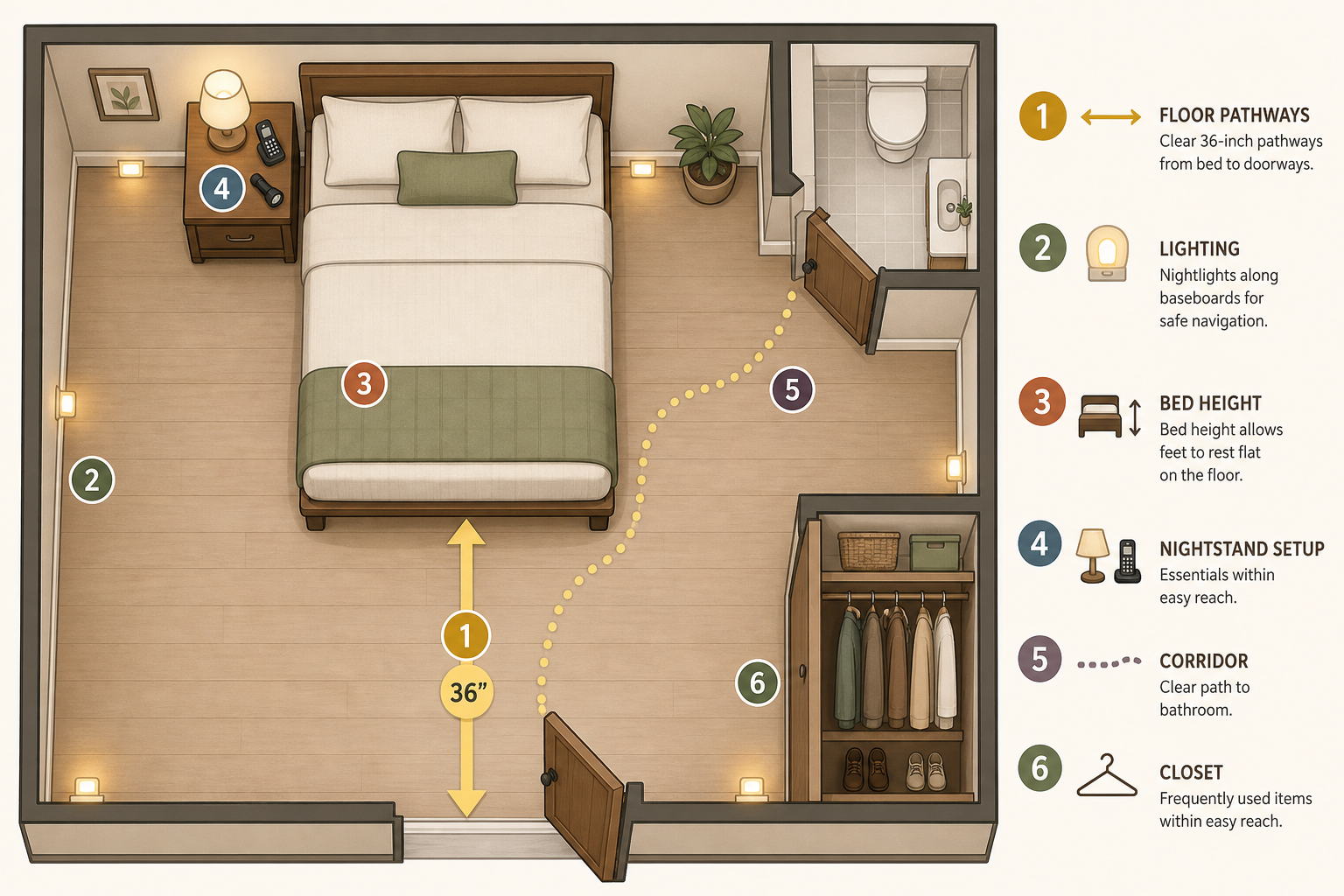
- Floor pathways and surfaces — the route from the bed to the door and bathroom, including rug placement and cord routing.
- Lighting — the transition from sleep-level darkness to enough visibility to move safely, without triggering disorienting glare.
- Bed height and egress — whether the bed allows a controlled, stable transition from lying to sitting to standing.
- Nightstand and bedside setup — whether essential items are reachable without leaning, reaching across the body, or getting out of bed unnecessarily.
- Bedroom-to-bathroom corridor — the highest-risk nighttime transition, shaped by orthostatic hypotension, vertigo, and urgency.
- Closet and wardrobe access — whether storage requires reaching overhead, bending low, or improvising with furniture as a step stool.
Zone-by-Zone Hazard Guide
Zone 1: Floor Pathways and Surfaces
Loose rugs and throw rugs are the most consistently overlooked tripping hazard in the bedroom. They shift underfoot, catch walker or cane tips, and become nearly invisible in low nighttime light. The National Institute on Aging explicitly advises against throw rugs and small area rugs throughout the home — the bedroom is not an exception.
The pathway from the side of the bed to the bedroom door (and to the bathroom beyond) should maintain a minimum clear width of 36 inches — enough to accommodate a walker or rollator without angling around furniture. Electrical cords from lamps, phone chargers, and other devices should be routed along the wall or secured with cord covers, never crossing the walking zone. Furniture that narrows the pathway — a chair at the foot of the bed, a laundry hamper in the corridor — should be relocated.
Zone 2: Lighting
Bedroom lighting presents a specific challenge: the goal is not to flood the room with bright light at 2 a.m., but to provide enough visibility to move safely without triggering the kind of glare that disrupts night vision and causes momentary disorientation.
The 2024 PMC study on lighting in long-term care facilities found that lower average bedroom light levels were significantly correlated with higher fall rates (rho = −0.18, p = .04), and that 57.7% of bedrooms fell below the 300-lux threshold recommended for focused activity. A 100-lux increase in overall lighting was associated with a 9–10% reduction in fall rate. It is worth noting that this research was conducted in New Zealand long-term care facilities with residents averaging age 85.1 — not in community homes — so the specific lux figures should be treated as directional benchmarks rather than precise home standards.
For nighttime use, the highest-return intervention is motion-activated baseboard LED path lighting — plug-in units positioned at floor level along the route from the bed to the bathroom door. These activate automatically on movement, provide enough light to navigate safely, and avoid overhead glare that can temporarily impair dark-adapted vision. Warm-spectrum bulbs rated at 2,700K or lower are preferable for nighttime use; cooler white light (above 4,000K) is more disruptive to sleep physiology.
A 2020 study cited by AARP found that each tenfold increase in room lighting was associated with 35% fewer falls in that room. A bedside lamp reachable without leaning, a light switch accessible from the lying position, and a small flashlight on the nightstand for power outages round out the lighting setup.
Zone 3: Bed Height and Egress
Bed height is a specific, measurable, and correctable fall risk factor that most generic checklists omit entirely. The goal is a mattress-top height that allows the person to sit on the edge of the bed with feet flat on the floor and knees at approximately 90 degrees. For most adults, that falls in the range of 20 to 26 inches from floor to mattress top — but the right height is determined by leg length, not by a universal number.
"If the height of the bed is too low, people oftentimes do a rocking-back-and-forth motion to gain momentum … and both of those have forward momentum and can cause falls." — Dr. Emily Samuels, geriatrician, Icahn School of Medicine at Mount Sinai, as cited by AARP
A bed that is too low forces a momentum-driven lunge to stand. A bed that is too high leaves feet dangling, making a controlled descent to standing unstable. Both are correctable: low beds can be raised with bed risers or a higher frame; high beds may require a step stool with a secure handle, or replacement with an adjustable-height care bed.
Zone 4: Nightstand and Bedside Setup
Reaching out of bed — for a glass of water, a phone, a lamp switch, or a dropped item — is a leading cause of bedside falls. The fix is straightforward: everything the person needs during the night or upon waking should be within arm's reach from a seated position on the bed edge, without leaning or twisting.
The NIA recommends keeping a phone (landline or charged mobile), a lamp or light switch, and a flashlight close to the bed. A glass of water, regularly taken medications, and glasses or hearing aids also belong on the nightstand — not on a dresser across the room. A personal emergency response device (wearable), if used, should be worn overnight or kept immediately reachable.
The nightstand itself should be stable — not a lightweight folding table or a surface that can slide — and positioned so that items on it are reachable from the seated-on-bed-edge position without the person needing to rotate their torso significantly.
Zone 5: Bedroom-to-Bathroom Corridor
The path from the bed to the bathroom is where most bedroom falls actually happen. Three physiological factors converge at this moment: orthostatic hypotension, benign paroxysmal positional vertigo (BPPV), and urgency-driven movement from nocturia or incontinence.
Orthostatic hypotension is a drop in blood pressure that occurs when a person moves from lying to standing. It can produce dizziness, lightheadedness, or brief visual dimming — enough to cause a fall in the first few steps. The recommended technique is sit-pause-stand: sit on the edge of the bed for 30 to 60 seconds before attempting to stand, allowing blood pressure to stabilize.
"Sometimes when people go to stand up from sitting down, their blood pressure drops and they get dizzy … sit on the side for a little bit; it gives you that extra beat or two to know how you're feeling." — AARP-cited expert guidance on orthostatic hypotension management
BPPV is a form of positional vertigo triggered by specific head movements, including rolling over in bed or rising quickly from a lying position. It can cause a sudden spinning sensation that resolves within seconds to a minute but is disorienting enough to cause a fall if the person is already moving.
Urgency from nocturia or incontinence compounds both risks: a person who wakes with a strong urge to urinate may move quickly and without the sit-pause-stand pause, bypassing the body's stabilization window. The corridor itself — flooring, lighting, and any obstacles — should be as safe as the bedroom proper. For individuals at very high nighttime fall risk, a bedside commode eliminates the corridor trip entirely.
Zone 6: Closet and Wardrobe Access
Closet access is the most commonly overlooked of the six zones. Reaching overhead for items on high shelves, bending to retrieve items stored on the floor, or — most dangerously — standing on a chair or step stool to reach storage are all fall risks that can be eliminated with simple reorganization.
The NIA specifically advises against standing on chairs or tables to reach items. Frequently used clothing and items should be stored at waist to shoulder height — the easy-reach zone that requires no overhead extension or low crouching. Seasonal or rarely used items can occupy higher or lower storage, but daily-use items should never require an unstable reach.
If the closet rod is too high, a lower secondary rod can be added. Sliding closet doors that require a pulling-and-stepping-back motion should be checked to ensure the person has enough clear floor space to open them without losing balance.
Bedroom Safety Checklist: Yes / No by Hazard Zone
Use this checklist to audit the bedroom one zone at a time. A "No" answer identifies an actionable hazard. The cost-tiered fix guide in the next section helps prioritize which hazards to address first.
| Checklist Item | Yes | No |
|---|---|---|
| ZONE 1: FLOOR PATHWAYS AND SURFACES | ||
| No loose rugs, throw rugs, or unsecured mats on the floor between the bed and the door | ☐ | ☐ |
| If area rugs are present, they are secured with non-slip backing or double-sided tape on all edges | ☐ | ☐ |
| A clear, unobstructed pathway of at least 36 inches runs from the bedside to the bedroom door | ☐ | ☐ |
| Electrical cords (lamp, phone charger, clock) are routed along the wall and do not cross the walking zone | ☐ | ☐ |
| No furniture (chairs, laundry hampers, footstools) narrows the pathway between bed and door | ☐ | ☐ |
| ZONE 2: LIGHTING | ||
| A lamp or light switch is reachable from the lying position in bed without getting up | ☐ | ☐ |
| Motion-activated night-lights are installed along the baseboard route from the bed to the bathroom | ☐ | ☐ |
| Night-lights use warm-spectrum bulbs (2,700K or lower) rather than bright white or blue-white light | ☐ | ☐ |
| A flashlight is kept on the nightstand for power outages | ☐ | ☐ |
| The path from the bedroom door to the bathroom is lit at night without requiring the person to find a switch | ☐ | ☐ |
| ZONE 3: BED HEIGHT AND EGRESS | ||
| When sitting on the edge of the bed, feet rest flat on the floor with knees at approximately 90 degrees | ☐ | ☐ |
| The bed does not require a rocking or lunging motion to stand from | ☐ | ☐ |
| No portable full-length bedrails are in use (entrapment risk; see CPSC recall data) | ☐ | ☐ |
| If a bed egress aid is needed, a bedside assist handle, wall grab bar, or transfer pole is in place instead | ☐ | ☐ |
| ZONE 4: NIGHTSTAND AND BEDSIDE SETUP | ||
| A telephone (landline or charged mobile) is within arm's reach from the seated bed-edge position | ☐ | ☐ |
| A lamp or light switch is within arm's reach without leaning or twisting | ☐ | ☐ |
| A flashlight is on the nightstand | ☐ | ☐ |
| A glass of water is within arm's reach | ☐ | ☐ |
| Regularly taken medications, glasses, and hearing aids are on the nightstand (not across the room) | ☐ | ☐ |
| If a personal emergency response device is used, it is worn overnight or kept immediately reachable | ☐ | ☐ |
| ZONE 5: BEDROOM-TO-BATHROOM CORRIDOR | ||
| The corridor floor between bedroom and bathroom is free of rugs, cords, and obstacles | ☐ | ☐ |
| Night-lighting is continuous from the bed to the bathroom — no dark gaps in the path | ☐ | ☐ |
| The person knows and uses the sit-pause-stand technique before getting up at night | ☐ | ☐ |
| If nocturia or urgency is a nightly occurrence, a bedside commode has been considered or is in place | ☐ | ☐ |
| ZONE 6: CLOSET AND WARDROBE ACCESS | ||
| Frequently used clothing and items are stored at waist to shoulder height (no overhead reaching required) | ☐ | ☐ |
| No chairs, step stools, or improvised surfaces are used to reach closet shelves | ☐ | ☐ |
| Closet doors open and close without requiring the person to step back into a confined or cluttered space | ☐ | ☐ |
Cost-Tiered Fix Guide: What to Do First
Not every bedroom hazard requires a contractor or a significant purchase. Many of the highest-impact changes cost nothing. The table below organizes fixes by investment level so caregivers can take immediate action the same day — and plan higher-investment changes for later.
| Investment Level | Actions | Approximate Cost |
|---|---|---|
| Zero cost — do today | Remove all loose rugs and throw rugs from the floor pathway; route electrical cords along the wall; clear furniture from the bed-to-door path; check bed height and adjust frame position if possible; move nightstand items within arm's reach; reorganize closet so daily items are at waist height | $0 |
| Under $50 — add this week | Plug-in warm-spectrum night-lights for the baseboard path; non-slip adhesive strips for any remaining rugs or transition strips; a dedicated bedside flashlight; non-slip socks or slippers with a secure fit and low heel | $10–$50 |
| $50–$300 — plan within the month | Motion-activated baseboard LED path lighting (hardwired or plug-in); a bedside assist handle that secures under the mattress; a wall-mounted grab bar beside the bed; bed risers to correct a too-low bed height | $50–$300 |
| $300 and above — for ongoing or higher-risk situations | Adjustable-height care bed (allows precise height calibration and head/foot elevation); occupational therapist home safety assessment; flooring replacement (carpet-to-low-pile or non-slip hard surface); structural grab bar installation by a CAPS-certified contractor | $300–$3,000+ |
For higher-investment modifications, several funding sources may apply. Medicare Part B covers durable medical equipment (DME) when prescribed by a physician — this can include items such as hospital-grade beds and prescribed assistive devices. Medicaid Home and Community-Based Services (HCBS) waiver programs in many states cover grab bars, ramps, and home modifications for eligible individuals. Area Agencies on Aging (AAA) often administer local home modification assistance programs; contact your local AAA through the Eldercare Locator (eldercare.acl.gov) to find programs in your area.
The Nighttime Risk Window: Nocturia, Orthostatic Hypotension, and the Bed-to-Bathroom Trip
Understanding why bedroom falls cluster at night — rather than during daytime activity — makes the six-zone framework more useful. Three physiological factors converge during nighttime bathroom trips to create a risk window that is qualitatively different from daytime movement.
Nocturia — waking at night to urinate — is common among older adults and becomes more frequent with age. When the urge is strong, many people move quickly from lying to standing without pausing, bypassing the body's natural blood pressure stabilization process. This urgency-driven movement is one of the most consistent behavioral contributors to nighttime bedroom falls.
Orthostatic hypotension amplifies the risk. When a person moves from lying to sitting to standing, blood pressure normally drops briefly before compensating mechanisms restore it. In older adults — particularly those on antihypertensive medications, diuretics, or certain other drug classes — this compensation is slower or less complete. The result is a few seconds of dizziness or lightheadedness that, if the person is already moving toward the bathroom, can cause a fall before they have a chance to steady themselves.
BPPV (benign paroxysmal positional vertigo) is a third factor. It is triggered by specific head position changes — including rolling over in bed or rising quickly from a lying position — and produces a sudden spinning sensation that typically lasts seconds to a minute. For someone already navigating a dark corridor with urgency, a BPPV episode can be enough to cause a fall.
The six hazard zones intersect directly with this nighttime risk window:
- Zone 2 (Lighting): Motion-activated baseboard lights eliminate the need to find a switch while disoriented, and provide enough visibility to navigate without triggering glare that worsens temporary vision disturbance.
- Zone 3 (Bed height): A correctly calibrated bed height makes the sit-pause-stand sequence natural and stable — a too-low bed makes it nearly impossible to pause before standing.
- Zone 4 (Nightstand setup): Glasses, a phone, and a lamp within arm's reach mean the person does not need to get up to retrieve items before their body has stabilized.
- Zone 5 (Corridor): A clear, lit corridor with continuous flooring removes the obstacles that turn a momentary dizzy spell into a fall.
For individuals who experience nocturia multiple times per night, or who have had a nighttime fall, a bedside commode is worth discussing with a physician or occupational therapist. Eliminating the corridor trip removes the entire Zone 5 risk for the most vulnerable nighttime window.
When to Request a Professional Assessment
This checklist is an educational reference — it identifies hazards and suggests fixes, but it does not replace the individualized assessment of a licensed professional. Three types of professional involvement are worth considering, depending on the situation.
- Occupational therapist (OT) home assessment. An OT can assess the bedroom in the context of the person's specific functional abilities, mobility aids, and daily routines — and recommend modifications tailored to that individual. Cochrane systematic reviews indicate that home hazard reduction programs reduce fall rates by approximately 26%, with OT-led programs demonstrating fall reductions of 31–39% in controlled trials. A physician referral may be needed for Medicare Part B coverage of this assessment.
- CAPS-certified contractor. For structural modifications — wall-mounted grab bars, flooring replacement, doorway widening — a Certified Aging-in-Place Specialist (CAPS) contractor has specific training in aging-related home modification. CAPS certification indicates training in this area but does not guarantee any specific outcome; verify contractor credentials and references independently.
- Physician medication review. Certain medication classes are independently associated with increased fall risk. These include benzodiazepines (such as those used for anxiety or sleep), antidepressants, and anticholinergics — a broad class that includes some over-the-counter sleep aids and antihistamines. If the person takes any of these medications and has had a fall or near-fall, a medication review with the prescribing physician is appropriate. Do not stop or adjust medications without physician guidance.
Related Safety Resources
A bedroom-specific audit is one component of a whole-home fall prevention approach. The following areas are natural next steps once the bedroom has been addressed:
- Bathroom safety — the bathroom is the second highest-risk room in the home, with distinct hazards (wet surfaces, tub entry and exit, toilet height) that require their own dedicated assessment. Grab bar placement in the shower and beside the toilet, non-slip bath mats, and a shower chair or tub transfer bench are the primary interventions.
- Grab bar installation — wall-mounted grab bars beside the bed, toilet, and in the shower require proper anchoring into wall studs or blocking. A guide to grab bar placement standards and installation considerations is a useful complement to both the bedroom and bathroom checklists.
- Personal emergency response systems (PERS) — a wearable medical alert device provides a safety net for falls that occur despite preventive measures. For individuals who live alone or who are at elevated fall risk, understanding the categories of PERS devices (in-home vs. mobile, automatic fall detection vs. manual activation) helps caregivers evaluate options without relying on product-specific marketing claims.
Related reading
Noticed something outdated or inaccurate on this page? Flag a correction. We review every report against CDC, NIA, and AARP HomeFit guidance before updating a page.
Part of the Fall Prevention section.