
Room-by-Room Fall Prevention Checklist for the Senior Home: A CDC STEADI-Aligned Walkthrough
If your parent has fallen at home, this room-by-room checklist helps you identify and fix hazards immediately. Based on the CDC STEADI 'Check for Safety' framework, it covers stairs, bathrooms, bedrooms, kitchens, living areas, and outdoors — with quick fixes under $20 and guidance on when to call an occupational therapist.
Why Falls Happen at Home — and Why This Checklist Works
If your parent has fallen, you are not alone — and the statistics are sobering. More than one in four older adults falls each year, according to the CDC, yet less than half of them tell their doctor. Falling once doubles the risk of falling again. Each year, roughly 3 million emergency department visits and about 1 million hospitalizations among older adults are linked to falls.
Where do these falls happen? The data is clear: 55% of fall injuries among older adults occur inside the home, and an additional 23% happen just outside, near the house. That means more than three-quarters of fall injuries are tied directly to the home environment — the stairs your parent uses daily, the bathroom they visit at night, the rug they have walked over for years.
The good news is that most of these falls are preventable. Research published in the Lancet and cited in a 2025 Stanford/UCSF study found that home safety assessments can reduce fall risk by up to 36% and decrease serious injuries such as hip fractures. A randomized controlled trial of 842 senior households showed a 26% decrease in fall injuries after standardized home modifications.
This checklist is built on the CDC's STEADI (Stopping Elderly Accidents, Deaths & Injuries) initiative — specifically the Check for Safety framework. It is a systematic, room-by-room walkthrough designed for families to use immediately, without waiting for a professional assessment. It will not replace an occupational therapist's evaluation, but it will give you a clear starting point — and in many cases, the fixes you need cost less than $20 and take less than an hour to install.
Before You Start: What You'll Need and How to Use This Checklist
This is a systematic inspection, not a quick glance. Set aside 45 minutes to an hour. Walk through each room with the older adult if they are willing and able — they know the home's quirks better than you do. Bring a small toolkit and a notebook.
- Flashlight — to check lighting adequacy and dark corners
- Measuring tape — to check handrail height, bed height, and step dimensions
- Screwdriver — for tightening loose handrails, grab bars, or door hinges
- Notebook or phone — to record hazards found and fixes needed
- Camera — take photos of problem areas for reference when shopping for supplies
Work through the checklist one room at a time. Mark each item as safe, needs repair, or not applicable. Do not skip rooms — the hazard that causes a fall is often the one you did not notice. After the walkthrough, prioritize fixes by cost and urgency: address immediate trip hazards today, plan for structural modifications over the coming weeks.
Stairs and Entryways: The First Line of Defense
Stairs are the most dangerous vertical space in any home. The National Safety Council reports that over the past decade, fall-related deaths among older adults have increased by 51%, and stairs are a primary contributor. Every staircase and entry point in the home needs a thorough inspection.
- Handrails on both sides of every staircase — they must be secure, easy to grip, and extend the full length of the stairs. The NIA recommends handrails on both sides, not just one.
- Good lighting at the top and bottom of stairs — switches should be accessible without walking up or down in the dark. Consider installing glow-in-the-dark light switch covers.
- Non-slip treads or adhesive strips on each step — especially important if the stairs are carpeted, hardwood, or tile.
- Steps are clear of clutter — no shoes, books, pet toys, or storage items on the stairs.
- Loose or frayed carpet is repaired or replaced — tripping on loose carpet is one of the most common stair hazards.
- Entryway mats are secure and non-slip — use a mat with a rubber backing or remove it entirely if it curls or slides.
- A grab bar near the front door — helps with balance when entering or exiting, especially in wet or icy weather.
Bathroom: The Highest-Risk Room in the Home
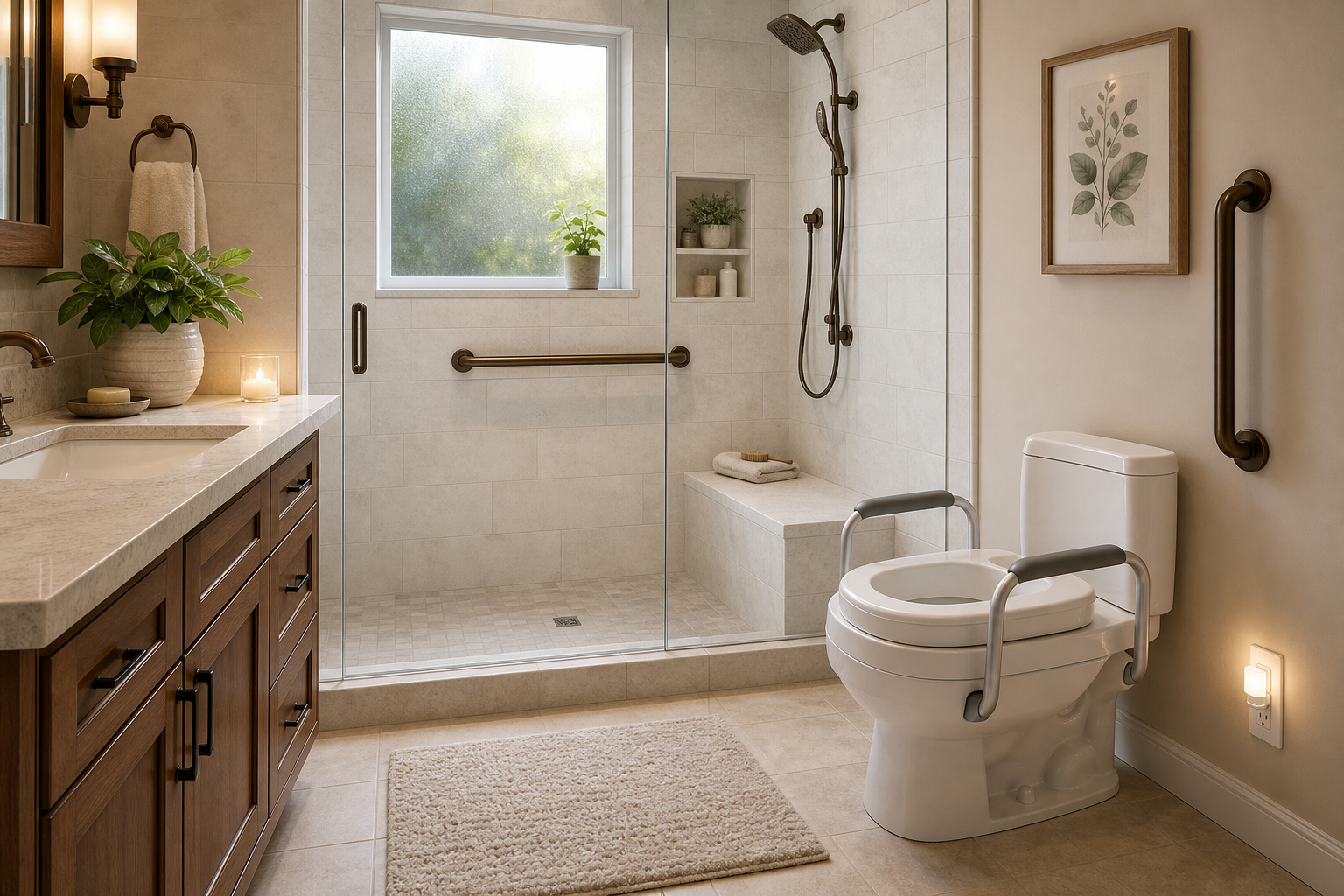
The bathroom is the number one location for home accidents among older adults. Wet surfaces, hard fixtures, and the need to transfer on and off the toilet or in and out of the shower create a perfect storm for falls. The NIA and Mayo Clinic both emphasize that bathroom modifications are among the most impactful changes you can make.
- Grab bars installed near the toilet and inside the tub or shower — not towel racks or soap dishes, which are not weight-bearing. Grab bars must be anchored into wall studs or blocking.
- Non-slip mats or adhesive strips in the tub and shower floor — these are inexpensive and can be installed in minutes.
- A raised toilet seat or toilet safety frame — reduces the distance of the sit-to-stand transfer, which is a common fall moment.
- A shower chair or transfer bench — allows the older adult to sit while bathing, eliminating the need to stand on a wet surface.
- Good lighting and a nightlight — the bathroom should be well-lit at all times, especially for middle-of-the-night visits.
- Water heater set to no more than 120°F — prevents scalding, which is a separate but serious risk for older adults with reduced sensation.
- Loose bath mats removed or secured with non-slip backing — bath mats are a classic trip hazard.
For a detailed breakdown of bathroom modification costs — from $200 grab bar installations to full walk-in shower renovations — see our Bathroom Remodel for Elderly Safety guide.
Bedroom: Safe Transitions from Sleep to Standing
Falls in the bedroom often happen during the most vulnerable moments — getting out of bed at night, disoriented and in a hurry to reach the bathroom. The NIA recommends several simple adjustments that dramatically reduce risk.
- Night lights and light switches close to the bed — the path from bed to bathroom should be illuminated without needing to cross a dark room.
- A clear, clutter-free path from the bed to the bathroom — remove shoes, cords, pet beds, and furniture that protrudes into the walking path.
- Bed height that allows the older adult to sit with feet flat on the floor — beds that are too low are difficult to rise from; beds that are too high create a drop risk.
- A flashlight kept on the nightstand — in case of power outage or if the night light fails.
- Loose rugs removed or secured with double-sided tape — area rugs near the bed are a common trip hazard during nighttime bathroom trips.
- Phone or emergency alert device within arm's reach of the bed — if a fall does happen, the older adult needs to be able to call for help.
If the older adult has dementia or is prone to wandering at night, additional safety measures — such as bed alarms or motion-sensor night lights — may be needed. Those are covered in our Memory Care section.
Kitchen and Living Areas: Daily Movement Hazards
The kitchen and living areas are where older adults spend most of their waking hours. These spaces accumulate clutter, cords, and small items that become trip hazards. The fixes here are almost all low-cost and immediate.
- Spills wiped up immediately — a wet spot on a kitchen or bathroom floor is a slip hazard within seconds.
- A sturdy step stool with a handrail for reaching high shelves — never use a chair, counter, or unstable stool.
- Clear walking paths free of electrical cords, phone chargers, and extension cords — tape cords to the baseboards or use cord shorteners.
- Furniture arranged to create wide, unobstructed pathways — at least 36 inches wide for walker or wheelchair access.
- Non-slip mats in front of the sink and stove — these are high-splash zones where the floor can become slick.
- Good lighting throughout — replace dim bulbs, add floor lamps in dark corners, and ensure light switches are accessible at room entrances.
- Throw rugs removed or secured with double-sided carpet tape — throw rugs are one of the most frequently cited fall hazards by the CDC and NIA.
The NIA also suggests preparing food while seated at a table rather than standing at the counter, which reduces fatigue and the risk of losing balance.
Outdoors and Exterior: Beyond the Front Door
Nearly a quarter of fall injuries happen just outside the home — on steps, porches, walkways, and driveways. These areas are exposed to weather, uneven surfaces, and poor lighting, making them especially hazardous.
- Secure handrails on both sides of all exterior steps — handrails should be sturdy and easy to grip, even with wet hands.
- Non-slip material on porches, decks, and ramps — adhesive non-slip strips or paint with a textured additive can be applied to wood or concrete surfaces.
- Broken or uneven walkways repaired — cracks, lifted pavement, and loose stones are trip hazards that should be fixed immediately.
- Adequate outdoor lighting — motion-activated lights near the front door, garage, and along walkways ensure the path is visible at night.
- Ice melt or sand stored near the door during winter — apply before the older adult needs to step outside.
- A grab bar installed near the front door — provides stability when unlocking the door or stepping over the threshold.
Quick Fixes Under $20 vs. Major Modifications: What to Do Now vs. Plan For
Not every fix requires a contractor or a large budget. Many of the most effective fall prevention measures cost less than $20 and can be installed in an afternoon. The key is knowing which fixes are urgent and which can be planned over time.
| Fix Type | Examples | Approximate Cost | Urgency |
|---|---|---|---|
| Non-slip adhesive strips | Bathroom tub/shower, outdoor steps | $5–$15 per pack | Immediate |
| Grab bars (basic) | Near toilet, in shower, near front door | $15–$50 each (installation extra) | Immediate |
| Night lights | Bedroom, bathroom, hallway | $5–$15 each | Immediate |
| Raised toilet seat | Bathroom | $25–$60 | Within a week |
| Shower chair or transfer bench | Bathroom | $30–$100 | Within a week |
| Cord shorteners or tape | Living room, bedroom, kitchen | $5–$10 | Immediate |
| Handrail installation (both sides) | Stairs, interior and exterior | $50–$200 per rail (installed) | Within a month |
| Stair lift | Multi-level home | $3,000–$10,000 (installed) | Plan over 3–6 months |
| Walk-in tub or shower remodel | Bathroom | $3,000–$15,000+ | Plan over 6–12 months |
| Ramp installation | Entryway | $1,000–$5,000 (installed) | Plan over 1–3 months |
A cost-benefit analysis cited by Age Safe America found that the average cost per home modification was $448, and that investing in modifications produced a 33% reduction in spending to treat fall injuries over three years. For families weighing the cost of modifications against the cost of a single fall-related hospitalization — which averages $18,658 per inpatient visit according to NCOA — the economic case is clear.
For a deeper look at the research behind home modifications — including the 39% reduction in falls and 42% reduction in care hours documented in peer-reviewed studies — see our guide on The Evidence for Aging-in-Place Remodels.
When to Call an Occupational Therapist for a Professional Home Safety Assessment
This checklist is a powerful starting point, but it has limits. A professional home safety assessment conducted by an occupational therapist (OT) goes beyond what a family member can see — an OT evaluates the older adult's specific movement patterns, strength, balance, and cognitive function, then recommends modifications tailored to their individual needs.
Consider requesting a professional assessment if any of the following apply:
- The older adult has already fallen and sustained an injury
- There have been two or more falls in the past 12 months
- The older adult uses a walker, cane, or wheelchair and has difficulty navigating the home
- There is a diagnosed condition affecting balance, strength, or cognition (e.g., Parkinson's, stroke recovery, dementia)
- The older adult has been hospitalized recently and is returning home with changed mobility
An OT will typically spend 60–90 minutes in the home, observing the older adult performing daily tasks — getting in and out of bed, walking to the bathroom, preparing a meal — and identifying risks that a checklist cannot capture. They can also recommend specific equipment (e.g., the right type of walker or transfer aid) and provide training on how to use it safely.
Occupational therapists differ from CAPS (Certified Aging-in-Place Specialists), who focus on the structural and design aspects of home modifications. An OT evaluates the person; a CAPS specialist evaluates the building. For complex projects involving both clinical and structural needs, the two professionals often work together.
For a detailed comparison of these two roles and guidance on which professional to call first, see our article: Occupational Therapist vs. CAPS Specialist: Who Should Assess Your Parent's Home for Safety?
Related reading
Noticed something outdated or inaccurate on this page? Flag a correction. We review every report against CDC, NIA, and AARP HomeFit guidance before updating a page.
Part of the Fall Prevention section.