
Cancer Diagnosis in Older Adults: What to Expect and How to Prevent Falls
This article explains why a new cancer diagnosis in an older adult raises fall risk even before treatment begins, outlines the diagnostic timeline, and provides actionable steps to prevent falls during the 2–6 week window before treatment starts.
After an older adult hears “cancer,” “possible cancer,” or “we need a biopsy,” the family usually starts looking toward the treatment decision. Surgery, chemotherapy, radiation, pills, staging, second opinions — those are the loud questions. But for many older adults, the first safety problem starts earlier, in the days and weeks before treatment begins.
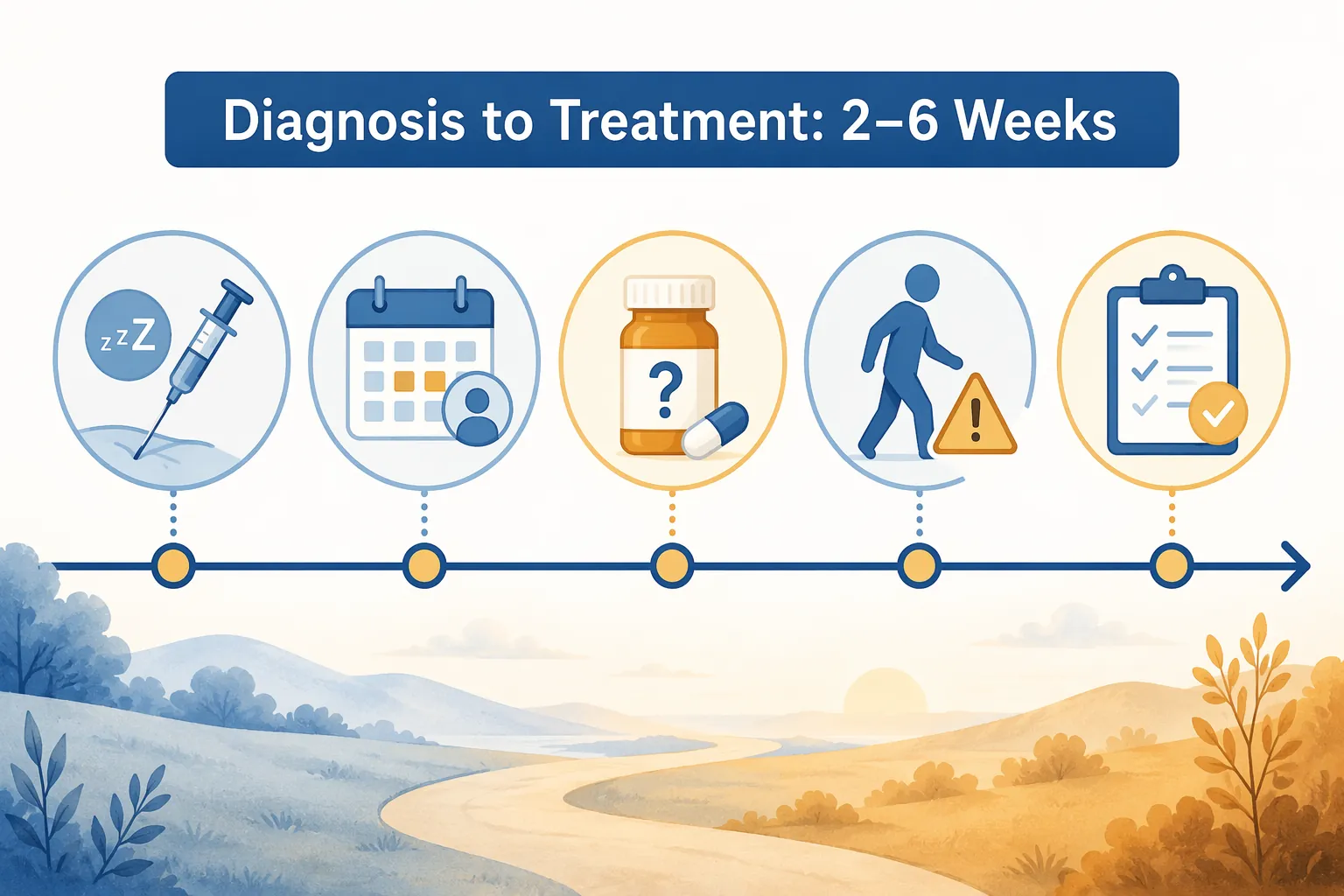
That waiting period is not empty time. The American Cancer Society describes the caregiver’s early cancer timeline as moving through diagnosis, more testing, treatment planning, treatment, and follow-up; in practice, families often spend roughly 2 to 6 weeks moving from an abnormal finding or diagnosis into the first treatment step, depending on the cancer, needed tests, and scheduling.[1] During that same window, older adults may be recovering from a biopsy, sleeping poorly, eating irregularly, changing medications, walking through unfamiliar clinics, and trying to absorb frightening news.
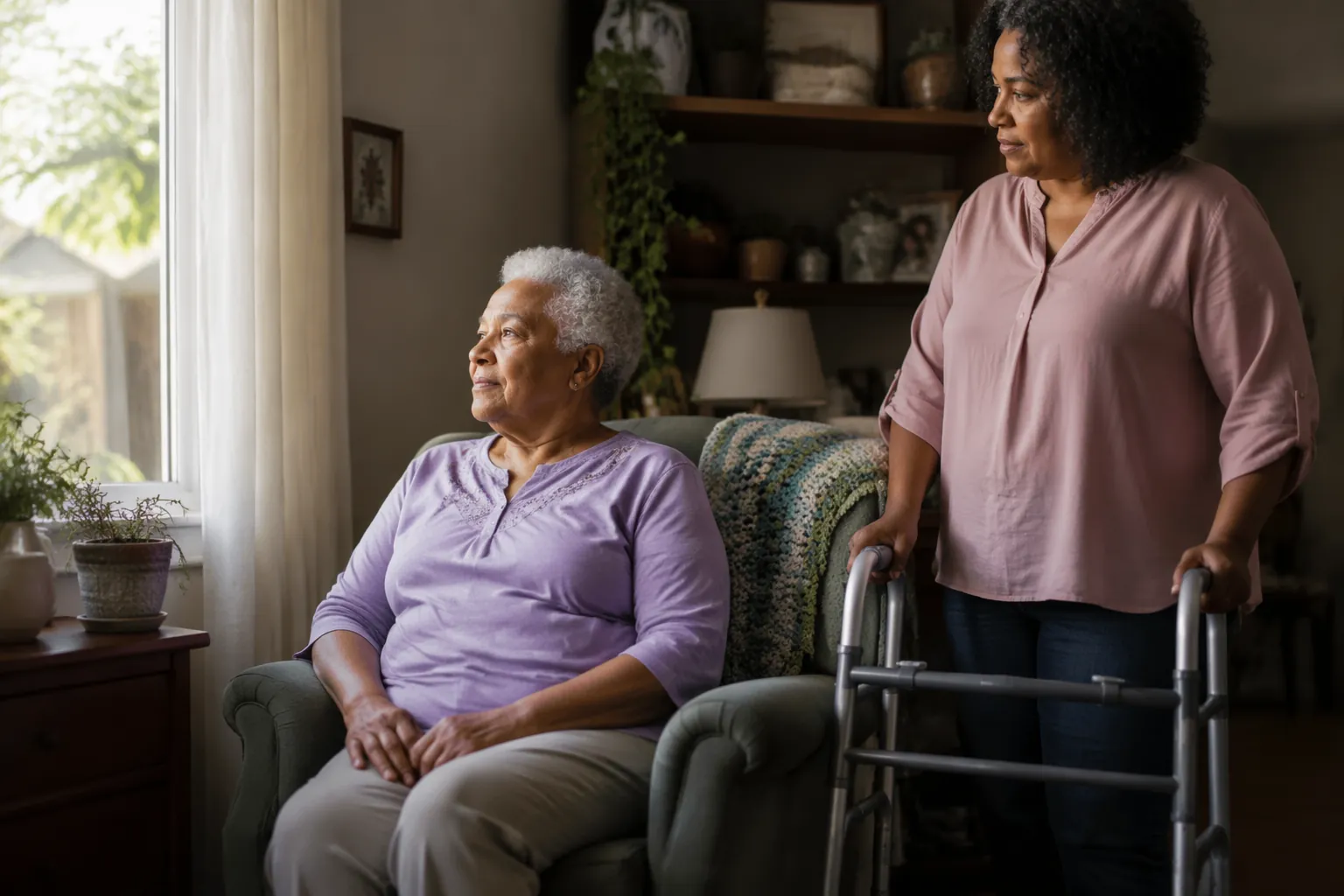
For an older adult, that is enough to change fall risk before a single treatment side effect appears. A family asking what to expect after a cancer diagnosis in an older adult needs the medical timeline, but also the Tuesday morning realities: who drives after sedation, who clears the hallway, who checks whether breakfast was skipped, and who brings the medication bottles to the next visit.
The First Few Weeks: What Usually Happens Next
Cancer diagnosis is rarely one appointment. The National Cancer Institute explains that doctors use exams, lab tests, imaging tests, biopsies, and pathology results to diagnose cancer and understand where it is in the body.[2] For the family, that means the early calendar often fills before anyone feels ready for it.
| Part of the early cancer timeline | What the family should expect | Fall-prevention action to do at the same time |
|---|---|---|
| Abnormal test, scan, or exam | More appointments are scheduled to confirm what was found. | Start a shared calendar and identify who can drive, wait, and hear instructions. |
| Biopsy or procedure | A tissue sample may be taken; some procedures use sedation. | Plan supervision for the first 24–48 hours if sedation is used, and keep the path to the bathroom clear. |
| Imaging and staging workup | Scans and lab work help the team understand the cancer’s extent. | Protect meals, hydration, rest breaks, and mobility aids on long clinic days. |
| Treatment-planning visit | The oncology team discusses options and trade-offs. | Bring medications, a fall history, recent confusion or fatigue notes, and ask for geriatric assessment. |
| Treatment start | The first treatment may be surgery, radiation, chemotherapy, immunotherapy, targeted therapy, hormone therapy, or another plan. | Make sure the home is already safer; treatment days are a poor time to discover loose rugs and missing grab bars. |
The exact sequence varies. Some cancers move faster; some require more scans, specialist visits, or pathology testing. What should not vary is the family’s decision to treat the diagnostic period as a safety period, not just a waiting period.
Why Fall Risk Changes Before Treatment Starts
Older adults with a new cancer diagnosis have been reported to have a 15% to 20% higher fall risk than similar adults without cancer, even before treatment begins.[3] That number matters because it catches the part families often miss: the diagnosis itself can destabilize routines.
The reasons are ordinary and cumulative. A biopsy may mean sedation and a groggy walk to the bathroom that night. A scan day may mean leaving home before breakfast. Anxiety may make someone rush, sleep poorly, or get up more often in the dark. Pain, anemia, weakness, dehydration, or infection may already be present. New specialists may add or stop medications while the primary care list is still sitting in a kitchen drawer.
The wider oncology literature also reports high fall rates among older adults with cancer, with estimates around 30% to 50% during or after treatment in some studies.[4] That range should not be used as a blanket prediction for every newly diagnosed older adult. The higher end comes from more vulnerable groups, including advanced or palliative-care populations. Still, it is a clear warning that cancer care and fall prevention belong in the same conversation.
The Biopsy Day Is a Safety Event, Not Just a Diagnostic Step
Families are often so focused on the biopsy result that they under-plan the biopsy recovery. A biopsy is the procedure that removes tissue so a pathologist can look for cancer cells.[2] Depending on the site and method, an older adult may receive local anesthesia, moderate sedation, or another medication plan. If sedation is used, the first 24 to 48 hours deserve practical supervision.
- Do not let the older adult drive home or “just run one errand” after a sedated procedure.
- Have someone stay within hearing distance the first night, especially if the bathroom is down a hall or on another floor.
- Keep a light on the bathroom path and remove throw rugs, shoes, cords, pet bowls, and low stools from that route.
- Put water, a phone, glasses, hearing aids, and the discharge instructions within easy reach.
- Call the procedure team if there is new confusion, heavy bleeding, fever, worsening weakness, or pain that makes walking unsafe.
This is not overprotecting. It is matching the environment to a temporary change in balance, alertness, and confidence.
Appointments Can Quietly Disrupt Food, Fluids, and Strength
Clinic days look passive on paper: arrive, wait, scan, wait again, drive home. In an older body, they can be tiring. A morning appointment may push breakfast later. A fasting instruction may be misunderstood and continued too long. A long walk from the parking garage may be the most walking someone has done all week. A spouse may be listening for cancer details and miss the fact that the patient has not had water since early morning.
Before each appointment, ask three plain questions: Is fasting required? Which medications should be taken that morning? How long will we likely be away from home? If the clinic allows it, pack a snack, water, a current medication list, reading glasses, hearing aids, and the usual cane or walker. If a wheelchair from the entrance will conserve enough energy for the visit itself, use it without turning that into a referendum on independence.
Fatigue before treatment should be written down, not waved away. Note when it started, whether it is worse after procedures, whether the person is sleeping in a chair more than usual, and whether walking speed has changed. Those details help the oncology team separate cancer symptoms, medication effects, dehydration, infection, and ordinary appointment exhaustion.
Medication Confusion Is Almost Built Into This Moment
Nearly 90% of older adults with cancer have at least one other chronic condition, according to the American Cancer Society.[5] That means most are not arriving at oncology with an empty medication slate. They may already be taking blood pressure medicines, diabetes medicines, sleep aids, pain medicines, blood thinners, antidepressants, bladder medicines, or supplements.
The safest medication review is not a neat list typed from memory. It is the actual bottles, inhalers, eye drops, patches, over-the-counter pills, vitamins, and supplements placed in one bag and brought to the appointment. If that is not possible, take clear photos of each label and dose direction.
- Ask which medicines increase dizziness, sleepiness, low blood pressure, or bathroom urgency.
- Ask whether any medicines should be held before biopsy, surgery, scans, or fasting lab work.
- Ask who is responsible for medication changes: oncology, primary care, cardiology, or another specialist.
- Ask for an updated printed or portal medication list after changes are made.
A fall can happen because one pill was added. It can also happen because one pill was stopped, doubled, taken without food, or taken after a fasting instruction was misunderstood.
Fall-Proof the Highest-Risk Places First
You do not need to renovate the whole house before the staging scan. Start where a tired, worried, or sedated person is most likely to walk: bed to bathroom, favorite chair to kitchen, entryway to car. Cancer centers commonly advise patients to use handrails, wear stable shoes, keep floors clear, use assistive devices as directed, and ask for help when feeling weak or dizzy.[6]
- Remove throw rugs or tape down edges on the main walking paths.
- Add night lights from bed to bathroom and near any step or threshold.
- Move frequently used items to waist-to-shoulder height so no one climbs or bends deeply.
- Put a sturdy chair near the entry if shoes, coats, or appointment bags are handled there.
- Check that the cane or walker is actually used inside the home, not saved for clinic visits.
- Keep the phone reachable from the bed, bathroom area, and main chair.
The bathroom deserves special attention because urgency, nighttime waking, pain medicine, and poor lighting often meet there. A non-slip bath mat, grab bars, a raised toilet seat when appropriate, and a clear route may prevent the fall that would delay treatment before it starts.
Ask for a Geriatric Assessment Before Treatment Decisions Are Final
The most useful sentence a caregiver can bring to the treatment-planning visit is simple: “Can we do a geriatric assessment before the final treatment plan?”
A geriatric assessment is not a judgment about whether someone is “too old” for cancer treatment. It is a structured way to find risks that a standard oncology visit may miss. The American Cancer Society describes geriatric assessment as looking across seven domains: strength and mobility, memory and cognition, medications, nutrition and weight, emotional health, social support, and personal goals.[5]
The assessment can be brief. The ACS describes a patient survey that may take about 5 to 10 minutes, along with short checks such as walking and memory tests.[5] The point is not to create another burden. The point is to notice, before treatment begins, that a patient is losing weight, forgetting instructions, using furniture for balance, taking a risky medication combination, or depending on a caregiver who cannot safely cover every appointment.
This matters because geriatric assessment can change care. In an NCI-funded nationwide trial of patients aged 70 and older with advanced cancer who were receiving chemotherapy in community oncology practices, geriatric-assessment-guided care reduced severe treatment side effects from about 70% to about 50%.[7] The same trial also found that falls dropped from 21% to 12%.[7]
Those results should be applied carefully. The strongest evidence from that trial comes from older adults with advanced cancer receiving chemotherapy, so the exact benefit may differ for an early-stage cancer, surgery-first plan, radiation-only plan, or non-chemotherapy treatment. But the logic is still practical: if weakness, cognition, nutrition, medications, mood, support, and goals affect whether treatment is safe, they should be known before the plan is locked in.
Medicare coverage is another reason to ask directly. The ACS notes that geriatric assessment is covered as part of an evaluation and management visit, with Medicare typically covering 80% after the deductible.[5] Families may still need to ask how the local clinic performs it, who reviews the results, and whether recommendations will be added to the treatment plan.
What to Say at the Oncology Visit
- “Has my parent had a geriatric assessment, or can we schedule one before treatment starts?”
- “They have had a fall, near-fall, new dizziness, or new confusion since the diagnosis.”
- “Can someone review these medications for fall risk and treatment interactions?”
- “Should physical therapy, nutrition, social work, pharmacy, or palliative care be involved now?”
- “Which symptoms should make us call before the next appointment?”
When to Call Instead of Waiting for the Next Appointment
Some changes should not wait for the next scheduled oncology visit. Call the oncology team, primary care clinician, procedure team, or urgent line if the older adult has a fall, hits their head, becomes newly confused, cannot walk safely to the bathroom, has repeated dizziness, cannot keep fluids down, has uncontrolled pain, or seems too weak to get out of a chair without help.
Also call if the caregiver cannot safely provide the supervision that discharge instructions assume. Many instructions say “have a responsible adult with you,” but they do not always ask whether that person can lift, drive, hear overnight, manage medications, or stay awake after a long day. If the home plan is not safe, the clinical team needs to know before the family quietly improvises.
The Next Appointment Cycle: A Short Safety Plan
Before the next biopsy, scan, staging visit, or treatment-planning appointment, make the plan small enough to finish.
- Name the fall-risk window: the weeks before treatment are part of cancer safety planning.
- Protect the biopsy or sedation period: arrange transportation, supervision, lighting, and a clear bathroom path.
- Stabilize food, fluids, and medications: ask about fasting, bring snacks when allowed, and carry the real medication list or bottles.
- Fix the highest-risk home routes first: bed to bathroom, chair to kitchen, entryway to car.
- Request geriatric assessment before treatment begins, especially for adults 65 and older or anyone with falls, frailty, memory concerns, multiple medications, weight loss, or limited support.
Families cannot make the diagnosis less frightening by organizing the hallway or gathering pill bottles. But they can make the waiting period safer. For older adults with cancer, the time before treatment starts is prevention time.
References
- Understanding the Cancer Experience When You're a Caregiver, American Cancer Society.
- How Cancer Is Diagnosed, National Cancer Institute.
- Falls in Older Patients With Cancer: Recognizing and Reducing the Risk, The ASCO Post, January 25, 2017.
- Systematic Review of Falls in Older Adults with Cancer, PMC.
- How Geriatric Assessments Can Benefit Older Adults with Cancer, American Cancer Society, April 2026.
- Fall Prevention, Fred Hutch.
- For Older Adults, Geriatric Assessment Reduces Cancer Treatment Side Effects, NCI Cancer Currents, 2021.
Related reading
Noticed something outdated or inaccurate on this page? Flag a correction. We review every report against CDC, NIA, and AARP HomeFit guidance before updating a page.
Part of the Fall Prevention section.