
Why heat advisories raise fall risk in older adults
Learn how heat advisories independently increase fall risk through four distinct physiological pathways — dehydration, blood pressure drops, medication interference, and cumulative fatigue — so caregivers can spot early warning signs and prevent falls before they happen.
The heat advisory goes up, and the usual checklist starts running in your head: water, air conditioning, shade, emergency symptoms. But when you call an older parent, the first clue may not sound like heat stroke. It may be a slower answer than usual, a pause before standing, a hand on the wall, or the familiar “I’m fine” delivered in a voice that is doing too much work.
That is why useful heat safety tips for older adults during a heat advisory have to include fall prevention. Heat does not wait until someone collapses outdoors. It can change hydration, blood pressure, medication tolerance, attention, and reaction time inside an ordinary home, before anyone thinks to connect the stumble in the hallway with the weather alert.
The reason to take the alert seriously is not abstract. In CDC mortality data from 2004 through 2018, adults 65 and older had the highest heat-related mortality rate, 0.7 deaths per 100,000, and accounted for about 40% of heat-related deaths in the United States.[1] A Harvard T.H. Chan School of Public Health report on a March 2026 Lancet Planetary Health study estimated roughly 17,600 excess deaths per year among older adults from heat waves, with Black older adults facing three times the risk.[2] Those numbers are the backdrop. The practical question for today is smaller and more immediate: why is this particular parent more likely to fall this afternoon?
A heat advisory changes the body before it looks like an emergency
Older adults are not just younger adults with more summer errands to avoid. The CDC notes that older adults do not adjust as well to sudden temperature changes and are more likely to have chronic medical conditions or take medicines that affect the body’s response to heat.[3] Thirst can also become a less reliable alarm. By the time an older adult says they feel thirsty, unsteady changes may already be underway.
For fall risk, that matters because standing, walking, turning, and recovering from a small trip all depend on several systems working together at once. The brain has to stay alert. Blood pressure has to adjust when the person stands. Muscles have to respond quickly. Vision and balance have to keep updating while the person moves through the room. Heat can interfere with each part of that chain.
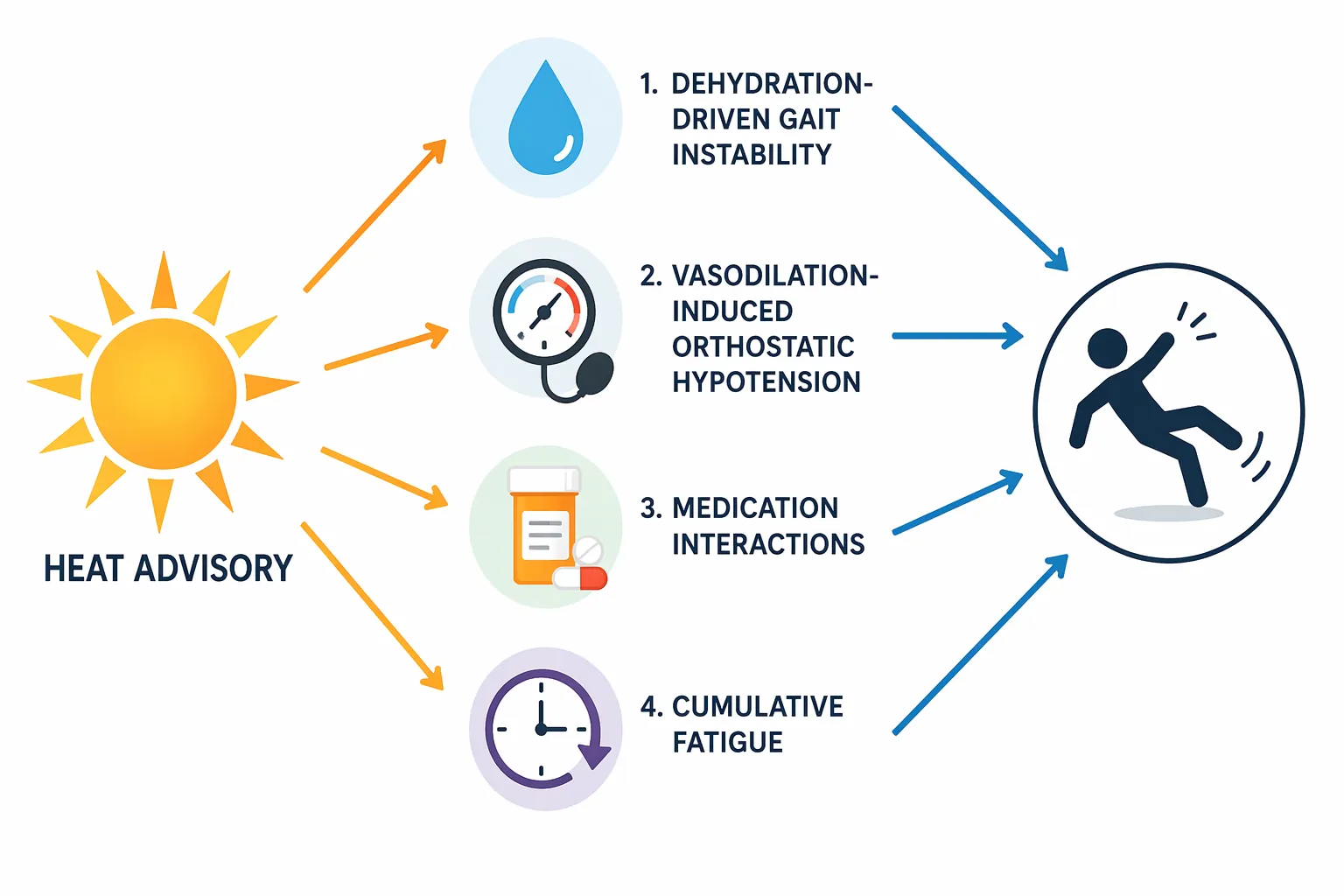
1. Dehydration can show up as sloppy movement, not just thirst
Dehydration is the familiar heat risk, but it is often described too simply. The fall danger is not only that an older adult feels thirsty or dizzy. Dehydration can impair cognition and judgment in older adults, which can contribute directly to falls.[4] In real life, that may look like choosing not to use the walker for a “quick” trip to the bathroom, misjudging the distance to a chair, or standing up before the body is ready.
The caregiver-visible signs are often ordinary enough to be dismissed: a parent skipping lunch because cooking feels like too much, drinking mostly coffee or very little at all, sounding foggy on the phone, or walking with shorter, less confident steps. A person may deny feeling thirsty and still be underhydrated enough for balance and attention to suffer.
The practical move is to make drinking and eating easier before the heat peaks. Put water within reach where the person actually sits, not just in the kitchen. Pair fluids with routine moments: morning pills, a phone call, lunch, an afternoon TV program. Add simple food that does not require using the stove if heat has made cooking feel exhausting.
There is an important exception. Older adults with heart failure, kidney disease, or a prescribed fluid restriction should not be told to “just drink more.” In that situation, the safer instruction is to ask the clinician what heat-day fluid targets should be and what warning signs should trigger a call.
2. Heat can drop blood pressure right when someone stands
This is the pathway I would watch most closely in a parent who says, “I only got a little light-headed.” In hot weather, blood vessels widen to help move heat toward the skin. That vasodilation can lower blood pressure and cause light-headedness or fainting, especially when someone stands up.[4][5] For an older adult, the risky moment may be the first ten steps after rising from a recliner, bed, toilet, porch chair, or car seat.
Heat syncope is fainting or near-fainting related to heat exposure, and it is a documented precursor to falls.[6] It does not need to look dramatic. A person may describe “a funny spell,” “the room moving,” “my knees went soft,” or “I had to grab the counter.” If nobody asks what was happening just before the stumble, the fall may be treated as a random accident instead of a heat-related warning.
The prevention step is boring, which is exactly why it works: slow the transition from lying or sitting to walking. On advisory days, standing should become a two-part action. Sit upright first. Pause. Stand with support. Pause again. Then walk. If the older adult uses a cane or walker, it needs to be within reach before standing, not parked across the room.
- Watch for hand-to-wall walking, sudden sitting back down, or needing furniture for balance after standing.
- Ask specifically, “Did it happen when you stood up?” rather than only, “Were you dizzy?”
- Move frequently used items closer so the first walk after standing is shorter.
- Treat a fainting episode, fall, chest pain, severe weakness, or new confusion as urgent, not as normal summer discomfort.
3. Some medicines make heat and balance problems arrive together
Medication is where vague advice becomes unsafe fast. The answer is not to stop pills when the forecast turns hot. The answer is to know which medicines deserve a prescriber or pharmacist conversation before the next heat advisory.
CDC clinician guidance describes several medication classes that can interfere with heat response. Diuretics can contribute to volume depletion and electrolyte imbalance. Beta blockers can reduce skin blood flow, decrease sweating, lower blood pressure, and increase syncope risk. Anticholinergic medicines can block sweating. Some antidepressants can increase or decrease sweating, disrupting thermoregulation. Antipsychotics can affect sweating, central temperature regulation, and sedation.[7] AARP’s 2026 medication overview gives similar consumer-facing cautions for common drug categories that can make heat harder to handle.[8]
The fall connection is the overlap. A medicine may make cooling less effective and make standing or walking less stable. A person who sweats less may not look as hot as they are. A person with lower blood pressure may seem “just tired” until they stand. A sedating medicine may turn a mild balance challenge into a delayed reaction at the edge of a rug or step.
On a practical level, the heat-advisory medication plan should have three parts. First, keep an updated medication list that includes prescriptions, over-the-counter sleep aids, bladder medicines, allergy medicines, and supplements. Second, ask the pharmacist or prescriber which medicines raise heat sensitivity, dehydration risk, low blood pressure risk, or sedation risk. Third, ask what to do during a heat event without changing doses on your own.
Medication storage also belongs in the plan. The CDC’s caretaker guidance includes checking whether medicines are stored properly during heat events.[3] A bathroom cabinet in a hot home, a pill organizer left in a sunny window, or a bag of medicines sitting in a car can quietly undermine the safety plan before anyone takes a dose.
4. The third hot day may be harder than the first
Heat fatigue is less tidy than dehydration or a blood pressure drop, but caregivers know what it looks like. The person is moving slower. Meals shrink. The shower gets postponed. The mail stays outside. Phone answers get shorter. None of that proves an emergency, but it tells you the margin for a safe recovery from a stumble is getting thinner.
The American Geriatrics Society’s Health in Aging tip sheet warns that heat stroke in older adults can develop gradually over several days of hot weather, rather than only from one sudden exposure.[5] That gradual buildup matters for falls because reaction time and strength do not fail all at once. They fade into smaller choices: not turning on lights, rushing to the bathroom, skipping the walker, staying in a warm bedroom because moving to the cooler room feels like too much effort.
By the second, third, or fourth hot day, prevention should become more conservative. Reduce optional trips across the house. Move meals, water, phone, glasses, and mobility aids into the coolest usable room. Check whether the person is sleeping; a bad night in a hot room can become a fall risk the next morning. If the home does not have reliable air conditioning, arrange time in a cooling center, library, mall, senior center, or another cool space before the person is already exhausted.
When “dizzy” is too vague
Once heat is affecting balance, the words people use can blur together: dizzy, weak, faint, tired, off, woozy. Sorting the pattern matters because heat syncope, heat exhaustion, and heat stroke do not call for the same response. Heat stroke is a medical emergency.
| Condition | Fall-related warning pattern | Other clues | What to do |
|---|---|---|---|
| Heat syncope | Light-headedness, near-fainting, or fainting, often when standing or after being upright in heat | May include brief loss of consciousness; skin can be cool and clammy | Move to a cooler place, sit or lie down, monitor closely, and seek medical help for fainting, injury, repeated episodes, or concerning symptoms.[6] |
| Heat exhaustion | Weakness, dizziness, slower walking, or needing support while moving | Heavy sweating, nausea, headache, cool moist skin; body temperature below 104°F | Stop activity, cool the person, give fluids if appropriate, and get medical help if symptoms worsen or do not improve.[9] |
| Heat stroke | Confusion, collapse, loss of consciousness, or inability to walk safely | Body temperature 104°F or higher; hot skin may occur; altered mental status is a major danger sign | Call 911 immediately and begin cooling while waiting for emergency help.[9][10] |
A table cannot diagnose someone over the phone. It can, however, stop one dangerous habit: treating every heat-related balance change as “probably just dizziness.” New confusion, loss of consciousness, collapse, or inability to stay safely upright should move the situation out of the home-monitoring category.
Cooling advice has limits
“Stay inside” is not a complete plan if inside is hot. “Use a fan” is not always safe either. The American Red Cross cautions that electric fans may provide comfort, but when temperatures are in the high 90s, fans do not prevent heat-related illness.[10] At that point, moving air around a hot room can give a false sense of control while the body keeps absorbing heat.
The safer question is: where will this person spend the hottest hours, and how will they get there without creating another fall risk? If the coolest room is downstairs, the stair plan matters. If the cooling center requires a ride, someone has to arrange it before the advisory peaks. If a power outage is possible, flashlights, charged phones, clear walking paths, and a backup destination become part of heat safety, not a separate emergency category.
For a deeper cooling plan in a home without reliable air conditioning, see how to cool seniors without AC and prevent falls during heat waves. If the same weather pattern brings outages or smoke, the neighboring guides on power outage fall prevention and air-quality alert fall safety fit the same practical problem: environmental alerts change how safely an older adult can move through the day.
A heat-advisory check-in that listens for fall risk
The CDC recommends checking on older adults twice daily during heat events and asking whether they are drinking enough water, have working air conditioning or access to a cool space, show signs of heat stress, and are storing medications properly.[3] For fall prevention, those questions need a few mobility details attached.
- Water and food: “What have you had to drink today?” and “Did you eat something that did not require heating the kitchen?”
- Cool space: “What room are you sitting in now?” and “Is it actually cooler than the rest of the home?”
- Standing and walking: “Any light-headedness when you stood up?” and “Are you using the walker or cane every time?”
- Alertness: “Do you feel clear-headed?” then listen for slow answers, confusion, or unusual irritability.
- Medication safety: “Are your medicines out of the heat?” and “Did the pharmacist say any of these need special caution on hot days?”
- Fatigue: “Are you more tired than yesterday?” because several hot days can wear down balance before anyone calls it illness.
If the answer sounds off, do not argue with “I’m fine.” Shorten the next movement. Get the person seated somewhere cooler. Bring the phone, water if allowed, mobility aid, and medications within reach. Call a clinician, pharmacist, urgent line, or 911 based on the symptoms in front of you.
During a heat advisory, fall prevention is not only removing rugs and installing grab bars. It is watching how heat changes hydration, blood pressure, medication tolerance, and reaction time before the fall happens.
References
- Heat-Related Deaths — United States, 2004–2018 | CDC MMWR
- Heat waves and annual death rates in older adults in the United States | Harvard T.H. Chan School of Public Health
- Heat and Older Adults (Aged 65+) | CDC
- Supporting older adults to beat the heat: the impact of heat on falls risk | Injury Matters Australia
- Tip Sheet: Hot Weather Safety Tips for Older Adults | HealthInAging.org
- HeatSyncope (Fainting) | Korey Stringer Institute, UConn
- Heat and Medications – Guidance for Clinicians | CDC | September 2025
- 8 Types of Medications That Can Make It Harder to Handle the Heat | AARP | July 7, 2026
- Is it heat exhaustion or heat stroke? Symptoms to watch for | UC Davis Health | July 2024
- Extreme Heat Safety | American Red Cross
Related reading
Noticed something outdated or inaccurate on this page? Flag a correction. We review every report against CDC, NIA, and AARP HomeFit guidance before updating a page.
Part of the Fall Prevention section.