
STEADI: Intervene
Caregiver's Guide to Fall Prevention in the First Month After Rehab
The first 30 days after rehab are the highest-risk period for falls — 42.9% of older adults fall within six months, and nearly half of those falls cause injury. This guide gives caregivers a room-by-room checklist to prevent falls and keep a parent safe during the critical first month home.
The day before an older parent comes home from rehab is not the day to trust memory. It is the day to walk the house with the discharge papers in one hand and the parent’s real route through the home in mind: bed to bathroom, chair to kitchen, front door to favorite seat, shower to towel rack. Many recovery tips for caregivers start with encouragement. Encouragement matters, but in the first month home, the safer question is more ordinary: where could this plan fail at 2:14 a.m.?
That first month deserves special attention. In a randomized clinical trial of 382 older adults discharged from hospital rehabilitation in three Western Australian hospitals, 42.9% fell within six months, 86.8% of those falls happened at home, and 49.7% caused injury. The first-month fall rate was 5.9 falls per 1,000 patient-days, which the authors described as about double the rate reported for comparable community-dwelling older adults.[1] Those numbers should not be stretched into a U.S. Medicare prediction; the study setting was different. But they do make one point hard to ignore: discharge is not the finish line. It is the handoff from supervised recovery to a home that may or may not be ready.
This guide is educational, not medical advice. Follow the rehab facility’s discharge plan, and ask the physician, therapist, nurse, or pharmacist about medication changes, exercise limits, weight-bearing rules, dizziness, pain, confusion, or any new symptom. The caregiver’s job here is not to invent a recovery program. It is to make the prescribed plan physically possible at home.

Start With the Eight Places Falls Hide
A fall-prevention plan for the first month does not need to predict every bad possibility. It needs to control the places where discharge instructions meet ordinary household friction: changed medications, a walker parked too far away, a bathroom doorway that is narrower than anyone remembered, a nighttime path with a throw rug, exercises that stop once therapy ends, skipped meals, missed follow-up appointments, and warning signs no one knows how to route.
| Risk zone | Caregiver action before or just after discharge |
|---|---|
| Medication changes | Put every change on one current medication list and ask who to call about dizziness, sleepiness, low blood pressure, confusion, or missed doses. |
| Mobility aids | Confirm which device to use, where it should be used, and whether the parent can reach it before standing. |
| Bathroom safety | Check the toilet, shower, doorway, floor surface, grab points, and caregiver footing before the first bathroom trip. |
| Nighttime path | Clear and light the route from bed to toilet; place the walker, call device, glasses, and footwear within reach. |
| Exercise continuation | Follow the rehab team’s home exercise instructions rather than adding unsupervised strength or balance challenges. |
| Nutrition and hydration | Make meals, fluids, and protein-containing snacks easy to reach, especially when appetite is low or fatigue is high. |
| Follow-up appointments | Schedule or confirm visits with the primary clinician, specialists, therapy, and home health if ordered. |
| Warning signs | Write down symptoms that require a call, urgent visit, or emergency care, using the discharge plan as the authority. |
The Centers for Disease Control and Prevention’s STEADI inpatient materials note that hospitalized older adults are more likely to fall than older adults who have not been hospitalized.[2] That increased vulnerability does not disappear because the car pulled into the driveway. Fatigue, new routines, pain, weakness, urgency to use the bathroom, and medication changes all come home too.
Before Discharge: Turn Instructions Into a Home Plan
The discharge meeting is when polite nodding can become expensive. AARP’s transition guidance urges caregivers to ask about medication reconciliation, needed equipment, follow-up appointments, home safety, and who to contact after discharge.[3] That is the right agenda. The difference is whether those answers land in a folder or become a plan for Tuesday night.
Before leaving rehab, ask the team to be specific about movement. Which device should your parent use inside the home? Is the walker for every standing trip or only longer distances? Are stairs allowed? Is someone supposed to stand nearby during transfers? Can the parent get up at night alone? If the answer depends on fatigue or dizziness, write that down plainly.
Then ask about medications in a way that catches real-life confusion. Which drugs are new? Which were stopped? Which doses changed? Which ones can cause dizziness, sleepiness, urgency, low blood pressure, or confusion? Which medication list should replace the old one on the refrigerator, in the pill organizer, and at the pharmacy? The goal is not to understand pharmacology. The goal is to prevent one bottle from the kitchen cabinet from quietly undoing the discharge plan.
Family caregivers are often asked to do far more than “help out.” AARP reported in 2025 that nearly half of family caregivers perform medical or nursing tasks at home with minimal training.[3] The American Academy of Physical Medicine and Rehabilitation’s caregiver education materials cite data that 58% of caregivers perform medical or nursing tasks, and that caregivers of elders with three or more mobility needs spend about 253 hours per month providing care.[4] Those figures explain why vague discharge advice is not enough. If a caregiver is being asked to supervise transfers, track symptoms, manage equipment, and reconcile medications, the instructions need to be usable.
The First 48 Hours Home
The first two days are not for reorganizing the whole house. They are for controlling the highest-use paths and watching how the rehab plan behaves outside the facility. If family members are available, this is the time to assign jobs: one person handles medications and calls, one clears the walking routes, one prepares food and fluids, and one stays close during the first bathroom and bedroom transfers if the discharge plan calls for supervision.
When You First Walk In
Bring your parent through the entrance they will actually use, not the one that looks best. Check the threshold, step height, door swing, and landing space. If a walker is involved, the question is whether the walker can be placed fully and steadily before the next step. A caregiver standing behind a parent on a narrow stoop is not a safety plan; it is a warning that the route needs help.
Once inside, do not let the walker end up folded near the wall while everyone celebrates being home. Park it where the first stand will happen. If your parent sits in a recliner, the walker belongs in reach of that chair. If the first destination is the bathroom, it should be positioned for that route. Many falls begin in the small gap between “I’m just getting up for a second” and the device sitting six feet away.
The One-Sheet Medication Check
Before the first evening dose, put every medication on one current sheet. Include the name, dose, time, reason if known, and what changed at discharge. Set aside old bottles that are no longer active, but do not throw away prescriptions unless a clinician or pharmacist tells you to. If a pill organizer is used, fill it from the current discharge list, not from habit.
- Call the pharmacy or discharge contact if two lists disagree.
- Ask before restarting vitamins, sleep aids, pain relievers, or older prescriptions that were not on the discharge list.
- Write down side effects the team told you to watch for, especially dizziness, unusual sleepiness, confusion, or new unsteadiness.
- Keep the updated list near the phone and bring it to follow-up appointments.
The First Bathroom Trip Is a Test, Not a Routine
Bathroom safety is where “safe to discharge” becomes physical. Watch the whole sequence before assuming it works: standing from the bed or chair, turning with the walker, crossing the threshold, approaching the toilet, lowering, reaching for paper, standing again, washing hands, turning back out. A toilet riser or shower chair can be helpful only if it creates a safer transfer. If it blocks the caregiver’s feet, crowds the walker, or forces a twist, it has introduced a new hazard.
Do this in daylight first if possible. Remove bathmats that slide. Check whether the floor becomes slick near the sink or shower. Make sure towels, clothing, continence supplies, and toiletries are reachable without leaning. If the rehab team ordered or recommended equipment, confirm it is installed and usable before the first shower, not after someone is tired and already undressed.
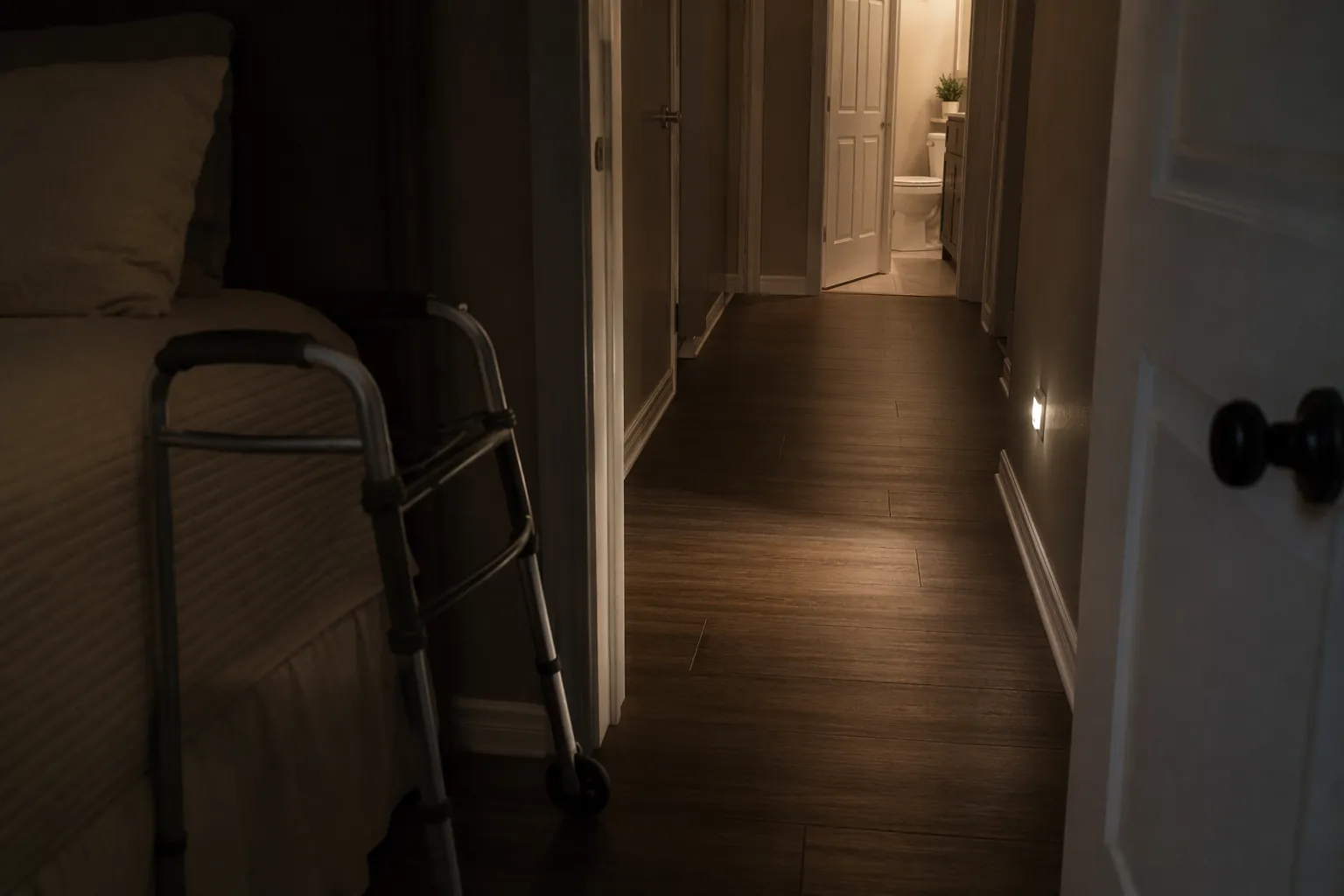
Build the Night Route Before the First Night
Night changes the house. A hallway that feels obvious at noon can become a row of shadows, doorframes, and bad guesses. The route from bed to toilet deserves its own inspection because urgency, grogginess, and poor lighting often arrive together.
Start at the bed, not the hallway. Can your parent sit up without grabbing a rolling nightstand, loose blanket, or unstable dresser? Are glasses, hearing aids, phone or call bell, water, and footwear within reach? Is the walker placed so the parent can stand into it rather than step toward it? If the bed is too high or too low for a controlled stand, ask the therapy team what adjustment is safe; do not improvise with unstable blocks or cushions.
Then walk the route in the dark with the lights set exactly as they will be overnight. Nightlights should illuminate the full path, not just decorate the outlet. Remove laundry baskets, shoes, pet beds, cords, and loose rugs. Tape down or reroute cords only if that actually removes the trip hazard; a cord along the walking line is still a problem. If a door must stay partly open for the walker to pass, set it that way before bedtime.
The bathroom doorway deserves a slow turn test. Can the walker enter and turn without catching? Does the parent have to abandon it outside the door and furniture-walk to the toilet? Is there space for a caregiver to assist without standing in the tub path or backing into the door? If the bathroom is too tight, ask the therapist about the safest approach. A narrow bathroom is not a character flaw; it is a design problem that needs a workaround approved by someone who understands the parent’s mobility status.
Room-by-Room Checks That Matter Most
Bedroom
The bedroom should support two safe actions: getting out of bed and getting back into bed. Clear both sides if both are used, or make the safer side obvious if only one side should be used. Remove slippery rugs and low clutter. Keep the phone, call device, tissues, water, lamp switch, glasses, and mobility aid reachable from the bed. If your parent uses nighttime continence supplies, place them where they do not require a rushed trip across the room.
Bathroom
The bathroom is not safe because it contains equipment. It is safe only if the transfer works. Watch for twisting, reaching backward, stepping over tub walls, pushing up from towel bars, or turning without the walker. A grab bar is different from a towel bar. A shower chair is useful only if the parent can sit, wash, and stand without creating a wet obstacle course. If bathing is not safe yet, ask about sponge bathing or supervised bathing until the therapist clears the setup.
Kitchen
The kitchen should reduce carrying and reaching. Put frequently used cups, plates, utensils, medications if stored there, and simple foods between shoulder and waist height. Avoid making your parent carry hot liquids while using a walker unless the rehab team has given a safe method. If meals will be reheated, set up a place to sit while waiting. Fatigue after standing at a counter can show up suddenly.
Living Room
The favorite chair may be the worst chair after rehab. Check whether your parent can stand from it without rocking, pulling on the walker, or pushing off a rolling side table. Deep cushions and low recliners can trap someone who was standing well from a higher rehab chair. Place the walker where it can be reached before standing, and keep remote controls, phone, water, and tissues close enough to prevent repeated small reaches.
Entry, Stairs, and Laundry Areas
Entries and stairs should be treated as supervised zones until the discharge plan says otherwise. Check handrails, lighting, weather mats, and where the walker or cane goes at the top and bottom. Laundry can wait if it requires stairs, carrying a basket, or turning on a cluttered floor. The first month is not the time to prove independence by restarting the hardest household route first.
Keep Rehab Going Without Inventing a New Program
Exercise after rehab should feel like continuation, not a family-designed fitness challenge. Use the written therapy plan. Keep the exercises in the same place each day if that helps memory and routine. Note what time of day your parent has the best energy. If pain, dizziness, shortness of breath, new weakness, or fear changes what they can do, call the clinician or therapist rather than pushing through.
Caregivers can help by setting up the space: sturdy chair if prescribed, clear floor, proper footwear, mobility aid nearby, water available, and no pets underfoot. Count repetitions only if the plan asks for it. More is not automatically better after a rehab discharge, especially when fatigue increases fall risk later in the day.
Food, Fluids, and Follow-Up Are Fall Prevention Too
Meals and hydration rarely sound as urgent as grab bars, but weakness and lightheadedness do not care which category they belong to. Ask the discharge team whether there are fluid limits, swallowing precautions, diet instructions, or protein goals. Then make the easiest safe choice visible: filled water cup if allowed, prepared snacks, meals that do not require standing for long, and a plan for the days when no one feels like cooking.
Follow-up appointments should be scheduled before the calendar becomes a blur. Confirm the primary care visit, specialist visits, therapy appointments, home health start date if ordered, lab work if needed, and transportation. Bring the medication sheet, discharge instructions, fall notes, blood pressure or glucose logs if requested, and questions from the first week. A small notebook near the main chair can keep symptoms from being reconstructed from memory.
If equipment costs or coverage questions are slowing decisions, a companion resource such as “What Fall Prevention Services Does Medicare Cover in 2025?” can help separate covered therapy services from out-of-pocket home modifications. For families still deciding whether home is realistic after a hospitalization, “Short-Term Senior Care After Hospitalization: A Discharge-to-Home Playbook” belongs earlier in the process.
A Simple Rhythm for the First Month
The first month goes better when it has a rhythm. Not a rigid chart for every minute, but a pattern that catches changes before they become crises.
| Time period | What to focus on |
|---|---|
| Day 0 to 2 | Medication list, first transfers, bathroom route, night lighting, food and fluids, urgent questions to the discharge contact. |
| Day 3 to 7 | Therapy routine, fatigue patterns, shower safety, follow-up appointments, equipment problems, caregiver coverage. |
| Week 2 | Whether the home setup still matches actual mobility, whether supervision needs changed, whether new symptoms appeared. |
| Weeks 3 to 4 | Sustaining exercises, nutrition, appointments, safe independence, and any home changes that were postponed during the first rush. |
During the first week, keep notes on near-falls as seriously as falls. A hand slapped onto the wall, a rushed grab for the sink, a stumble at the bedroom rug, or a refusal to use the walker at night all tell you where the system is weak. Do not turn those moments into scolding. Turn them into adjustments: move the walker, improve the light, change the chair, call the therapist, ask whether the medication timing could be contributing.
By the second week, families often relax because the first scary days are over. That can be appropriate, but it should be earned by what is actually happening. Is your parent more stable or simply more willing to take risks? Are they skipping the walker because strength improved, or because the device is inconvenient? Are exercises being done, or did appointments replace the home routine? Recovery can bring confidence before it brings full safety.
Warning Signs: Know Who to Call
The discharge plan should tell you which symptoms require a routine call, same-day call, urgent care, or emergency care. If it does not, ask before leaving rehab. The list will vary by diagnosis, surgery, medications, and baseline health, so do not rely on a generic internet checklist for the final decision.
- Call the designated clinician for new dizziness, repeated near-falls, increasing confusion, medication uncertainty, worsening pain, or a sudden decline in walking.
- Ask the therapist about unsafe transfers, equipment that does not fit, fear of showering, or a walker that cannot navigate the bathroom.
- Ask the pharmacist or prescribing clinician about side effects, duplicate medications, missed doses, or old prescriptions that conflict with the discharge list.
- Use emergency services for symptoms the discharge team identified as emergencies, or when a fall, injury, severe weakness, chest pain, breathing trouble, stroke symptoms, or loss of consciousness is suspected.
Caregiver strain belongs on the warning list too. The 30-day period after rehab can become a quiet marathon of lifting, watching, calling, cleaning, persuading, and sleeping lightly. If one person is doing all of it, the safety plan is fragile. A resource such as “Caregiver Burnout: Warning Signs and How to Recover” is not a detour from fall prevention; an exhausted caregiver misses details.
What to Do Today
If discharge is tomorrow, do not try to perfect the whole house. Clear and light the bed-to-bathroom route. Put the walker where it can be reached before standing. Reconcile the medication list. Confirm who to call after hours. Watch the first toilet transfer before assuming it is safe. Set up meals, fluids, and the therapy plan where they can actually happen.
A caregiver cannot make recovery fall-proof. The first month after rehab still carries real risk, and some of that risk comes from illness, surgery, frailty, medication effects, or conditions no rug removal can fix. But many falls are helped along by solvable household problems: a dark route, a loose mat, a device out of reach, a confusing pill bottle, a bathroom transfer no one tested. Treat the first 30 days as an active safety period, not a passive return home.
References
- Falls After Hospital Discharge: A Randomized Clinical Trial — J Gerontol A Biol Sci Med Sci, 2019
- Inpatient Care | STEADI — Older Adult Fall Prevention — CDC
- How to Care for the Elderly After Hospital Stay or Rehab — AARP, 2025
- Caregiver Education — AAPMR PM&R KnowledgeNow
Related reading
Noticed something outdated or inaccurate on this page? Flag a correction. We review every report against CDC, NIA, and AARP HomeFit guidance before updating a page.
Part of the Fall Prevention section.