
STEADI: Intervene
Why the 2026 Egg Recall Matters for Fall Prevention in Seniors
The July 2026 egg recall is more than a food-safety issue — it can also raise the risk of falls for older adults. This guide explains the physiological link between salmonella infection and falls, and provides practical steps for identifying recalled eggs, preventing dehydration, and knowing when to call a doctor.
An egg recall can become a fall-prevention problem when an older adult develops diarrhea, vomiting, fever, dehydration, dizziness, or weakness. The first job is still the kitchen job: find the eggs, stop using them, throw them out safely, and clean what they touched. But for an adult 65 or older, the next few days also deserve a steadiness check, especially at night and on the way to the bathroom.
Last updated July 27, 2026: FDA lists this Salmonella egg investigation as ongoing, and the illness and hospitalization counts available here reflect the FDA and CDC updates current as of July 24, 2026.[1][2]
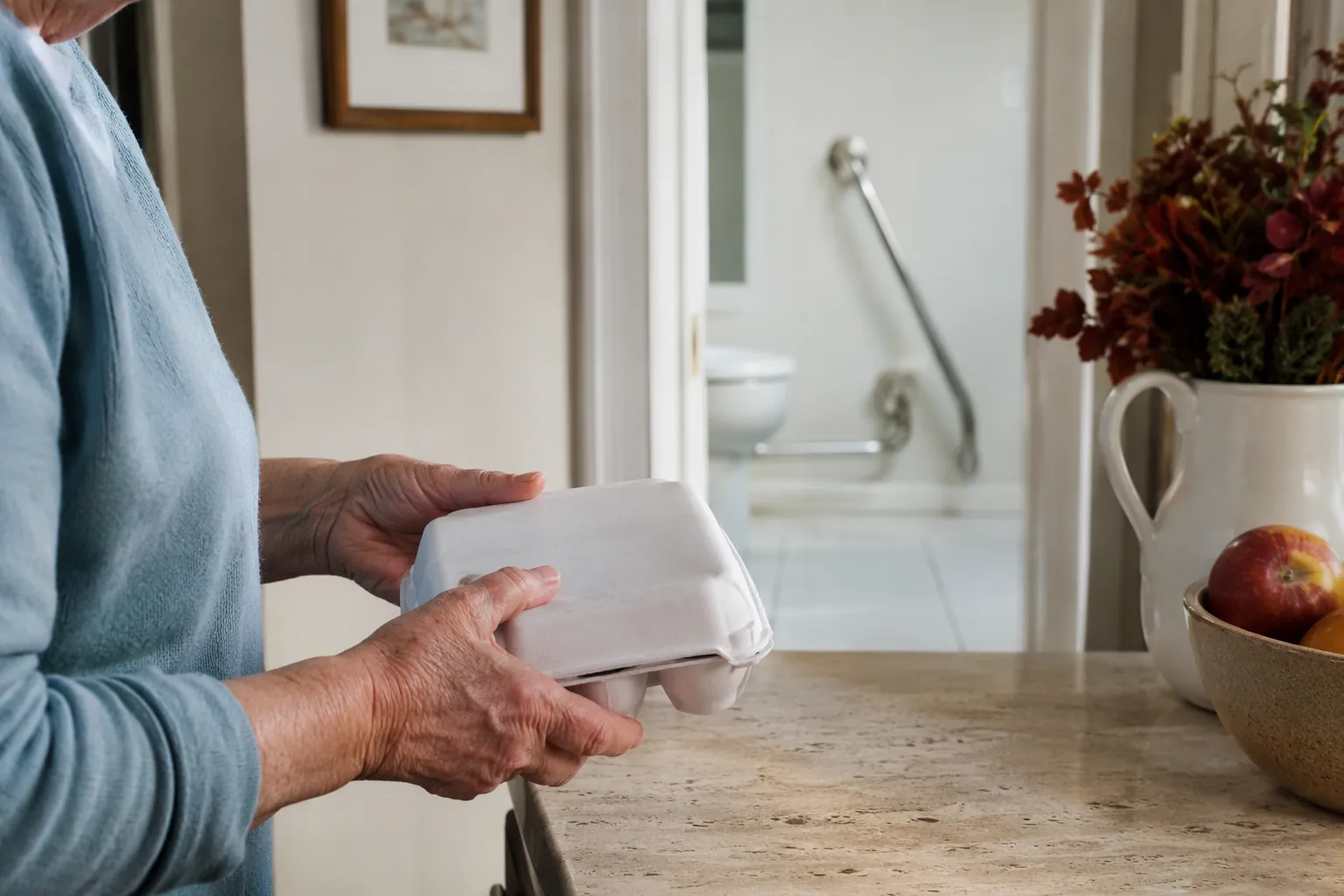
Check the carton first
Midwest Poultry Services, L.P. recalled 1,589,577 dozen shell eggs, or about 19 million eggs, on July 22, 2026, because of possible Salmonella Enteritidis contamination.[3] The recalled eggs were sold under Kroger, Simple Truth, Brookshire's, Country Morning, and Sunups brands in Arkansas, Louisiana, Mississippi, New Mexico, Oklahoma, and Texas.[3]
| What to check | Affected recall details |
|---|---|
| Brands | Kroger, Simple Truth, Brookshire's, Country Morning, Sunups |
| Distribution states | AR, LA, MS, NM, OK, TX |
| Plant codes | P-1950 or 0840962 |
| Julian dates | 157-184 |
| Best-by dates | July 20-August 17, 2026 |
If you are checking for a parent from a distance, ask for photos of the top, side, and end of the carton. The plant code and date codes are the part people miss when they only read the front label. If the carton matches the recall, do not use the eggs, even for baking or a well-cooked breakfast.
As of the July 24 update, CDC reported 98 illnesses and 26 hospitalizations across 17 states, with illnesses dating back to November 2025.[2] That does not mean every household with these eggs has illness. It means the recall deserves exact checking, not a quick glance.
Do not turn recalled eggs into a cooking project
The safest household answer is to discard the recalled eggs, not to cook around the problem. Salmonella can be killed by cooking eggs to 160 F, but handling the recalled eggs first can spread bacteria to hands, utensils, counters, refrigerator shelves, and sink handles before the food ever reaches the pan.[4]
- Put the recalled carton in a sealed bag before placing it in the trash, or follow the store's return instructions if offered.
- Wash hands with soap and water after touching the carton, eggs, trash bag, refrigerator handle, or any leaked egg residue.
- Clean refrigerator shelves, drawers, counters, cutting boards, bowls, and utensils that may have touched the eggs or carton.
- Do not save loose eggs from a recalled carton in another container; that removes the very codes needed to identify the risk.
- If another older adult in the home cooks independently, tape a short note on the refrigerator until the eggs are gone and surfaces are cleaned.
This is the unglamorous part of recall safety, but it is also where a lot of exposure happens. A person can throw away the eggs and still keep touching the sticky shelf where the carton sat.
Why this recall is different for adults 65 and older
CDC says older adults are more likely to get very sick from foodborne germs because aging and medical conditions can weaken the body's ability to fight infection.[5] CDC also notes that nearly half of adults 65 and older with a lab-confirmed Salmonella foodborne illness are hospitalized.[5] That is a general Salmonella statistic for older adults, not an age-specific hospitalization rate for this July 2026 outbreak.
The reasons are not mysterious. FoodSafety.gov describes older adults as a higher-risk group for foodborne illness, and NDSU Extension points to age-related changes such as reduced immune response, less stomach acid, and slower gastrointestinal movement that can make infections harder to clear.[6][7] For a healthy younger adult, a stomach bug may be miserable. For an older adult who already uses a cane, takes blood pressure medicine, or gets up twice a night for the bathroom, the same illness can change the safety of ordinary movement.
The fall-risk chain: illness, fluid loss, blood pressure drop, dizziness
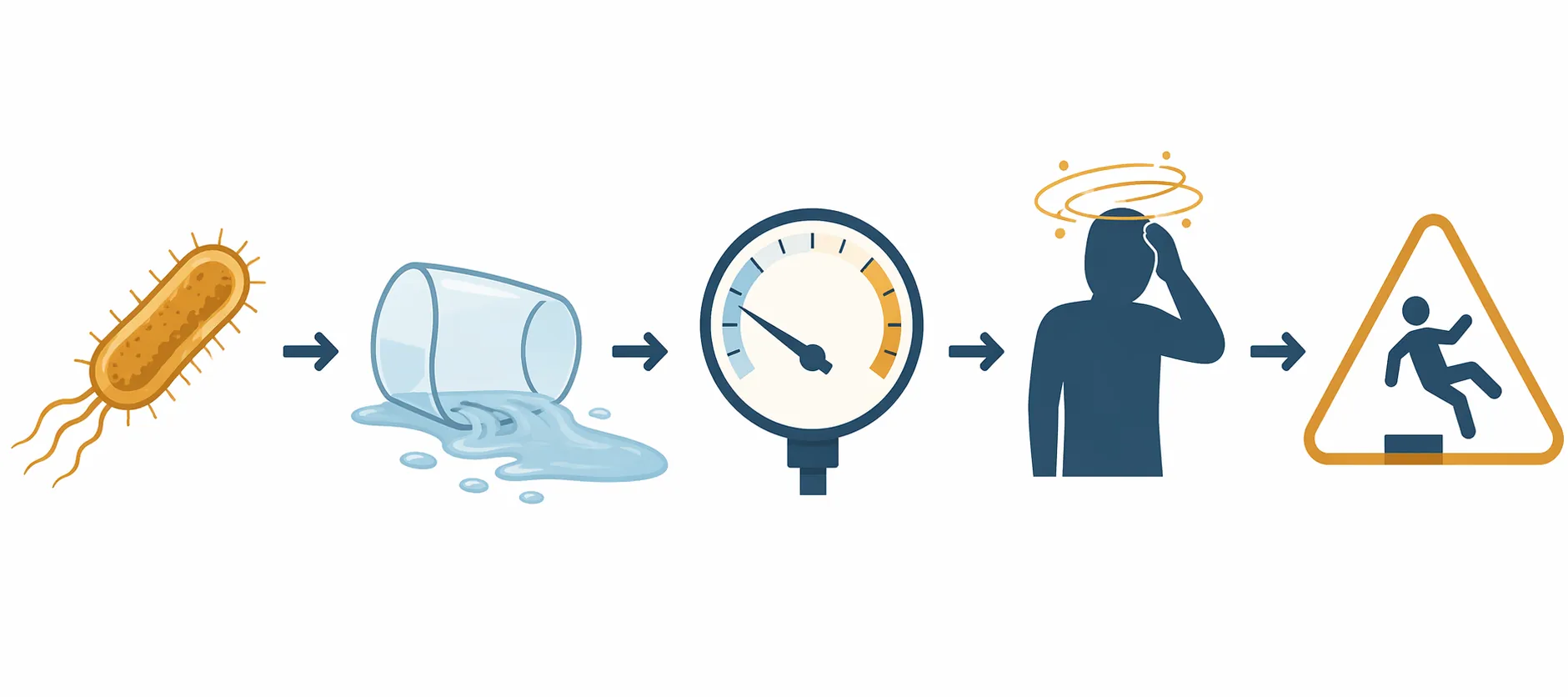
Salmonella commonly brings the exact symptoms that make an older adult unsteady: diarrhea, vomiting, fever, and reduced appetite. Fluid leaves the body faster than it is replaced. Blood volume can drop. Then, when the person stands up, blood pressure may fall instead of adjusting quickly.
Mayo Clinic describes orthostatic hypotension, also called postural hypotension, as a form of low blood pressure that happens when standing after sitting or lying down; it can cause dizziness, lightheadedness, blurred vision, weakness, fainting, and falls.[8] CDC's STEADI materials also identify postural hypotension as a fall risk and advise checking symptoms that occur when a person changes position.[9]
The dehydration piece is not just a household hunch. In a Mayo Clinic Proceedings study of 30,634 older adults, 37.9% were dehydrated, and dehydration was associated with higher odds of falls, with an odds ratio of 1.13.[10] That study shows an association, not a tidy one-cause explanation for every fall. Still, it gives caregivers a useful warning: when illness causes fluid loss, balance deserves attention.
This is where an egg recall stops being only a refrigerator problem. A parent may not fall because of Salmonella itself. They may fall because they had diarrhea all afternoon, drank very little, got up too fast at 2 a.m., felt lightheaded halfway to the bathroom, and reached for a towel rack instead of a grab bar.
Watch symptoms and steadiness together
After recalled eggs are removed and the kitchen is cleaned, the next routine is simple: do not monitor stomach symptoms in one mental folder and fall risk in another. For the next few days, ask about both.
- Hydration: Is the older adult drinking fluids regularly, keeping fluids down, and urinating as usual?
- Standing: Do they feel dizzy, faint, weak, or blurry-eyed when rising from bed, a chair, or the toilet?
- Bathroom trips: Are they rushing because of diarrhea, walking farther than usual, or getting up more often overnight?
- Medication timing: Are blood pressure pills, diuretics, sleep aids, or other medicines making dizziness more likely during illness?
- Support: Is someone close enough to check in, bring fluids, clear the walking path, and notice if weakness is getting worse?
A temporary illness deserves temporary tightening of fall precautions. That may mean using the walker even inside the house, turning on hallway and bathroom lights before bed, keeping a phone within reach, moving a commode closer for a night or two, or asking someone to stay nearby until vomiting, diarrhea, or dizziness improves.
The nighttime bathroom trip is the one I would not shrug off. It combines darkness, urgency, standing from sleep, possible dehydration, and often a floor surface that is less forgiving than carpet. If dizziness has shown up even once during the day, treat that path as a fall zone until the illness has clearly passed.
When to call a doctor
For adults 65 and older, do not wait for symptoms to become dramatic before asking for medical guidance. CDC and physician guidance reported by Serious Eats point to calling a provider for diarrhea with a fever higher than 102 F, diarrhea lasting more than 2 days without improvement, bloody diarrhea, vomiting that prevents keeping fluids down, or signs of dehydration such as dizziness when standing.[2][4]
A call is also reasonable when an older adult sounds newly confused, cannot safely walk to the bathroom, has fainted, has fallen, or is too weak to manage fluids and toileting. Those are not just comfort problems. They are safety problems.
A paired plan for this recall
If your older parent shops at Kroger or Brookshire's in one of the affected states, the practical sequence is not complicated, but it does need to be complete.
- Check the carton for the affected brand, plant code, Julian date, and best-by date.
- Stop using any matching eggs and discard or return them according to recall instructions.
- Wash hands and clean refrigerator shelves, counters, utensils, and other contact surfaces.
- Watch for diarrhea, vomiting, fever, bloody stool, and signs of dehydration.
- For the next few days, treat dizziness, weakness, rushed bathroom trips, and nighttime walking as fall warnings.
For a deeper food-safety walkthrough, see Protect Your Older Adult From Salmonella During This Egg Recall. For more on why dehydration can make seniors unsteady, see How to Prevent Falls During an Extreme Heat Warning.
For adults 65 and older, this recall is not only about avoiding food poisoning. It is a prompt to protect hydration, balance, and safe movement while the body gets through the risk window.
References
- Outbreak Investigation of Salmonella: Eggs (July 2026), FDA.
- Salmonella Outbreak Linked to Shell Eggs, CDC.
- Midwest Poultry Services, L.P. Recalls Shell Eggs, FDA Recall Notice.
- 1.6 Million Eggs Are Being Recalled—Here's Everything You Need to Know, Serious Eats, July 24, 2026.
- Safer Food Choices for Adults 65 and Older, CDC.
- People at Risk: Older Adults, FoodSafety.gov.
- Older Adults and Food Safety, NDSU Extension, Revised Jan. 2024.
- Orthostatic hypotension (postural hypotension), Mayo Clinic.
- Postural Hypotension Brochure, CDC STEADI.
- Association Between Dehydration and Falls, Mayo Clinic Proceedings, 2020.
Related reading
Noticed something outdated or inaccurate on this page? Flag a correction. We review every report against CDC, NIA, and AARP HomeFit guidance before updating a page.
Part of the Fall Prevention section.