
STEADI: intervene
Post-Earthquake Fall Prevention for Older Adults in Shelters
After an earthquake, older adults face heightened fall risks from unfamiliar shelter environments and rapid physical decline. This guide explains specific hazards in shelters and temporary housing, and provides targeted countermeasures to prevent falls during evacuation life.
After the shaking stops, the fall danger for an older adult often moves into quieter places: the gym floor where people are sleeping, the hallway to the bathroom, the food line, the temporary unit with a different threshold than home. A useful 地震後の高齢者向け避難生活ガイド has to start there, not with a perfect supply list.
Picture the first night in a shelter. Mats are close together. Someone has pushed a chair into an aisle to make room for another family. A wet patch spreads near the bathroom entrance. The lights are dim because power is limited. An older woman’s cane is under a blanket instead of beside her hand. Her walker may still be in the car, damaged at home, or mixed in with other belongings. Nothing in that scene looks dramatic, but every part of it can turn a safe step into a fall.
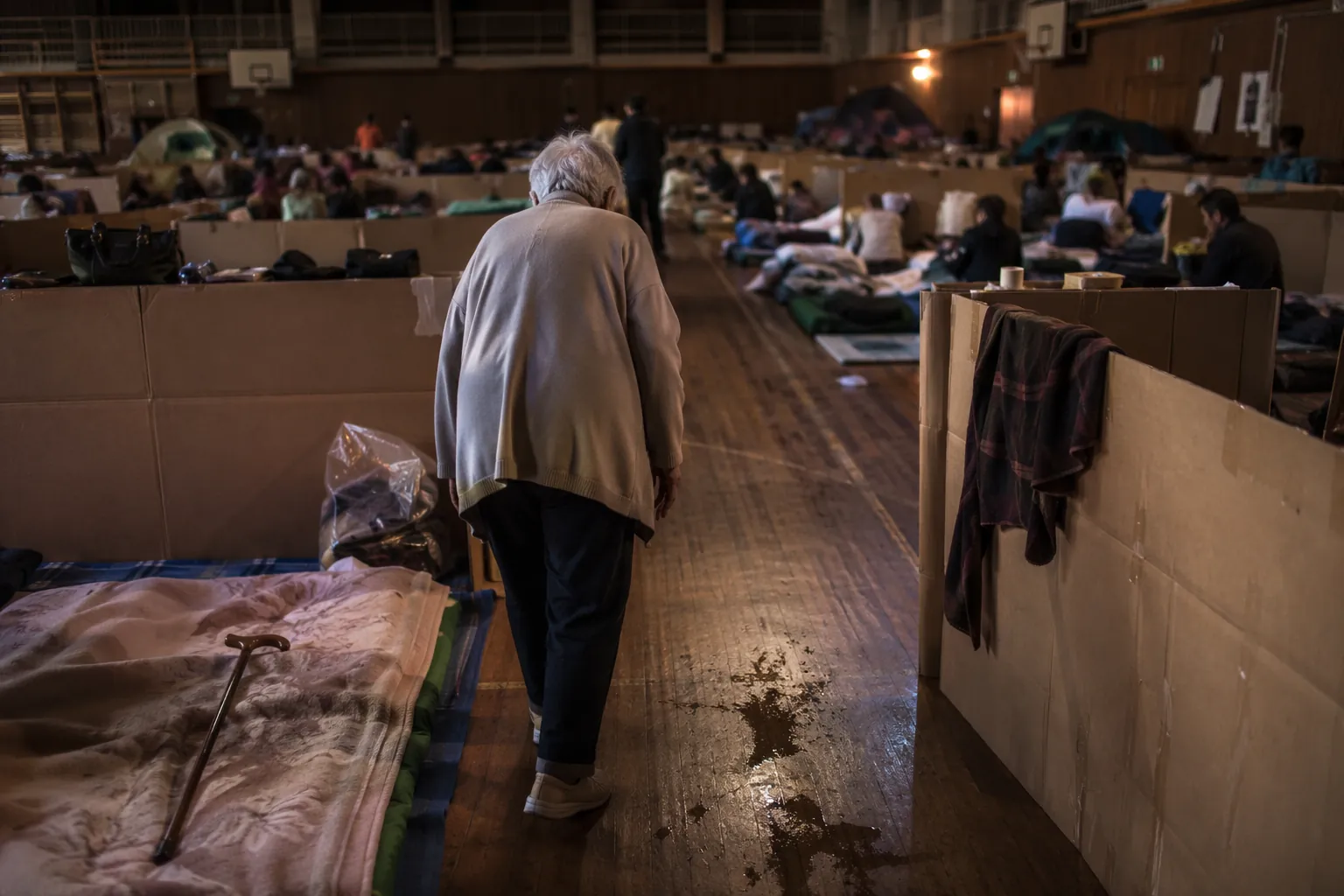
The problem does not end when people reach a shelter. In a 2025 JMA Journal study of older adults relocated to temporary housing after the Great East Japan Earthquake, one-leg standing time was 4.3 seconds lower than among non-evacuees, and that deficit persisted throughout a 10-year follow-up.[1] The study came from Soma City in Fukushima Prefecture, so it should not be treated as a perfect map of every earthquake setting. It does show something that caregivers often sense but cannot easily prove: evacuation life can leave a measurable mark on balance.
Japanese disaster data also warns against assuming that survival from the quake itself means the older person is now safe. After the 2024 Noto Peninsula earthquake, 94% of disaster-related deaths were among people aged 70 and older, with many linked to prolonged immobility and deconditioning in shelters, according to Ishikawa Prefecture data summarized in 2025. During the Great East Japan Earthquake, 56.1% of fatalities were among people 65 and older, although that age group represented 23% of the affected population.[2]
The first fall-prevention job is the route, not the room
A shelter can look orderly from the entrance and still be dangerous for the person who has to stand up at midnight, find a toilet, wash hands, and return without stepping on bedding or asking strangers to move. Fall prevention works better when someone walks the routes an older adult actually uses.
| Route | Fall hazard to look for | Low-cost countermeasure |
|---|---|---|
| Sleeping mat or cot to standing | Cane, glasses, shoes, or flashlight out of reach; bedding edges that catch the foot | Keep the mobility aid on the same side every time; place shoes toe-out; keep one handhold nearby if shelter rules allow |
| Sleeping area to aisle | Narrow gap between mats, bags, cardboard partitions, chair legs, charging cords | Mark a straight exit path with tape or visible objects; move bags under or behind bedding; ask neighbors to keep one shared aisle open |
| Aisle to bathroom | Dim light, wet floor, debris, uneven floor coverings, people sleeping near the walkway | Check the route in daylight; choose the shortest safer route rather than the closest route; report wet spots and place a chair or sign as a warning until staff can clean |
| Bathroom entrance and toilet area | Thresholds, slippery flooring, unfamiliar layout, no room to turn with a walker | Go before urgency becomes severe; bring the cane or walker all the way to the door; ask staff where accessible toilets are located |
| Food or water line back to rest area | Standing too long, carrying items with both hands, crowd pressure | Use a seat while waiting if possible; have one person carry food while the older adult uses the handrail, cane, or walker |
This is not housekeeping for its own sake. The Red Cross and ShakeOut both emphasize that many earthquake injuries for older adults and people with access and functional needs come from falling during shaking or while navigating hazards afterward, including debris.[3][4] Once people are living together in a crowded space, the same logic continues: every bottle, bag, wet towel, and rolled mat becomes part of the walking surface.
From the sleeping area to standing
The first unsafe step often happens before anyone reaches the aisle. An older adult wakes up stiff, reaches for a cane that has slid under bedding, and tries to stand while half-asleep. Put the cane, walker, glasses, hearing aids, phone, light, and shoes in the same small zone every time. If the person uses a walker, keep it facing the direction of travel, not sideways behind the pillow where it has to be dragged into position.
Shoes matter more than they look. Loose slippers and socks on a polished floor are a poor match for a shelter aisle. If an older person has only indoor slippers, check whether a family member, staff member, or neighbor can help locate sturdier footwear from their belongings. This is not a shopping issue in the moment; it is a search-and-recover issue.
From the aisle to the bathroom
Bathroom trips deserve more attention than they usually get. People delay them because the route is embarrassing, crowded, cold, or confusing. Then they stand up in a hurry. The safer plan is plain: identify the bathroom route before dark, walk it once with the older adult if possible, and decide where they can pause if dizzy or tired.
- Look for wet areas near sinks, toilet entrances, outdoor shoes, and water distribution points.
- Check whether the path is wide enough for the person’s actual aid: cane, walker, wheelchair, or another person walking beside them.
- Use available light carefully: a flashlight, phone light, battery lantern, or staffed route lighting is more important on the bathroom path than in a corner where no one walks.
- If the route crosses a wet or cluttered area, ask shelter staff before moving official equipment, but do not wait silently when a hazard is obvious.
Privacy is real, especially for older men and women who do not want to be watched struggling across a gym floor. A caregiver can reduce that barrier by agreeing on a quiet phrase, a usual time, or a nearby waiting spot. The goal is not to take over the person’s dignity. It is to make help easier to accept before urgency and fatigue make the walk more dangerous.
From the bathroom back to bedding
The return trip can be worse than the outward trip because the person is tired, the floor is wetter, and the aisle may have changed. Someone may have placed a bag where there was open space an hour earlier. If a caregiver cannot accompany every trip, the next best step is to check the route at predictable times: before sleep, after meals, and after the busiest bathroom periods.
For shelter staff and volunteers, one cleared aisle to toilets is worth more than several half-cleared aisles that look polite but do not fit a walker. Chairs can define a waiting edge. Tape can show where not to store bags. A volunteer stationed near a wet entrance for 10 minutes can prevent a cluster of slips until cleaning supplies arrive. These are small acts, but they are exactly the scale at which many shelter falls are prevented.
Disuse syndrome can begin while everyone is still waiting
Shelter life encourages stillness. People sit because aisles are crowded. They lie down because there is nowhere private to walk. They avoid moving because they do not want to bother anyone. Meals, information updates, charging stations, and toilets may all require waiting, but not necessarily walking. Within days, that pattern can start a downward loop: less walking, more sitting or lying down, weaker legs, poorer balance, fear of moving, and then even less movement.
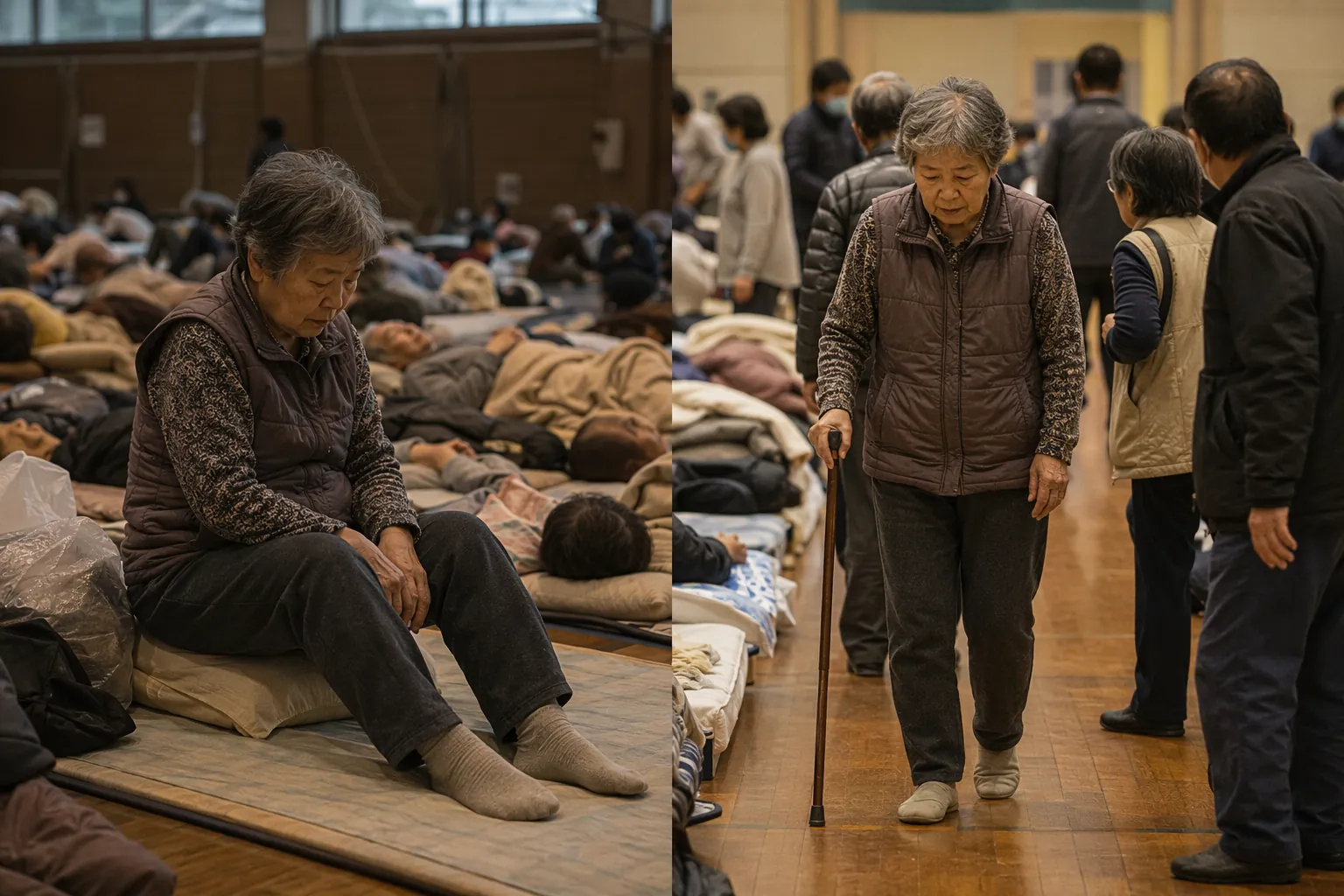
Japan’s Ministry of Health, Labour and Welfare has treated this as a shelter-care problem, not simply a fitness problem. Its 2023 guidance on disuse syndrome in shelters described countermeasures such as deliberate daily movement, walking circuits, role assignments, and cleared pathways.[5] Those measures are easy to dismiss when the building is crowded and everyone is exhausted. They should not be dismissed.
The JMA Journal balance findings make that warning harder to ignore. A 4.3-second lower one-leg standing time is not a mood measure or a general complaint about evacuation. It is a balance measure, and in that study the difference persisted across 10 years of follow-up.[1] The study does not prove that every shelter stay will produce the same decline, and it cannot by itself separate every cause. It does show that reduced activity and altered living conditions after relocation deserve fall-prevention attention early, while routines can still be protected.
A daily movement plan that works in a crowded shelter
The safest movement plan is not a workout. It is a way to keep ordinary body use from disappearing. For an older adult who was walking at home before the earthquake, that may mean several short, supervised walks along a known clear route. For someone with weaker balance, it may mean standing up at regular times, shifting weight while holding a stable support, or walking only with assistance to meals and the toilet.
| If the older adult can... | Try this shelter movement task | Stop and seek help if... |
|---|---|---|
| Stand safely with a cane or walker | Stand before meals and before sleep; check that dizziness settles before walking | They sway suddenly, cannot bear weight, or report new severe pain |
| Walk short distances | Use one planned walking circuit with a clear start, turn, and return point | They become breathless, confused, faint, or unusually weak |
| Help with light tasks | Give a small role such as folding blankets, sorting personal items, or carrying only light objects while seated or supported | The task makes them rush, twist, lift beyond comfort, or walk without their aid |
| Leave the sleeping area only with help | Schedule assisted bathroom trips and brief standing periods rather than waiting for urgent requests | They cannot transfer safely, fall, or nearly fall |
Role assignments can sound childish if handled badly. They are not meant to keep an older adult busy for appearance’s sake. A useful role gives a reason to sit up, stand, reach, sort, or walk within ability. It also lets neighbors see the person as part of the shelter community rather than only as someone waiting to be helped.
Walking circuits need boundaries. Do not send an older adult wandering through a chaotic building “for exercise.” Choose a short route with the least clutter, the best lighting, a place to turn, and a place to sit if needed. If the shelter has staff, ask where walking is least disruptive. If the person uses a walker, test the route with the walker, not by eyesight alone.
Mobility aids are emergency equipment after an earthquake
A cane, walker, wheelchair, brace, hearing aid, glasses, and sturdy shoes are not comfort items in evacuation life. They are fall-prevention equipment. Ready.gov and the Red Cross both advise older adults to plan for medical, mobility, communication, and support needs in emergencies.[6][3] In the shelter, that planning becomes a search list.
- Find the usual mobility aid first, before reorganizing less urgent belongings.
- Check rubber tips, brakes, height settings, loose screws, bent frames, and wet grips.
- Label the aid with the person’s name if supplies allow, because many canes and walkers look alike in shelters.
- Do not substitute a chair, umbrella, or another person’s cane unless there is no safer immediate option.
- Tell shelter staff if a mobility aid is missing or damaged; replacement, repair, or accessible placement may require coordination.
If the older adult refuses the aid because the shelter is crowded, treat that as a hazard signal, not stubbornness. They may be embarrassed, afraid of hitting someone’s bedding, or unsure where to park the walker at the toilet. The answer is often a wider path or a planned parking spot, not another reminder to “be careful.”
Temporary housing continues the same risk pattern
Moving from a shelter into temporary housing can feel like the fall risk has passed. Sometimes it has only changed shape. The older adult now has more privacy, but also a new floor plan, different thresholds, unfamiliar bathroom access, changed lighting, and fewer reasons to walk if services are delivered nearby or neighbors are far away.
The first inspection should follow the same route logic used in the shelter: bed to standing, bed to bathroom, entrance to kitchen, bathroom to living area, and exit to outside. Look for small elevation changes, loose mats, cords, boxes waiting to be unpacked, low light near the toilet, and places where the walker cannot turn. If power is unreliable, the lighting plan matters even more; a separate power outage fall-prevention checklist for seniors can help with that narrower problem.
Temporary housing also needs a walking routine. The JMA Journal study’s long follow-up does not mean decline is inevitable; it means relocation is a serious enough disruption to monitor.[1] If an older adult walked to a mailbox, garden, shop, temple, church, or neighbor’s home before the earthquake, the temporary setting has to replace at least part of that daily movement. Otherwise the person may appear settled while their legs, balance, and confidence are quietly shrinking.
Preparedness advice helps only when it reaches the walking path
General earthquake guidance still matters. Drop, cover, and hold on; emergency contacts; medication lists; backup power; evacuation alerts; and support networks all have their place. The National Council on Aging also urges older adults to prepare for disasters with attention to medications, documents, communication, and support contacts.[7] But for fall prevention after an earthquake, those preparations have to become practical movement support.
- A contact list helps when someone can bring the missing walker, shoes, glasses, or charger.
- A medication list helps when dizziness, sedation, dehydration, or missed doses may be affecting balance.
- A flashlight helps when it is placed on the bathroom route, not buried in a bag.
- A support network helps when someone is assigned to check movement, meals, toileting, and changes in strength.
Heat, dehydration, dust, and poor air can add to weakness or dizziness in real shelters, but they should not be blended into one vague warning. If heat is the immediate problem, use a heat-specific plan such as cooling seniors without AC while preventing falls. If air quality is limiting safe movement, a guide to fall safety during air quality alerts may be more useful than asking the person to walk through dust or smoke.
When to escalate beyond caregiver fixes
Tape on the floor and a cleared route cannot solve everything. Get medical evaluation, shelter management help, or emergency services when an older adult has fallen, hit their head, cannot stand or bear weight, has new severe pain, shows sudden weakness, becomes confused, faints, has chest pain or trouble breathing, or cannot move safely even with their usual aid.
Also escalate when the environment itself is unsafe: no accessible toilet route, repeated wet floors, blocked exits, missing mobility equipment, or a sleeping location that forces the person to crawl, climb, or step over others. Those are shelter-management problems as much as family problems.
Post-earthquake fall prevention for older adults means restoring safe movement early, clearing the paths people actually use, protecting bathroom access, replacing or adapting mobility aids, and watching for rapid decline. This article is educational and is not a substitute for medical care, physical therapy, emergency services, or local shelter instructions. When injury, sudden weakness, confusion, or unsafe mobility is present, seek professional help promptly.
References
- JMA Journal 2025 balance decline in temporary housing, JMA Journal, 2025.
- Disaster Planning for Aging Communities — Lessons from Japan's Noto Earthquake, ICMA.
- Older Adults Emergency Preparedness, American Red Cross.
- ShakeOut Earthquake Guide for People with Disabilities, Earthquake Country Alliance.
- Japanese MHLW shelter guidelines, Joint介護, 2023.
- Ready.gov Older Adults, Ready.gov.
- What Older Adults Can Do If Disaster Strikes, National Council on Aging.
Related reading
Noticed something outdated or inaccurate on this page? Flag a correction. We review every report against CDC, NIA, and AARP HomeFit guidance before updating a page.
Part of the Fall Prevention section.