
STEADI: Intervene
How to Check Frozen Food Recall Lot Numbers for Older Adult Safety
A step-by-step guide for caregivers to verify whether recalled frozen foods are in an older adult's freezer by matching UPC, lot code, and best-by dates, and what to do when a match is found or a lot cannot be identified. Older adults face higher risks from Listeria and other foodborne infections, making accurate lot‑number checking a critical safety step.
Start with the recall notice open and the package still in your hand. Do not empty a waffle carton into a freezer bag, toss the outer box, or wipe frost off a code until you have checked every identifier the notice names. For frozen food recall lot numbers, the safe check for an older adult’s freezer is not a package-photo match. It is a product, package size, UPC, lot code, and best-by or use-by date match; for meat, poultry, and egg products, the establishment number may also matter.
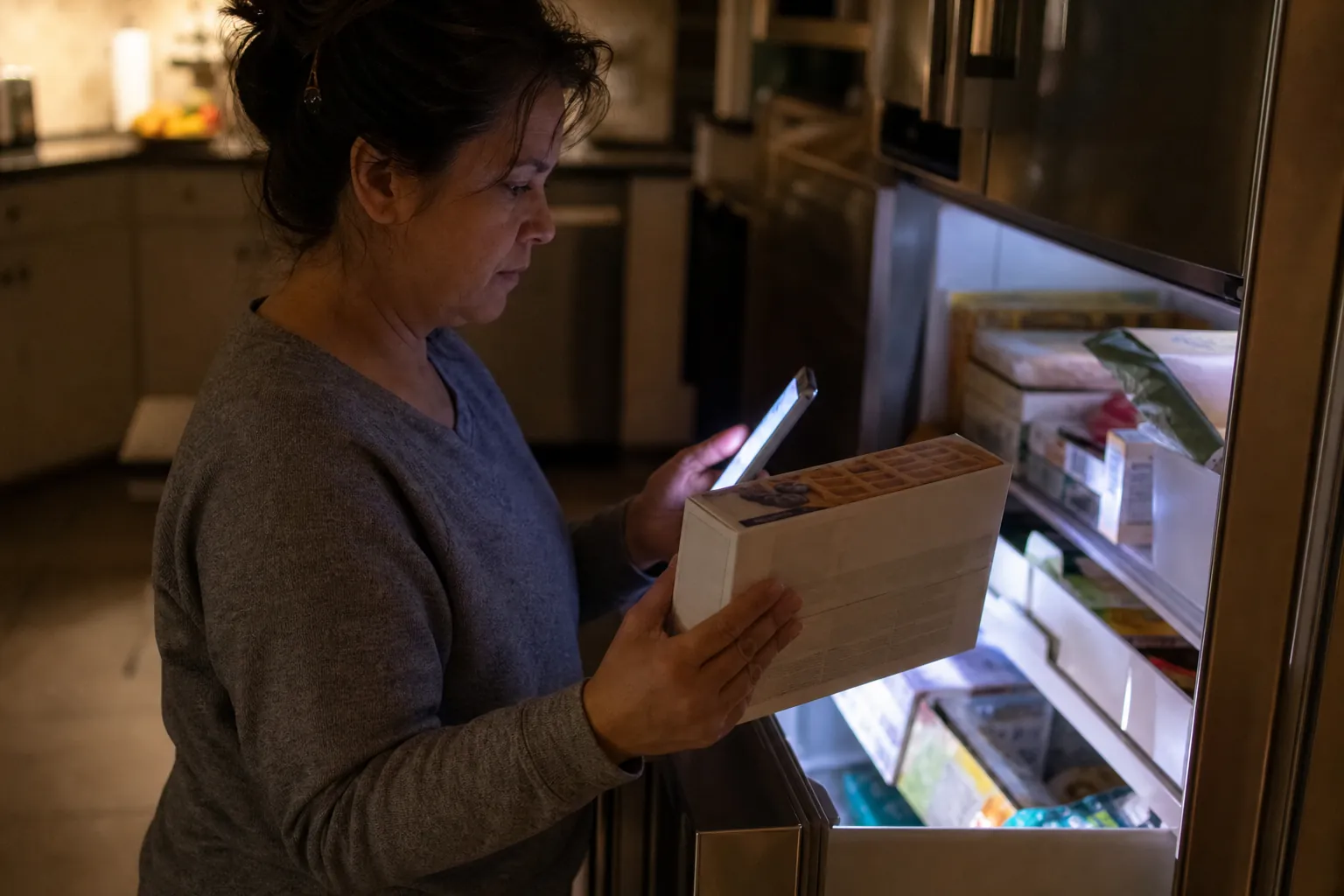
That extra care is justified when the freezer belongs to someone 65 or older. CDC says more than half of all Listeria infections occur among people 65 and older, and 1 in 6 older adults with listeriosis dies.[1] CDC also says nearly half of adults 65 and older with lab-confirmed Salmonella, Campylobacter, Listeria, or E. coli infection are hospitalized.[2] A freezer check is ordinary kitchen work, but for this household it is also a safety task.
Keep The Package With Its Codes Until The Check Is Finished
Pull out only the foods that could plausibly match the notice first: the same product type, brand, flavor, size, and package form. Put them on a counter or in a cooler if the check will take more than a few minutes. Keep each food in its original carton, bag, sleeve, or tray until you have either ruled it out or recorded the codes.
FDA says recall notices identify affected products by details such as product name, package size or type, UPC, and codes including lot codes and sell-by or use-by dates.[3] FSIS recall notices for meat, poultry, and egg products add another field: the establishment number, shown as “EST.” for meat, “P” for poultry, and “Plant” or “G” for egg products.[4]
| Identifier | What It Tells You | Where To Look First |
|---|---|---|
| Product name and package size | Whether the item is even in the recalled product group | Front panel, flavor panel, net weight line |
| UPC | Whether the barcode matches the recalled retail item | Barcode panel, often on the back or side |
| Lot code | Whether the package came from the affected production lot | Carton end, back seam, bag edge, under Nutrition Facts, ink-stamped area |
| Best-by or use-by date | Whether the package falls inside the recalled date window | Near the lot code, on the carton end, seam, or back panel |
| EST./P/Plant/G number | Whether a meat, poultry, or egg product came from the named establishment | USDA inspection mark or nearby printed code area |
For frozen products, date wording matters. FSIS explains that when a calendar date is used on a frozen product, it must include the year and a phrase immediately next to the date, such as “Best if Used By.”[5] That makes the date a useful matching field, not just a freshness suggestion.
The Actual Matching Order
Work from broad to exact. A recall notice may include a photo, but the photo is only a clue. Packaging designs change, store brands share visual layouts, and freezer frost makes labels look more alike than they are.
- Match the product identity: brand, product name, flavor or variety, package size, and package type.
- Match the UPC exactly, digit for digit, from the barcode panel.
- Find the lot code and compare the full code, not just the first few characters unless the official notice specifically defines the recall that way.
- Match the best-by, use-by, sell-by, or similar date window named in the notice.
- For meat, poultry, or egg products, match the establishment number if the FSIS notice uses one.
A package is a recalled package only when the notice’s required fields line up. If the brand and flavor match but the UPC does not, it is usually a different retail item. If the UPC matches but the lot code is outside the recall range, it may be the same product from a different production run. If the lot code is unreadable, that is not the same as “no match.” It is “cannot verify,” and it needs a separate decision.
Where Lot Numbers Hide On Frozen Packages
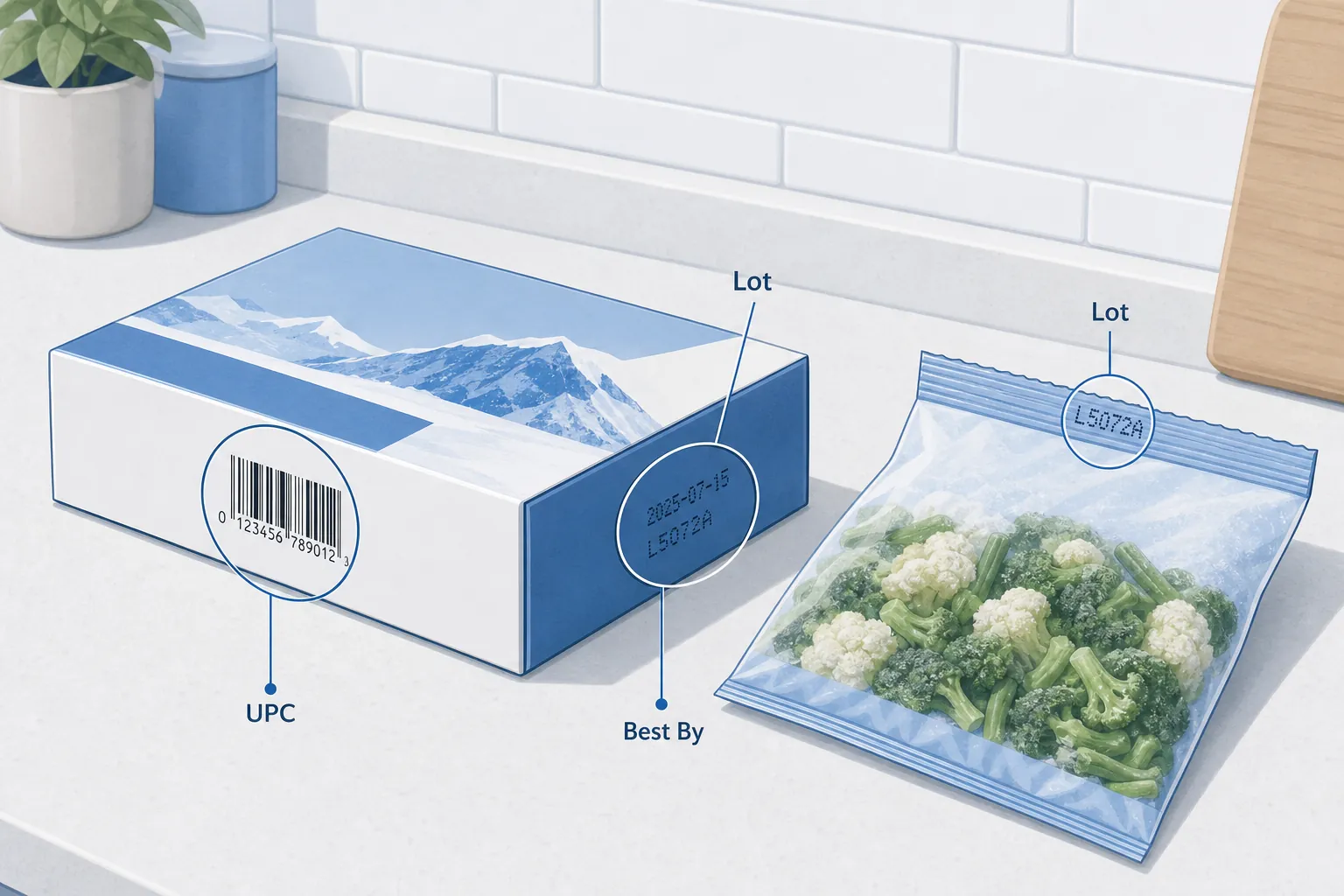
The UPC is usually the easiest part. Turn the package to the barcode panel and compare every digit printed under the bars. Do not rely on a scanner app unless the recall notice itself tells you to; the printed UPC is the field the notice normally names.
The lot code is the part that makes people give up. On frozen cartons, look first at both short ends of the box. Tilt the carton toward a lamp or phone light and check for black, blue, gray, or indented ink near the flap seam. On bags, check the back panel, the crimped top and bottom edges, the side seam, and the area under or near the Nutrition Facts label. On trays or pouches inside a carton, check the outer carton first; the inner wrapper may not carry the same retail code.
Frozen packaging adds two problems: frost and abrasion. Let frost soften briefly rather than scraping hard across the ink. If the bag is wet, blot it instead of rubbing. A half-torn bag should be handled like evidence: photograph the front, the UPC, and every remaining printed code before the tear gets worse.
The best-by or use-by date is often printed next to the lot code, but not always in the same ink size. On a carton end, it may appear as a date followed by a production code. On a bag, it may sit below Nutrition Facts, above a seam, or near a stamped line that also includes letters and numbers. If the recall notice gives both a lot code and date window, use both.
Example: Waffles And Pancakes
A TreeHouse Foods FDA recall posting is useful as a code-reading example, not as a shortcut for judging current freezer risk. In that notice, the expanded recall covered waffle and pancake products with lot codes beginning with “2C”; the notice said the lot code and Best By date were printed on the carton end, and the UPC appeared on the back of the carton.[6] That is the kind of notice where looking only at the brand or package photo would be too loose. The code location tells you which side of the carton to turn toward the light.
Example: Frozen Burrito Bowl Bags
A Good & Gather Southwest-Style Burrito Bowl Blend recall posting gives a different packaging lesson. The recalled 12-ounce bags listed lot codes L5055-1 through L5055-6, and the notice said those lot codes were located under the Nutrition Label on the back of the bag.[7] For bagged frozen foods, the code may not be on the front, the barcode panel, or the crimped edge. Sometimes the correct move is simply to flip the bag over and look below the nutrition box.
Both examples should be treated as demonstrations of how official notices describe code locations. Recall status changes. In Q3 2026, check FDA, FSIS, CDC, or FoodSafety.gov for the current notice before deciding what is affected.
If The Food Is Meat, Poultry, Or An Egg Product, Add The Establishment Number
Frozen breaded chicken, meatballs, breakfast sandwiches, and ready-to-eat meals can fall under FSIS rather than FDA. That changes the label field you must check. FSIS explains that establishment numbers identify where meat, poultry, and egg products were produced; meat numbers use “EST.,” poultry numbers use “P,” and egg product numbers may use “Plant” or “G.”[4]
Look for the USDA inspection mark first. The establishment number may be inside that mark or printed nearby. On a small frozen meal box, it may be on a side panel or near the ingredient and distributor information. On a bag of breaded poultry, check the back panel and the sealed edges. If the FSIS notice names an establishment number, a matching product name alone is not enough.
After Checking: Match, No Match, Or Cannot Verify
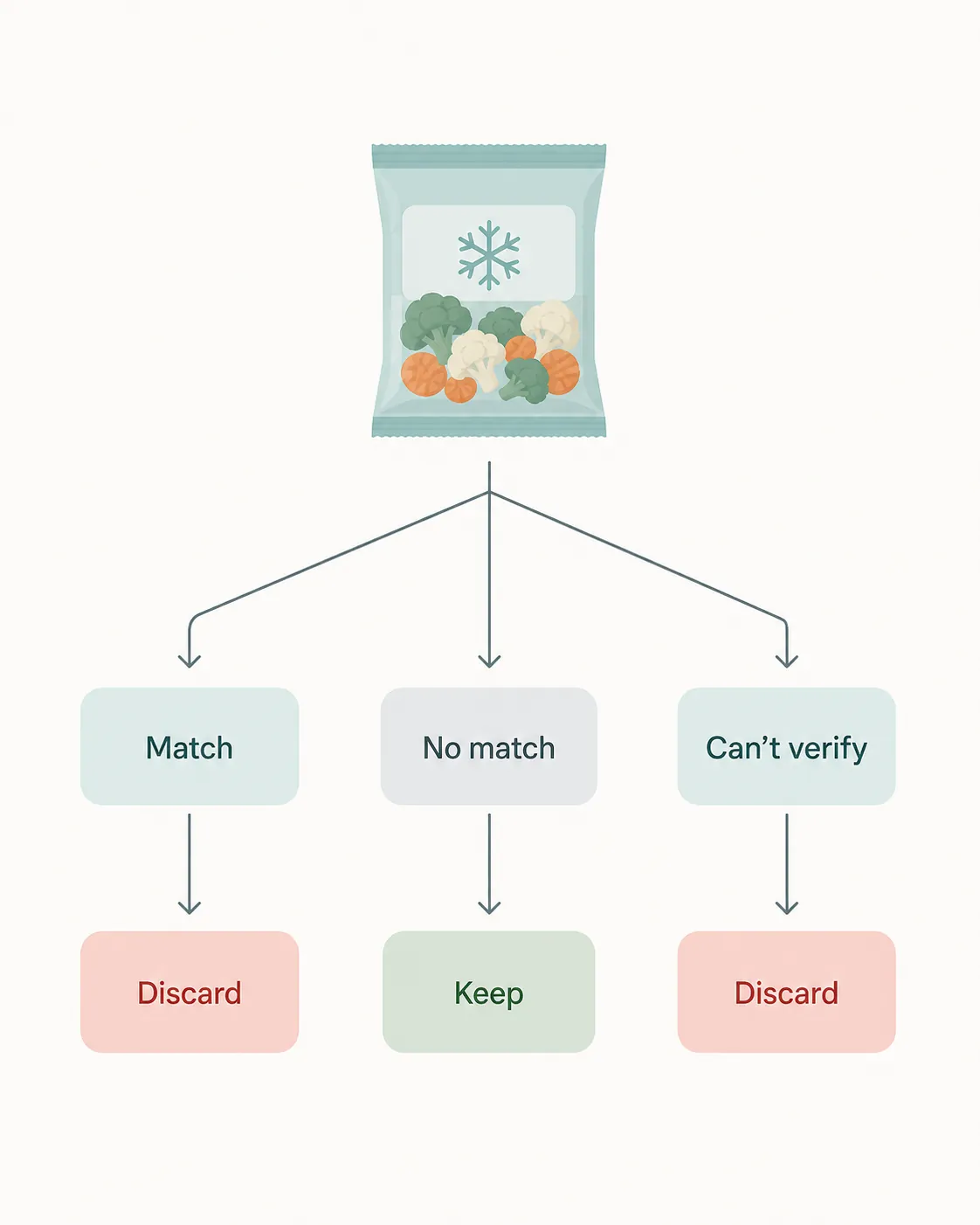
Once the identifiers are checked, do not leave the food in a maybe pile. Decide which branch it belongs to while the notice and package are still together.
If The Package Matches
Do not eat it. Do not cook it “just to be safe.” Do not donate it, offer it through a neighborhood group, or feed it to pets. FDA tells consumers to follow the recall instructions, which may include returning the product for a refund or disposing of it properly, and specifically says recalled food should not be donated or given to pets.[3]
Before discarding or returning it, preserve the information the notice may ask for: product name, package size, UPC, lot code, date, and any establishment number. A phone photo is usually enough for a household record. If the older adult already ate some of it, keep the photo and the recall link where you can find them if a healthcare provider asks what the food was.
Then clean the places the recalled package touched. FDA advises sanitizing surfaces that contacted recalled food with a solution of 1 tablespoon of chlorine bleach in 1 gallon of hot water.[3] In a freezer drawer, that means the shelf or bin, the counter where the package sat, and any reusable bag or cooler used during the check. Wash hands afterward.
If The Package Clearly Does Not Match
If the UPC, lot code, date window, and any required establishment number do not match the notice, put the food back. It helps to mark the notice date on a temporary freezer inventory note so the same package is not rechecked three times during one visit.
Do not mark a package “safe” just because the flavor sounds different from a news headline. Use the official notice. Some recalls cover several varieties; others are narrow. The difference is in the code table, not in the headline.
If You Cannot Verify The Lot
For an older adult’s freezer, an unreadable or missing lot code should be treated as a failed verification, not as a pass. That can feel wasteful, especially with a full bag or an expensive frozen meal. But the lot code is the field that separates an affected production run from a similar-looking package.
The problem is not theoretical. In a December 2025 letter to food industry leaders, FDA said it had conducted more than 4,000 retail checks, found recalled product still for sale at more than 175 locations in 36 states, and heard from retailers who were uncertain which lot numbers or codes were subject to a recall.[8] If trained retail systems can stumble over lot-code uncertainty, a frosted, torn freezer bag in a home kitchen deserves caution.
Do not try to solve an unreadable lot by cooking the food longer. Recalls are issued because the product should not be eaten as identified by the notice. If you cannot confirm that the older adult’s package is outside the recall, discard it and clean the contact surfaces. The defensible decision is the one you can explain later: the product could not be verified by the required codes.
Watch For Symptoms If The Food Was Already Eaten
This is practical safety guidance, not a diagnosis. If an older adult ate a recalled food and feels ill, contact a healthcare provider and mention the recalled food. CDC has listed Listeria symptoms in older adults that include fever, muscle aches, tiredness, headache, stiff neck, confusion, loss of balance, and seizures; CDC also notes that symptoms usually start within 2 weeks after eating contaminated food but may start as early as the same day or as late as 10 weeks after.[9]
The “loss of balance” part matters in a home safety context. A food recall can become a fall-risk issue when illness, weakness, confusion, or balance changes show up in someone who is already vulnerable. If you are already reviewing home hazards, connect this check with the same practical mindset used in fall-prevention planning and kitchen safety walkthroughs.
Age also changes the margin for error. FDA says the immune system begins to weaken between ages 50 and 60, and many adults have weaker immune systems after age 75.[10] That does not mean every recalled food exposure leads to illness. It means the freezer decision should not depend on optimism when the package code cannot be read.
Make The Next Recall Easier To Check
The best freezer habit is simple: keep frozen foods in their original packaging until they are used up. If a box takes too much space, cut out and keep the panel with the UPC, lot code, best-by date, and cooking instructions in the same freezer bag as the food. Do this before the carton goes into recycling, not after a recall notice appears.
When you stock an older parent’s freezer, avoid separating identical loose items from their labels. Waffles, chicken patties, frozen vegetables, and prepared meals become much harder to verify once several opened bags are clipped shut without code panels. If the household uses bins, one small “opened packages” bin with labels intact is safer than a drawer full of anonymous frozen food.
Use official sources when a recall appears: FDA for many packaged foods, FSIS for meat, poultry, and egg products, CDC for outbreak and symptom updates, and FoodSafety.gov as a federal recall gateway. News reports are useful alerts, but the package decision should come from the notice that lists the identifiers.
The repeatable freezer check is now straightforward: keep the notice open, keep the package with its codes, match the product and UPC, find the lot code, match the date window, add the establishment number when FSIS is involved, discard matches and unverifiable packages, clean touched surfaces, and watch for symptoms if the food was eaten. For older adult safety, the lot number is not fine print; it is the deciding evidence.
References
- People at Increased Risk for Listeria Infection, CDC
- People at Increased Risk for Food Poisoning, CDC
- Food Recalls: What You Need to Know, FDA
- Understanding FSIS Food Recalls, FSIS
- Food Product Dating, FSIS
- TreeHouse Foods Announces Expansion of Voluntary Recall to Include All Waffle and Pancake Products Due to Potential Listeria monocytogenes Contamination, FDA
- One Frozen LLC Voluntarily Recalls Good & Gather™ Southwest-Style Burrito Bowl Blend Frozen 12oz Bags, FDA
- FDA Calls on Food Industry Leaders to Strengthen Recall Compliance and Ensure Recall Effectiveness, FDA, December 15, 2025
- CDC Continues to Note Illnesses Despite Product Recalls and Asks Consumers to Check for Recalled Foods, CDC, October 30, 2025
- Food Safety for Older Adults and People with Cancer, Diabetes, HIV/AIDS, Organ Transplants, and Autoimmune Diseases, FDA
Related reading
Noticed something outdated or inaccurate on this page? Flag a correction. We review every report against CDC, NIA, and AARP HomeFit guidance before updating a page.
Part of the Fall Prevention section.