
STEADI: Intervene
El Niño Winter Safety Checklist for Older Adults
Forecasters see strong El Niño odds for the 2026–27 winter, a season that can coat steps and walkways in ice and raise fall risk for older adults. Use this pre-storm checklist to finish entryway, walkway, and footwear fixes before the first storm, with guidance from CDC, NCOA, and NIA.
Before the first winter storm, the most useful forecast may be the one you can see from the driveway: the shaded strip of concrete that never dries, the front step that catches runoff, the doormat that slides under a boot, the threshold where a cane tip lands before the door is fully open. For an older adult, that short route from car to door can become the riskiest part of the day long before anyone is talking about blizzards.
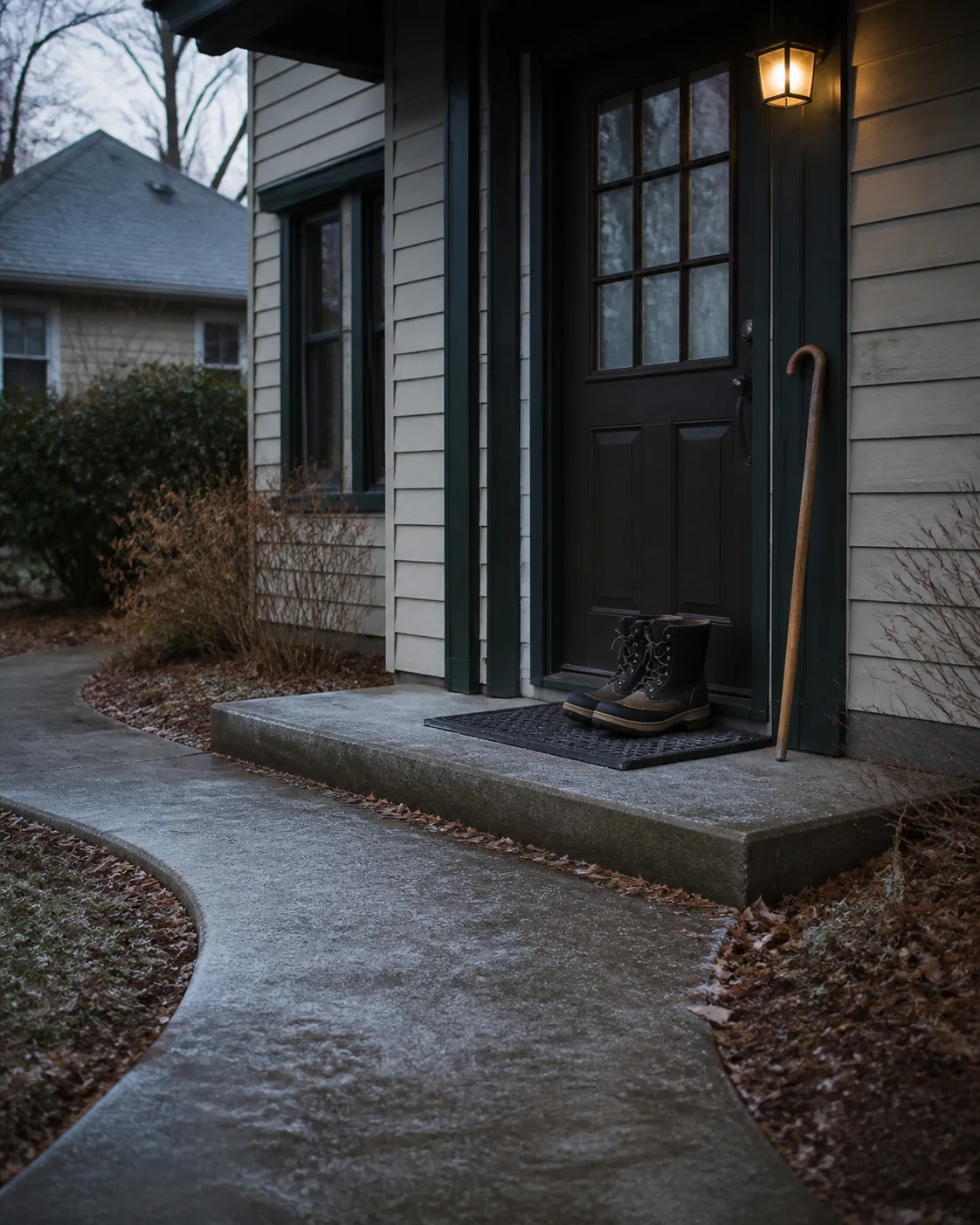
Verified as of July 31, 2026: NOAA’s Climate Prediction Center put the odds of El Niño persisting through early spring 2027 at 97%, with an 81% chance of a very strong event during October–December 2026; CPC’s next ENSO Diagnostic Discussion is scheduled for August 13, 2026, so those figures should be rechecked before publication or major seasonal planning decisions are finalized. Typical El Niño winters shift the storm track over the southern United States, bringing wetter and stormier conditions there, while parts of the northern tier may run warmer and see more freeze-thaw cycles.[1]
That does not mean one forecast can promise ice on one particular porch. It means the coming winter is credible enough to justify doing the boring, useful work now: fix the surfaces, improve the lighting, decide where traction supplies live, and make sure shoes and walking aids are ready before the first slick morning.
Why this winter deserves pre-storm attention
Falls are already common without winter helping. More than 1 in 4 adults age 65 and older falls each year, and falls lead to about 3 million emergency department visits and 1 million hospitalizations annually. After one fall, the chance of falling again doubles.[2]
Winter surface conditions add a plain, physical problem to that baseline risk. AARP’s review of extreme-cold safety research cites Nordic and U.K. studies that found double to triple the number of emergency room visits and hospitalizations for falls on ice and snow.[3] That is not a personal-care failure. It is what happens when wet pavement, refrozen slush, low light, and smooth soles meet slower reaction time, weaker balance, or a cane that lands on a slick patch.
The link between the El Niño outlook and fall risk is a practical synthesis, not a single statistic: CPC supports the seasonal weather outlook; CDC and winter-safety sources support the seriousness of older-adult falls and the prevention steps. Put together, they point to one reasonable conclusion: if a wetter or more freeze-thaw-prone winter is on the table, the exterior route into the home should be treated as a maintenance problem now, not as a surprise later.
The pre-season walkthrough: start where feet, wheels, and cane tips actually land
Do the walkthrough on a normal day, not during sleet. Start from the place the older adult usually arrives — driveway, curb, garage, mailbox path, or transit drop-off — and move slowly toward the door. The point is not to admire the whole yard. The point is to notice every surface that will be wet, shaded, uneven, poorly lit, or crowded when hands are full and balance is already working hard.
| Zone | What to check before the first storm | What to finish now |
|---|---|---|
| Driveway or curb | Standing water, slope, potholes, oil-slick patches, where a car door opens | Choose the safest unloading spot; keep traction material close enough to use |
| Walkway | Shaded sections, cracked pavement, raised edges, leaves that trap moisture | Clear debris; repair or mark trip edges; plan snow and ice removal |
| Step and landing | Runoff from roof or railing, shallow ice, loose handrail, narrow place to stand | Fix drainage where possible; tighten railings; create a dry standing zone |
| Mat and threshold | Mat that curls or slides, raised threshold, puddles where boots enter | Replace or secure the mat; keep an absorbent indoor landing area |
| Inside entry | Wet floor, no place to set keys or packages, cane or walker brought in wet | Add a small table or chair-height surface; keep towels where they will be used |
The exterior route should have a snow-and-ice plan before weather arrives. The National Council on Aging recommends simple traction tactics such as using cat litter on slick surfaces, along with choosing rubber-soled winter shoes and appropriate ice-gripper options for canes and shoes.[4] CDC winter-weather guidance and Ready.gov also emphasize keeping walkways clear of snow and ice.[5][6]
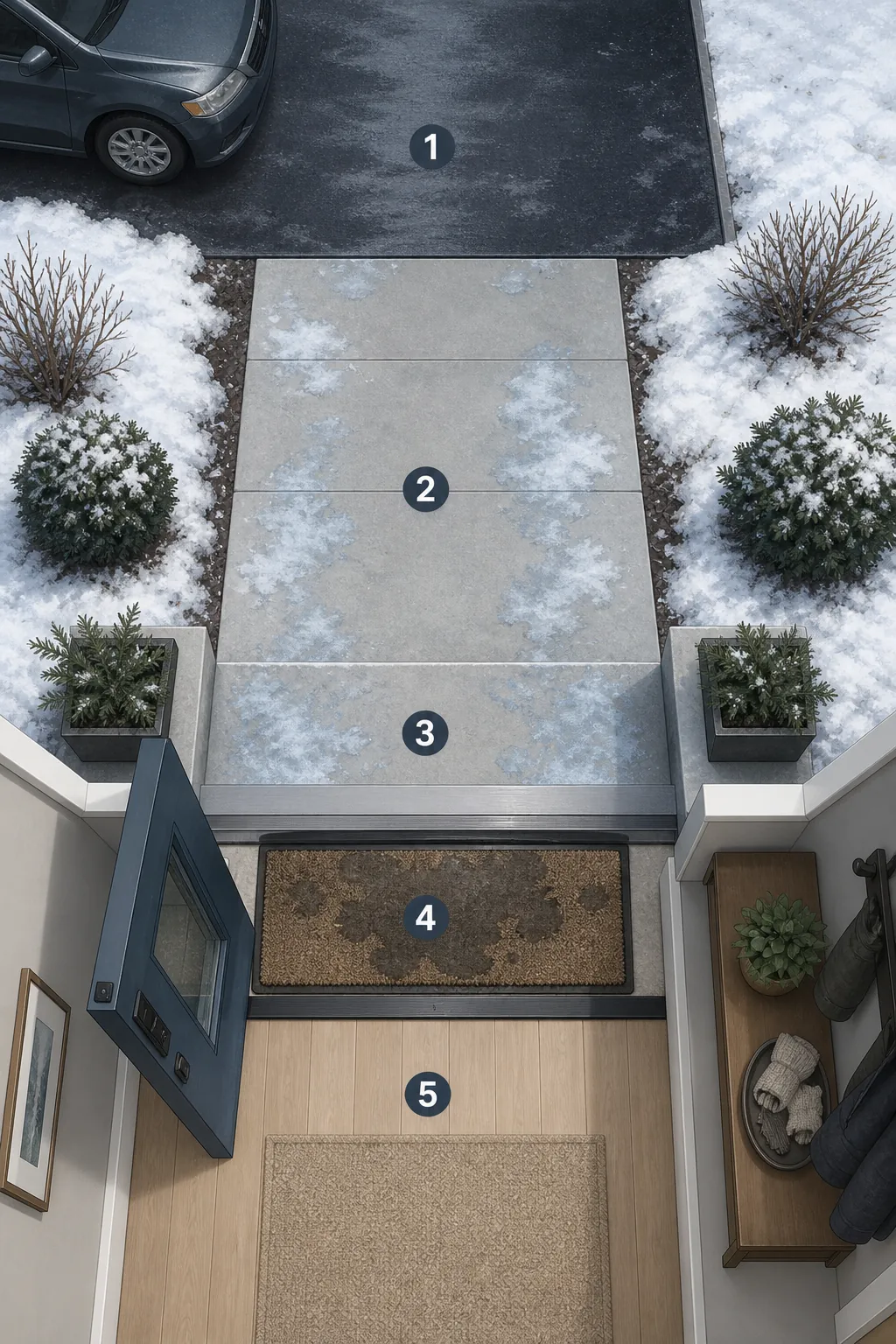
Driveway to walkway
Look at where the older adult actually gets out of the car. If the passenger-side door opens onto a sloped patch, a gutter stream, or a strip that stays shaded all day, the safest winter route may start somewhere else. That could mean parking closer to the garage, using the side door, or asking family to clear a different path first after storms.
Traction material needs to be reachable from the place it will be used. A bag of cat litter in the basement does not help someone standing on an icy landing. Put the chosen material in a sealed container near the door, garage, or carport, with a scoop that can be handled while wearing gloves. If a neighbor, aide, or adult child will clear the route, make sure that person knows which path matters most.
Walkway to step
The walkway is where small defects become winter problems. A raised seam that is merely annoying in September can hide under a skim of snow. Leaves and mulch hold moisture. A downspout that drains across the walk can make the same icy ribbon after every thaw. The fix may be as simple as clearing debris and redirecting drainage; the important part is doing it before ice turns the route into a guessing game.
Lighting deserves the same practical treatment. Low lighting is a major cause of falls, and winter adds early darkness to wet or icy footing.[5] Test the route at the time it is usually used — after dinner, before a morning appointment, or when the caregiver normally drops someone off. Replace weak bulbs, aim motion lights at the actual walking line, and make sure switches can be reached before stepping onto the route.
Step, threshold, and the first dry place inside
The step and threshold are where a person has to change levels, open a door, manage a key, shift weight, and sometimes move a cane or walker at the same time. That is too much to leave to “just be careful.” Tighten the handrail. Remove the mat that curls at the corner. Replace a slick decorative mat with one that stays flat and drains or absorbs water properly. If the landing is narrow, keep packages and planters off it for the season.
Inside the door, make a dry landing area. CDC winter-weather guidance advises drying wheels or the tips of walking aids before entering, and it recommends keeping a small table near the entry door so people are not trying to balance while holding keys, mail, or bags.[5] That small table is not decoration. It gives hands a job other than clutching everything at once.
Keep towels, an absorbent mat, and a place for wet shoes where they will actually be used. If the older adult uses a walker, wheelchair, or rollator, think about where wet wheels go after crossing the threshold. A slick interior tile floor can undo a perfectly cleared walkway.
When the safest door is not the usual door
If the front entrance is icy, use another entrance if one is safer; CDC and Ready.gov winter guidance both support choosing a clear, safer route rather than insisting on the normal one.[5][6] Decide that backup route now. It may be the garage, a side door with better cover, or a ramped entry that gets morning sun. Then treat that route like the main entrance: light it, clear it, and make sure everyone who helps knows to use it.
This is especially important when family members are helping from a distance. A caregiver may shovel the front walk because it is visible from the street, while the older adult actually uses the side door. The right route is the one the person can cross safely, not the one that looks neatest from the curb.
Footwear and walking aids are winter equipment, not afterthoughts
Shoes, cane tips, walker feet, and wheelchair wheels are the contact points between the body and winter. If they are wrong, the cleared walkway has to work too hard. Before storms begin, put the older adult’s usual shoes on the floor and look at the soles. Smooth, worn, dressy, backless, or loose footwear should not be the default for winter errands or porch steps.
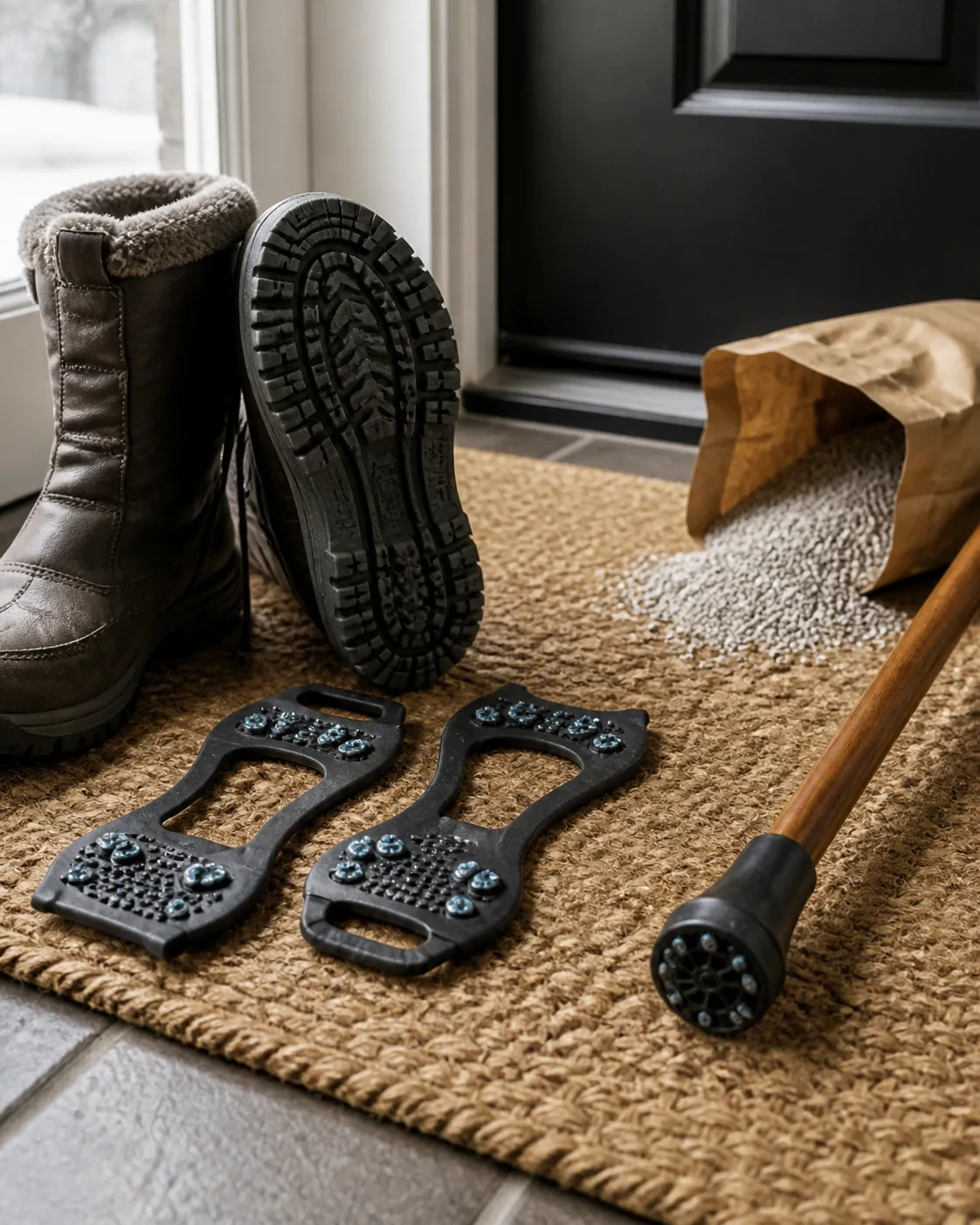
NCOA recommends rubber-soled winter shoes and spike-less snow or ice grips for shoes, along with ice-gripper cane tips and winter precautions for wheelchair users.[4] The timing matters. These are pre-storm decisions. Waiting until the first icy appointment morning usually means the person wears whatever is by the door.
- Shoes: choose a pair with rubber soles and real tread, and keep them by the door used most often.
- Ice grips: test spike-less grips before they are needed; make sure they fit the actual shoes and can be put on without rushing.
- Canes: inspect the rubber tip, replace worn tips, and consider an ice-gripper tip if the cane will be used outdoors.
- Walkers and rollators: check the feet, brakes, wheels, and places where slush can collect; plan where the device will be dried inside.
- Wheelchairs: think through traction, wet wheels at the threshold, ramp clearing, and whether the usual route has enough dry turning space.
The best winter footwear is the pair the person will actually wear. If boots are heavy, hard to fasten, or stored in a closet, they become theory. Put them where the older adult sits or stands to change shoes. Add a long-handled shoehorn, a stable chair if needed, and a place to put wet footwear without creating a new puddle.
For cane users, the transition into the house needs attention. A cane tip that picked up snow, grit, or water outside can slip on an interior floor. Put a towel or mat where the cane naturally lands after the door opens, not across the room. If someone uses two hands for balance, the small entry table matters again: it gives keys and bags somewhere to go before the person changes surfaces.
A short safety context that should not replace the fall plan
Cold exposure and home heating still belong in winter preparation, especially for older adults. The National Institute on Aging says that, for an older person, a body temperature of 95°F or lower can be hypothermia; it also warns that even indoor temperatures of 60–65°F may not be safe for some older adults and advises setting heat to at least 68–70°F.[7]
Heating safety has its own rules. Ready.gov notes that home heating is the second leading cause of home fires and cites an estimated 32,200 heating fires in 2021; it advises keeping space heaters at least 3 feet from anything that can burn and using generators only outdoors because of carbon monoxide risk.[6] Those are serious hazards. They just should not crowd out the surface-level fall fixes that determine whether someone can get from the car to the door without going down.
When the forecast changes or the storm is close
Seasonal El Niño odds are useful for deciding to prepare early. They are not a substitute for the local forecast the week of a storm. Before travel, appointments, or visits, check short-term weather and the actual condition of the route: precipitation, temperature swings, refreezing after sunset, and whether the cleared path stayed clear.
A simple storm-day adjustment can prevent a bad decision at the threshold: if the main entrance is icy, use the safer entrance; if no entrance is safely clear, delay the errand or ask for help clearing the route before the older adult steps onto it. That is not overreacting. It is treating a known winter surface hazard like the predictable maintenance issue it is.
The 2026–27 El Niño outlook makes winter fall hazards predictable enough to prepare for now. Local conditions will still decide the day-to-day risk. Finish the walkway, lighting, traction, footwear, and entryway fixes before the first storm, then re-check the actual path each time weather turns wet, icy, or dark.
References
- CPC ENSO Diagnostic Discussion. CPC. July 9, 2026.
- CDC Facts About Falls. CDC. Jan. 27, 2026.
- AARP Extreme Cold Safety. AARP. Updated Jan. 23, 2026.
- NCOA Winter Fall Prevention Tips. NCOA.
- CDC Winter Weather Safety. CDC.
- Ready.gov #WinterReady. Ready.gov.
- NIA Cold Weather Safety for Older Adults. NIA.
Related reading
Noticed something outdated or inaccurate on this page? Flag a correction. We review every report against CDC, NIA, and AARP HomeFit guidance before updating a page.
Part of the Fall Prevention section.