
STEADI: intervene
Flash Flood Safety Tips for Older Adults and Caregivers
Flash floods can leave older adults only minutes to gather medications and reach higher ground — too little time to make a safe evacuation call in the moment. Pre-deciding the stay-or-go choice, packing a medication go-bag, naming helpers, and practicing the drill turn an active warning into a simple 'go now' and reduce fall risk during the rush.
A flash flood warning is a terrible time to discover that the pill bottles are split between the kitchen, bathroom, and nightstand; the walker is by the recliner; the phone is at 18%; and the person who usually drives is twenty minutes away. For many older adults, “leave now” is not one action. It is a chain of small, physical tasks, any one of which can become a fall, a missed medication dose, or a car trapped on the wrong road.
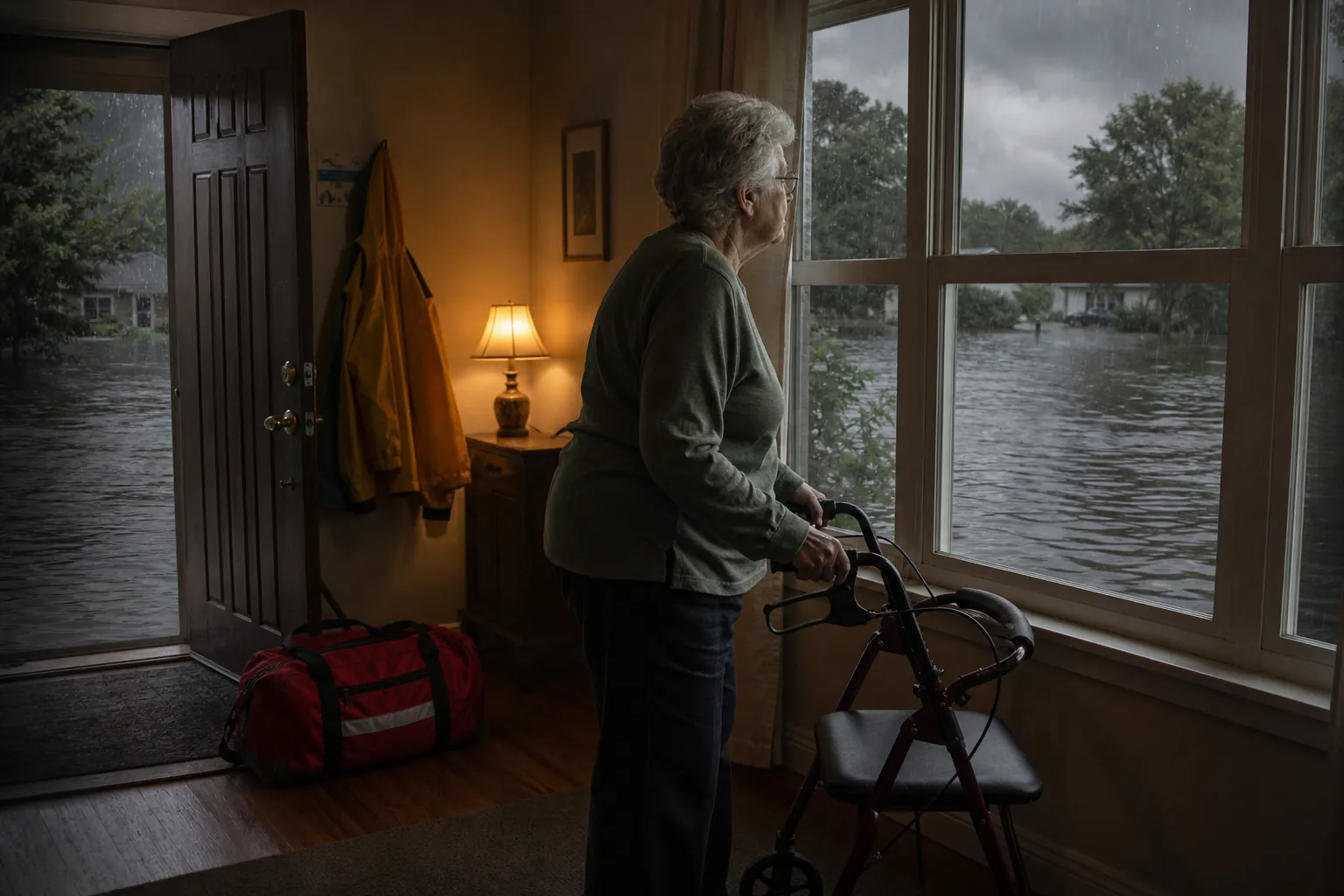
So the most useful flash flood safety tip for older adults is not a dramatic one. It is to decide the stay-or-go branch before the warning arrives, write it down, and practice it with the exact helpers, medications, mobility aids, and alert sources that will be used when the weather turns ugly.
A warning is an action trigger, not a planning meeting
The National Weather Service uses these flood alerts in a specific way: a Flash Flood Watch means conditions are favorable and people should be prepared; a Flood Warning means flooding is imminent or already occurring and people should take action; a Flash Flood Warning means flash flooding is imminent or already occurring and people should move to high ground immediately. Flash floods can develop in minutes to hours, and they can happen even where it is not raining. [1]
That timing matters more for an older adult who needs help transferring, uses a walker, depends on powered medical equipment, or cannot safely rush down wet steps. A plan that works for a person who can grab keys and run may be dangerous for someone who needs ten minutes just to put on shoes, gather medications, and get to the door.
Older adults are not a small side group in disasters. AARP’s Disaster Resilience Tool Kit reports that people age 75 and older were about 6% of New Orleans’ population in 2005 but about half of Hurricane Katrina deaths; nearly half of Hurricane Sandy fatalities were people age 65 and older; and of 87 Hurricane Ian fatalities with known age, 61 were age 60 or older. [2]
Preparedness also looks better in people’s heads than it does in the hallway by the door. In AARP’s 2023 survey of adults age 50 and older, 60% said they felt prepared for a natural disaster or emergency, yet about one in three did not have extra prescription medicine, nearly half did not have emergency phone chargers, and only 12% followed local authorities on social media. [3]
Those gaps are exactly where a flash flood becomes a fall-prevention problem. The water is one hazard. The hurried search for glasses, the uncharged phone, the walker that does not fit in the helper’s car, and the missing medication list are the hazards people can fix before the alert.
Build the stay-or-go decision tree while the floor is dry
The written plan should not ask an older adult to weigh every possible weather detail under stress. It should answer a few blunt questions in advance, using local emergency guidance, the home’s actual layout, and the person’s actual mobility.
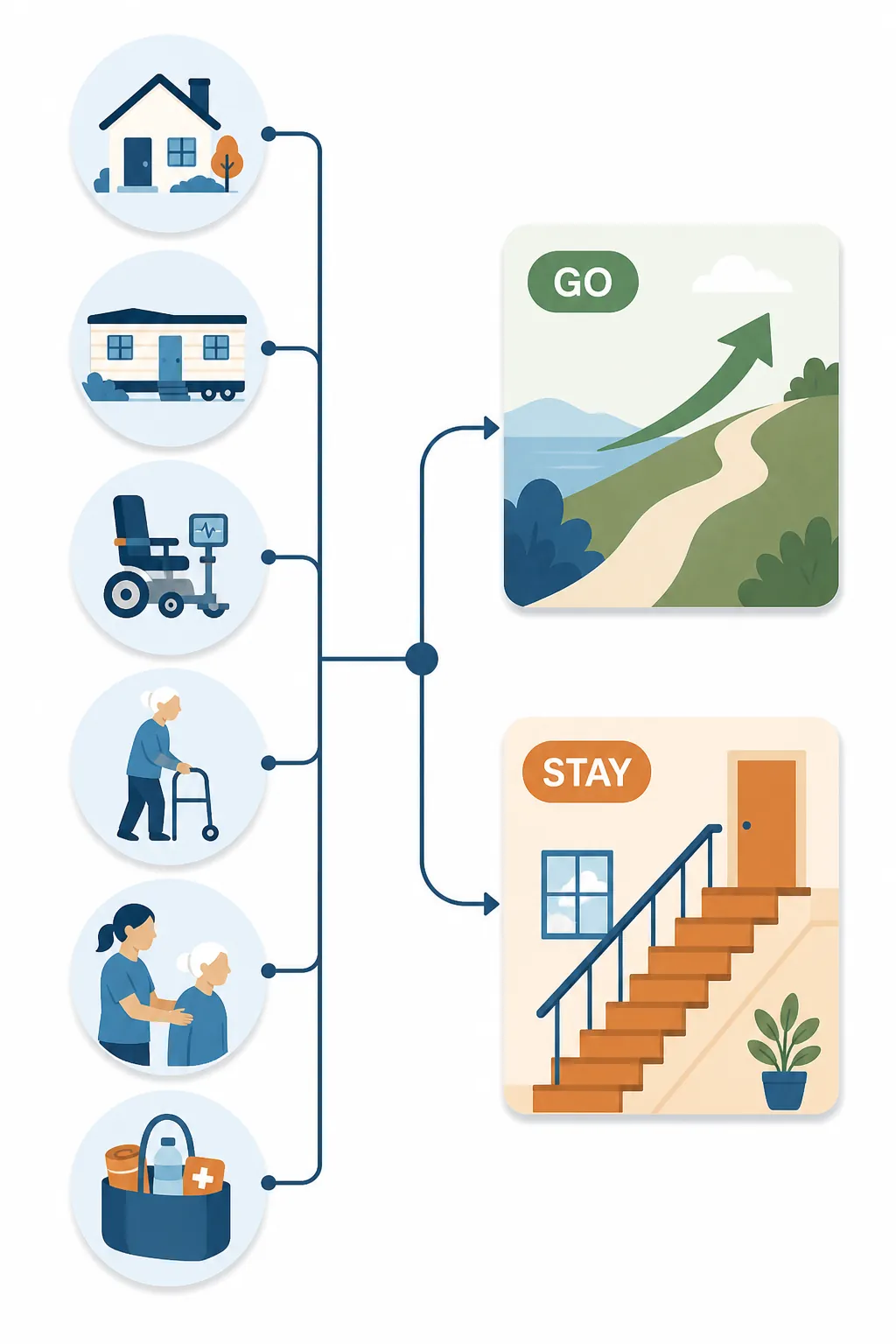
| Decision question | If the answer is yes | If the answer is no or uncertain |
|---|---|---|
| Is the home in a local flood evacuation zone, flood-prone street, basement apartment, or area where officials tell residents to leave? | Use the GO branch before roads are threatened. The plan should name the destination, driver, pickup point, and medication bag. | Keep checking official alerts and move to the next question. Do not assume “not in a zone” means no flash flood risk. |
| Is the home a manufactured home, single-story home, low-lying home, or place with no safe upper level? | Favor a pre-planned early GO branch when a watch or local advisory gives enough time. Waiting for water at the door may remove the safe option. | A STAY-UPSTAIRS branch may be reasonable if local officials have not ordered evacuation and the upper level is safer than a late trip outside. |
| Does the older adult use power-dependent medical equipment or refrigerated medication? | Plan backup power, transportation, and a shelter or destination that can support the device or medication need. Check local special-needs registry options before storm season. | Still pack the medication list, charger, and device instructions. Power loss can create needs that were not obvious at breakfast. |
| Would leaving safely require another person because of stairs, transfers, low vision, a walker, wheelchair, oxygen, or balance problems? | Name the helper and backup helper now. The warning plan should not depend on “someone will come.” | Write the solo route anyway, including shoes, cane or walker, phone, keys, and where to move first. |
| Can the mobility device, oxygen, cane, walker, wheelchair, hearing aids, glasses, and charger actually travel with the person? | Assign who carries what and which vehicle has room. Practice loading the device once. | Change the destination, helper, vehicle, or stay branch. A plan that abandons the walker is not a safe plan. |
| If staying is the branch, are there supplies, medications, lighting, phone power, water, and a way to receive alerts on the safe level? | Stage the supplies upstairs or on the chosen higher level, not in a flood-prone basement or garage. | Do not call it a stay plan yet. Fix the missing items or choose an earlier GO branch. |
| Does the person need a local accessible shelter, transportation assistance, wellness check, or emergency registry? | Register or call the local emergency management office in advance, and write down the confirmation details. | Write down the ordinary shelter or family destination, plus a backup if the usual route is flooded. |
The manufactured-home question deserves a real answer, not a shrug. The same goes for a basement bedroom, a first-floor apartment near a creek, or a house where the only “higher ground” is a staircase the person cannot safely climb. If there is no safe place to go up, the plan usually needs an earlier departure trigger.
The opposite is also true. If water is already rising outside, roads are flooding, and local officials have not ordered evacuation from that specific home, a pre-decided move to an upper floor may be safer than a late attempt to drive through floodwater. That branch should be written just as clearly as the evacuation branch: which room, which supplies, which phone, which helper gets called, and what condition would change the plan.
For slower-moving storms, families may also need a broader evacuation plan. If that is the issue, use a separate evacuation checklist such as hurricane evacuation tips for seniors to prevent falls. A flash flood plan is narrower: it removes the debate that otherwise happens when minutes matter.
Write the plan so someone else can execute it
A good plan is not a paragraph of advice. It is a handoff sheet. If the adult child is stuck at work, the neighbor, sibling, home aide, or older adult should be able to read the page and know what to do first.
| Put this on the flash flood plan | What to write |
|---|---|
| Primary branch | GO early, STAY upstairs, or WAIT FOR SPECIFIC LOCAL ORDER — choose the branch in advance with local guidance. |
| Trigger | The exact alert or local message that starts action: Flash Flood Watch, local evacuation notice, Flash Flood Warning, or water at a named landmark. |
| Older adult’s first action | Put on shoes, grab walker or cane, put on glasses/hearing aids, take phone, move to named location. |
| Medication go-bag location | Example: red bag on hook by front door; backup medication list in kitchen drawer. |
| Helper 1 | Name, phone number, driving route, key access, and what they carry. |
| Helper 2 | Name, phone number, when to call, and whether they can transport a walker, wheelchair, oxygen, or pet. |
| Destination if going | Address, phone number, accessible entrance, bathroom access, and backup destination. |
| Safe place if staying | Upper room or higher floor, chair placement, supplies, charger, flashlight, and how to call for help. |
| Medical notes | Medication list, allergies, diagnoses that matter in an emergency, device instructions, pharmacy, doctor, and insurance information. |
| Registry or shelter notes | Local emergency registry, accessible transportation contact, shelter instructions, and confirmation number if provided. |
Keep the page plain. Large type. No tiny margins. No clever color coding that disappears when printed in black and white. Put one copy by the medication go-bag, one near the main exit, and one with the primary caregiver.
The medication go-bag should already be packed
The American Red Cross advises older adults to keep at least 30 days of medications and extra assistive items such as a cane or eyeglasses as part of emergency preparedness. [4] That does not mean every dose sits loose in a storm bag all year. It means the caregiver and older adult should decide how prescriptions will be rotated, where the current list is stored, and which items leave the house every single time.
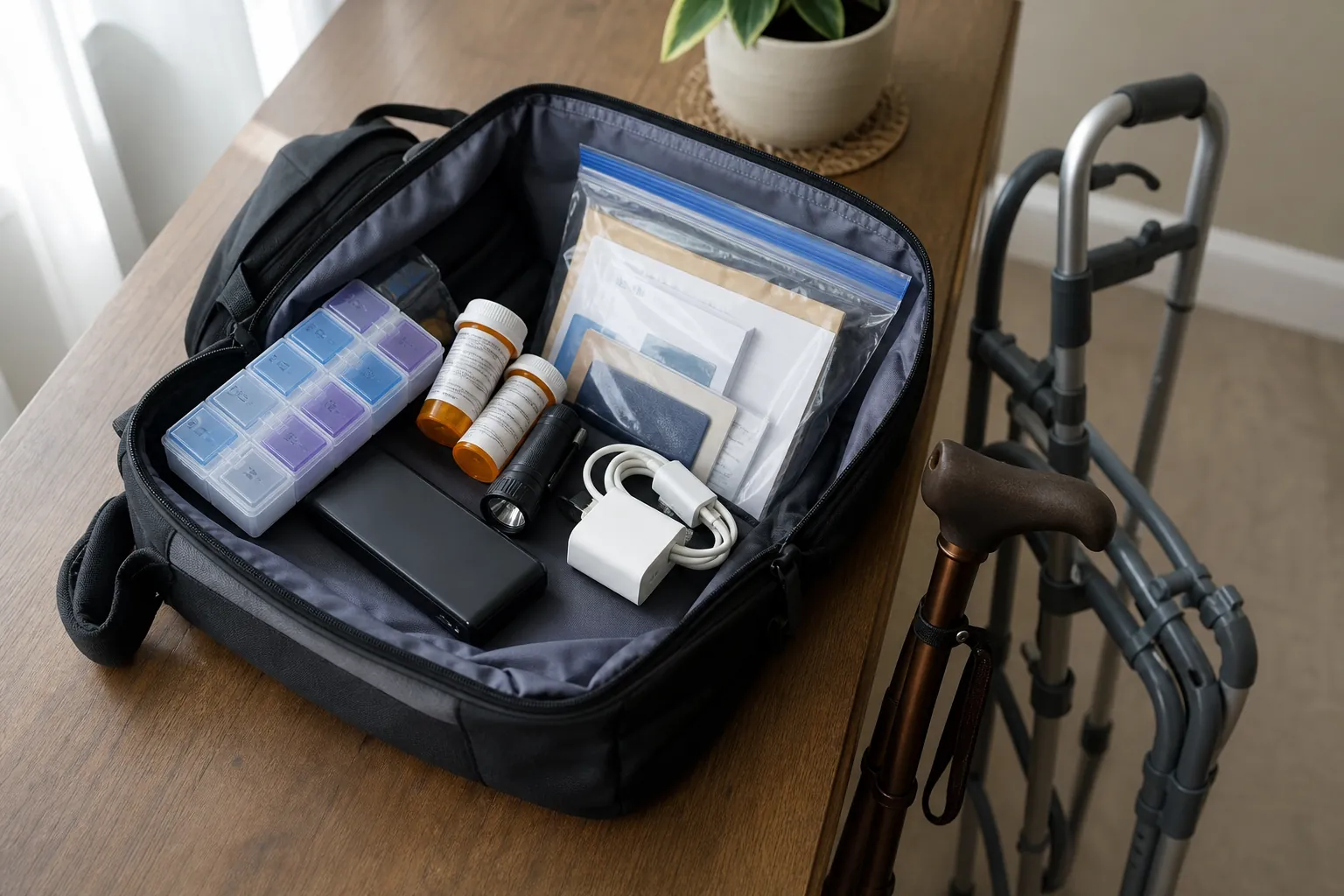
- Current medication list, including dose, timing, prescribing clinician, and pharmacy
- Prescription medications and a rotation plan so the bag does not fill with expired bottles
- Copies of insurance cards, ID, emergency contacts, and key medical information in a waterproof pouch
- Glasses, hearing aid batteries or charger, dentures supplies, and any communication aids
- Phone charger, power bank, flashlight, and spare batteries
- Small labeled bag for the items that must be added at the last minute, such as refrigerated medication
- Written instructions for oxygen, CPAP, mobility equipment, or other devices a helper may not know how to manage
Do not hide the bag in a closet because it looks untidy. The bag’s job is to be found under stress by someone who may not know the house. If a parent dislikes the look of it by the door, use a clean bin, a labeled cabinet, or a hook inside the coat closet. Just do not make the helper hunt.
Mobility equipment needs a transportation plan, not a wish
Ready.gov tells older adults to plan how assistive devices such as wheelchairs, walkers, or crutches will be transported, and to build and practice a support-network plan. [5] This is where many family plans quietly fail. The walker fits in the older adult’s sedan, but the neighbor drives a compact car. The wheelchair folds, but only if someone knows which latch releases. The oxygen tubing tangles at the doorway. These are not details to solve while rain is blowing sideways.
Practice the awkward parts once when nothing is happening: getting from the chair to the door, locking the house, loading the walker, climbing into the car, and walking into the destination. Time it if that helps, but the main goal is to find the snag. A plan that depends on speed should be treated with suspicion.
Name helpers before anyone is scared
The Red Cross advises older adults to plan who will help them evacuate and to register with local registries where available. [4] The helper list should include more than a favorite adult child. It should say who has a key, who can lift or steady safely, who can drive in bad weather, who can take a pet, and who is the backup when the first person does not answer.
If the older adult may need accessible transportation, electrical support for medical equipment, or a special-needs shelter, start with the local emergency management office, county website, or 211-style community referral line where available. Registration systems vary by place, and signing up does not usually mean someone will automatically appear at the door at the perfect moment. It means the need is visible earlier, which is the point.
For families building a broader support system around aging in place, the same named-helper thinking applies beyond floods. A practical fall prevention handout for caregivers can sit beside the flood plan so helpers are not guessing about balance risks, medications, or home hazards.
Set alerts that the older adult will actually receive
A phone alert helps only if the phone is charged, nearby, loud enough, and trusted. A social media post helps only if the person follows the right local authority and checks it. The AARP survey finding that only 12% of adults age 50 and older followed local authorities on social media is a useful warning: do not make one app the whole alert plan. [3]
- Turn on Wireless Emergency Alerts on the phone and test volume settings with the older adult present.
- Use a NOAA Weather Radio or another reliable local alert method if the home has weak cell service, nighttime hearing concerns, or frequent power outages.
- Follow the city, county, emergency management office, and local National Weather Service office on the channels they actually use.
- Write down which alert triggers the GO branch and which alert triggers the STAY-UPSTAIRS branch.
- Put a charger and power bank in the same place every day, not just during storm season.
If the older adult already tracks tropical systems or severe weather, keep that setup separate from the flash flood action trigger. A monitoring routine can be useful days ahead; the flash flood warning is the point where the written branch takes over. For a safer monitoring station, see how seniors can monitor hurricane updates safely.
What to do when a flash flood warning sounds
When the warning arrives, the family should not reopen the whole argument. Use the written branch. If the plan says move to higher ground immediately, do that. If the plan says go early and the warning means the helper is already coming, the helper follows the sheet. If the plan says stay on the upper floor because late evacuation would put the older adult into rising water, go to the named room with the named supplies.
- Put on sturdy shoes before moving, even inside the home. Wet floors, dark stairs, and bare feet are a bad combination.
- Take the walker, cane, wheelchair, glasses, hearing aids, phone, and medication go-bag. Do not trade mobility for speed.
- Call or text the named helper using the script on the plan: “Flash flood warning. I am following the GO branch,” or “Flash flood warning. I am upstairs in the east bedroom.”
- Avoid walking, swimming, or driving through floodwater. Ready.gov warns against all three. [6]
- If evacuation routes are already flooded or the older adult cannot leave without entering water, call emergency services or the local emergency number and move to the preselected higher location.
- Keep the phone on the charger or power bank once in the safe location. A dead phone turns a good stay plan into isolation.
The point is not to be fearless. It is to remove the extra movements that cause injuries: three trips back for pills, a rushed bend into a low cabinet, a wet step without the cane, a helper trying to fold an unfamiliar walker in the rain.
Practice it twice a year, and after anything changes
A flash flood plan goes stale quietly. A medication changes. A neighbor moves. A walker is replaced. The upstairs bedroom becomes a storage room. A phone number changes. Review the plan roughly every six months, and sooner after a hospitalization, new diagnosis, fall, move, change in caregiver schedule, or change in mobility.
- Read the plan out loud with the older adult and the main helper.
- Check every phone number and destination.
- Open the medication go-bag and rotate anything expired or missing.
- Charge and test the power bank.
- Practice moving to the safe upper room or getting to the pickup point.
- Load the walker, wheelchair, oxygen, or other device into the actual helper’s vehicle.
- Update local registry or shelter information if the older adult’s needs have changed.
This practice does not need to become a family production. Ten uncomfortable minutes in daylight are better than ten panicked minutes in ankle-deep water.
A one-page caregiver handoff
For the adult child trying to make this usable, the finished page can be very simple. Print it. Fill it in with the older adult, not for them. Put it where both of you can find it.
| Line on the page | What to fill in |
|---|---|
| My flash flood branch is: | GO EARLY / STAY UPSTAIRS / FOLLOW LOCAL EVACUATION ORDER |
| My trigger is: | Example: Flash Flood Watch plus local evacuation notice; Flash Flood Warning; water reaching named street or driveway marker |
| If I go, I go to: | Address, phone, accessible entrance, backup address |
| If I stay upstairs, I go to: | Room, chair, supplies, phone charger, window or communication plan |
| My medication go-bag is: | Exact location |
| My mobility equipment plan is: | Walker/cane/wheelchair/oxygen location and who transports it |
| Helper 1: | Name, phone, key access, role |
| Helper 2: | Name, phone, role if Helper 1 cannot come |
| Local registry or shelter contact: | Agency, phone, website, registration status |
| Last practice date: | Date, what changed, next review date |
If medication side effects, dizziness, low vision, or recent falls make the plan hard to carry out, bring that into the next medical or fall-risk conversation. A fall prevention FAQ can help caregivers sort the home-safety pieces, and a Medicare wellness visit focused on fall prevention is one place to raise medication review and balance concerns.
Older adults who need extra time or help should not be asked to invent safety after the warning sounds. The safe work is done earlier: decide the branch, pack the medications, name the helpers, set the alerts, and practice the route before water is moving.
References
- Flood Watch vs. Warning, National Weather Service.
- Disaster Risks to Older Adults, AARP, 2022.
- Preparing for an Emergency, AARP, 2023.
- Older Adults Emergency Preparedness, American Red Cross.
- Older Adults, Ready.gov.
- Floods, Ready.gov.
Related reading
Noticed something outdated or inaccurate on this page? Flag a correction. We review every report against CDC, NIA, and AARP HomeFit guidance before updating a page.
Part of the Fall Prevention section.