
STEADI: Intervene
How to Check a Parent's Fridge for the Salmonella Egg Recall
A practical plan for checking an older parent's fridge during the July 2026 salmonella egg recall — what to do when the carton is missing, how to recover the cost, and how to respond when a parent refuses to discard the eggs. Caregivers get the exact recall details and a conversation approach that keeps the check respectful while recognizing that 'probably fine' is not a safe default for a 65+ adult.
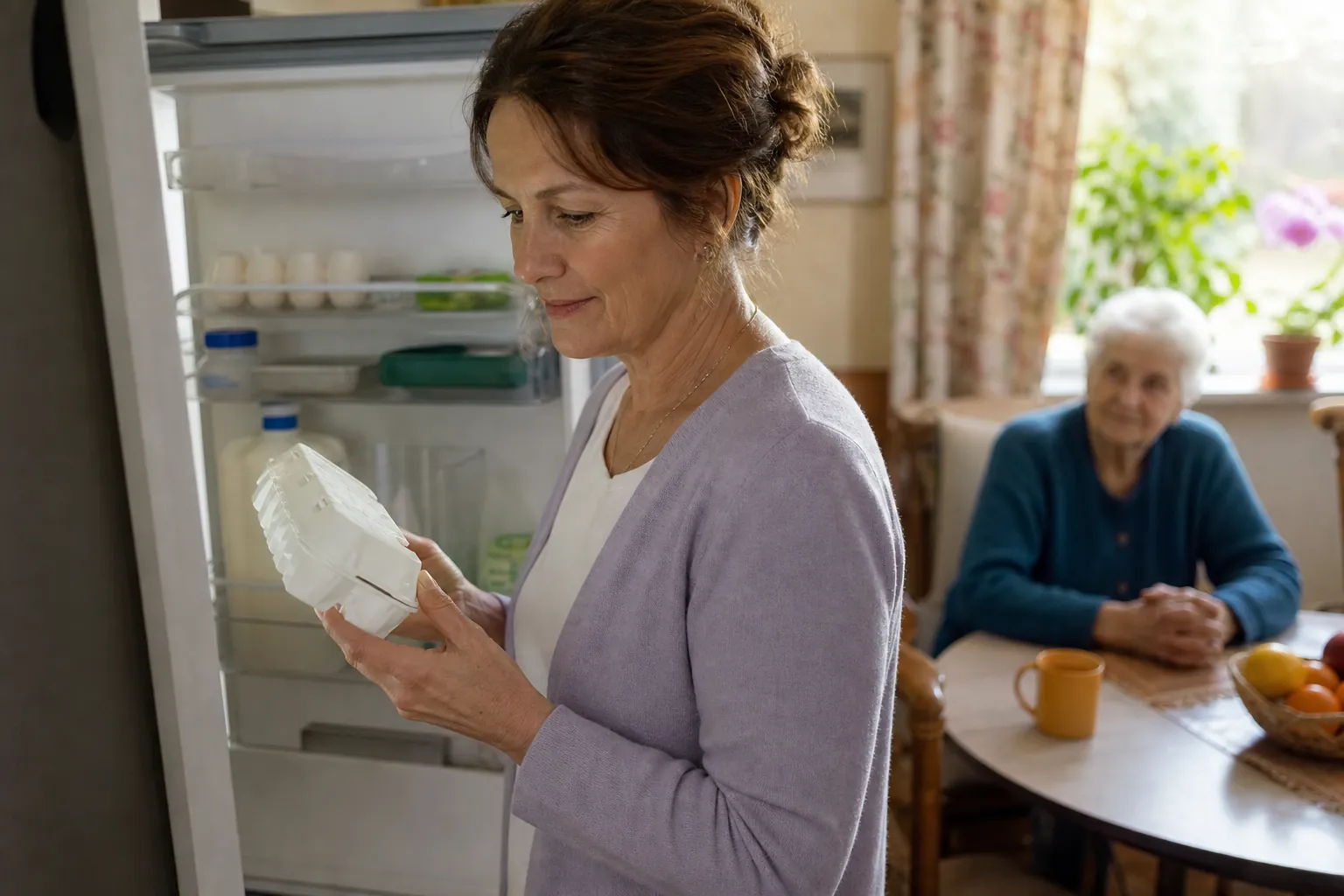
You are not really checking eggs. You are standing in a parent’s kitchen, trying to read a torn carton flap under refrigerator light while your parent watches from the table and reminds you that food is expensive. The practical way through the July 2026 salmonella egg recall is to arrive with the exact identifiers, decide what to do when the carton is missing, remove the money problem, and leave the kitchen restocked.
Medical review: Elena Ramirez, MSN, RN, geriatric care reviewer. Last verified: August 25, 2026, against FDA and CDC recall/outbreak pages. This article is for caregiver education and planning, not a substitute for medical advice, diagnosis, or treatment. If your parent has concerning symptoms or you are unsure what to do, contact a clinician or local health department.
Bring the recall note before you open the fridge
A vague “I need to check your eggs” visit turns into a debate fast. A better visit starts with a short working note on your phone or a piece of paper. The current recall identifiers are specific enough that you do not need to inspect every egg in the house as if you are solving a mystery.
| What to check | Working detail |
|---|---|
| Plant code | P-1950 or 0840962 [1] |
| Julian date range | 157–184 [1] |
| Sell-by / best-by window | July 20 through August 17, 2026 [1] |
| Brands named in the recall | Country Morning, Cal-Maine Sunups, Brookshire’s, Simple Truth, and Kroger [1] |
| Store and distribution context | Sold at Kroger stores in Texas and Louisiana; Brookshire Grocery stores in Texas, Oklahoma, Arkansas, and Louisiana; and smaller outlets. Confirmed distribution states include Arkansas, Louisiana, Mississippi, New Mexico, Oklahoma, and Texas. Case states are broader than distribution states, so do not treat this as relevant only to those six states. [1][2][3] |
| Current outbreak status to re-check before relying on it | FDA/CDC materials reviewed for this article reported 98 illnesses in 17 states, 26 hospitalizations, no reported deaths, and a mid-August 2026 Class I upgrade; the investigation is ongoing. [2][3] |
If you need the carton-code mechanics in more detail, use CareWise’s egg recall code guide or the older-adult recall checklist. This visit has a different job: make a respectful decision in someone else’s kitchen.
The fridge check, in the order that usually works
Do the check in a sequence that narrows uncertainty instead of inviting opinions about whether the eggs “look fine.” They will look fine. That is not the test.
- Ask where the eggs are usually kept. Do not start by rearranging the refrigerator without permission.
- Look for the original carton first. The recall identifiers are on the carton, not on the eggs in a way most caregivers can reliably use.
- Read the plant code, date range, and sell-by or best-by date against your note.
- If the carton matches the recall, bag the carton and remove it from the kitchen.
- If the carton is gone or you cannot tell whether the eggs are part of the recall, use the FDA’s discard rule rather than guessing.
- Clean only the surfaces and containers that may have touched the recalled eggs, using a checklist rather than improvising.
- Take responsibility for the refund and replacement so your parent is not left with the cost of cooperating.
If the carton is there
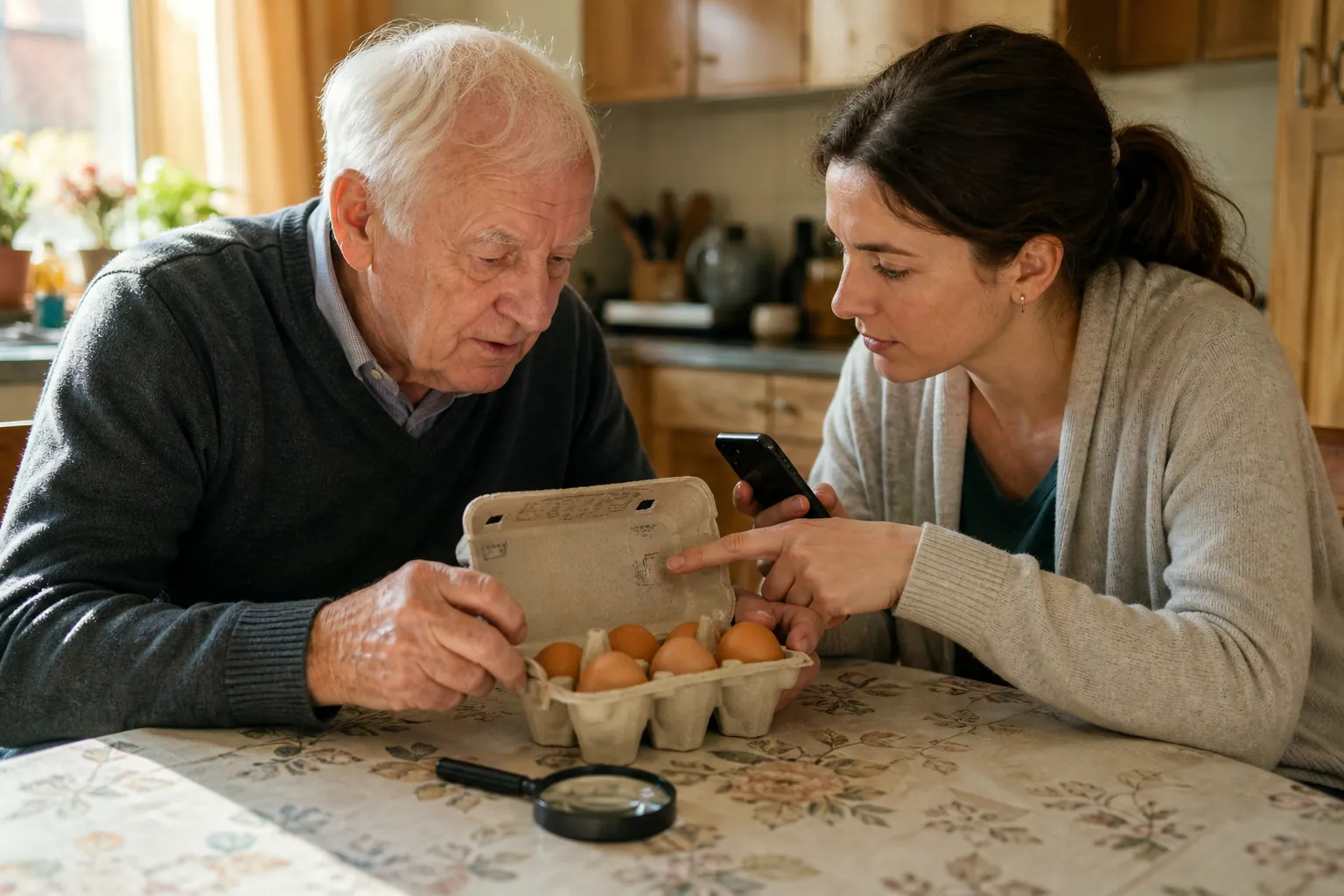
Move the carton to the table if your parent wants to see what you are doing. A flashlight or phone camera zoom is more useful than leaning into the fridge and muttering. Read the plant code first. If it is not P-1950 or 0840962, keep checking only if another identifier gives you reason to pause; if it is one of those codes, compare the Julian date range and sell-by or best-by window.
When the carton matches the recalled identifiers, do not leave it in the refrigerator “for now.” Put it in a bag, set it aside for disposal or return according to the store’s process, and wash your hands. If the eggs leaked, broke, or were stored loose in a bin, use CareWise’s recall cleaning checklist instead of turning a simple recall check into a whole-kitchen scrub.
If the carton is missing, torn, or unreadable
This is the moment most recall advice skips. The eggs may be in a ceramic tray. The carton may have gone out with last week’s recycling. The flap may be torn exactly where the code was printed. Your parent may remember buying eggs at Kroger but not the date, or may say the neighbor picked them up.
For this recall, the FDA says to throw out eggs stored without their original packaging if you cannot tell whether they are part of the recall. That is the rule that removes the argument. You are not accusing your parent of being careless, and you are not deciding that every loose egg in America is dangerous. You are applying a specific recall rule to a specific uncertainty in this refrigerator. [2]
Say it plainly: “Because we can’t prove these are not part of the recall, I’m going to treat them as recalled. I’ll replace them today and handle the refund.” That last sentence matters. Without it, the rule can sound like punishment.
Do not try to rescue the decision by sniffing the eggs, checking for cracks, or asking whether anyone felt sick after breakfast. Those checks do not answer the recall question. The question is whether the eggs can be ruled out. If they cannot, they leave the kitchen.
When your parent says, “I’m not wasting them”
Refusal is often not really refusal. It is money, pride, habit, and the aggravation of having someone else come into the kitchen and declare a normal-looking food unsafe. Treat those as real concerns. Then still remove the eggs.
A useful sequence is short:
- Name the concern: “I know you paid for these, and I know it feels wasteful.”
- Make the cost your job: “The recall says there is a full refund at the place of purchase. I’ll take care of that.”
- Replace the food: “I’m also bringing new eggs, so you’re not stuck changing breakfast.”
- Share the rule instead of making it personal: “For recalls, if we can’t rule it out, it goes out. That’s the family rule, not a judgment about you.”
- Give the risk context without a lecture: “For someone over 65, ‘probably fine’ is not the fairest default.”
The refund point is not a small courtesy. The FDA recall notice describes a full refund at the place of purchase. If you are the caregiver pushing for disposal, consider making yourself the person who bags the carton, brings the receipt if there is one, asks the store about the refund, and buys the replacement. [1]
The risk context should be accurate and modest. The CDC says nearly half of adults 65 and older with a lab-confirmed foodborne infection from Salmonella, Campylobacter, Listeria, or E. coli are hospitalized. That statistic is not the same as the hospitalization count in this egg outbreak, and it does not predict what will happen to your parent. It does explain why “we’ll chance it” is a poor default when the person taking the chance is older and the food can be replaced. [4]
If your parent still objects, lower the temperature of the conversation rather than raising your voice. Try: “I’m not asking you to agree that they would have made you sick. I’m asking us not to keep food we can’t clear during an active recall.” That leaves dignity intact while keeping the decision tied to the recall, not to obedience.
After the eggs leave, close the loop
Once the eggs are bagged, do not create more work than the situation requires. If the carton sat cleanly on a refrigerator shelf, the cleaning job may be limited. If eggs were loose in a bin, cracked, or handled during cooking, follow the existing CareWise cleaning steps. For a broader kitchen routine after this recall, use the senior egg safety checklist.
Then do the part that makes the next recall easier: take a photo of the discarded carton label if it is available, keep the store receipt or app purchase record, and replace the eggs before you leave or schedule a delivery. A parent who cooperates and then has no breakfast food left may remember the recall check as a loss of control. A parent who cooperates and sees the replacement carton in the fridge is more likely to let you help next time.
Watch symptoms without turning the visit into surveillance
If your parent may have eaten recalled eggs, monitor for illness and use clear thresholds. The CDC says to call a doctor for fever above 102°F; diarrhea or vomiting that lasts more than 2 days; bloody stool or urine; or signs of dehydration, including little or no peeing, very dark pee, feeling very thirsty, dry mouth or throat, or dizziness when standing. [5]
For a deeper symptom plan, use CareWise’s guide on when older adults should seek care for salmonella symptoms. If your parent is weak, dizzy, or making extra trips to the bathroom, also read the fall-risk explanation in Why Salmonella Symptoms in Seniors Become a Fall Risk. If your parent tends to under-report symptoms, a simple shared note like the one in How to Monitor Health Changes in Elderly Parents can help you track appetite, fluids, bathroom changes, dizziness, and fever without asking the same anxious questions all day.
Make the next recall less personal
After this check is over, set the household rule while no one is standing in front of an open refrigerator. Eggs stay in the original carton. If someone transfers them to a tray, the carton label gets photographed first. If you shop for your parent, take a picture of the carton code before the eggs go into the fridge. If your parent shops alone, agree that you can ask for a quick carton photo during recalls.
The rule for uncertainty should be decided in advance: when recalled food cannot be ruled out, it leaves the kitchen. Then the caregiver handles the refund, replaces the food, cleans only what needs cleaning, and watches for symptoms using the CDC thresholds.
References
- Midwest Poultry Services, L.P. Recalls Shell Eggs Due to Possible Salmonella Enteritidis Contamination — FDA
- Outbreak Investigation of Salmonella: Eggs, July 2026 — FDA — July 24, 2026
- Salmonella Outbreak Linked to Shell Eggs — CDC
- People at Increased Risk for Food Poisoning — CDC
- Symptoms of Salmonella Infection — CDC
Related reading
Noticed something outdated or inaccurate on this page? Flag a correction. We review every report against CDC, NIA, and AARP HomeFit guidance before updating a page.
Part of the Fall Prevention section.