
STEADI: Assess
When to Seek Care for Salmonella Symptoms in Older Adults
For caregivers deciding in the moment, this guide turns salmonella symptoms in an older adult into a red-flag decision: which signs call for 911, urgent care, or a primary care appointment. It includes a 72-hour watch-and-record plan for at-home recovery, a dehydration checklist specific to adults 65+, and what to tell the clinician.
If an older adult may have salmonella, the first question is not “Is this definitely salmonella?” It is “Has anything happened that means we stop watching at home and get medical help now?” For adults 65 and older, that threshold is lower because the CDC names this age group as higher risk for serious foodborne illness, and nearly half of people 65 and older with lab-confirmed Salmonella-family illness are hospitalized.[1]
This guide is for real-time caregiver triage, not a diagnosis or a substitute for medical advice. If a clinician, nurse line, poison control specialist, emergency dispatcher, or local emergency instruction tells you to do something different from this checklist, follow that instruction.

Red flags: when to stop waiting
Use the highest level that matches what you are seeing. Do not wait for every symptom on the list. One serious sign is enough to escalate.
| What you see in the older adult | Care level to seek | Why it matters |
|---|---|---|
| Any change in mental state, such as new confusion, unusual irritability, or marked lack of energy | Emergency care now; call 911 if transport is unsafe or the person is hard to rouse | Yale Medicine lists mental-status change among ER-level food poisoning signs.[2] |
| Signs of dehydration: little or no urination, very dark urine, very thirsty, dry mouth or throat, or dizziness when standing | Same-day medical care; emergency care if severe, worsening, or paired with weakness/confusion | CDC lists these as dehydration signs that should prompt a doctor call; Cleveland Clinic also includes dark or reduced urine, dry mouth or throat, and dizziness in ER-level criteria.[3][4] |
| Frequent vomiting or inability to keep liquids down | Same-day urgent care or ER, especially if fluids are not staying down | Cleveland Clinic lists frequent vomiting or inability to keep liquids down as a reason to go to the ER for salmonella.[4] |
| Blood in stool | Same-day medical care; ER if heavy, recurrent, or accompanied by weakness, fever, dizziness, or confusion | CDC says to call a doctor for bloody poop; Mayo Clinic also flags bloody stools as a reason older adults should contact a provider.[3][5] |
| Fever higher than 102°F | Same-day medical care; ER if the person looks very ill, confused, dehydrated, or cannot keep fluids down | CDC uses fever higher than 102°F as a doctor-call threshold for salmonella symptoms.[3] |
| Six or more loose stools in one day | Same-day urgent evaluation, especially in an adult 65+ | Yale Medicine lists six or more loose stools in a day as an ER-level food poisoning sign.[2] |
| Diarrhea or vomiting lasting more than 2 days | Call a doctor; do not keep extending the watch period without advice | CDC says to call a doctor if diarrhea or vomiting lasts more than 2 days.[3] |
| Symptoms are mild, fluids are staying down, urination is normal, no blood, no confusion, fever is not above 102°F, and symptoms are improving | Continue close monitoring and record symptoms | Typical salmonella illness often lasts 4–7 days, but caregivers should keep checking against the red flags above.[3] |
If you are deciding between urgent care and the emergency department, choose the place that can handle the worst current problem. An older adult who cannot keep fluids down, has dark or reduced urine, is dizzy when standing, or seems newly confused may need faster assessment than a routine office visit can provide.
Dehydration is the symptom cluster to watch most closely
With salmonella, diarrhea and vomiting are easy to notice. Dehydration can creep in while the caregiver is busy cleaning the bathroom, changing sheets, and trying to get the next sip of water accepted. In an older adult, dehydration is not a side issue. It is one of the named reasons to call a doctor or seek emergency-level care.[3][4]
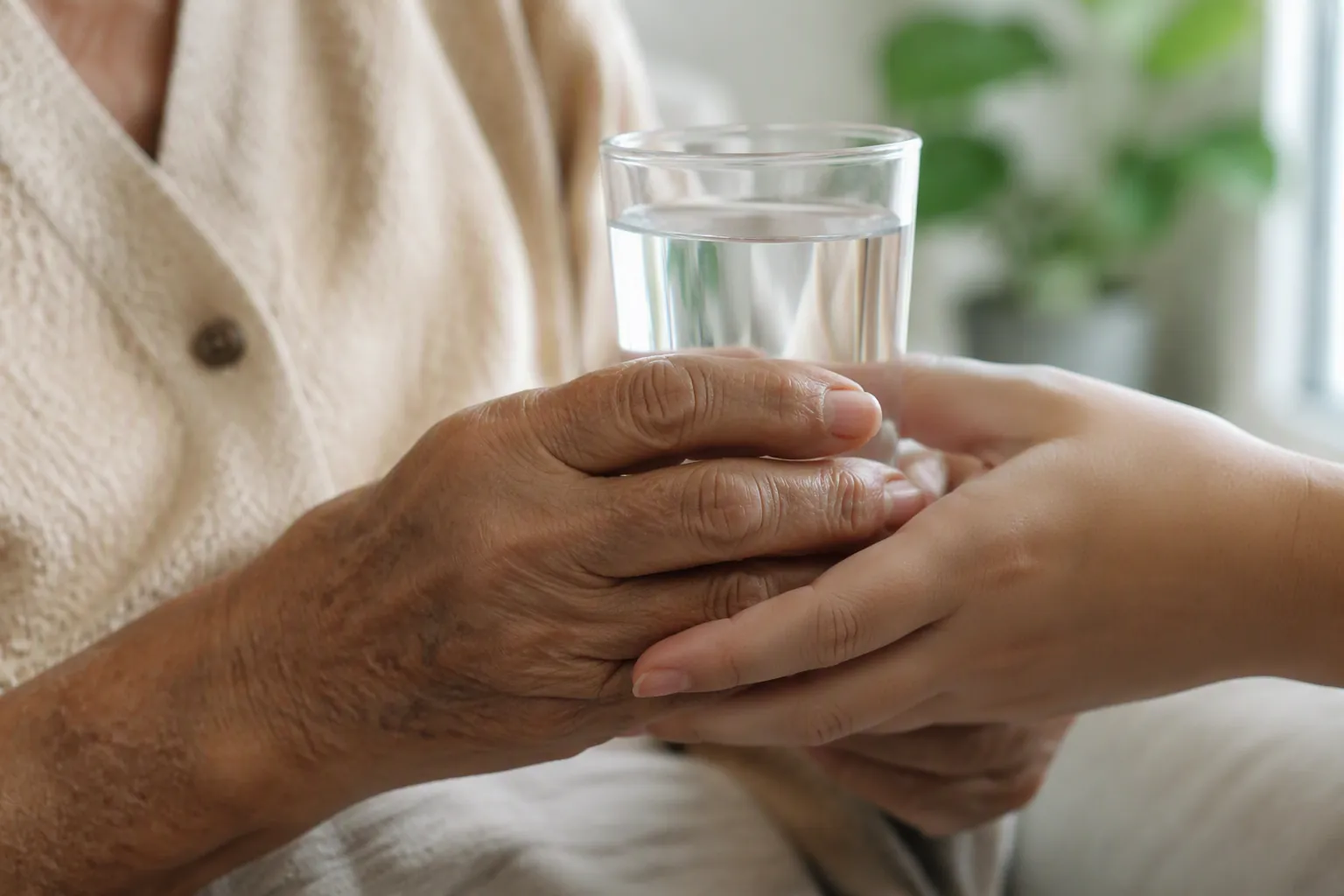
Check for dehydration by looking at what is observable, not by guessing whether the person “seems dry.” The signs to write down are:
- Little or no urination
- Very dark urine
- Unusual thirst
- Dry mouth or throat
- Dizziness when standing
- Frequent vomiting or inability to keep liquids down
- New confusion, irritability, or lack of energy
The mental-status check matters because a parent may not say “I’m dehydrated.” They may instead stop answering normally, become unusually short-tempered, seem sleepy in a way that does not fit the situation, or struggle to follow a simple conversation. Yale Medicine includes confusion, irritability, and lack of energy among ER-level warning signs in food poisoning.[2]
Dizziness when standing deserves special caution in a home setting. Even before anyone has fallen, dizziness plus diarrhea or vomiting is a sign that the body may not be keeping up with fluid loss. If you are also worried about steadiness, the related guide on salmonella prevention and fall risk in seniors goes deeper into the fall-prevention side; here, dizziness is treated as a care-escalation clue.
What symptoms can fit salmonella, and how long to watch
The CDC says salmonella symptoms usually begin 6 hours to 6 days after infection and usually last 4–7 days.[3] That wide onset window is one reason exposure is often uncertain: the suspicious egg dish, restaurant meal, leftovers, or recalled food may not be from the same day symptoms began.
The 4–7 day typical duration should not be used as permission to ignore red flags. CDC also says to call a doctor when diarrhea or vomiting lasts more than 2 days.[3] Those two facts can sit together: some salmonella illnesses run several days, but an older adult whose vomiting or diarrhea has crossed the 2-day mark should not simply be watched in silence.
For broader food poisoning context across different germs, use How to Spot Food Poisoning Symptoms in Older Adults. If the exposure may involve the July 2026 egg recall, the recall-specific page on salmonella outbreak safety for seniors can help you sort out what product information to save.
A 72-hour watch-and-record plan
If the older adult does not currently meet emergency criteria, watching at home should still be active. The goal is to notice when the situation crosses a named threshold, not to reconstruct the whole illness from memory after a long night.

Hour 0: mark the starting point
Write down when the first symptom began, even if it is approximate. If diarrhea started overnight, write “overnight” and the time you first noticed it. Add possible exposures from the prior 6 hours to 6 days, because that is the CDC’s salmonella onset window.[3]
Start a simple log with five columns: time, temperature, loose stools, vomiting or fluids kept down, and urine or mental-status notes. The guide to monitoring health changes in elderly parents can help if you need a fuller recording system, but a paper notebook is enough for this decision.
The first day: count, don’t estimate
Count loose stools instead of writing “a lot.” Six or more loose stools in a day is an ER-level sign in Yale Medicine’s food poisoning guidance.[2] Also write down each vomiting episode and whether fluids stayed down afterward.
Take and record temperature readings. The number that changes the decision is a fever higher than 102°F, which CDC lists as a reason to call a doctor for salmonella symptoms.[3] If the temperature is near that point and the person looks worse, do not wait for a perfect repeat reading before calling for advice.
For fluids, Yale Medicine describes a practical sequence: water on the first day, then an electrolyte drink on the second day if symptoms continue, while noting that sports drinks are not formulated to treat dehydration from illness.[2] If vomiting prevents fluids from staying down, that is no longer a routine watch-at-home situation.[4]
The second day: look for failure to improve
By the second day, the log should answer practical questions: Is stool frequency lower, the same, or higher? Is there any blood? Is vomiting blocking fluids? Is urine normal, reduced, or very dark? Is the person acting like themselves?
If diarrhea or vomiting has lasted more than 2 days, call a doctor.[3] For an older adult, that call is not overcautious; it is the point where home observation needs a clinician’s input.
The third day: do not let “still sick” become the new normal
Some salmonella illnesses last several days, but day three should not feel like starting over. If symptoms are not clearly improving, if the person is weaker, if urine output is down, or if you are repeatedly debating whether to call, use the log and contact a clinician. The record gives the nurse or doctor something more useful than “I think it’s been going on a while.”
If you are trying to compare salmonella with E. coli warning signs, the related pages on E. coli symptoms in older adults and E. coli symptoms in the elderly may help, but do not delay care to identify the germ at home.
What to tell the doctor, nurse line, or ER team
When you call or arrive, lead with the facts that change urgency. A clear handoff can sound like this: “My father is 78. Diarrhea started yesterday morning. He has had seven loose stools today, vomited twice, temperature is 102.4°F, urine is very dark, and he seems more confused than usual.”
Have these details ready:
- Age and major medical conditions, if known
- When symptoms began
- Highest temperature reading and when it was taken
- Number of loose stools in the past day
- Whether there is blood in the stool
- How many times the person vomited and whether fluids stay down
- Urination pattern: normal, less than usual, little or none, or very dark
- Any dizziness when standing, weakness, confusion, irritability, or unusual lack of energy
- Possible food exposures within the prior 6 hours to 6 days, including recalled foods if relevant
A stool sample may be needed to confirm salmonella. CDC notes that a stool sample confirms the diagnosis, so do not be surprised if the clinician asks for one rather than relying only on the symptom pattern.[3]
Also say directly if the person is older than 65. Mayo Clinic specifically includes older adults among the groups that should call a provider when illness lasts more than a few days, involves high fever or bloody stools, or shows dehydration signs such as urinating less, dark urine, or dry mouth and tongue.[5]
Clinical sources for this article were checked on August 5, 2026. The CDC pages used here were last updated or reviewed between October 2024 and November 2025, and the Cleveland Clinic salmonella page was medically reviewed on March 27, 2026.[4]
References
- People at Increased Risk / Safer Food Choices for Adults 65+, CDC, https://www.cdc.gov/food-safety/risk-factors/index.html
- Worried About Food Poisoning? Here's What You Need to Know, Yale Medicine, https://www.yalemedicine.org/news/worried-about-food-poisoning-heres-what-you-need-to-know
- Symptoms of Salmonella Infection, CDC, https://www.cdc.gov/salmonella/signs-symptoms/index.html
- Salmonella, Cleveland Clinic, March 27, 2026, https://my.clevelandclinic.org/health/diseases/15697-salmonella
- Salmonella, Mayo Clinic, https://www.mayoclinic.org/diseases-conditions/salmonella/symptoms-causes/syc-20355329
Related reading
Noticed something outdated or inaccurate on this page? Flag a correction. We review every report against CDC, NIA, and AARP HomeFit guidance before updating a page.
Part of the Fall Prevention section.