
How to Choose an Evidence-Based Fall Prevention Program for Your Parent
Choosing a fall prevention program for an older adult can feel overwhelming with dozens of options. This guide helps family caregivers compare the most widely available evidence-based programs — A Matter of Balance, Otago, Stepping On, Tai Ji Quan, and CAPABLE — and select the one that fits their parent's mobility level, fall history, and preferences.
By the time most families start searching for fall prevention programs for older adults, something has already happened. A parent slipped in the bathroom, caught themselves on the stair rail, stopped going down to the basement, or began saying no to outings that used to be easy. The question feels urgent, and the list of program names can make it feel more confusing than reassuring.
The first choice is not between A Matter of Balance, Otago, Stepping On, Tai Ji Quan, or CAPABLE. The first choice is to find out what kind of fall risk your parent has. The CDC’s STEADI framework is built around screening, assessment, and intervention, which is a useful guardrail for families: a web article can help you prepare questions, but it cannot tell whether dizziness, medications, vision changes, neuropathy, strength loss, home hazards, or fear is driving the risk in front of you.[1]
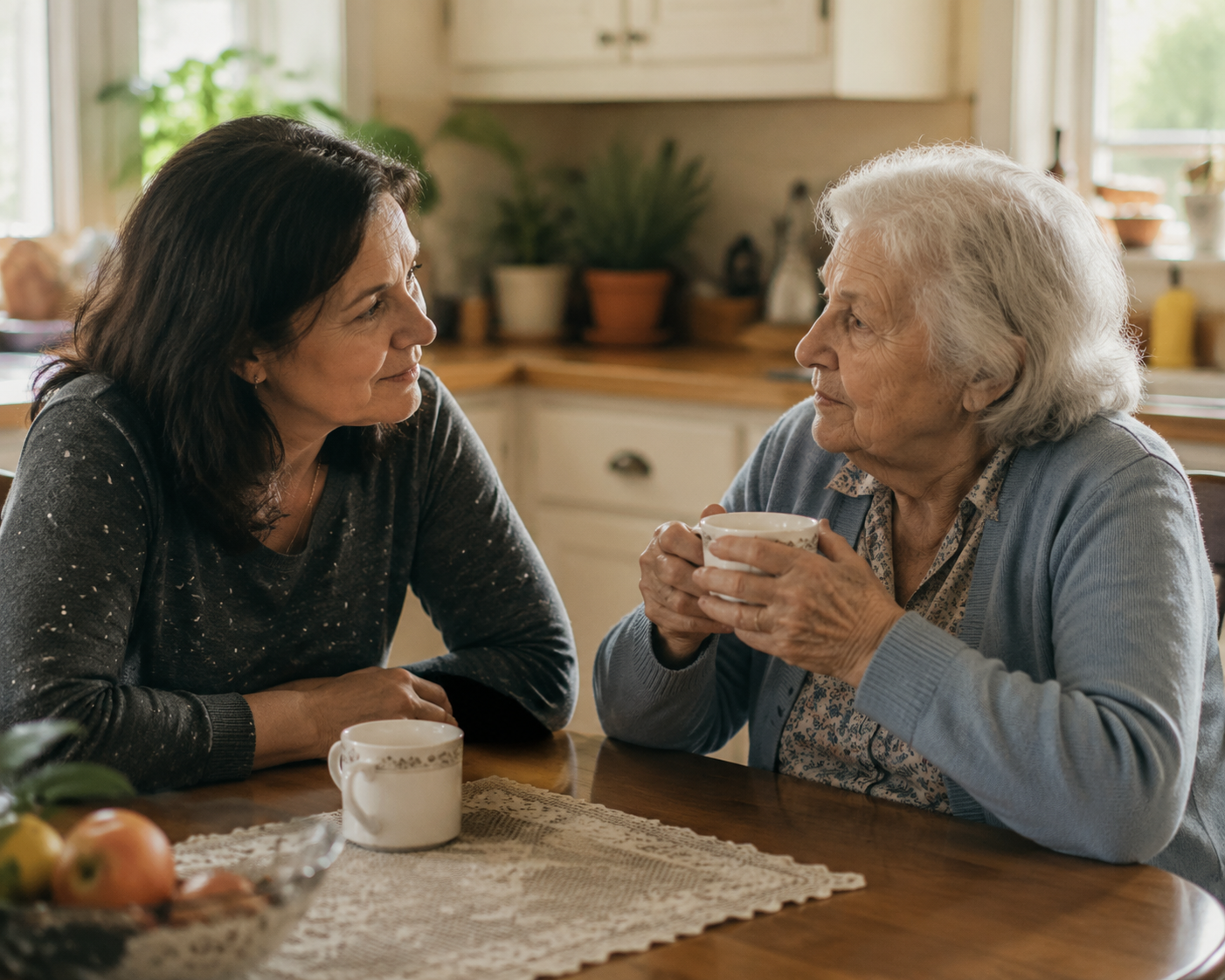
Once the concern is real, it is tempting to ask for the “best” program. A better starting question is more ordinary: What can your parent safely begin, where can they realistically attend, and what problem are you trying to solve? A parent who is steady enough for a movement class but has lost confidence after a near fall needs a different match than a parent who is homebound, using a walker, and struggling with bathing or meal preparation.
Start With Assessment, Not a Program Name
Before you narrow the list, ask the clinician, physical therapist, Area Agency on Aging, senior center, or falls-prevention coordinator a few practical questions:
- Has my parent had a fall, near fall, or new fear of falling in the past year?
- Can they rise from a chair without using their arms, walk across a room safely, and turn without losing balance?
- Are medications, blood pressure changes, vision, foot pain, or dizziness part of the picture?
- Would they attend a group class, accept a home visit, or prefer one-on-one exercise instruction?
- Is transportation easy, unreliable, or already a reason they skip appointments?
This is not paperwork for its own sake. It keeps a family from sending a parent into the wrong level of help. Someone with an unexplained fall, fainting, new weakness, or rapid decline needs clinical attention before a community class. Someone who is medically stable but losing strength may benefit from a structured exercise program. Someone avoiding normal activity because they are afraid may need education, confidence-building, and practice as much as they need leg exercises.
The Main Evidence-Based Options Families Usually Encounter
The National Council on Aging lists more than 18 evidence-based falls prevention programs, with programs available nationwide through ACL grantees in more than 35 states.[2] That larger catalog matters because it keeps the five familiar names from becoming the whole universe. Local availability still decides a lot. In many communities, the realistic choice is not between every proven model; it is between the programs being offered this season within driving distance, by phone referral, or at home.

| Program | Best fit to consider | Delivery style | Watch-outs for caregivers |
|---|---|---|---|
| A Matter of Balance | A parent who has become cautious, anxious, or avoidant after a fall or near fall | Group-based sessions focused on reducing fear of falling and increasing activity | It may not be enough by itself if the main issue is significant weakness, unsafe gait, or complex home needs |
| Otago Exercise Program | A parent who needs individualized strength and balance exercises, often with higher fall risk | Individually delivered exercise program, commonly associated with physical therapy-style support | Requires follow-through between visits; a parent who dislikes home exercise may need encouragement and tracking |
| Stepping On | A community-dwelling parent who can participate in group learning and practice around fall risks | Group workshop model combining exercises, education, and risk-reduction strategies | Works best when the parent is willing to discuss habits, footwear, vision, medications, and home risks |
| Tai Ji Quan: Moving for Better Balance | A parent who can safely participate in a movement class and may respond well to repeated balance practice | Group exercise program using tai ji quan-based movement forms | Not the right first stop for someone who cannot safely stand, turn, or follow class movements without closer supervision |
| CAPABLE | A parent whose fall risk is tied to home function, daily activities, and the living environment | Home-based model involving nursing, occupational therapy, and home modifications | More intensive than a class; availability may be limited, and eligibility can vary by local program |
The table is a starting point, not a diagnosis. A Matter of Balance, Otago, Stepping On, Tai Ji Quan: Moving for Better Balance, and CAPABLE all appear in evidence-based program listings, but they are not interchangeable versions of the same thing.[2] They ask different things of the older adult. Some ask them to show up in a room with peers. Some ask them to practice exercises at home. Some bring professionals into the home and change the environment around the person.
When Fear Is the Problem You Can See
A parent who says, “I’m fine, I just don’t go downstairs anymore,” may be describing fear more than fitness. That fear is not a character flaw. In a real-world implementation study of ACL-funded falls prevention programs from 2014 to 2019, 86.2% of participants reported fear of falling at baseline.[3] That number should soften the way families approach resistance. If fear is common among people who do eventually enroll, then a hesitant parent is not being unusually difficult.
A Matter of Balance often fits this situation because it was designed around fear of falling and activity restriction. It can be especially useful when the parent is still mobile enough for a group setting but has started shrinking their world: fewer walks, fewer errands, fewer stairs, more sitting “just to be safe.” The goal is not to talk them into pretending falls are no concern. The goal is to rebuild safe activity before avoidance becomes the new routine.
When Strength and Balance Need Rebuilding
If your parent has trouble rising from a chair, walks more slowly, reaches for furniture, or has had repeated falls, look closely at programs with a stronger exercise component and ask whether a clinician should assess them first. The U.S. Preventive Services Task Force gave exercise interventions a Grade B recommendation in June 2024 for preventing falls in community-dwelling adults age 65 or older who are at increased risk.[4] That is a strong reason to take exercise-based prevention seriously, but it should not be stretched to mean every falls program has the same evidence for every older adult.
Otago and Tai Ji Quan: Moving for Better Balance often come up here, but they suit different personalities and starting points. Otago can make sense when a parent needs a more individualized exercise plan and may need professional oversight. Tai Ji Quan may fit someone who can safely participate in a class and is willing to learn repeated movement patterns over time. A person who would be embarrassed by choreography may reject Tai Ji Quan even if the program is well supported; a person who hates doing assigned exercises alone may not follow Otago well without support.
This is where caregivers sometimes need permission to choose the less glamorous match. A completed class that your parent can tolerate, reach, and repeat is more useful than a better-known program they quit after two sessions.
When the Home Itself Is Part of the Risk
Some fall risk is not solved by telling someone to be careful. A tub wall is still high. A bedroom path is still dark. A person who cannot carry laundry safely down basement stairs still has the same problem after a brochure on balance. CAPABLE belongs in the conversation when daily function and the home environment are central to the risk. Its model brings home-based support into the place where the hazards and routines actually live.[2]
That does not mean every parent needs an intensive home-based model. It means a family should not keep signing up for community classes when the urgent issue is bathing, toileting, stairs, clutter, or unsafe transfers at home. If your parent is already avoiding basic activities of daily living, ask about occupational therapy, home modification resources, and whether a CAPABLE-style program exists locally.
Availability and Completion Matter More Than Brochures Suggest
Real programs live in real places: senior centers, community rooms, health systems, YMCAs, housing sites, and homes. In the Brach implementation study, senior centers were the most common delivery site, accounting for 25.3% of delivery locations.[3] That detail may sound small, but it explains why a senior center can be the front door to prevention in many towns. It is also why a parent’s feelings about that building matter.
Some older adults like the familiarity of a senior center. Others hear “senior center” and imagine being sorted into a category they never chose. If that is your parent, do not start by arguing about identity. Ask what would make attendance acceptable: a friend going with them, a class described as balance training rather than fall prevention, a smaller group, a medical referral that makes it feel less like family nagging, or a home-based option instead.
Completion deserves the same practical attention. In the same 2014–2019 implementation data, 62% of participants completed their falls prevention program.[3] That is encouraging enough to take these programs seriously and low enough to remind caregivers that drop-off is normal. Transportation, illness, caregiving responsibilities, embarrassment, class time, weather, hearing difficulty, pain, and plain dislike can all interfere. If two programs look equally appropriate, choose the one your parent is most likely to finish.
What the Evidence Can and Cannot Tell You
The evidence is strongest when it is read at the right size. The USPSTF recommendation supports exercise interventions for community-dwelling older adults at increased risk of falls; it does not turn every education session, home modification effort, or multi-component service into the same kind of intervention.[4] That distinction matters because families deserve confidence without being oversold.
The real-world ACL implementation study is useful because it shows what happened outside a tightly controlled trial. Participants showed clinically meaningful average improvements in Timed Up and Go of −0.9 seconds and chair stands of +1.8 repetitions.[3] Those are modest numbers, but modest is not trivial when the task is standing, turning, and moving through a house more safely.
The same study also tells us whose experience is most visible in the data. Participants were 79.7% female and 83.2% White, based on ACL grantee programs from 2014 to 2019.[3] That does not make the findings unusable, but it does mean families and program planners should be careful about assuming the same reach, comfort, or completion patterns for every community today.
Cost is another place where the numbers help, as long as they do not become the whole moral argument. NCOA’s 2024 return-on-investment analysis reports a 52% reduction in falls, a 56% reduction in injurious falls, and estimated returns of $8.36 to $38.04 for every $1 invested across evidence-based falls prevention programs.[5] Those figures can help a family justify time, transportation, and program fees. They can also help a community defend funding prevention before an ambulance ride, fracture, or hospitalization forces the issue.
Older program-specific ROI estimates should be kept in their time and scope. NCOA’s ROI discussion cites a 2015 analysis reporting estimated returns for Otago of 36% to 127%, Tai Ji Quan: Moving for Better Balance of 491%, and Stepping On of 59%.[5] Those numbers are not a current head-to-head ranking for your parent. They are economic estimates from an earlier analysis, not a substitute for fit, availability, safety, or willingness to continue.
A Caregiver’s Shortlist Method
Once fall risk has been raised with a clinician or local aging-services contact, narrow the options in this order:
- Safety first: rule out medical causes or mobility problems that need clinical evaluation before a community class.
- Main barrier next: decide whether the biggest obstacle is fear, strength and balance, home hazards, transportation, or daily function.
- Format after that: match the parent to group class, individual exercise, home-based support, or a combined model.
- Attendance reality: choose the location, schedule, and social setting your parent can actually tolerate.
- Follow-through: ask what counts as completion, how missed sessions are handled, and what practice is expected between sessions.
For a parent who is mobile but newly afraid, A Matter of Balance or Stepping On may be a reasonable first shortlist. For a parent who needs progressive strength and balance work, ask about Otago, Tai Ji Quan, or another exercise-based program available locally. For a parent whose risks are wrapped into bathing, stairs, transfers, and home setup, ask whether CAPABLE or occupational therapy-linked home modification services are available. If your parent refuses groups completely, do not pretend a group model is a match just because it is evidence-based.
The best fall prevention program is the one your parent can safely begin, realistically attend or receive at home, and is most likely to continue. When fall risk is significant, confirm the choice with a clinician, physical therapist, or local aging-services contact before enrollment.
References
- STEADI - Older Adult Fall Prevention, CDC,
- Evidence-Based Falls Prevention Programs, National Council on Aging,
- Implementation and Effectiveness of Community-Based Falls Prevention Programs for Older Adults, PMC,
- Falls Prevention in Community-Dwelling Older Adults: Interventions, U.S. Preventive Services Task Force, June 2024,
- Return on Investment of Evidence-Based Falls Prevention Programs, National Council on Aging, 2024,
Related reading
Noticed something outdated or inaccurate on this page? Flag a correction. We review every report against CDC, NIA, and AARP HomeFit guidance before updating a page.
Part of the Fall Prevention section.