What Is a Certified Aging-in-Place Specialist (CAPS) — and Does Your Aging Parent Need One?
This guide helps adult children decide whether to hire a Certified Aging-in-Place Specialist (CAPS) after a parent's fall or mobility decline. It explains what a CAPS is, how the credential works, what it costs, and how to choose between a CAPS, an occupational therapist, and a general contractor.
By Editorial Team
CAPS certified
home modification cost
aging-in-place home modifications
fall prevention
home safety audit
The Home Readiness Gap: Why Most Families Don't Know Where to Start
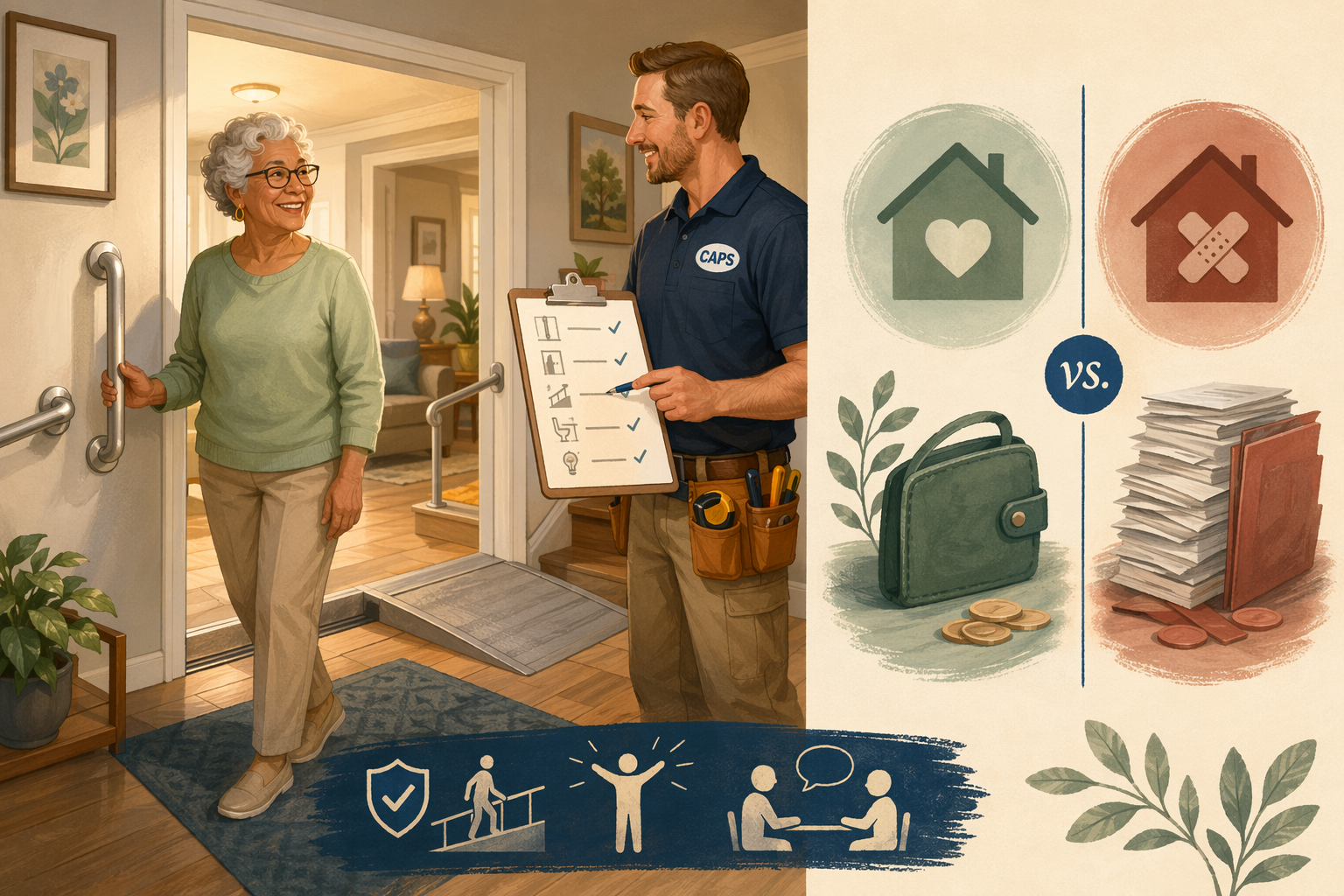
The numbers are stark. According to the University of Michigan National Poll on Healthy Aging, 88% of adults aged 50 and older want to remain in their homes for as long as possible. Yet, as CAPS professional Amy Roberts notes, fewer than 4% of homes in the U.S. housing market are actually aging-in-place ready. That gap between desire and reality is where most family caregivers find themselves — especially after a parent has fallen.
Falls are not rare events. The CDC reports that more than 1 in 4 older adults falls each year, leading to roughly 3 million emergency department visits and 1 million hospitalizations annually. In 2021, falls caused 38,000 deaths among those 65 and older. The financial toll is equally staggering: the total healthcare cost of non-fatal older adult falls reached $80 billion in 2020, with 67% paid by Medicare.
For an adult child who has just received a call about a parent's fall, the immediate question is not about national statistics — it is about what to do next. Should you call a contractor? An occupational therapist? A home modification specialist? Most family caregivers have never heard of a Certified Aging-in-Place Specialist (CAPS), and that lack of awareness can lead to costly missteps: hiring a general contractor who installs grab bars into drywall without blocking, or spending thousands on renovations that don't address the parent's actual functional limitations.
This guide is designed to close that knowledge gap. It will help you understand what a CAPS is, what they do, how much it costs, and — most importantly — whether your parent needs one or whether you should start with a different professional first.
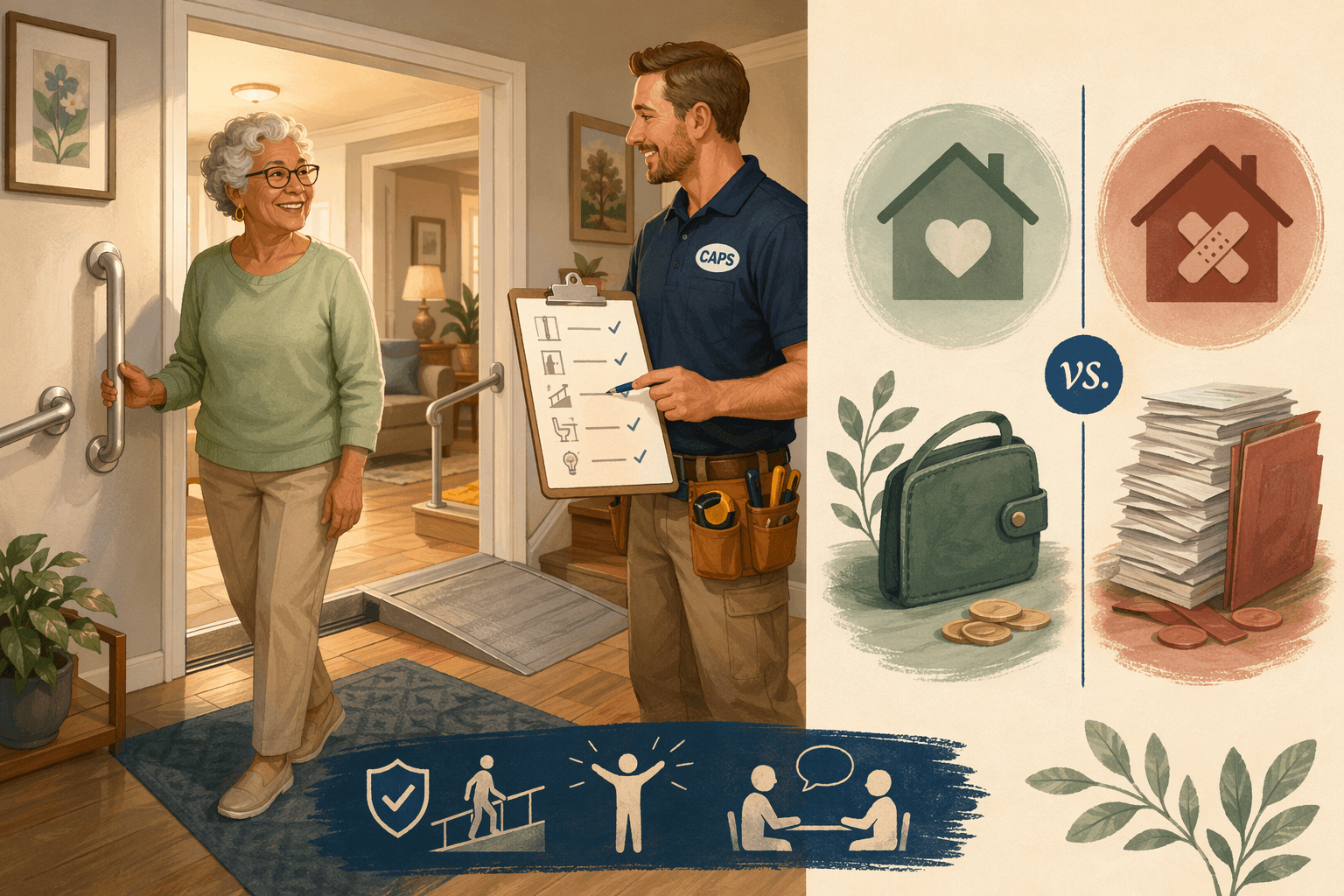
A CAPS professional helps bridge the gap between a family's desire to age in place and the reality of an unprepared home.
What Is a Certified Aging-in-Place Specialist (CAPS)?
A Certified Aging-in-Place Specialist is a professional who has completed a specialized certification program through the National Association of Home Builders (NAHB). The credential is designed to teach "the technical, business management, and customer service skills essential to competing in the fastest growing segment of the residential remodeling industry: home modifications for the aging-in-place," according to the NAHB's official program description.
The CAPS program consists of three courses:
CAPS I — Marketing & Communicating Aging in Place Client: Covers understanding the aging-in-place market, client communication strategies, and how to collaborate with allied professionals such as occupational therapists and geriatric care managers.
CAPS II — Design Concepts and Methods for Livable Homes and Aging in Place: Focuses on universal design principles, product selection, and creating living spaces that accommodate changing mobility and sensory needs.
CAPS III — Details and Solutions for Livable Homes and Aging in Place: Addresses installation details, common errors to avoid, budget planning, and project management for aging-in-place renovations.
What makes the CAPS credential distinct is that it bridges two worlds: home renovation expertise and senior safety knowledge. A CAPS professional understands not just how to build a ramp or install a grab bar, but also why those modifications matter for an older adult's independence and fall risk. They are trained to think about the 10-year outlook — how a parent's needs may evolve and how to design modifications that remain useful as mobility declines.
What a CAPS Actually Does: From Assessment to Follow-Up
A CAPS professional's work typically follows a structured process. Understanding this workflow helps you know what to expect and whether it matches your parent's situation.
Step 1: Home Accessibility Assessment
The CAPS visits the home to evaluate its current state. They measure doorways, check bathroom layouts, assess entryways, examine lighting, and identify tripping hazards. This assessment typically costs between $300 and $1,000, depending on the size of the home and the complexity of the evaluation. Some CAPS professionals, like Gina Knight quoted in a Care.com article, charge around $500 for a personalized home evaluation with a full written report.
Step 2: Written Recommendations and Prioritized Plan
After the assessment, the CAPS provides a written report with prioritized recommendations. Common modifications include:
Widening doorways to at least 32 inches for wheelchair and walker access
Installing grab bars in bathrooms and near entryways
Building ramps for step-free entry
Adding walk-in tubs or roll-in showers
Installing stairlifts for multi-level homes
Improving lighting, especially in hallways and stairways
Replacing doorknobs with lever handles
Adding contrasting colors on stair edges for visibility
Step 3: Contractor Coordination and Oversight
Many CAPS professionals are themselves contractors who can perform the work. Others act as project managers, obtaining quotes from multiple contractors, coordinating schedules, and ensuring that installations meet aging-in-place standards. This oversight is critical: a grab bar installed into drywall without proper blocking can pull out under weight, causing a fall rather than preventing one.
Step 4: Post-Project Follow-Up
After modifications are complete, the CAPS returns to evaluate the work and ensure everything meets safety standards. They may also provide guidance on how to use new features — such as how to safely transfer into a walk-in tub or how to operate a stairlift.
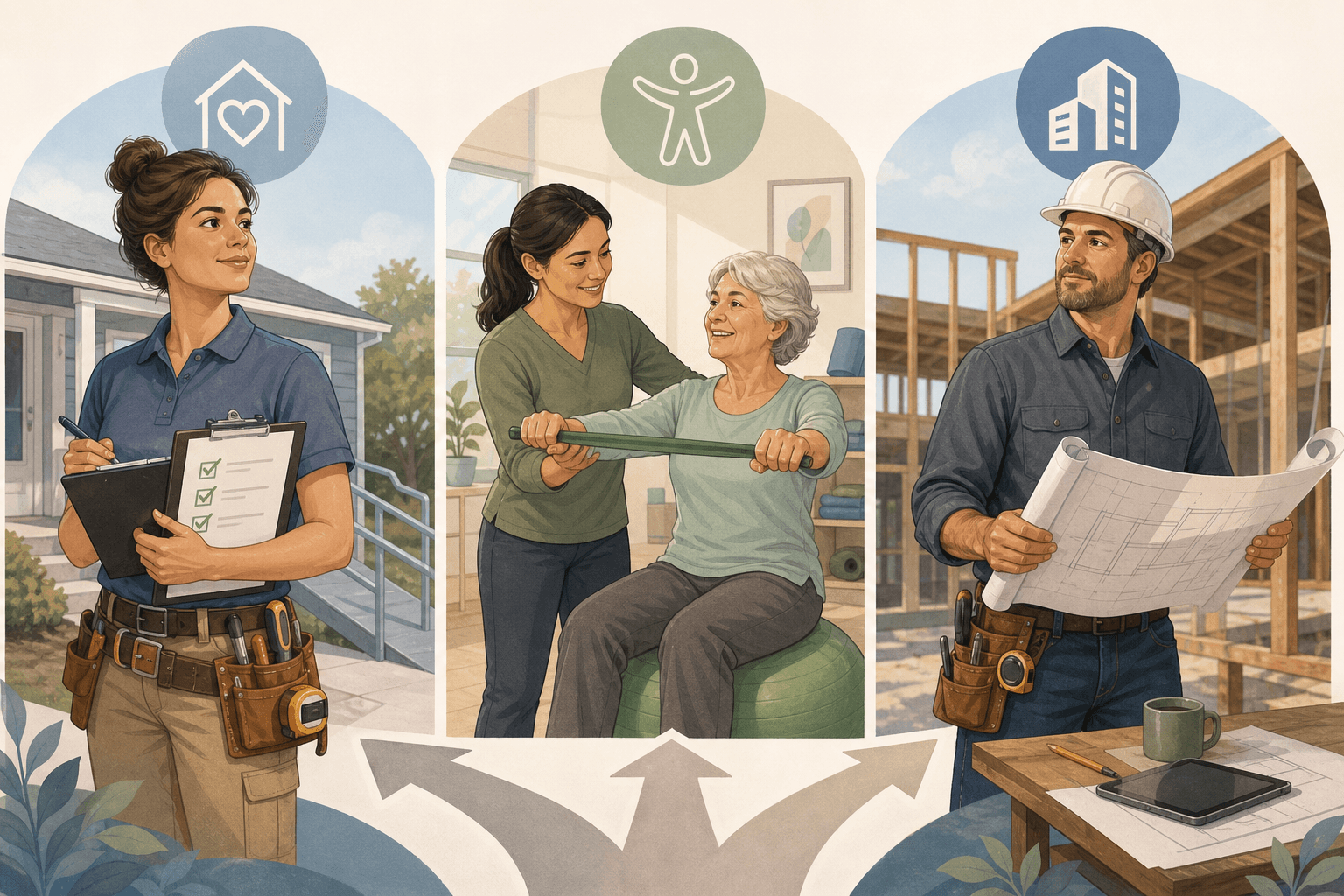
CAPS, OT, and general contractor: three professionals with different roles in the aging-in-place process.
CAPS vs. Occupational Therapist vs. General Contractor: A Decision Framework
One of the most common questions family caregivers ask is: which professional should I call first? The answer depends on whether the primary barrier is the home itself or the parent's functional abilities. The table below summarizes the differences.
Comparison of CAPS, OT, and general contractor roles in aging-in-place projects.
Professional
Training & Credential
Primary Focus
Best When...
CAPS
3 NAHB courses (CAPS I, II, III)
Home environment: assessing and modifying the physical space for safety and accessibility
The home has clear physical barriers (narrow doors, steps, unsafe bathroom) and the parent is generally healthy
Occupational Therapist (OT)
Master's degree + NBCOT certification
Person's functional abilities: assessing strength, balance, vision, cognition, and daily living skills
The parent has complex medical conditions, recent hospitalization, or you need a functional assessment first
General Contractor
State license (varies); may have no aging-in-place training
Construction execution: building, installing, and remodeling according to specifications
You already have a detailed modification plan from a CAPS or OT and need someone to execute the work
The key insight is that these roles are complementary, not competing. An OT can identify that your parent needs a raised toilet seat and grab bars at specific heights based on their body mechanics. A CAPS can then design the bathroom layout and coordinate the installation. A general contractor executes the work. In an ideal scenario, all three collaborate.
If your parent has recently been hospitalized, has multiple chronic conditions, or is showing signs of cognitive decline, start with an OT. The OT's clinical assessment will reveal whether the parent's limitations are due to the home environment, their physical condition, or both. If the parent is generally healthy but the home is the problem — narrow doorways, a bathroom that requires stepping over a high tub wall, stairs without railings — start with a CAPS.
What Does a CAPS Cost — and Is It Worth It?
Cost is often the first concern for families. The table below provides a range of typical costs based on data from the Aging in Place Directory and Care.com. Note that prices vary significantly by region, scope of work, and material costs.
Estimated costs for CAPS services and common home modifications (2024 data). Assisted living figures from AssistedLiving.org via Care.com.
Service or Modification
Typical Cost Range
Home safety assessment (CAPS)
$300 – $1,000
Hourly consultation (CAPS)
$75 – $200
Grab bars (including installation)
$100 – $300
Wheelchair ramp
$1,500 – $5,000
Walk-in tub
$5,000 – $15,000
Stairlift
$3,000 – $5,000
Major renovation (kitchen or bathroom)
$10,000 – $50,000+
Monthly assisted living (national average)
$3,500 – $10,500
The financial case for hiring a CAPS becomes clear when you compare these one-time costs to the recurring expense of assisted living. A $500 CAPS assessment is roughly 5% of one month's assisted living cost at the low end. Even a $10,000 bathroom renovation is less than three months of assisted living at the national average. And unlike monthly rent, home modifications are a permanent improvement that adds value to the home.
One-time CAPS assessment and modification costs compared to recurring monthly assisted living expenses.
How to Find a CAPS and What to Ask Before Hiring
The NAHB maintains a CAPS directory that allows you to search for certified professionals by location. This is the most reliable starting point. You can also ask for recommendations from senior care organizations, your parent's primary care physician, or a local occupational therapist.
Once you have a few candidates, ask these screening questions:
"How many aging-in-place projects have you completed in the past year?" — Look for someone who does this work regularly, not occasionally.
"Do you work with occupational therapists?" — A CAPS who collaborates with OTs is more likely to recommend modifications that match your parent's specific functional needs.
"Can you provide references from similar projects?" — Ask for references from families whose parent had a similar level of mobility or cognitive function.
"Do you handle both assessment and installation, or do you subcontract?" — Understand who will be in your home and who is responsible for quality control.
"What is your process for ensuring modifications remain useful as needs change?" — A good CAPS plans for the 10-year outlook, not just the current situation.
"Can you provide a detailed written estimate before work begins?" — Avoid verbal quotes; get everything in writing.
"Are you licensed and insured?" — Verify state licensing requirements and ask for proof of insurance.
Bottom Line: When to Hire a CAPS — and When to Start with an OT Instead
The decision comes down to one question: Is the primary barrier the home or the person?
Hire a CAPS first when the home has clear physical barriers — narrow doorways, steps at every entrance, a bathroom that requires stepping over a high tub wall, poor lighting, or missing grab bars — and your parent is generally healthy with no recent hospitalizations or complex medical conditions.
Start with an OT first when your parent has complex medical conditions, has been recently hospitalized, is showing signs of cognitive decline, or you are unsure whether their difficulty with daily activities is due to the home environment or their own functional limitations. An OT can provide a clinical assessment that guides all subsequent decisions.
A CAPS is not always the right first call, but for many families, they are the missing piece that turns the desire to age in place into a practical, safe reality. Understanding what they do, what they cost, and when to hire them is the first step toward making an informed decision — one that could prevent a fall, save thousands of dollars, and keep your parent in the home they love.


Comments
Join the discussion with an anonymous comment.