
STEADI: Intervene
Recognizing Botulism vs Stroke Symptoms After the Coffee Recall
After the July 2026 cold-brew coffee recall, sudden weakness or slurred speech could signal a stroke or botulism. This guide compares onset timing, progression patterns, and other key clues to help caregivers decide what to tell 911.
If an older adult has sudden face drooping, arm weakness, slurred speech, trouble swallowing, worsening weakness, breathing trouble, or you are not sure what you are seeing, call 911 now. Do not wait to decide whether it is stroke or botulism. Tell the dispatcher what changed, when it started, and whether the person may have had a recalled food or drink.
That is the first safety tip after the July 2026 coffee recall: use the recall information to improve the emergency handoff, not to diagnose at the kitchen table.

Why the Coffee Recall Matters, Without Making It the Whole Story
Brooklyn Roasting Company recalled 1,219 units of 2.5-gallon cold brew concentrate distributed in New York and New Jersey, with best-by dates from June 3 through September 3, 2026; the recall was reported as a Class II, precautionary recall, with no confirmed illnesses reported as of July 25, 2026.[1][2]
That matters because a 2.5-gallon container is the kind of product that can sit in a refrigerator for a while. It also matters because botulism can cause neurological symptoms that look close enough to stroke to make a tired caregiver pause. The pause is the dangerous part.
A Class II recall is not the same as a confirmed outbreak, and no caregiver should assume every weak or dizzy older adult has botulism because cold brew was in the house. At the same time, “no confirmed illnesses” is not a reason to ignore new speech trouble, eyelid drooping, swallowing trouble, or weakness. Those symptoms deserve emergency evaluation on their own.
The Overlap That Can Cause Hesitation
The CDC lists foodborne botulism symptoms that include double or blurred vision, drooping eyelids, slurred speech, difficulty swallowing, difficulty breathing, and muscle weakness.[3] Those words are uncomfortably close to the language caregivers are taught for stroke: face drooping, arm weakness, and speech difficulty.
In a calm classroom, those two lists can be separated neatly. At home, they may not be. An older parent may say “I feel weak” without being able to describe whether it is one-sided. A caregiver may notice speech is off before noticing an eyelid. Someone may be standing, then suddenly become unsafe on their feet. This is one reason crisis symptoms belong in fall-prevention work: neurological weakness, poor coordination, confusion, or delayed response can turn into a collapse before anyone has named the condition.
FAST and BEFAST still matter. If you want a deeper review of subtle stroke signs families miss, see stroke symptoms in seniors caregivers often overlook. Here, the narrower question is what to report when the symptoms could fit stroke and there is also a possible recalled coffee exposure.
The Decision Guide: What Pattern Should You Report?
| What you are checking | More concerning for stroke | More concerning for botulism | What to tell 911 |
|---|---|---|---|
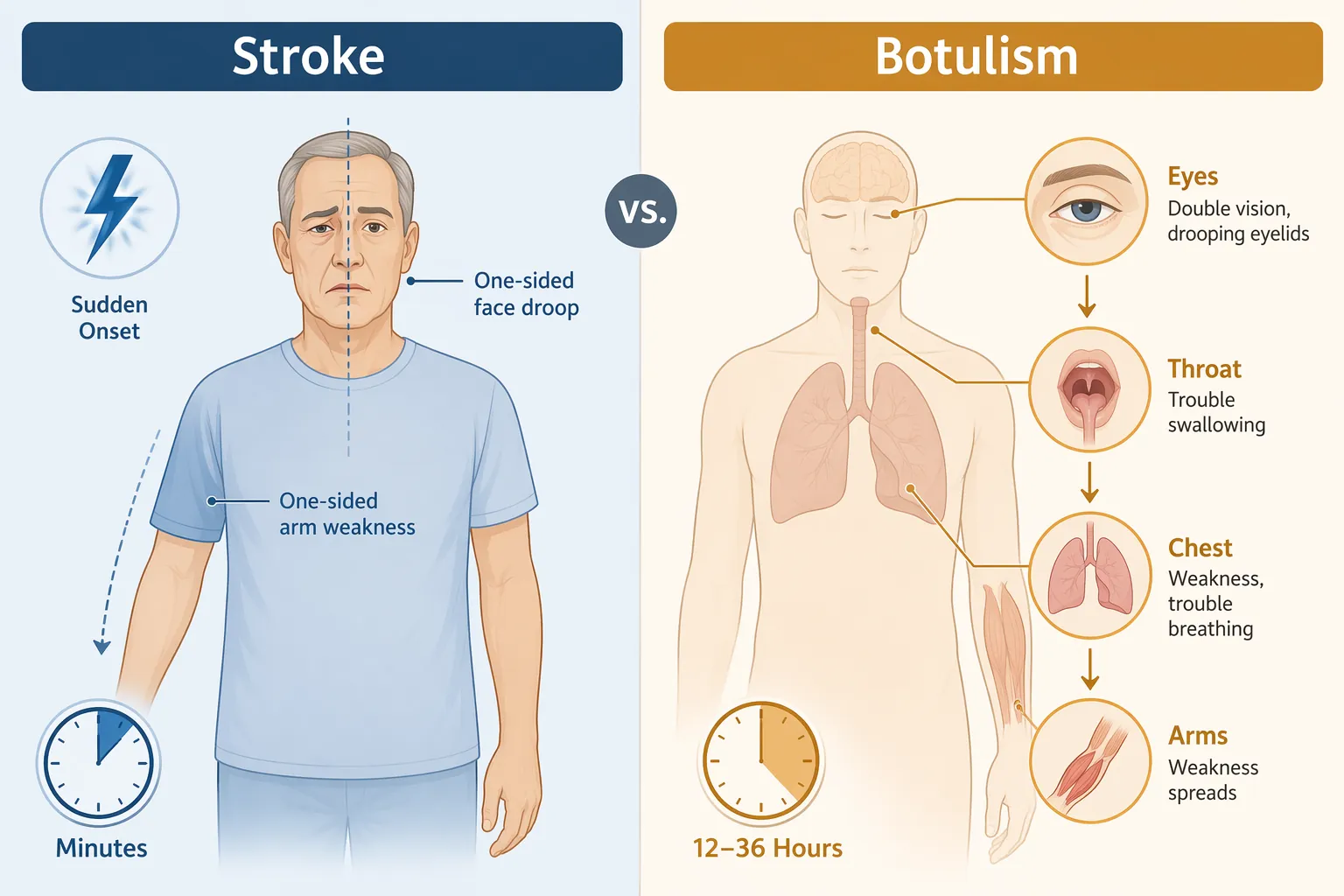
| Onset | Sudden change over minutes to hours | Symptoms often appear 12 to 36 hours after exposure, though the wider range is 6 hours to 2 weeks | “The symptoms started suddenly at about ___” or “They drank recalled cold brew about ___ hours/days ago.” |
| Weakness pattern | One-sided face, arm, or leg weakness | Weakness that starts around eyes, face, mouth, or throat and moves downward | “The weakness is mostly on the ___ side” or “It started with eyelids/vision/swallowing and now seems lower.” |
| Speech and swallowing | Slurred speech, trouble finding words, facial droop | Slurred speech plus drooping eyelids, double vision, dry mouth, or trouble swallowing | “Their speech is slurred, and they are having trouble swallowing.” |
| Breathing | Can be affected depending on stroke location | Can become dangerous as paralysis descends toward the chest | “Their breathing is difficult/changed” or “They are getting weaker and I am worried about breathing.” |
| Exposure history | No food exposure is needed for stroke concern | Known or possible recalled food or drink exposure helps responders consider botulism | “There may have been recalled cold brew in the refrigerator, best-by date ___.” |
Timing: sudden change carries stroke urgency
Stroke symptoms are usually treated as sudden because minutes matter. If an older adult was speaking normally at dinner and now has a crooked smile, cannot lift one arm, or is suddenly slurring, that timing belongs in the first sentence to the dispatcher.
Botulism timing is different. The CDC says symptoms generally begin 12 to 36 hours after eating contaminated food, but can begin as early as 6 hours or as late as 2 weeks after exposure.[4] Mayo Clinic gives the same broad timing frame for foodborne botulism symptoms.[5]
That wider range should not slow the call. It simply gives you another detail to collect while help is coming. If your mother drank the recalled cold brew yesterday morning and now has drooping eyelids, double vision, slurred speech, and trouble swallowing, say that. If she drank it ten days ago but now has sudden one-sided weakness, say that too. Dispatchers and emergency clinicians can sort the possibilities better when they hear both the timing of symptoms and the timing of exposure.
Progression: one-sided versus descending weakness
A classic stroke pattern points to sudden trouble on one side of the body: one side of the face droops, one arm drifts down, one leg becomes weak, or speech changes abruptly. Real life is not always textbook, but one-sided weakness is a detail worth checking quickly.
- Ask the person to smile, and look for one side of the face not moving normally.
- Ask them to hold both arms out, and watch whether one arm drops.
- Listen for slurred speech, wrong words, or speech that suddenly does not match their usual baseline.
- Notice whether walking, standing, or transferring has suddenly become unsafe.
Botulism often starts higher. Cleveland Clinic describes botulism paralysis as descending, beginning with symptoms involving the eyes, face, mouth, and throat before moving down to the neck, arms, chest, and legs.[6] That means the early clues may be drooping eyelids, double vision, blurry vision, dry mouth, slurred speech, or trouble swallowing before the person looks weak all over.
For a caregiver, the useful observation is not “I know this is botulism.” It is: “Her eyelids started drooping, then her speech became slurred, and now she says swallowing is hard.” That sequence is valuable.
If the Recalled Cold Brew Is in the House
Do not serve more of it. Keep the container if you can do so safely, and note the product name, best-by date, where it was bought, and when the older adult last drank it. If emergency symptoms are present, those details can wait until after the 911 call is started.
A practical order at home is:
- Call 911 for stroke-like symptoms, trouble swallowing, breathing trouble, or rapidly worsening weakness.
- Keep the person seated or lying safely to reduce fall risk while waiting.
- Do not give more recalled coffee, food, or drink if swallowing is impaired.
- Bring or save the container information for emergency responders or the hospital.
- Write down symptom start time and the last known normal time, even if the times are approximate.
That “last known normal” time is especially important when stroke is possible. The “last drank recalled coffee” time is important if botulism is possible. They are not the same question, and both can matter.
Why Older Adults Get Less Room for Delay
Older adults are more likely to have severe outcomes from foodborne illness. FoodSafety.gov states that nearly half of people age 65 and older who have a lab-confirmed foodborne illness are hospitalized.[7] USDA FSIS explains that age-related changes, including a weakening immune system, reduced stomach acid, and slower digestion, can make older adults more vulnerable to foodborne illness.[8]
That statistic is not botulism-specific, and it should not be stretched into a prediction about one person in one kitchen. Its practical meaning is simpler: an older adult with neurological symptoms after a possible food exposure deserves a lower threshold for emergency care, not a longer period of watching and wondering.
The 911 Script to Use
When people are frightened, they often start with the least useful sentence: “I don’t know what’s wrong.” It is an honest sentence, but it can be followed by a better one.
My parent is having stroke-like symptoms. They have [face drooping / arm weakness / slurred speech / trouble swallowing / double vision / drooping eyelids / breathing trouble]. The symptoms started at about [time], and they were last normal at [time]. They may have had recalled cold brew coffee; the best-by date is [date] if known.If symptoms seem to be moving from the eyes or throat down toward the chest, arms, or legs, say that plainly. If the weakness is mainly on one side, say that plainly. If you do not know, say you do not know. Guessing wastes more time than uncertainty.
If botulism is suspected, treatment decisions are time-sensitive; CDC notes that botulism is treated with antitoxin, which can stop toxin from causing more harm but cannot reverse damage already done.[4] That is another reason the recalled coffee detail belongs in the emergency call rather than in a search tab opened after the call.
What Not to Do While Waiting
- Do not drive the person yourself if stroke-like symptoms, breathing trouble, or worsening weakness are present; EMS can start assessment and route care appropriately.
- Do not give food, coffee, or pills by mouth if swallowing is difficult unless emergency responders tell you to.
- Do not make the person stand for repeated “tests”; one quick arm or smile check is enough if they are weak or unsteady.
- Do not discard the recalled container before product details are recorded or responders advise you.
- Do not let the absence of confirmed recall illnesses talk you out of calling for current neurological symptoms.
The safest handoff is clean and brief: call 911, say stroke-like symptoms are present, mention possible recalled coffee exposure if relevant, list the symptoms and when they began, and let emergency clinicians move fast.
References
- Cold Brew Recall: 3,000 Gallons Recalled Over Botulism Risk, Delish, July 2026.
- Coffee Recalled in 2 States for Possible Botulism Risk, The Healthy, July 2026.
- Symptoms of Botulism, CDC.
- About Botulism, CDC.
- Botulism - Symptoms and Causes, Mayo Clinic.
- Botulism: Causes, Symptoms & Treatment, Cleveland Clinic.
- The Importance of Food Safety for Older Adults, FoodSafety.gov.
- Adults 65 and Older: An At-Risk Population, but Why?, USDA FSIS.
Related reading
Noticed something outdated or inaccurate on this page? Flag a correction. We review every report against CDC, NIA, and AARP HomeFit guidance before updating a page.
Part of the Fall Prevention section.