
STEADI: intervene
A Fall-Prevention Travel Checklist for Seniors After a Wildfire
This guide provides a phased fall-prevention checklist for seniors returning after a wildfire, covering pre-departure health readiness, travel adaptations, property walkthrough hazards, and 72-hour monitoring — because standard return checklists assume able-bodied returnees and miss the specific risks for older adults with mobility limitations.
Before anyone starts the car, the most important part of a travel safety checklist for seniors after a wildfire is deciding whether this is really one trip. For an older adult with a walker, poor vision, shortness of breath, new medication changes, or just two nights of bad sleep, “return home and inspect the property” is too broad to be safe. It bundles the drive, the emotional shock, the first steps over ash, the search for medications, and the long evening afterward into one exhausting assignment.
Falls are already common without burned steps, loose debris, smoke irritation, or a missing cane tip. The CDC reports that more than 1 in 4 older adults fall each year, and falls are the leading cause of fatal injury for adults 65 and older.[1] That statistic is not here to frighten anyone away from going home. It is permission to treat ordinary walking problems as serious planning problems.
Public return-home guidance is useful, especially when it says to wait for official clearance, watch for hazards, and avoid unsafe structures. But general wildfire checklists are usually written for a person who can see hazards clearly, stand for a while, step over debris, bend down, react quickly, and tolerate smoke or ash exposure. Many seniors cannot count on those abilities after evacuation, even if they managed well before the fire.
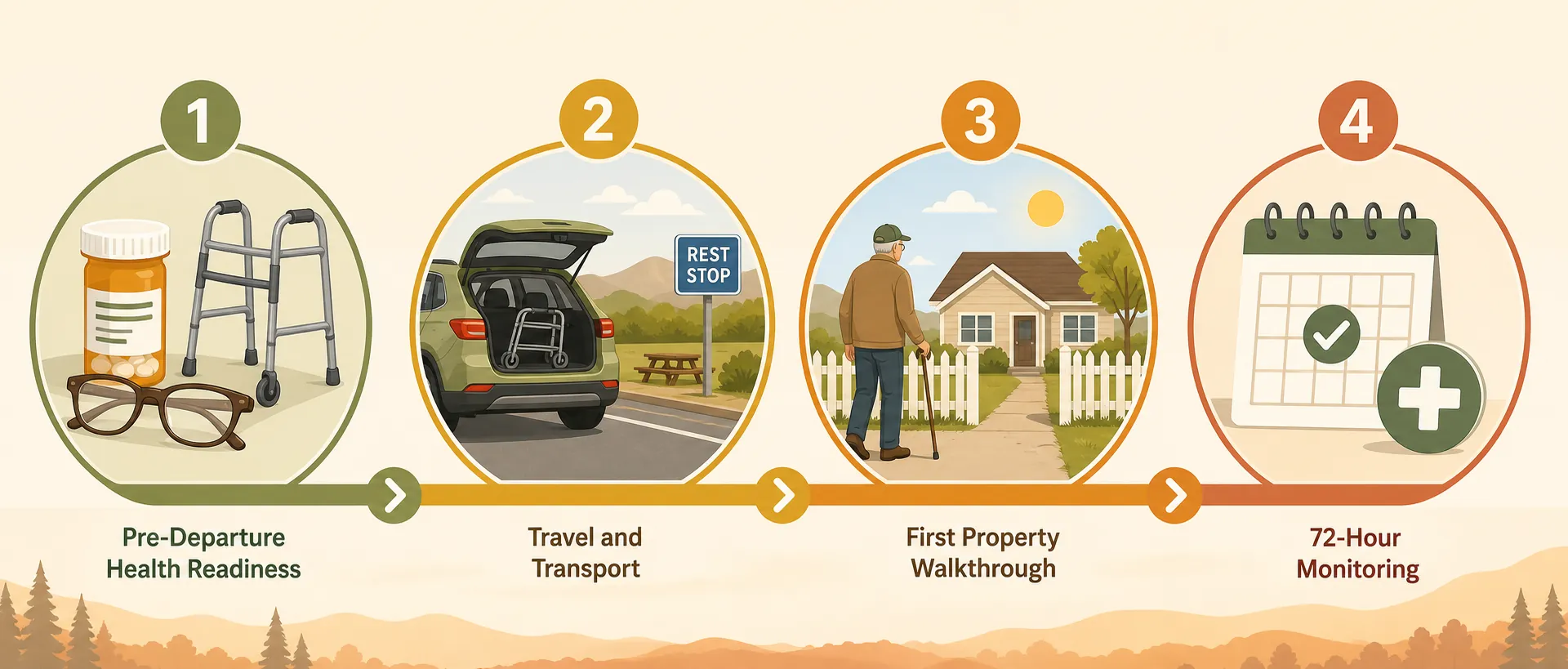
Treat the Return as Four Separate Decisions
A safer return separates the trip into phases. Each phase has its own stop point. If the answer is not safe in one phase, the family does not “push through” to the next one just because the house is close.
| Phase | Main fall-prevention question | Do not proceed if... |
|---|---|---|
| Pre-departure health readiness | Can the senior tolerate the trip and the first look without losing medication, balance, oxygen, vision, hearing, or mobility support? | Medications, mobility aids, respiratory supplies, emergency contacts, or basic stamina are not ready. |
| Travel and transport | Can the person get in, ride, stop, exit, and still have enough energy to move safely? | The drive will use up the strength needed for safe walking afterward. |
| First property walkthrough | Can the route be viewed in daylight without stepping into hidden, unstable, smoky, or structurally uncertain areas? | Ash, debris, railings, stairs, lighting, air quality, dizziness, or damage make footing uncertain. |
| 72-hour monitoring | Can someone watch for delayed symptoms, confusion, fatigue, dizziness, smoke effects, and fall warning signs? | The senior will be alone without a way to report changes or get help quickly. |
Ready for Wildfire’s returning-home checklist gives a general framework for coming back after evacuation, but it does not address senior mobility or fall prevention in detail.[2] The missing layer is not complicated. It is physical: feet, hands, eyes, lungs, medication timing, and whether the walker is actually reachable when the car door opens.
Phase 1: Pre-Departure Health Readiness
Most preventable problems start before departure. The family is thinking about road closures and the house. The older adult may be thinking about seeing the kitchen, the pets, the photo albums, the garden, or the place where life was interrupted. Meanwhile, the practical questions are quieter: Did the blood pressure medication run out? Is the hearing aid battery dead? Is the walker in the trunk or buried under bottled water?
Start with the person, not the property. If the senior is unusually dizzy, confused, short of breath, weak, heavily fatigued, newly incontinent, feverish, or unable to transfer safely from chair to standing, the property can wait. A return trip asks more from the body than a normal car ride. It asks the body to handle stress, smoke or ash concerns, uneven surfaces, emotional shock, and decision fatigue in sequence.
Medication readiness deserves its own check because evacuation disrupts routines. The CDC identifies medication side effects, vision problems, lower body weakness, and home hazards as fall risk factors; certain medicines can affect balance, and skipped doses can worsen underlying conditions.[3] After a wildfire evacuation, the issue is not only whether the pill organizer is packed. It is whether refills are available, whether the pharmacy is open, whether instructions changed during evacuation, and whether anyone knows what was actually taken over the last few days.
- Confirm 7–14 days of essential medications before leaving temporary housing, not after arriving at the property.
- Bring the current medication list, pharmacy contact, prescriber contact, allergies, and recent medication changes.
- Pack extra glasses, hearing aid batteries, and any backup communication tools the senior actually uses.
- Charge medical devices and bring backup power for equipment that cannot safely fail during the trip.
- Check that emergency contacts are updated and accessible to both the senior and the person driving.
Fire Help Center’s senior preparedness guidance recommends 7–14 days of medications, extra glasses, hearing aid batteries, and N95 masks for seniors and caregivers, although that guidance is aimed at preparedness and evacuation rather than the return phase.[4] Those same items matter on the way back because a return can fail for very small reasons. A parent who cannot hear instructions over idling engines, cannot see a raised threshold through ash, or misses a medication dose because the bottle is in another bag is not being difficult. The plan is incomplete.
Footwear is another pre-departure decision, not something to negotiate in the driveway. The CDC recommends sturdy closed-toe shoes with thick soles for post-wildfire cleanup.[5] For a senior, that recommendation also applies to simply approaching the home. Slip-on shoes, worn slippers, thin soles, and loose sandals may be familiar, but familiarity does not make them safe on ash, wet pavement, broken glass, nails, gravel, or warped boards.
Inspect the Mobility Aid Before the Property Does
A cane, walker, rollator, wheelchair, or portable ramp should be checked before departure because the wildfire site will not be forgiving. Look at cane tips, walker glides, brake tension, wheel movement, loose screws, seat stability, hand grips, and whether the aid still matches the person’s current strength. A cane tip worn smooth on normal flooring becomes a different hazard on gritty ash or damp pavement.
- The mobility aid must be loaded last enough that it can be removed first.
- The senior should not have to stand beside the vehicle while someone unloads supplies to reach the walker.
- If the device has brakes, test them on a flat surface before leaving.
- If the person normally uses furniture or walls for balance at home, assume that support may be gone, damaged, or unsafe.
This is also the moment to name the trip’s limit out loud. The purpose may be to view the property from the curb, retrieve essential documents if officials have cleared safe access, or meet an inspector. It does not have to include walking every room. If the senior believes the trip means “I am going back to normal,” and the caregiver believes it means “we are taking one controlled look,” that mismatch will surface at the worst possible place: the front step.
Phase 2: Travel and Transport
The drive back is not just transportation. It is the first fall-risk exposure of the day. Getting into a high vehicle, sitting for a long time, skipping fluids to avoid restroom stops, standing up stiffly, stepping onto unfamiliar pavement, and then immediately trying to inspect a damaged property is a predictable sequence. It should be interrupted on purpose.
- Choose the vehicle the senior can enter and exit most safely, not the one that carries the most supplies.
- Use stable handholds where available; do not ask the person to pull on a loose door, a caregiver’s arm, or a walker that may roll.
- Plan rest stops before they are urgent, especially for people who become stiff, dizzy, short of breath, or rushed.
- Keep water, masks, medications, glasses, hearing supplies, and the mobility aid within immediate reach.
- Avoid a long drive followed by an immediate walkthrough; build in a seated pause before anyone approaches the property.
Check road conditions and air quality before departure. Wildfire ash can create both respiratory risk and visibility or footing problems; the CDC notes that ash may contain toxic substances and can irritate the skin, eyes, nose, and throat.[5] For an older adult, coughing, watery eyes, dizziness, or fatigue can become a balance problem long before anyone calls it a medical problem.
If the route includes road debris, poor visibility, active smoke, emergency vehicles, or long delays, the safest decision may be to postpone the property visit or send a qualified, able-bodied representative first. That is not overprotection. It is recognizing that the senior still has to get out of the car at the other end.
Phase 3: The First Property Walkthrough
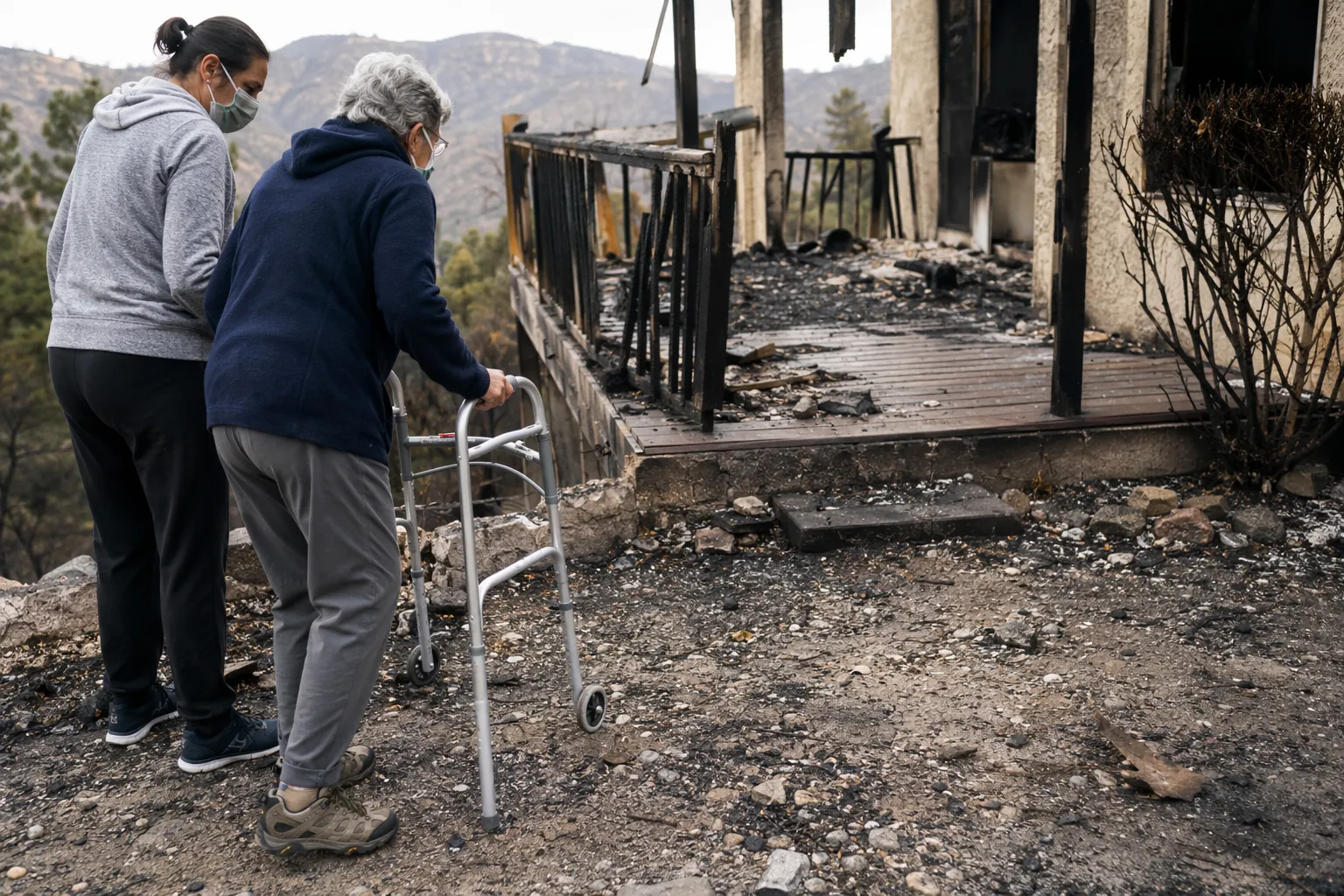
The first property walkthrough is where standard advice can quietly become unsafe. “Inspect your property” sounds simple until the person doing the inspecting has bifocals, neuropathy, arthritis, a walker, limited stamina, or a new medication that makes standing up too quickly feel like the floor moved.
Return only when officials say it is safe, and do the first look in daylight. CDC post-wildfire guidance tells people to return only after authorities say it is safe and to avoid entering damaged buildings or structures until they have been inspected and certified as safe.[5] For fall prevention, daylight is not a preference. It is a boundary. A porch edge, curb, cable, hose, nail, loose board, or change in grade that is barely visible to a younger person may be invisible to an older adult in smoke haze or dusk.
Begin from the seated position in the vehicle. Before the senior stands, someone else should scan the ground where both feet will land. Look for ash piles, gravel, mud, puddles, glass, nails, downed branches, melted materials, uneven pavement, and anything that could catch a cane or walker leg. The first unsafe step may be the one out of the car.
Use a Stop-First Walkthrough
A stop-first walkthrough means the default is to pause and look before moving, not to keep walking until something obviously blocks the way. It is slower. It can feel frustrating. It is also the only pace that matches the environment.
- Stop at the vehicle and check the landing area before the senior exits.
- Stop at the sidewalk, driveway, or curb and choose the flattest visible route.
- Stop before any step, threshold, ramp, porch, or change in surface.
- Stop before touching railings, fences, doors, gates, or outdoor furniture that may be heat-damaged or unstable.
- Stop the walkthrough completely if footing, breathing, balance, visibility, or structure becomes uncertain.
Ash is especially deceptive because it can flatten the scene. It may hide raised edges, holes, cords, warped boards, stones, nails, broken pottery, or the lip of a step. It can also irritate the lungs and eyes, increasing fatigue and reducing attention.[5] A person who is coughing, squinting, or wiping tears behind glasses is not fully available for balance.
Do not let the senior test railings, stairs, or porch boards with body weight. A railing that looks familiar may no longer be anchored. A step that held yesterday may have been weakened by heat, water, or debris removal. If a route requires leaning on an uncertain railing, stepping over debris, crossing charred ground, or lifting a walker, it is not a senior-safe route.
What the Caregiver Should Look For Before Each Step
- Uneven or charred ground, including softened soil, cracked pavement, unstable gravel, and hidden holes.
- Loose debris that can roll underfoot or catch a cane, walker wheel, or shoe.
- Damaged or missing handrails, porch supports, stair treads, ramps, gates, and thresholds.
- Poor lighting, smoke haze, shadows, glare, or ash-covered edges that reduce depth perception.
- Signs that the senior is tiring: shorter steps, heavier leaning, slower responses, irritability, dizziness, or needing to sit.
The senior’s desire to see the house matters. After evacuation, walking toward the front door may be the first act that feels like control. But control is not the same as access to every room. Sometimes the dignified choice is to let the person see what can be seen safely, name what cannot be assessed today, and leave before fatigue makes the return to the car harder than the approach.
When This Is No Longer a Family Inspection
Families can notice obvious fall hazards. They cannot safely certify structural stability. Stop and bring in qualified help if stairs, ramps, railings, porches, floors, roofs, retaining walls, decks, doors, or access routes appear damaged, shifted, burned, waterlogged, or unstable. CDC guidance is clear that damaged buildings or structures should not be entered until inspected and certified as safe.[5]
If the home will need repairs before an older adult returns, a Certified Aging-in-Place Specialist, or CAPS-certified contractor, may be useful because access repairs and fall-prevention changes have to work for the person who will use them. That does not mean a family should turn the first visit into a remodeling consultation. It means that when the question becomes railings, thresholds, ramps, bathroom access, lighting, or safe entry after damage, the work has moved beyond a quick family walkthrough.
Phase 4: Monitor the Next 72 Hours
The return trip is not over when the senior gets back to temporary housing, a relative’s house, or a partially usable home. The next 72 hours matter because wildfire exposure and a stressful property visit can leave delayed effects: fatigue, dizziness, coughing, poor sleep, confusion, medication errors, or soreness that changes gait the next day.
The National Council on Aging reports that falls are the leading cause of injury death among adults 65 and older, and that 3 million older adults are treated in emergency departments for falls each year.[6] The practical takeaway is simple: after a high-stress return, do not assume “no fall today” means the risk has passed.
- Watch for dizziness, new weakness, unsteady walking, unusual sleepiness, confusion, or trouble following familiar routines.
- Check whether medications were taken correctly after the trip, especially if the day’s schedule changed.
- Monitor coughing, wheezing, eye irritation, shortness of breath, and fatigue after smoke or ash exposure.
- Ask directly about near-falls, slips, stumbles, or grabbing furniture for balance; many older adults will not volunteer this.
- Keep pathways clear in the temporary sleeping area, especially if the senior is getting up at night in an unfamiliar place.
If there was an actual fall, a head strike, new confusion, worsening shortness of breath, chest pain, severe dizziness, inability to bear weight, or a sudden change in function, the follow-up plan should become medical, not observational. The same is true if the senior seems “off” in a way the family cannot explain. Disaster days make it easy to normalize symptoms that would be taken seriously on an ordinary Tuesday.
The Stopping Rule
A successful return is not defined by reaching the front door. It is not defined by seeing every room, retrieving every item, or proving that the senior can still manage the old route from driveway to kitchen. After a wildfire, the safer measure is whether the older adult gets through the trip, the first look, and the next 72 hours without turning damage, ash, fatigue, smoke, or uncertainty into a preventable fall.
If medication readiness is incomplete, do not go. If the mobility aid is not usable and reachable, do not go. If the drive will exhaust the person before the walkthrough begins, do not inspect on arrival. If the property can only be approached through hidden debris, unstable surfaces, poor light, damaged railings, or questionable structures, stop. The home can be assessed another way. The fall may not be so easy to undo.
References
Related reading
Noticed something outdated or inaccurate on this page? Flag a correction. We review every report against CDC, NIA, and AARP HomeFit guidance before updating a page.
Part of the Fall Prevention section.