
The Common Heatstroke Prevention Mistake That Puts Seniors at Risk
Many caregivers assume a fan is enough to keep a senior safe during extreme heat. This article explains why fans fail above 95°F and how air conditioning or cooling alternatives are the only reliable protection.
A fan sounds reassuring on a hot day. If you call an older parent during a heat wave and they say, “I’ve got the fan on,” it is easy to picture a manageable room: curtains drawn, air moving, maybe a cold drink nearby. For a long-distance caregiver, that sentence can feel like proof that the immediate danger is handled.
That is one of the most common heatstroke prevention mistakes for seniors: treating a running fan as if it were cooling the room. The Centers for Disease Control and Prevention warns that older adults should not rely on a fan as their main cooling source during extreme heat; air conditioning is the strongest protection, and even a few hours in an air-conditioned place can help reduce heat exposure.[1]
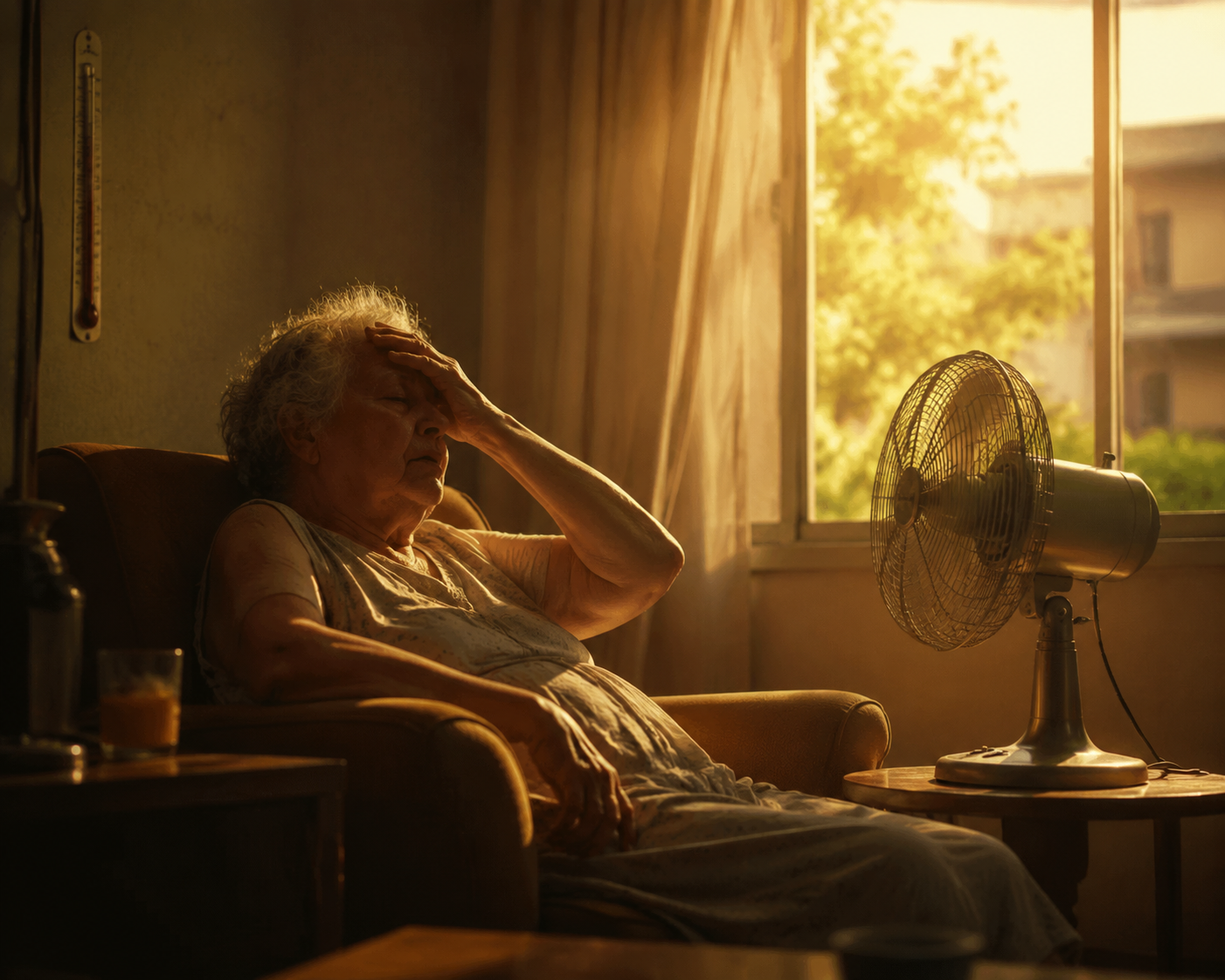
The problem is not that fans are useless. In mild heat, they can make a person feel better. The problem is the line where “air movement” stops being “cooling.” In very hot conditions, especially when the room is near or above 95°F or the air is humid, a fan can become the wrong tool for an older body that is already working hard to shed heat.
Why Older Adults Run Into Trouble Faster
Heat is harder on older adults for several overlapping reasons. The body’s ability to cool itself changes with age, chronic health conditions can make heat more dangerous, and some medicines can affect hydration, sweating, or the way the body responds to high temperatures. AARP’s review of heat risk after 50 notes that older adults may have less efficient circulation and sweat response, which can make it harder to move heat away from the body.[2]
That is why age shows up so clearly in heat-death data. A CDC MMWR QuickStats report found that adults 65 and older accounted for the largest share of heat-related deaths in the United States during 2018–2020.[3] This does not mean every older person is fragile, and it does not mean every warm room is an emergency. It means the margin for error is smaller, especially for someone who lives alone, has limited mobility, avoids air conditioning, or is trying to keep utility bills down.
That smaller margin is exactly where the fan mistake hides. A caregiver hears that the fan is running and imagines an active safety measure. In reality, the room may still be gaining heat, the person may be sweating without replacing enough fluid, and the fan may be making the room feel less stagnant without lowering the body’s heat burden.
What A Fan Can And Cannot Do
A fan cools people indirectly. It moves air across the skin, helps sweat evaporate, and can carry heat away from the body when the surrounding air is cooler than the skin. That is why a fan can feel wonderful in ordinary summer heat, particularly in a shaded or air-conditioned room.
But when the air around the person is very hot, the direction of heat transfer changes. The fan is still moving air, but it may be moving hot air across the skin. Dr. Aaron Bernstein, then acting director of CDC’s National Center for Environmental Health and Agency for Toxic Substances and Disease Registry and interim director of The Center for Climate, Health, and the Global Environment at Harvard T.H. Chan School of Public Health, put it bluntly in AARP: “When the temperature is hotter outside than in our bodies, fans work like a convection oven.”[2]
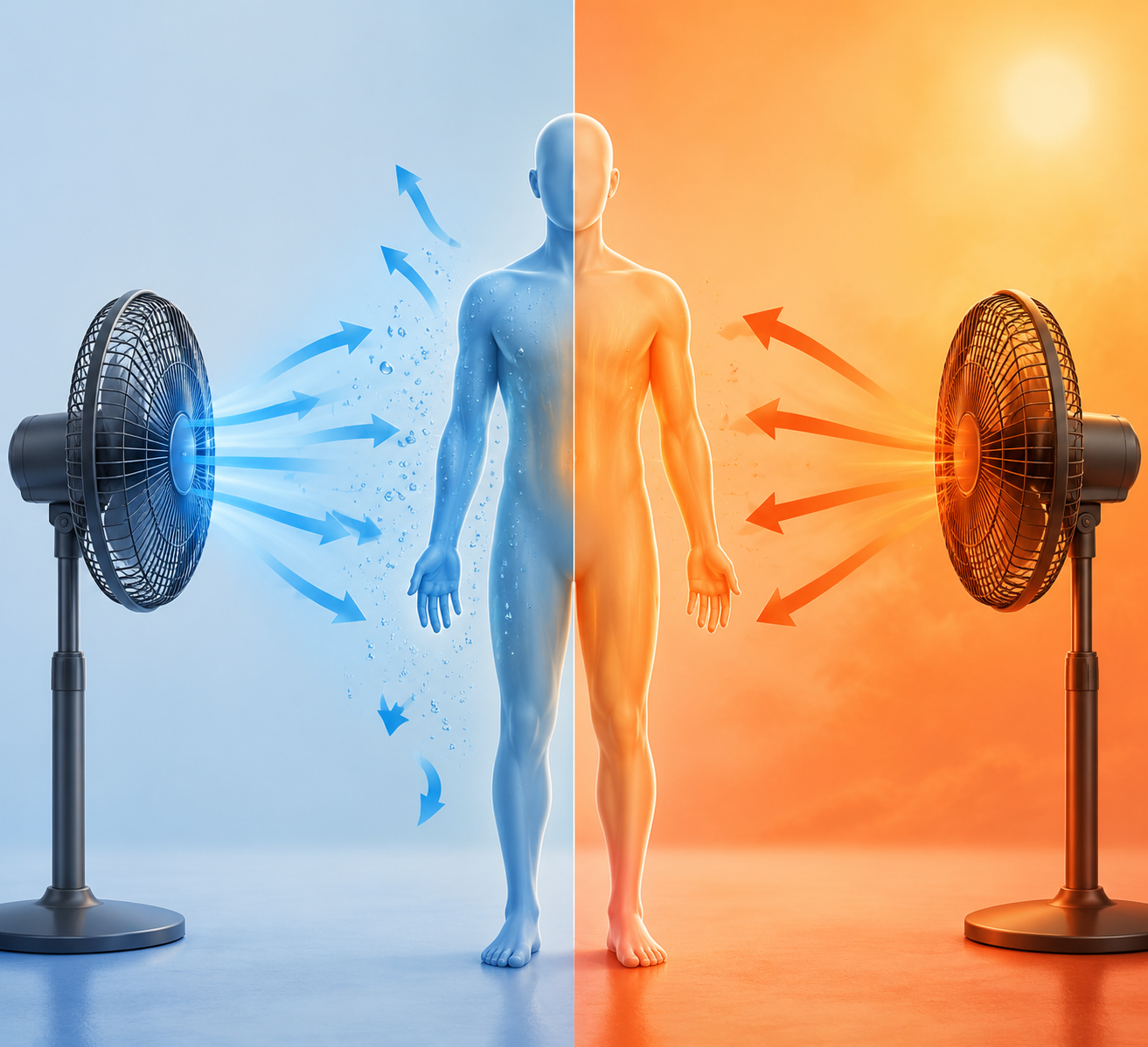
The phrase is memorable because it explains the practical danger: the fan can keep doing something visible while failing to do the thing that matters. The blades spin. The curtain moves. The person may feel a breeze. None of that proves the body is cooling.
Humidity makes this worse. Sweat cools the body mainly when it evaporates. In damp air, sweat sits on the skin instead of evaporating efficiently. A fan may still create a breeze, but if evaporation is limited and the air is hot, the person can continue absorbing heat faster than they release it.
| Condition in the home | What the fan is likely doing | Caregiver takeaway |
|---|---|---|
| Warm but not extreme, air is relatively dry | May improve comfort by helping sweat evaporate | Still check hydration, room temperature, and how the person feels |
| Around 95°F or hotter | May blow hot air across the body instead of cooling it | Do not treat the fan as the main cooling plan |
| High humidity | May feel breezy while sweat evaporates poorly | Look for actual cooling, not just air movement |
| Hot room, closed windows, no air conditioning | May mask how unsafe the room has become | Move the person to air conditioning or a cooler location |
This is also why asking, “Do you have the fan on?” is not a strong enough check-in question during extreme heat. Better questions are more specific: What does the thermostat say? Is the air conditioner on? Which room are you sitting in? Have you spent any time today somewhere air-conditioned? Does the room feel cooler than outside, or just breezy?
The Harm Is Not Rare Enough To Ignore
Heat deaths are not limited to dramatic outdoor situations. A 2026 Harvard T.H. Chan School of Public Health report on research published in The Lancet Planetary Health estimated that heat waves are associated with about 17,600 excess deaths each year among older adults in the United States. The same report noted disproportionate impacts on low-income and Black communities.[4]
That scale matters because many household choices around cooling are shaped by money, housing quality, neighborhood conditions, and whether a person feels safe or able to leave home. Telling an older adult to “just use the AC” can be medically right and still fail as caregiving advice if the person is afraid of the bill, dislikes cold air blowing on them, or has spent decades seeing a fan as the sensible, frugal answer.
What To Do Instead Of Relying On The Fan
The replacement plan has to be simple enough to survive the real conversation. During dangerous heat, the goal is not “more airflow.” The goal is time in cooler air. The CDC advises older adults to stay in air-conditioned buildings as much as possible during extreme heat, and says that even a few hours in air conditioning can help.[1]
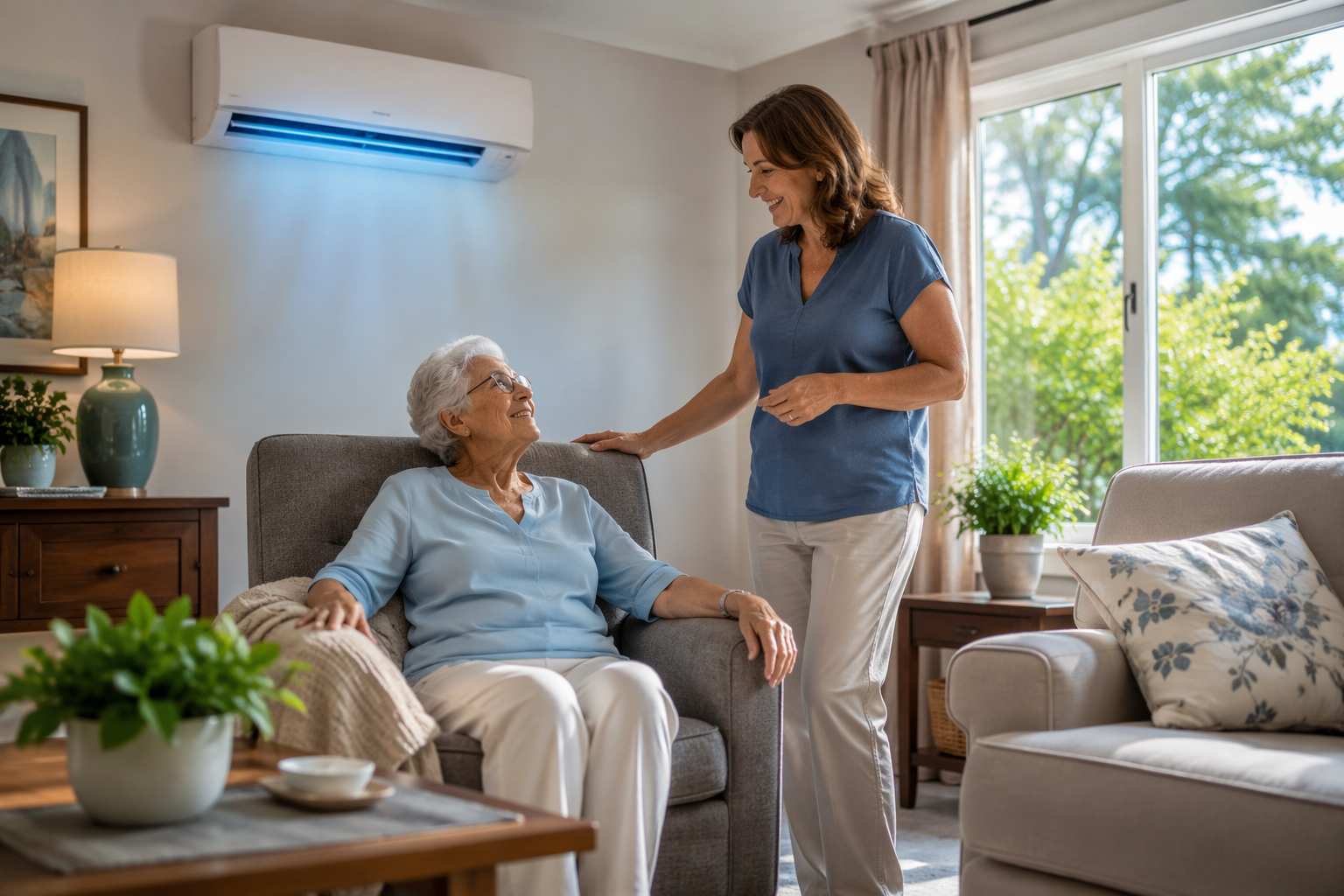
For many families, that means choosing one dependable cooling location before the heat becomes severe. It might be the bedroom with a window unit, the living room with central air, a neighbor’s apartment, a library, a senior center, a mall, or a designated cooling center. The exact place matters less than whether the older adult will actually go there and stay long enough to bring body heat down.
If Cost Is The Barrier
Cost worries are not stubbornness. They are often the reason the fan gets promoted from comfort device to “cooling plan.” A caregiver may need to make the safer choice financially tolerable before it becomes medically realistic.
- Ask the utility company whether it offers medical, senior, budget-billing, or shutoff-protection programs during extreme heat.
- Check whether local agencies offer cooling assistance through energy-aid programs such as LIHEAP.
- Use room-specific cooling if whole-home air conditioning feels unaffordable: cool one bedroom or sitting room and make that the daytime refuge.
- Agree on a temperature rule in advance, such as turning on the air conditioner when the indoor temperature reaches a certain point, instead of renegotiating every hot afternoon.
The temperature rule is useful because it removes some of the emotional tug-of-war. Instead of “You never listen to me about the AC,” the conversation becomes, “We agreed that when the apartment hits this number, the AC goes on.”
If The Older Adult Dislikes Air Conditioning
Some older adults avoid air conditioning because it feels too cold, too loud, too dry, or too forceful. That complaint deserves a practical fix, not an argument about whether they are being difficult.
- Redirect the vent or move the chair so cold air is not blowing directly on the person.
- Set the thermostat to a tolerable cooling level rather than trying to make the room chilly.
- Cool the room before the hottest part of the day, then keep curtains closed to slow heat gain.
- Use a light layer, socks, or a throw blanket if the person feels chilled while the room itself remains safely cooled.
That last point can sound odd during a heat wave, but it solves a real problem. A person may reject the air conditioner because their arms feel cold while the room is still the safest place to be. A light layer is a better compromise than shutting off the cooling system and sitting in hot air with a fan.
If There Is No Reliable Air Conditioning At Home
When the home cannot be cooled safely, the plan has to move outside the home. That may mean arranging transportation to a cooling center, library, community center, place of worship, relative’s home, or another public air-conditioned space. The hard part is often not identifying the place; it is making the trip feel acceptable before the heat becomes urgent.
Caregivers can make that easier by turning it into a normal appointment: lunch at the mall, an afternoon at the library, a scheduled visit with family, a ride to the senior center during the hottest hours. The more ordinary the plan feels, the less it sounds like an evacuation.
A fan can still have a secondary role. In a cooler room, it may help comfort. In a short-term fallback, pairing a fan with damp cloths or a cool shower may help a person feel cooler while transportation or better cooling is arranged. But during dangerous heat, especially in a hot or humid room, those tactics should not be treated as equal substitutes for air conditioning.
What To Verify During A Heat-Wave Check-In
A good check-in is not an interrogation. It is a way to confirm that the cooling plan exists outside everyone’s good intentions. “I have the fan on” should lead to a few follow-up questions, not relief.
- Ask for the indoor temperature, not just whether the fan is running.
- Confirm that the air conditioner is on, set to cool, and cooling the room the person is actually using.
- Find out whether the person has spent several hours in air conditioning that day.
- Ask whether the room feels cooler than outside or merely has moving air.
- Have someone nearby check in person if the older adult sounds confused, unusually tired, dizzy, weak, nauseated, or unable to cool down.
Medical help should not wait if symptoms suggest heat illness, especially confusion, fainting, persistent vomiting, or a very high body temperature. But the better caregiving move is to avoid letting the situation get that far. If the heat index is extreme, the home is hot, or humidity is high, “has a fan” does not mean “is safe.”
Fans are comfort devices. During extreme heat, they are not reliable heatstroke prevention for seniors. The safer job is to secure actual cooling, verify that it is being used, and solve the cost, comfort, transportation, or habit barriers that keep an older adult sitting in hot air while the fan hums beside them.
References
- Heat and Older Adults (Aged 65+), Centers for Disease Control and Prevention.
- How Extreme Heat Affects the Body After 50, AARP.
- QuickStats: Percentage Distribution of Heat-Related Deaths, by Age Group — National Vital Statistics System, United States, 2018–2020, CDC MMWR.
- Heat Waves and Annual Death Rates in Older Adults in the United States, Harvard T.H. Chan School of Public Health, 2026.
Related reading
Noticed something outdated or inaccurate on this page? Flag a correction. We review every report against CDC, NIA, and AARP HomeFit guidance before updating a page.
Part of the Fall Prevention section.