
How to Use the AQI to Protect an Aging Parent
Confused by air quality alerts? This color-coded action guide tells you exactly what to do for an aging parent at every AQI level — from green to hazardous — based on EPA and lung health guidelines that account for age-related vulnerability.
The hard part is not knowing that poor air quality can be risky. The hard part is looking at an AQI color before breakfast and deciding whether your parent should still walk to the mailbox, whether the windows stay open, whether the air cleaner goes on, and whether a little breathlessness deserves a call instead of a shrug.
For an aging parent, the useful answer starts earlier than many alert systems make it sound. EPA AirNow places older adults in the group more likely to be affected by particle pollution, and the American Lung Association uses the AQI colors to guide activity changes as pollution rises.[1][2] In practice, that means Yellow is not a panic color, but it is a planning color.
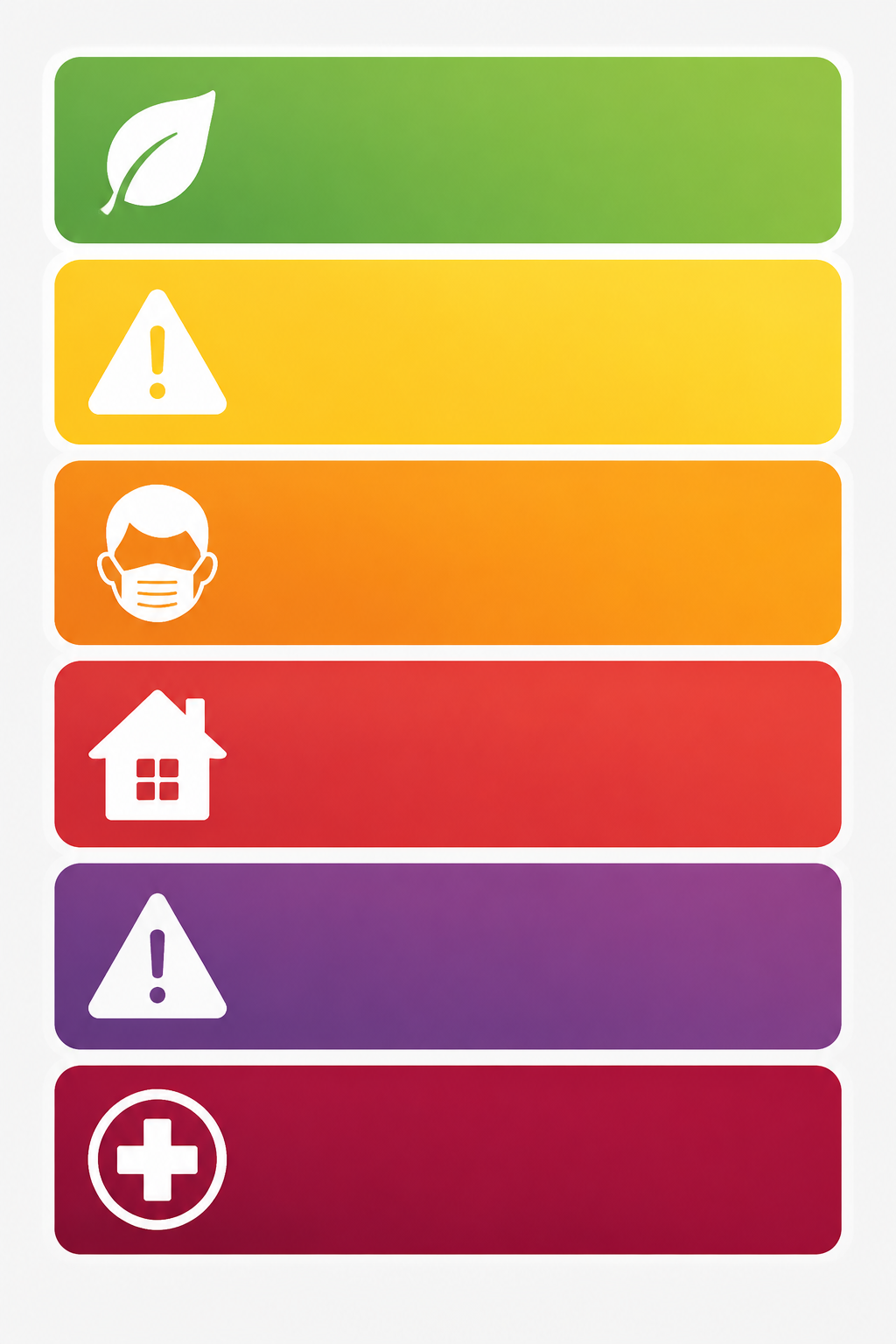
AQI Action Guide for an Aging Parent
| AQI color and range | What it means for an older adult | What to do now |
|---|---|---|
| Green, 0-50 | Air quality is good. This is the easiest day to keep the normal routine.[1][2] | Keep regular walks, errands, gardening, and outdoor visits. If your parent has COPD, heart disease, asthma, or recent respiratory illness, still watch their usual symptom pattern rather than the color alone. |
| Yellow, 51-100 | Air quality is moderate. Most people may be fine, but older adults and people with heart or lung disease can have less reserve.[1][2] | Keep activity, but make it easier: choose a shorter walk, move it away from traffic, avoid steep hills, check symptoms before leaving, and close windows if outdoor air smells smoky or stale. Run filtration in the main room if your parent is sensitive. |
| Orange, 101-150 | Unhealthy for sensitive groups. EPA includes older adults among people more likely to be affected, especially by particle pollution.[1] | Move longer or heavier activity indoors. Keep outdoor trips short and practical. Skip yard work, brisk walks, and outdoor exercise classes. Use recirculation in the car, close windows, and run a properly sized portable air cleaner in the room your parent uses most. |
| Red, 151-200 | Unhealthy. At this level, outdoor physical activity should stop for older adults and other sensitive groups.[1][2] | Cancel outdoor exercise and nonessential errands. Bring chair exercises, walking laps, or stretching indoors only if the indoor air is controlled. Keep doors and windows closed, reduce indoor particle sources, run filtration, and check for chest tightness, unusual fatigue, wheezing, dizziness, or shortness of breath. |
| Purple, 201-300 | Very unhealthy. The risk is no longer limited to people who already feel sensitive.[1][2] | Stay indoors as much as possible in the cleanest available room. Postpone appointments that can safely wait. Avoid vacuuming, frying, candles, fireplaces, and other indoor particle sources. If symptoms worsen or your parent has heart or lung disease, contact their clinician for individualized instructions. |
| Maroon, 301+ | Hazardous. This is an emergency-level air quality condition.[1][2] | Keep your parent indoors with windows and doors closed. Use the cleanest room setup you have. Avoid all outdoor activity. Follow local emergency instructions, and seek medical help promptly for severe shortness of breath, chest pain, confusion, blue lips, fainting, or symptoms that do not improve indoors. |
The table is deliberately conservative at Yellow. That does not mean a healthy 78-year-old has to be treated as housebound whenever the AQI hits 63. It means the day deserves a small adjustment before the body has to prove it is struggling.
Green: Keep the Routine, Keep the Baseline
Green is the day to protect independence, not restrict it. If your parent usually walks after lunch, waters plants, sits on the porch, or goes to the pharmacy, keep the routine. The only caregiving job is to notice the baseline: how far they usually walk, whether they pause on the stairs, what their normal cough sounds like, and how much fatigue is typical after errands.
That baseline matters later. On a Red day, “Dad seems tired” is too vague. “He usually walks to the corner without stopping, but today he stopped twice inside the house” is a different kind of information.
Yellow: Start Small Before the Alert Feels Serious
Yellow is where many families wait too long, because “moderate” sounds like permission to ignore it. For an older adult, Yellow should change the shape of the day, not cancel the day.
- Move walks earlier or later if the local forecast shows a cleaner part of the day.
- Shorten the route and avoid hills, heavy traffic, leaf blowers, and construction dust.
- Ask about symptoms before leaving: chest pressure, new cough, wheeze, dizziness, unusual fatigue, or breathlessness.
- Close windows if outdoor air smells smoky, dusty, or exhaust-heavy, even if the temperature is pleasant.
- Run the portable air cleaner in the room where your parent spends the most time if they have heart disease, COPD, asthma, or a recent respiratory infection.
This is also the level where dignity matters. A parent who values a morning walk may accept “let’s do the flat block today” better than “you can’t go out.” The goal is to lower the dose of pollution and physical strain at the same time.
If Yellow days are common where your parent lives, make a standing version of the plan. Maybe Yellow means the porch visit stays, but the walk moves away from the road. Maybe it means the bedroom window closes after breakfast. The best plan is the one your parent will actually follow when nobody is standing there.
Orange: Treat Your Parent as the Sensitive Group the AQI Is Talking About
Orange is the point where EPA guidance becomes explicit: AQI 101-150 is “unhealthy for sensitive groups,” and older adults are included among people at greater risk from particle pollution.[1] This is not the day to debate whether the sky looks bad enough.
At Orange, the first change is physical effort. A slow walk from the car to the clinic is one thing. Raking, mowing, brisk walking, climbing an outdoor hill, or carrying groceries across a large parking lot is another. The pollution exposure and exertion arrive together, and that is where many older bodies lose margin.
- Replace outdoor exercise with indoor movement: chair exercises, hallway laps, balance practice near a counter, or gentle stretching.
- Batch necessary errands so your parent is not going in and out repeatedly.
- Use car recirculation in smoky or polluted traffic, and avoid idling near open doors or windows.
- Keep medications, rescue inhalers, oxygen supplies, and clinician instructions easy to find if your parent has a diagnosed condition.
- Ask siblings or paid helpers to follow the same AQI rule so one person is not canceling what another person reschedules.
For a deeper single-scenario plan, see How to Protect an Older Adult During an Air Quality Alert and Protect Your Aging Parent During an Air Quality Alert. Those are useful when the phone alert has already arrived and the family needs one shared script.
Red: Stop Outdoor Physical Activity
Red is not a “take it easy outside” level for an aging parent. At AQI 151-200, EPA and lung health guidance treat the air as unhealthy, and outdoor physical activity should be avoided by sensitive groups.[1][2]
That includes the activities families often underestimate: sweeping the porch, pulling weeds for ten minutes, walking the dog around the block, carrying laundry to an outdoor building, or standing outside to talk with a neighbor. The body still has to breathe harder, and the particles are still there.
Red is also when fall prevention and air quality start to overlap. Poor air can worsen fatigue, dizziness, breathlessness, and hurried movement. If your parent is trying to “just get it done” before coming back inside, they may rush, skip a cane, or take stairs while already winded. For that angle, the related guide How to Use the Air Quality Index for Senior Fall Prevention goes deeper.
Purple and Maroon: Make the Cleanest Indoor Space the Default
Purple and Maroon are not levels where a family needs clever exceptions. Purple means very unhealthy air; Maroon means hazardous air.[1][2] For an older parent, the plan should be boring and firm: stay indoors, reduce indoor particle sources, use filtration if available, and follow local emergency guidance.
If a medical appointment cannot be postponed, call ahead. Ask whether the visit can be changed to telehealth, whether arrival can be timed to reduce waiting outdoors, and whether the clinic has specific instructions for patients with heart or lung disease. If the trip must happen, keep the route direct and avoid unnecessary stops.
For Code Purple-specific home precautions, use Code Purple Air Quality Precautions for Older Adults at Home.

Why Older Adults Have Less Room for Error
The reason to act early is not that older adults are delicate. It is that aging changes the reserve capacity of the lungs, heart, and immune response. One aging-health source summarizes that lung function can decline by about 30-40% with age, which helps explain why the same outdoor air can feel merely annoying to one person and exhausting to another.[3]
Fine particle pollution is especially important because PM2.5 is small enough to move deep into the lungs. Johns Hopkins Medicine describes how fine particles can enter the bloodstream and contribute to cardiovascular problems, including heart attacks and strokes.[4] That is the part easy to miss if the only symptom you are watching for is coughing.
This is why “he is not wheezing” does not settle the question. An older parent with coronary artery disease, heart failure, COPD, asthma, diabetes, a recent infection, or a history of stroke may need the Yellow plan sooner and the Orange plan more strictly. The AQI color is the starting point; the parent’s baseline health decides how much buffer to add.
Indoors Helps Only If the Indoor Air Is Managed
EPA notes that Americans spend about 90% of their time indoors, where pollutant levels can sometimes be higher than outdoor levels.[5] For an older parent, that statistic should not become “indoors is safe.” It should become “the indoor room is where we can control more variables.”
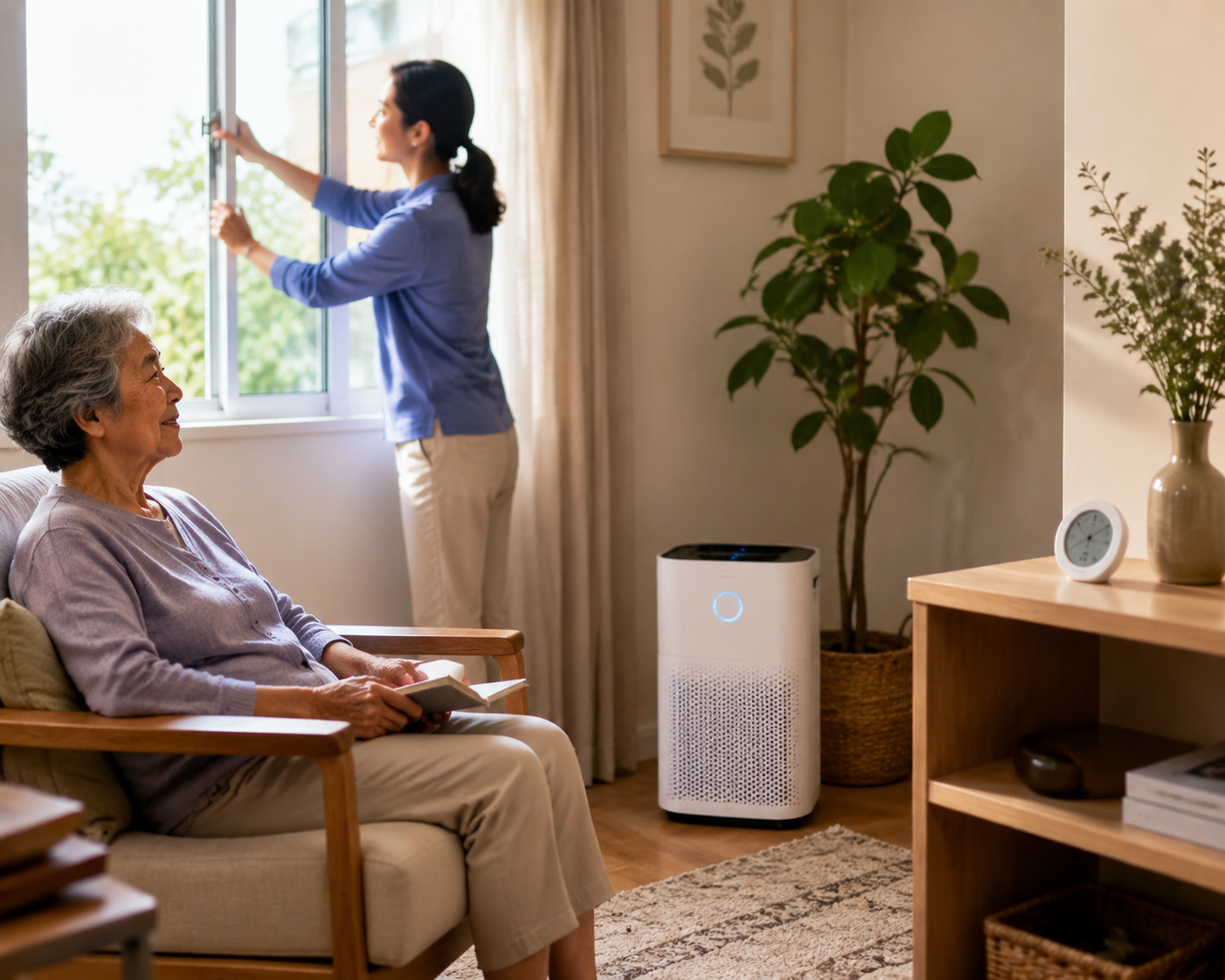
The practical indoor plan has three parts: reduce sources, decide when to ventilate, and filter the room air. EPA describes indoor air improvement in terms of source control, ventilation, and air cleaning; caregivers can turn that into a simple household routine.[5]
| Indoor control | Caregiver decision |
|---|---|
| Source control | On poor-air days, avoid candles, fireplaces, incense, frying, smoking, aerosol sprays, and unnecessary vacuuming. These add particles indoors when the house is already trying to be a refuge. |
| Ventilation | Open windows when outdoor air is clearly better than indoor air; close them when AQI is elevated, smoke is present, or outdoor air smells polluted. Kitchen and bathroom exhaust can help with indoor sources, but they may also pull outdoor air in, so use judgment during smoke events. |
| Filtration | Use a portable air cleaner in the bedroom or main sitting room, especially at Orange and above. Keep doors and windows closed enough for the device to work on the room air. |
| Humidity | Aim for a comfortable middle range. EPA guidance commonly points to indoor humidity below 60% to reduce mold risk, and caregiver-oriented guidance often uses a 30-50% target range for older adults.[6] |
A HEPA filter is a tool, not a miracle. EPA describes HEPA filters as filters that remove at least 99.97% of airborne particles 0.3 microns in diameter.[7] That standard is useful because fine particles are exactly the concern on many AQI and smoke days. It does not mean any purifier in any corner protects the whole house.
Place the air cleaner where your parent actually breathes the most air: beside the favorite chair during the day, then in the bedroom at night if you have only one unit. Keep the filter maintained, avoid blocking the intake or outlet, and do not run an ozone-generating device around an older adult.
Some commercial air-cleaner calculators claim large reductions in respiratory hospitalizations, but unless the calculation identifies the study, population, device use, and baseline risk, treat that as a marketing claim rather than a household guarantee. The safer promise is narrower: filtration can reduce particles in the room where it is properly used.
If your parent has COPD, the room-by-room decisions get more specific. Use Room-by-Room Air Quality Checklist for Seniors with COPD alongside the AQI color plan.
When Wildfire Smoke Changes the Rules
Wildfire smoke deserves faster escalation than a hazy city day. AARP reported in July 2026 that wildfire smoke may be about 10 times more toxic than typical urban air pollution, citing current research on smoke-related health risk.[8] That does not mean every smoky smell is an emergency, but it does mean the family should stop waiting for the air to look dramatic.
If smoke is visible or you can smell it, use the stricter version of the AQI plan. At Yellow with smoke, behave closer to Orange for an older parent with heart or lung disease. At Orange with smoke, cancel outdoor exertion rather than merely shortening it. At Red or worse, the clean-room plan becomes the center of the day.
- Close windows and exterior doors before smoke thickens, not after the room already smells like smoke.
- Run the portable air cleaner continuously in the main room or bedroom.
- Pause cooking methods that create particles, especially frying or broiling.
- Move medications, water, phone chargers, glasses, and mobility aids into the cleanest room.
- Check local emergency instructions if smoke is part of an active wildfire event.
For a more detailed smoke-only plan, use the Wildfire Smoke Safety Checklist for Seniors and Caregivers.
When to Call a Clinician
The AQI tells you about outdoor conditions. It does not know your parent’s ejection fraction, oxygen saturation history, inhaler plan, recent pneumonia, or whether yesterday’s “tired” was actually the start of something. If symptoms appear out of proportion to the day, do not make the AQI color the final judge.
- Call the clinician for new or worsening shortness of breath, wheezing, chest tightness, unusual fatigue, dizziness, swelling, or a cough that changes quickly.
- Ask in advance what AQI level should trigger medication changes for a parent with COPD, asthma, heart failure, or oxygen use.
- Seek urgent care or emergency help for chest pain, severe breathing trouble, fainting, confusion, blue lips, or symptoms that do not improve after moving indoors.
- If your parent lives alone, set a check-in plan for Orange and above so symptoms are not discovered hours later.
A good family rule is simple enough to survive a rushed call: Yellow means adjust; Orange means move exertion indoors; Red means no outdoor physical activity; Purple and Maroon mean stay in the cleanest indoor space and follow emergency guidance. That is how to protect an older relative from poor air quality without turning every forecast into a crisis.
References
- Air Quality Index (AQI) Basics, AirNow.gov.
- Air Quality Index, American Lung Association.
- Aging and Lung Health, GoLighthouse.
- Air Pollution and Heart Disease, Johns Hopkins Medicine.
- Improving Indoor Air Quality, U.S. Environmental Protection Agency.
- A Brief Guide to Mold, Moisture and Your Home, U.S. Environmental Protection Agency.
- What is a HEPA filter?, U.S. Environmental Protection Agency.
- Wildfire Smoke May Be More Toxic Than Other Air Pollution, AARP, July 17, 2026.
Related reading
Noticed something outdated or inaccurate on this page? Flag a correction. We review every report against CDC, NIA, and AARP HomeFit guidance before updating a page.
Part of the Fall Prevention section.