
STEADI: intervene
Senior Fall Safety Tips for the Taco Bell Cyclospora Outbreak
Learn why the July 2026 Taco Bell Cyclospora outbreak creates acute fall hazards for seniors through dehydration-related dizziness and weakness, and get actionable steps to prevent falls before and after exposure.
Last updated: July 25, 2026. Outbreak details may change after this date.
The most useful Taco Bell Cyclospora outbreak safety tips for seniors start in the hallway, not in the produce aisle. If an older adult develops diarrhea during this outbreak, the household should treat dehydration, dizziness, weakness, and urgent nighttime bathroom trips as immediate fall risks.
As of July 25, 2026, the CDC outbreak investigation reports more than 1,947 Cyclospora cases across 9 states, traced to iceberg lettuce from Taylor Farms de Mexico that was served at Taco Bell and sold at Walmart under the Marketside brand. The lettuce distribution and recall reach 27 states, but that is not the same as confirmed illness in 27 states; confirmed epidemiologic links are reported in 9 states as of this update. [1]
For a younger, steady adult, cyclosporiasis may sound like a stomach infection to manage with fluids and rest. For a senior who already takes blood pressure medicine, diabetes medication, a diuretic, or a blood thinner, the same illness can make standing up from bed or the toilet suddenly unsafe. Dr. Luis Marcos of Stony Brook Medicine told AARP that the older-adult concern is dehydration leading to "weakness, dizziness, falls." [2]
Why this stomach illness becomes a fall problem
Cyclospora infection commonly causes diarrhea, and diarrhea drains fluid faster than many people replace it. The fall risk does not wait until someone feels severely ill. It can show up at the first hurried stand from a chair, the first walk from bed to the bathroom, or the first time a person tries to steady themselves after using the toilet.
The mechanism is plain enough to act on: fluid loss can contribute to orthostatic hypotension, a drop in blood pressure when standing. In older adults, dehydration is associated with falls, with orthostatic hypotension and muscle weakness described as part of the pathway. [3]
That matters because bathroom movement combines almost every hazard at once. The person may be half-awake, moving quickly, embarrassed, weak from diarrhea, and reluctant to call for help. Floors may be wet. A throw rug may slide. A cane or walker may be across the room because the person "only has to go a few steps."
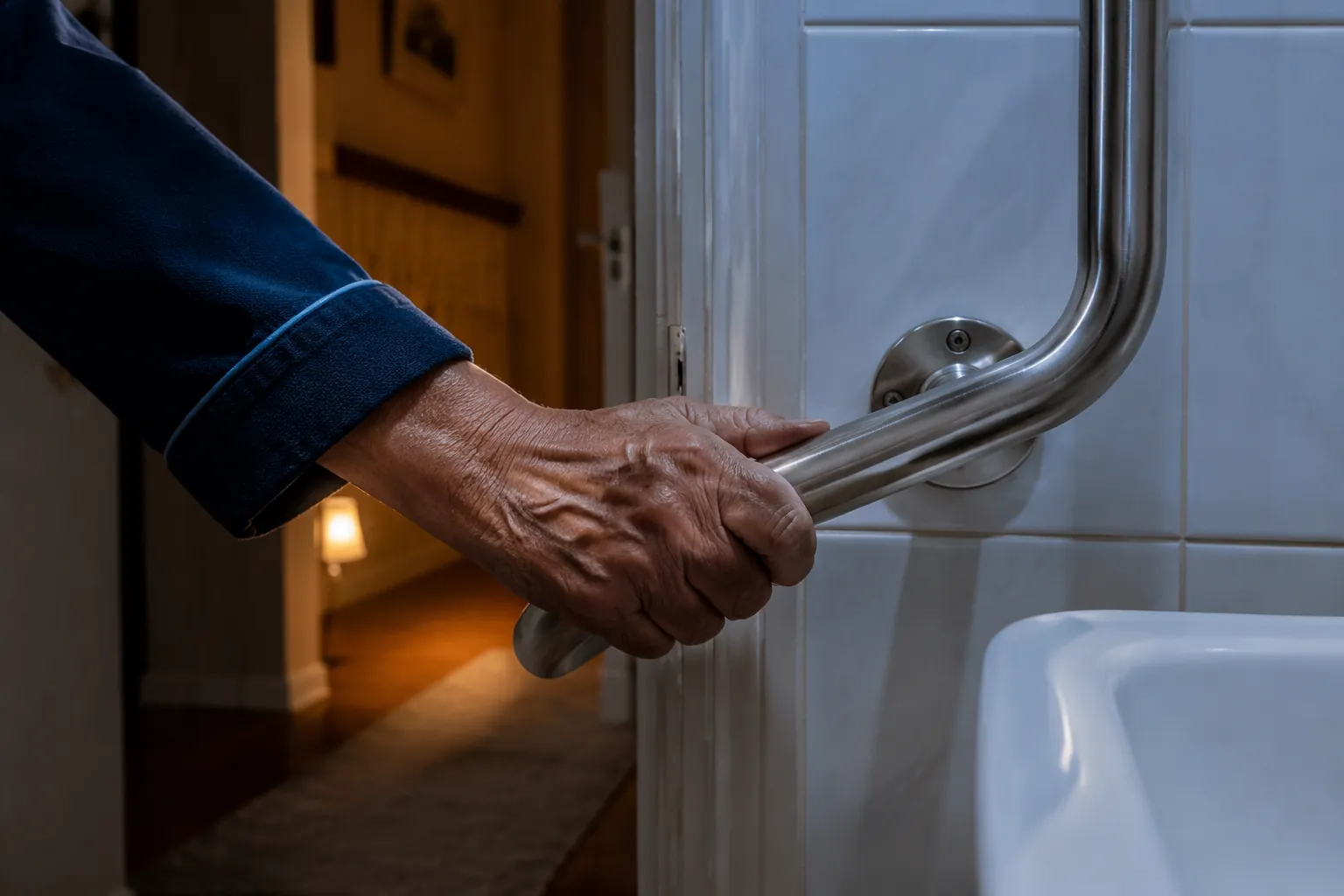
This is why the household response should begin before symptoms peak. Waiting until a senior is already dizzy at 2 a.m. leaves the hardest decisions to the worst moment.
First decide whether anyone in the home may have been exposed
The practical question is not whether every bag of lettuce in America is unsafe. It is whether an older adult in the home recently ate potentially affected iceberg lettuce from the outbreak channels, especially through Taco Bell menu items or Walmart Marketside products named in the investigation. The CDC update is the best place to check current products, states, and recall details because the investigation is active. [1]
If the answer is yes or uncertain, stop serving the implicated raw lettuce and follow the CDC's current discard or recall instructions. Do not try to make a recalled raw product safer by rinsing it. Washing produce can reduce some surface contamination, but it is not a reliable fix for an item already identified in an outbreak.
For produce that is appropriate to cook, heat is the more dependable safety step. Tufts Medicine and FoodSafety.gov note that cooking to 158°F, or 70°C, kills Cyclospora. [4][5] That does not mean every salad ingredient should be cooked into something else; it means seniors should avoid gambling on raw produce when a specific raw product is under active investigation.
Set up hydration monitoring before the diarrhea gets bad
Telling an older adult to "stay hydrated" is too vague when the risk is a fall. Someone needs to know what is being drunk, how often the person is urinating, whether dizziness appears when standing, and whether the person is becoming too weak to walk safely.
- Keep water or an oral rehydration drink within reach of the bed and chair, not across the room.
- Use small, frequent sips if nausea or urgency makes larger drinks unappealing.
- Track bathroom trips, diarrhea episodes, and dizziness on paper or in a phone note so a clinician gets a clear picture.
- Watch for standing dizziness, new confusion, unusual sleepiness, very dark urine, or weakness that changes walking.
- Do not restrict fluids because bathroom trips are inconvenient; instead, make the bathroom route safer.
Fluid plans also need common sense about medical conditions. A person with heart failure, kidney disease, or fluid restrictions should not suddenly increase fluids without clinical guidance. The point is not to prescribe a volume; it is to notice dehydration early enough to keep the person from standing up dizzy and alone.
Ask for a medication review early, especially before treatment changes
Older adults often start this illness with a medication list that already affects balance, blood pressure, blood sugar, or bleeding risk. Diuretics can worsen fluid loss. Blood pressure medicines can make standing dizziness more likely. Diabetes drugs become trickier when eating is disrupted. None of that means a caregiver should stop medicines on their own.
AARP's report notes that the standard treatment, TMP-SMX, can interact with warfarin, sulfonylureas, diuretics, and ACE inhibitors, and Dr. Marcos recommends pharmacist review before starting treatment. [2] That is especially important for seniors who already have fall risk, because a medication change meant to treat infection can also change dizziness, blood pressure, blood sugar, or bleeding consequences if a fall occurs.
| Medication or issue to flag | Why it matters during diarrheal illness |
|---|---|
| Diuretics | May worsen fluid loss or dizziness; ask the prescriber whether temporary guidance is needed. |
| ACE inhibitors or other blood pressure medicines | May contribute to standing dizziness when fluid intake is low. |
| Sulfonylureas or other diabetes drugs | Eating less and losing fluid can complicate blood sugar control. |
| Warfarin or other bleeding-risk medicines | Falls can have more serious consequences; TMP-SMX interaction review is important. |
| Any new antibiotic or anti-diarrheal plan | Check with a clinician or pharmacist before combining it with the existing medication list. |
A pharmacist can often do the first safety screen quickly if the caregiver has the current medication bottles or an updated medication list. The useful question is direct: "With diarrhea and possible Cyclospora treatment, which of these medicines could increase dizziness, dehydration, low blood sugar, bleeding risk, or interactions?"
Make the bathroom route safe before the first urgent night
During gastrointestinal illness, the bathroom path becomes the main fall-prevention project. It is not enough to tell someone to be careful. The home should be arranged so a weak, half-awake person has fewer chances to trip, slip, or reach for something unstable.
- Clear the path from bed or chair to toilet: no loose rugs, laundry, shoes, cords, pet bowls, or low stools.
- Put night-lights in the bedroom, hallway, and bathroom before bedtime.
- Keep the walker, cane, or rollator within arm's reach, not parked by the front door.
- Use installed grab bars near the toilet and shower; do not rely on towel bars, sink edges, or sliding doors.
- Place a phone, call button, or bell where the person can reach it from bed and from the bathroom.
- If dizziness starts, have the person sit first and call for help rather than rushing the last few steps.
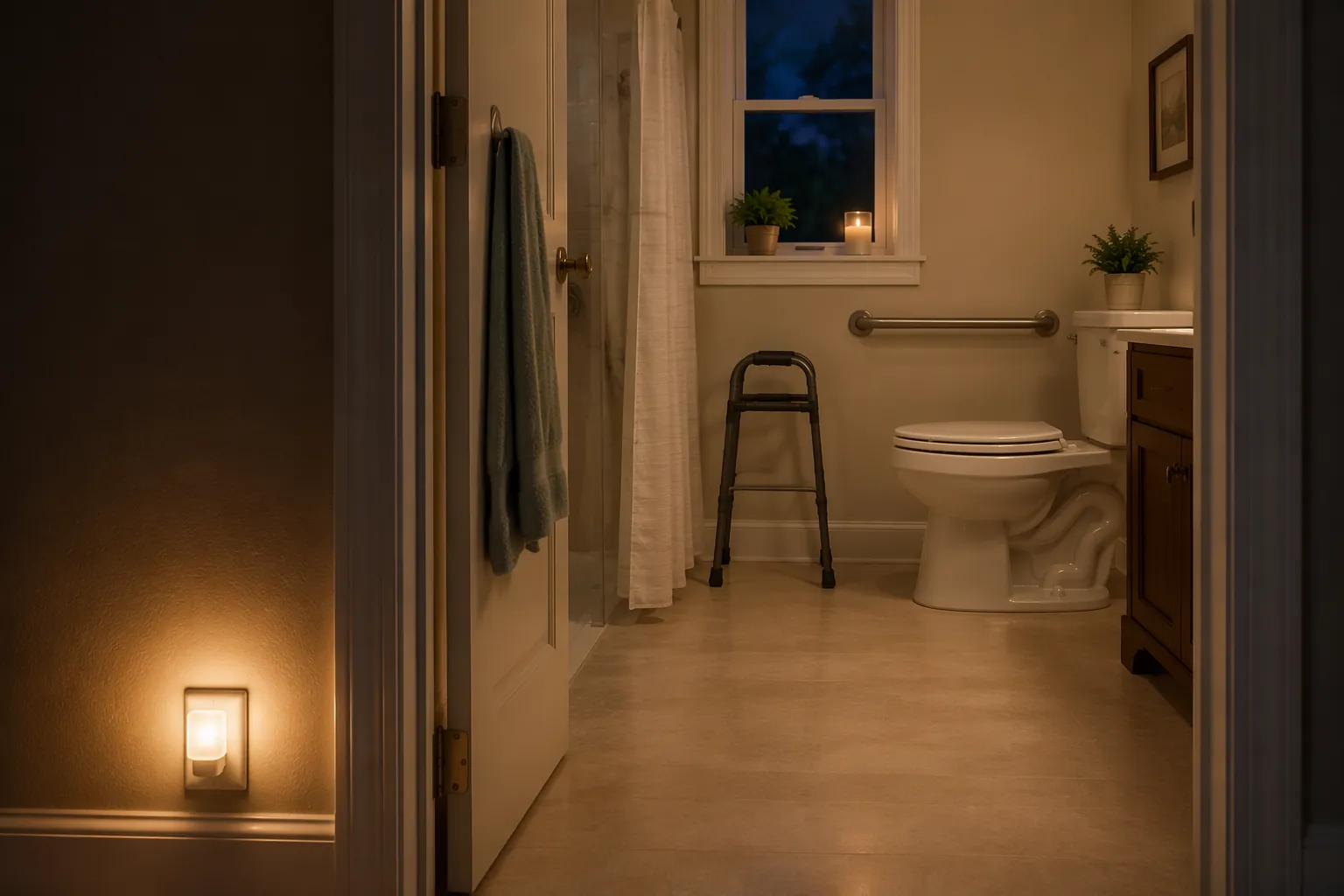
A bedside commode may be safer than repeated long walks for someone who is acutely weak, dizzy, or having urgent diarrhea. That decision depends on the person, the home layout, and dignity concerns, but it should be considered before the caregiver is trying to improvise in the middle of the night.
If symptoms begin, slow the movement down
Once diarrhea, weakness, or dizziness starts, fall prevention becomes a sequence. Sit up. Pause. Stand with support. Pause again. Walk only if steady. That may feel excessive to a person who was independent yesterday, but dehydration can change balance faster than pride adjusts.
- Before standing, sit on the edge of the bed or chair and check for lightheadedness.
- Use the walker, cane, grab bar, or caregiver support every time, including short bathroom trips.
- Turn on lights fully if possible; do not walk through a dark hallway to avoid waking someone.
- After using the toilet, stand slowly and hold a stable support before stepping away.
- If dizziness, chest pain, fainting, confusion, severe weakness, or inability to keep fluids down occurs, seek medical advice promptly.
Caregivers should take a report of "I just feel weak" seriously during this outbreak. Weakness is not just a comfort issue when the person must keep getting to the toilet. It is a mobility warning.
Ask specifically about Cyclospora testing
A senior with prolonged diarrhea after possible exposure should not assume a negative routine stool culture rules out Cyclospora. AARP and Tufts Medicine note that routine stool cultures do not detect Cyclospora; clinicians may need to order ova-and-parasite testing with modified acid-fast staining. [2][4]
That testing detail belongs in the first phone call, not after a week of worsening weakness. A caregiver can say: "There is an active Cyclospora outbreak linked to iceberg lettuce. This person has diarrhea and is older. Do we need Cyclospora-specific stool testing?"
When to call for medical advice
Medical advice is appropriate when an older adult has persistent diarrhea after possible exposure, symptoms that are worsening instead of improving, dizziness when standing, signs of dehydration, blood sugar instability, new confusion, fainting, or any fall. The threshold should be lower for seniors who live alone, take diuretics or blood pressure medicines, use warfarin, have diabetes, or already have balance problems.
Emergency care may be needed if the person cannot stand safely, cannot keep fluids down, faints, has severe weakness, shows sudden confusion, or falls and may be injured. This article is educational and cannot replace a clinician's assessment, especially when dehydration, medication interactions, and fall injuries overlap.
The July 2026 Cyclospora outbreak is serious for seniors because it can turn ordinary movements into acute fall hazards. Monitor hydration, do not brush off dizziness, review medications before treatment changes, and secure the bathroom route before the first urgent nighttime trip.
References
- CDC Investigation Update: Cyclospora Outbreak, July 2026 - CDC - https://www.cdc.gov/cyclosporiasis/outbreaks/07-26/investigation.html
- What Older Adults Should Know About Cyclospora - AARP - https://www.aarp.org/health/conditions-treatments/cyclospora-outbreak-older-adults/
- Association Between Dehydration and Falls - NIH/PMC - https://pmc.ncbi.nlm.nih.gov/articles/PMC7283563/
- Cyclospora Symptoms, Prevention and Food Safety Tips - Tufts Medicine - https://www.tuftsmedicine.org/about-us/news/cyclospora-symptoms-prevention-food-safety-tips
- The Importance of Food Safety for Older Adults - FoodSafety.gov - https://www.foodsafety.gov/blog/importance-food-safety-older-adults
Related reading
Noticed something outdated or inaccurate on this page? Flag a correction. We review every report against CDC, NIA, and AARP HomeFit guidance before updating a page.
Part of the Fall Prevention section.