
STEADI: Intervene
Cyclospora Outbreak Symptoms That Raise Fall Risk in Older Adults
Caregivers of older adults need to distinguish Cyclospora symptoms from a stomach virus and know that routine stool tests often miss this parasite. This guide explains the signs to watch for, when dehydration becomes a fall emergency, and key medication warnings.
If an older adult has watery diarrhea, poor appetite, and unusual tiredness after possible exposure to recalled lettuce or a Taco Bell meal in an affected state, do not file it away as “just a stomach bug” too quickly. Cyclospora can look ordinary at first. The pattern that deserves a closer look is watery diarrhea without bloody stool, low-grade fever at most, fatigue that lingers, and symptoms that seem to improve and then return over days or weeks.[1][2]
Last reviewed: July 25, 2026. CDC outbreak numbers are still moving. As of the CDC’s July 2026 health alert, more than 1,645 confirmed cases had been reported across 34 states, with 141 hospitalizations, and the agency linked the outbreak investigation to iceberg lettuce from Taylor Farms de Mexico, including a Taco Bell recall in 9 states and a broader product recall in 27 states.[3][4] Reporting can lag, so the count is not a clean measure of who may be sick tonight.[5]
The Symptom Pattern That Should Change Your Plan
The common Cyclospora symptoms to watch for are watery diarrhea, loss of appetite, weight loss, abdominal cramps, bloating, nausea, and fatigue.[1][2] In an older adult, the fatigue is not a side note. It changes how safely the person can stand, walk to the bathroom, get up at night, and recover after each trip.
| What you are seeing | Why it matters in an older adult |
|---|---|
| Watery diarrhea | Fluid loss can build up across repeated bathroom trips, especially if drinking and eating have slowed. |
| Loss of appetite or eating only a few bites | Low intake makes weakness and lightheadedness more likely during recovery. |
| Abdominal cramps, bloating, or nausea | These can keep the person from drinking enough, even when diarrhea is the obvious symptom. |
| Fatigue that seems out of proportion | Tired legs, slower reactions, and unsteady standing can turn a short walk to the toilet into a fall-risk moment. |
| Symptoms that ease and then return | Cyclospora can follow a relapsing-remitting course and may last more than a month if untreated.[3] |
A typical short stomach virus often burns through the household quickly and improves steadily. Cyclospora is harder to sort out because a caregiver may hear, “I’m better today,” then find the person weak again after dinner or back in the bathroom overnight. That waxing-and-waning course is one of the reasons exposure history matters.
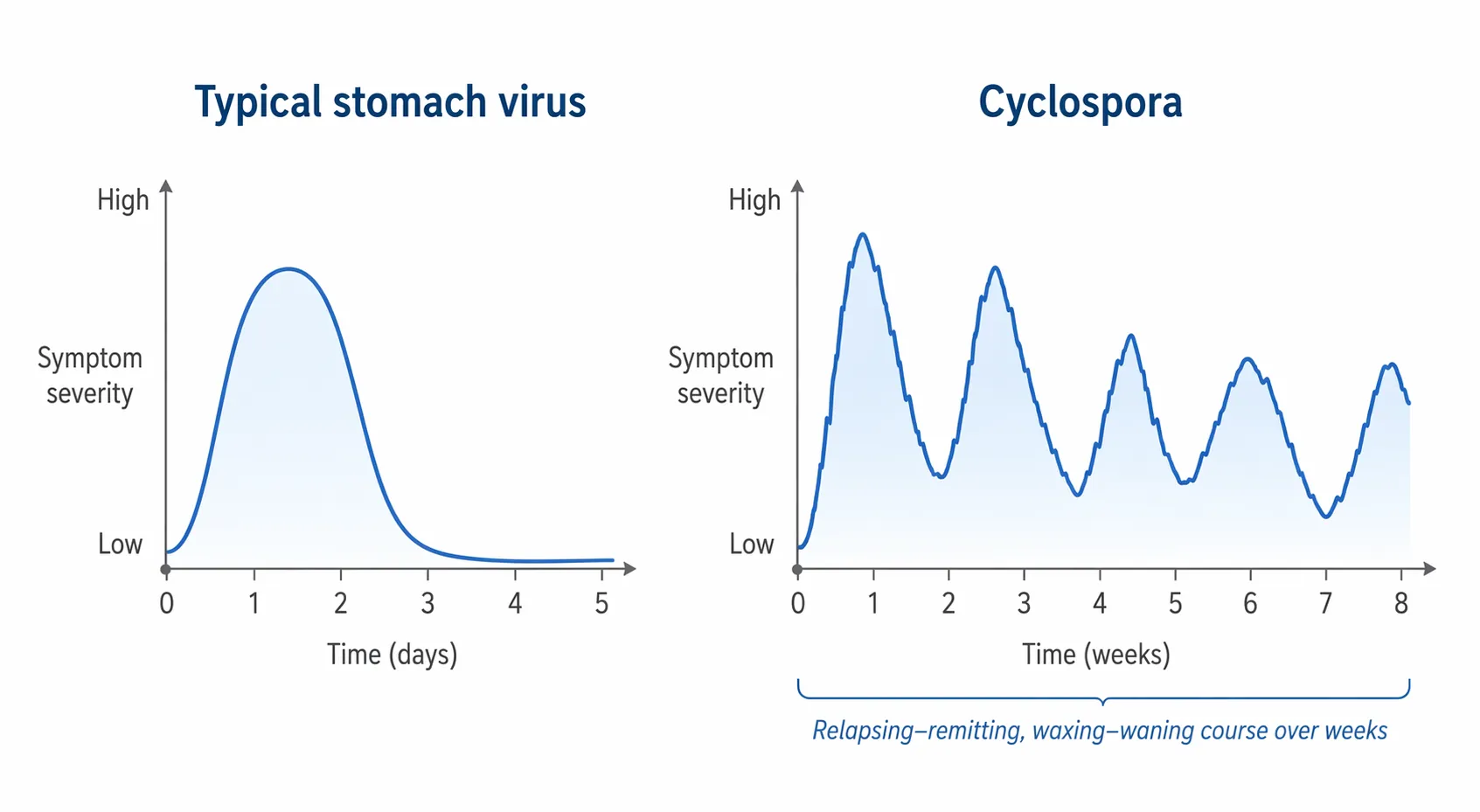
Two details can keep the illness from being misread. Bloody stool is not a typical Cyclospora feature, and fever, when present, is usually low-grade.[1][2] Bloody diarrhea, high fever, severe belly pain, or a rapidly worsening appearance should not be squeezed into a Cyclospora explanation at home; those findings deserve prompt medical guidance.
A Negative Routine Stool Test May Not Settle It
One of the easiest mistakes is stopping the workup after hearing that a stool test was “negative.” Routine ova-and-parasite stool exams can miss Cyclospora unless the lab is specifically asked to look for it. CDC guidance and infectious disease experts advise requesting Cyclospora-specific testing or a multiplex gastrointestinal PCR panel when the symptom pattern and exposure history fit.[1][3]

When you call the clinician, the useful wording is direct: “There is watery diarrhea, appetite loss, fatigue, and possible lettuce or Taco Bell exposure. Was the stool test able to detect Cyclospora, or do we need Cyclospora testing or a multiplex GI PCR panel?” That question matters more than asking for “another stool test” without specifying what the lab should detect.
Testing is especially worth revisiting when the person seemed to recover and then relapsed, when diarrhea has continued beyond the usual few days of a stomach virus, or when several household members are not following the same quick illness-and-recovery pattern. The goal is not to diagnose Cyclospora from the kitchen table. It is to avoid letting the wrong test close the case.
When Diarrhea Becomes Fall-Dangerous
For older adults, the most dangerous part of a diarrheal illness may be the walk after the sixth bathroom trip, not the first cramp. Repeated fluid loss, low intake, poor sleep, and deconditioning can make standing up harder. If the person is already using blood pressure medicine, diuretics, diabetes medicine, or a walker, the margin for error is smaller.
More than 6 to 8 diarrheal episodes in a day is considered severe by Dr. Cory Fisher of Cleveland Clinic, quoted by AARP.[6] That threshold is a practical reason to call the clinician the same day, even if the person is still talking normally and insisting they can manage.
- Seek immediate care for dizziness, fainting, confusion, decreased urination, very dry mouth, or a rapid heartbeat during or after diarrhea.[1]
- Call promptly if diarrhea is frequent enough that the person cannot keep up with fluids, cannot safely get to the bathroom, or is too weak to stand without grabbing furniture.
- Do not wait for a full week of symptoms if an older adult is getting weaker after only 1 or 2 days; dehydration signs can move faster than the diagnostic workup.[1]
- Treat new confusion as urgent, not as ordinary tiredness from a bad night.
The fall connection should be kept honest. Dehydration does not automatically cause a fall, and a single study does not turn diarrhea into a simple cause-and-effect story. But the association is real enough to respect: in a study of 30,634 adults age 65 and older, 37.9% were dehydrated at baseline, and dehydrated older adults had 13% higher odds of falling; 17.6% of the cohort was taking loop diuretics, which were also associated with a falls-or-death composite outcome.[7]
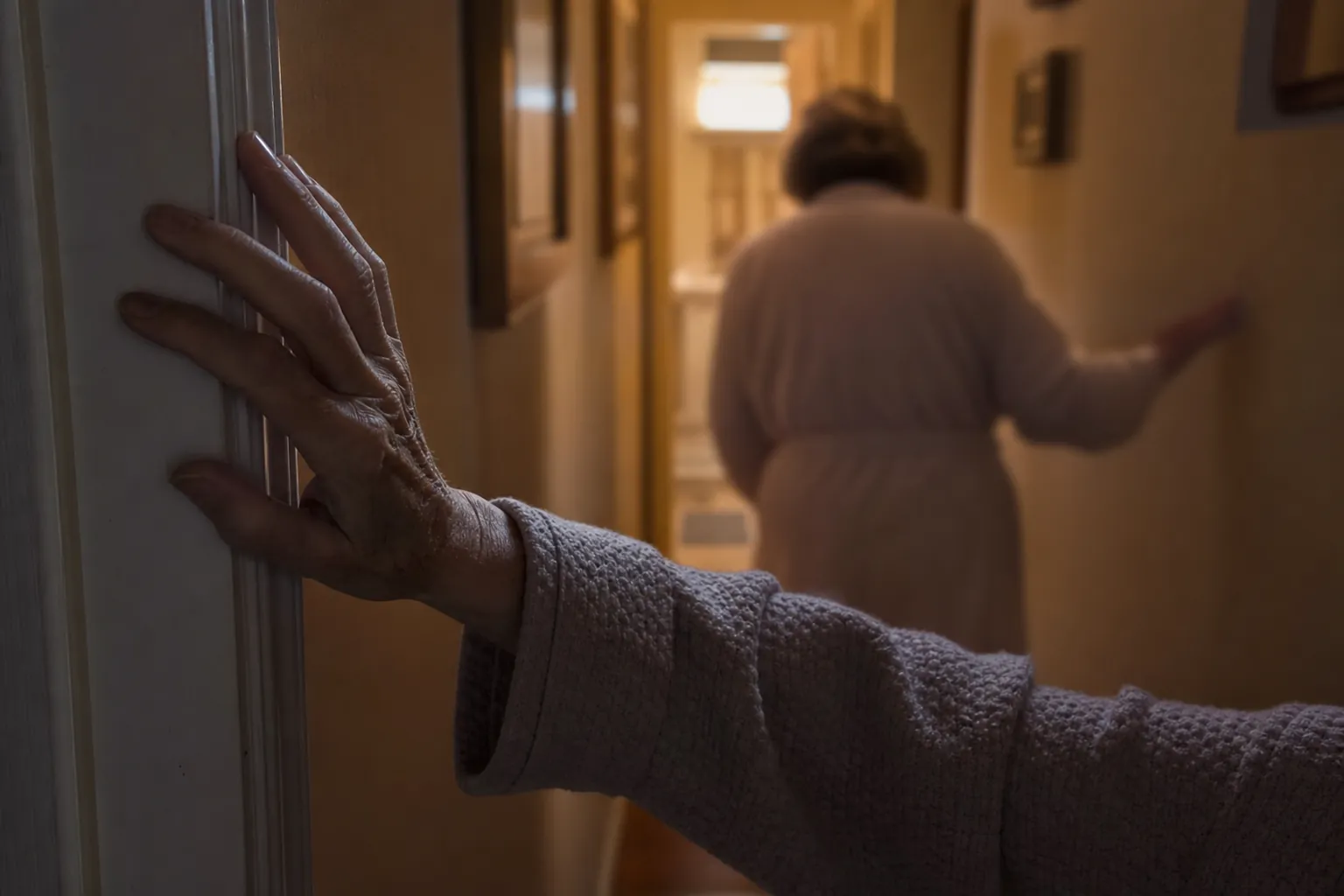
That is why “weak and tired” needs more detail. Can the person stand from a chair without rocking forward twice? Do they pause after standing because the room feels light? Are they urinating less than usual? Are they reaching for the wall on the way to the bathroom? Those observations help decide whether home monitoring is still reasonable or whether the illness has become a safety problem.
Treatment Is Usually Straightforward, But Medication Review Comes First
Once Cyclospora is diagnosed, trimethoprim-sulfamethoxazole, often shortened to TMP-SMX, is the usual first-line treatment.[1] The caution for older adults is that “usual” does not mean “start without checking the medication list.”
Before the first dose, the prescriber or pharmacist should review whether the older adult takes warfarin, loop diuretics, ACE inhibitors, ARBs, diabetes medications such as sulfonylureas, or digoxin. Interaction data and expert warnings point to important risks, including increased bleeding concern with warfarin, potassium problems with ACE inhibitors or ARBs, worsened dehydration concerns with diuretics, low blood sugar risk with some diabetes medicines, and digoxin toxicity concerns.[1]
This is also the moment to look beyond the antibiotic itself. During a diarrheal illness, medicines that were stable last week may behave differently because the person is eating less, drinking less, losing fluid, or standing up more slowly. For a broader review, see A Caregiver’s Guide to Medications That Increase Fall Risk in Older Adults.
What To Watch Overnight And During Early Recovery
At home, the job is not to hover over every symptom. It is to make the predictable risky moments less dangerous while the illness is active and while strength is returning.
- Count bathroom trips for the day and note whether the stool is still watery, improving, or returning after a better stretch.
- Track urine output in plain terms: normal for this person, less than usual, very dark, or barely happening.
- Have the person sit at the edge of the bed or chair before standing, especially after sleep or a long rest.
- Keep the path to the bathroom lit, clear, and short; do not wait until nighttime urgency exposes every loose rug and dark corner.
- Use the walker, cane, bedside commode, or hands-on assistance temporarily if fatigue has changed the person’s usual gait.
Recovery can be misleading. Diarrhea may ease before appetite, hydration, sleep, and leg strength are back to normal. That is the stretch when families often relax just as the older adult starts walking to the bathroom alone again. Keep the fall precautions in place until standing, walking, urination, and intake look like the person’s usual baseline, not merely better than the worst day.
Cyclospora in an older adult is a testing-sensitive and medication-sensitive illness. The home-safety danger often shows up in an ordinary scene: a weak, dehydrated walk to the bathroom after everyone assumes the worst has passed.
References
- Cyclosporiasis diarrheal outbreak: what experts say, Stanford Medicine, July 2026
- Cyclosporiasis Outbreak, Johns Hopkins Medicine
- CDC HAN-00531, Centers for Disease Control and Prevention
- CDC Investigation Update, July 2026, Centers for Disease Control and Prevention, July 2026
- US Cyclospora cases mount, but CDC lags in tracking, CIDRAP, University of Minnesota
- Cyclospora outbreak older adults, AARP
- Dehydration and Falls in Older Adults, Mayo Clinic Proceedings
Related reading
Noticed something outdated or inaccurate on this page? Flag a correction. We review every report against CDC, NIA, and AARP HomeFit guidance before updating a page.
Part of the Fall Prevention section.