
STEADI: Assess
Can Hot Weather Sleep Loss Make Seniors More Likely to Fall?
Learn how elevated bedroom temperatures during hot weather reduce sleep quality in older adults and significantly increase next-day fall risk, plus practical steps caregivers can take to protect a parent during a heat wave.
Yes: if an older parent is sleeping badly during hot weather, that poor night can plausibly raise fall risk the next morning. The useful way to think about it is not “heat is dangerous” in the abstract. It is a shorter chain: a warm bedroom reduces sleep efficiency, the person gets up groggy or under-rested, balance and reaction time are worse, and ordinary movements — bathroom trips, morning medications, walking to the kitchen — become less forgiving.
That does not mean one hot night guarantees a fall. It means hot-weather sleep loss creates a modifiable window of risk, especially for someone who already uses a cane, takes blood pressure medication, gets up overnight, or insists they are “fine” while moving too quickly.
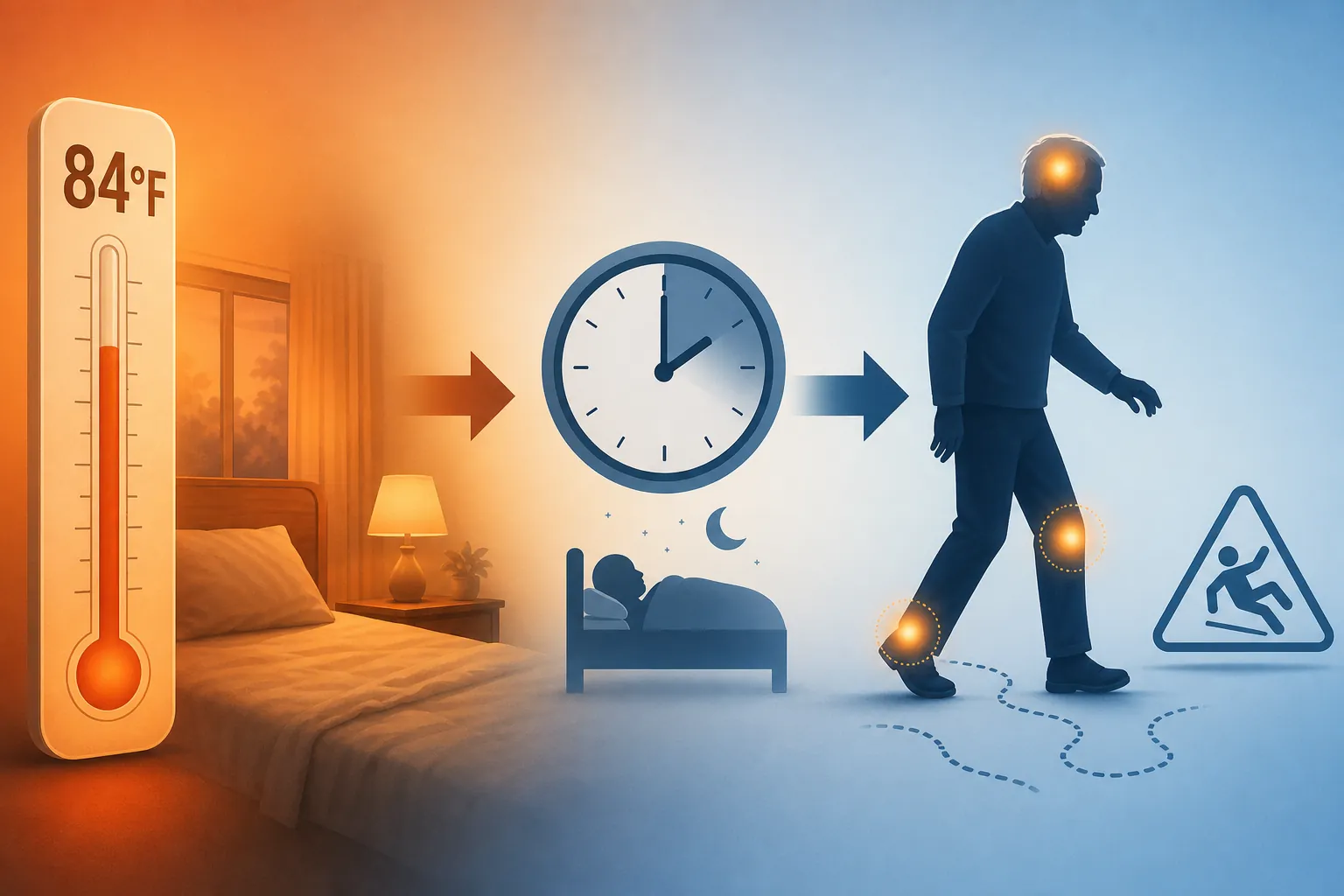
The Overnight Chain: Hot Room, Worse Sleep, Riskier Morning
The bedroom temperature evidence is unusually practical because it gives caregivers a number they can check. In a study of older adults that analyzed 10,903 person-nights, sleep was most efficient when bedroom temperature was roughly 68-77°F. When bedroom temperature rose from 77°F to 86°F, sleep efficiency dropped by about 5-10%, and the model predicted about 60 minutes less sleep when temperature increased from 72°F to 86°F.[1]
Sleep efficiency is not just how long someone lies in bed. It measures how much of that time is actually spent asleep. An older adult can be in bed for eight hours and still have a fragmented, poor-quality night if heat keeps waking them, makes them restless, or prevents deeper sleep.
The same temperature study matters because the effect was not tiny in everyday terms: the authors described the sleep-efficiency impact of warmer nights as comparable to factors such as evening alcohol use or chronic pain.[1] That is a useful comparison. Families often take pain, sedating medication, or alcohol seriously as fall-risk contributors. A hot bedroom belongs in the same practical conversation.
There is one important fairness note. The temperature study was conducted among relatively high-socioeconomic-status, predominantly white older adults in Boston.[1] Households with less reliable cooling, worse insulation, crowded housing, or higher energy costs may have a harder time reaching the 68-77°F range. The target is still useful, but it should not be treated as if every family can simply run perfect air conditioning all night.
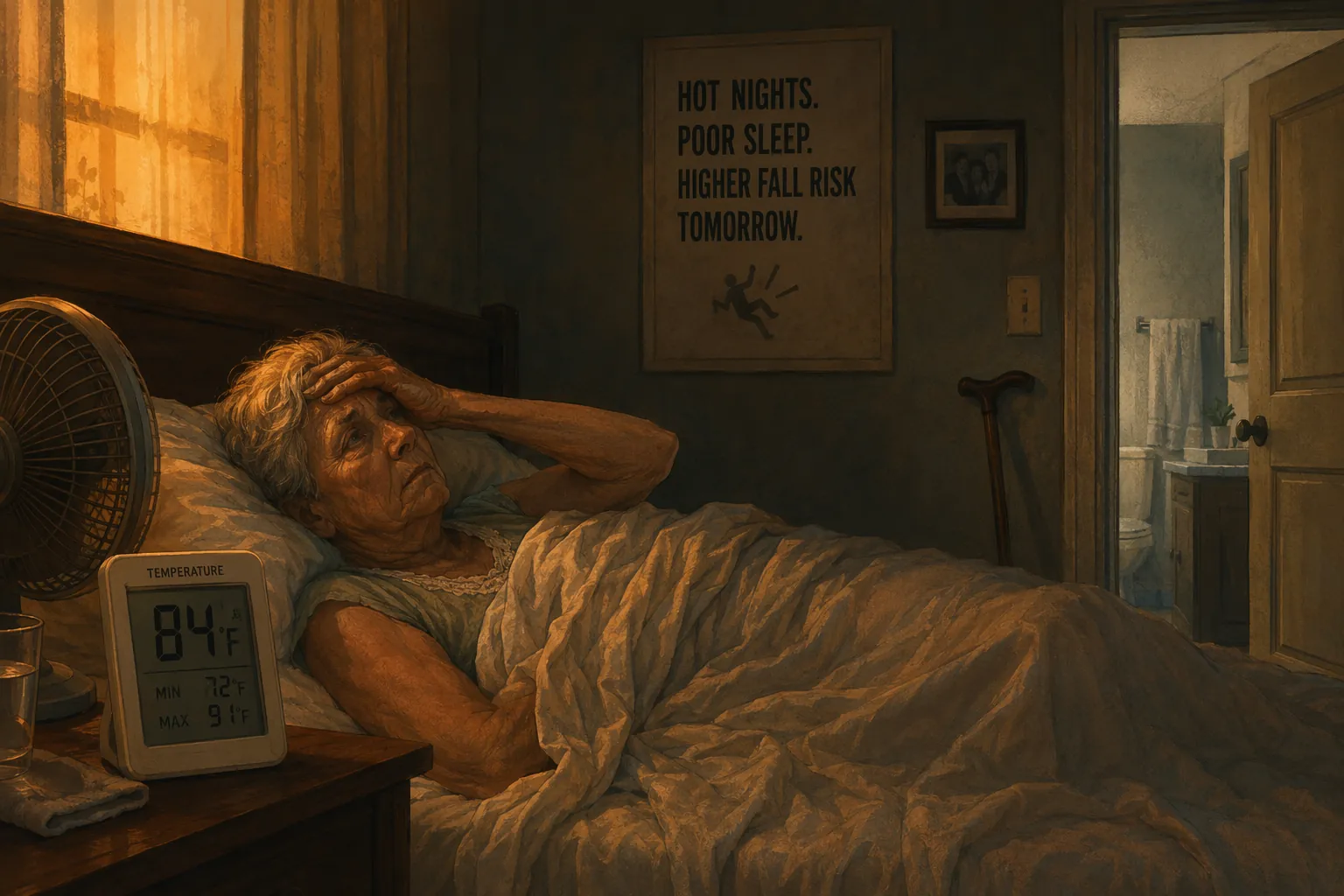
Why a Bad Hot-Weather Night Can Show Up as a Fall Risk
Falls often happen during ordinary transitions: standing from bed, turning toward the bathroom, stepping over a rug, reaching for a light switch, or walking before breakfast. Poor sleep makes those moments more fragile. The person may react more slowly, misjudge distance, drag a foot, forget the cane, or stand before blood pressure has stabilized.
A 2025 study of 404 older adults found a measurable association between poorer sleep quality and higher fall risk. For each one-point increase in Pittsburgh Sleep Quality Index score — where a higher score means worse sleep — fall risk increased by 16%. The study also reported that 88.6% of participants had poor sleep quality, using a PSQI score above 7.[2]
That study is especially relevant to fall prevention because it used the CDC STEADI Fall Risk Questionnaire, a screening tool built around the kind of questions clinicians use to identify older adults at risk.[2] It does not prove that a hot night caused a fall the next day. It does help connect sleep quality to the same fall-risk logic families already use when they worry about dizziness, unsteadiness, medications, or previous falls.
The setting also matters: the study was conducted in Vietnam.[2] Climate, housing, cooling access, and healthcare patterns may differ from those in the United States. Still, the basic finding is not exotic or distant: worse sleep quality tracked with higher fall risk in older adults, using established clinical screening instruments.
Short Sleep Adds a Second Signal
A separate Korean community study looked at sleep duration rather than sleep quality. Among 55,654 older adults, those sleeping 5 hours or less per night had 26% higher odds of fall injury.[3] That is a different measurement from the sleep-quality study, but it points in the same direction: very short sleep is not just an annoyance in later life.
This finding should be used carefully. The Korean study was cross-sectional and relied on self-reported sleep duration, so it cannot prove whether short sleep led to fall injuries, fall risk disrupted sleep, or both.[3] For a caregiver making a decision tonight, though, it strengthens the reason to treat “I barely slept” as a fall-prevention cue, not just a complaint.
The Parent May Not Feel as Hot as the Room Really Is
One reason this problem gets missed is that an older adult may not respond to heat the way a younger person expects. The CDC notes that people aged 65 and older are more prone to heat-related health problems because they do not adjust as well to sudden temperature changes.[4] That makes the bedroom thermometer more trustworthy than a parent’s quick “I’m okay.”
Aging can make sweating and heat dissipation less effective, and common medications can add to the problem. Antihistamines, diuretics, beta-blockers, and antidepressants are among the medication types that can interfere with heat response or fluid balance.[5] For fall prevention, the point is not to stop a medication on your own. It is to recognize that a parent may be hotter, drier, or less steady than they realize.
This is where the usual heat-wave advice often feels too thin. “Stay cool” is not an action plan if the apartment is 84°F, the bedroom is upstairs, the air conditioner is expensive to run, and the person does not want help. A better first move is to identify the highest-risk hours: bedtime, overnight bathroom trips, and the first hour after waking.
Dehydration Turns the Same Morning Into a Harder One
Heat-related sleep loss and dehydration often travel together. Dehydration can contribute to dizziness, orthostatic hypotension, and reduced coordination — all direct fall triggers.[6] Orthostatic hypotension is the drop in blood pressure that can happen when someone stands up; in real life, it looks like pausing at the bed, gripping furniture, or saying they felt “a little woozy” after getting up.
Hydration advice has to be balanced with bathroom safety. Pushing a large amount of fluid right before bed may lead to urgent nighttime trips, which can be risky if the room is dark, the floor is cluttered, or the person is half-awake. The safer pattern is usually steady fluids earlier in the evening, a small bedside drink if appropriate, and a clear, well-lit path to the bathroom.
What to Do Tonight
The goal is not to redesign the whole home during a heat wave. It is to lower the chance that a bad night becomes a bad morning.
| Tonight’s check | Why it matters for fall risk |
|---|---|
| Check the bedroom temperature before bed and again if the room heats overnight. | The most useful target from the sleep-temperature evidence is roughly 68-77°F when achievable. |
| Cool the sleeping area first, not the whole home if resources are limited. | A cooler bedroom is more directly tied to the overnight sleep window. |
| Encourage fluids earlier in the evening, then avoid creating an urgent bathroom problem. | Dehydration can worsen dizziness and coordination, but rushing to the bathroom half-awake also raises risk. |
| Clear the path from bed to bathroom. | Hot, fragmented sleep makes small obstacles less forgiving. |
| Check morning steadiness before normal routines begin. | The first standing and walking of the day may reveal sleep loss, dehydration, or medication-related lightheadedness. |
Cooling Without Assuming Perfect Air Conditioning
If air conditioning is available, prioritize the bedroom and start cooling before bedtime rather than waiting until the room is already uncomfortable. If full-night cooling is not affordable or available, aim for the safest partial improvement: a cooler sleeping room during the first part of the night, a fan used safely, lighter bedding, shaded windows before sunset, and moving sleep to a lower or cooler room if that is realistic.
Fans should not create their own hazard. Keep cords out of the walking path, avoid placing a fan where it blocks a walker or cane, and make sure the older adult does not have to step around it during a bathroom trip.
Make the Bathroom Trip Boring
The safest overnight bathroom route is uneventful: no loose rugs, no laundry basket near the bed, no dark hallway, no cane across the room. Put the walking aid where the hand naturally reaches on standing. Add a nightlight or motion light. If the bathroom is far away, consider whether a bedside commode is safer during the hottest nights, especially for someone who already wakes frequently.
This is also the moment to slow the first stand. Sitting at the edge of the bed for a few breaths before walking is a small habit, but it gives dizziness a chance to declare itself before the person is halfway across the room.
Treat the Morning as Part of the Heat Plan
If your parent says they barely slept, the next morning is not the time to assume everything is back to normal. Ask how steady they feel when standing. Notice whether they are holding furniture, shuffling, unusually confused, or more irritable than usual. If you are there in person, watch the first walk to the bathroom or kitchen before the day gets busy.
For a parent living alone, a morning call during a heat wave can be more than a courtesy. It can catch the difference between “I slept badly” and “I am dizzy when I stand.” The second sentence deserves action.
When to Escalate Beyond Home Fixes
Call a clinician, urgent care line, or emergency services as appropriate if poor sleep during heat comes with confusion, fainting, chest pain, severe weakness, repeated vomiting, signs of heat illness, or a fall with injury. A medication review is also reasonable when hot-weather dizziness, dehydration concerns, or repeated near-falls show up, especially if the person takes diuretics, blood pressure medications, antidepressants, antihistamines, or multiple prescriptions.
Repeated falls or near-falls should not be explained away as “just the heat.” Heat may be the trigger that exposes a larger balance, vision, medication, hydration, or home-safety problem. But on a hot night, the bedroom temperature and the next morning’s steadiness are concrete places to start.
Hot-weather sleep loss is not merely uncomfortable for seniors. When a warm bedroom cuts into sleep, the next day can begin with slower reactions, poorer balance, and less margin for ordinary mistakes. A caregiver cannot control the weather, but tonight’s room temperature, hydration pattern, bathroom path, and morning check-in can reduce a real fall-risk window.
References
- Nighttime ambient temperature and sleep in community-dwelling older adults, PMC, 2023.
- Association between sleep quality and fall risk among older adults, Frontiers in Sleep, 2025.
- Sleep Duration and Injury from Falling among Older Adults: A Cross-Sectional Analysis of Korean Community Health Survey Data, PMC, 2017.
- Heat and Older Adults Aged 65+, CDC.
- How to Protect Yourself From Extreme Heat, AARP, updated June 2026.
- Beat the Heat this Summer, Injury Matters.
Related reading
Noticed something outdated or inaccurate on this page? Flag a correction. We review every report against CDC, NIA, and AARP HomeFit guidance before updating a page.
Part of the Fall Prevention section.