
STEADI: Intervene
Heat Waves Disrupt Sleep in Older Adults and Raise Fall Risk
Heat waves don't just make older adults uncomfortable at night—they trigger a physiological cascade that disrupts deep sleep, causes dehydration, and increases fall risk. This article explains the science behind the link and offers room-by-room steps to protect your parent's safety during summer heat.
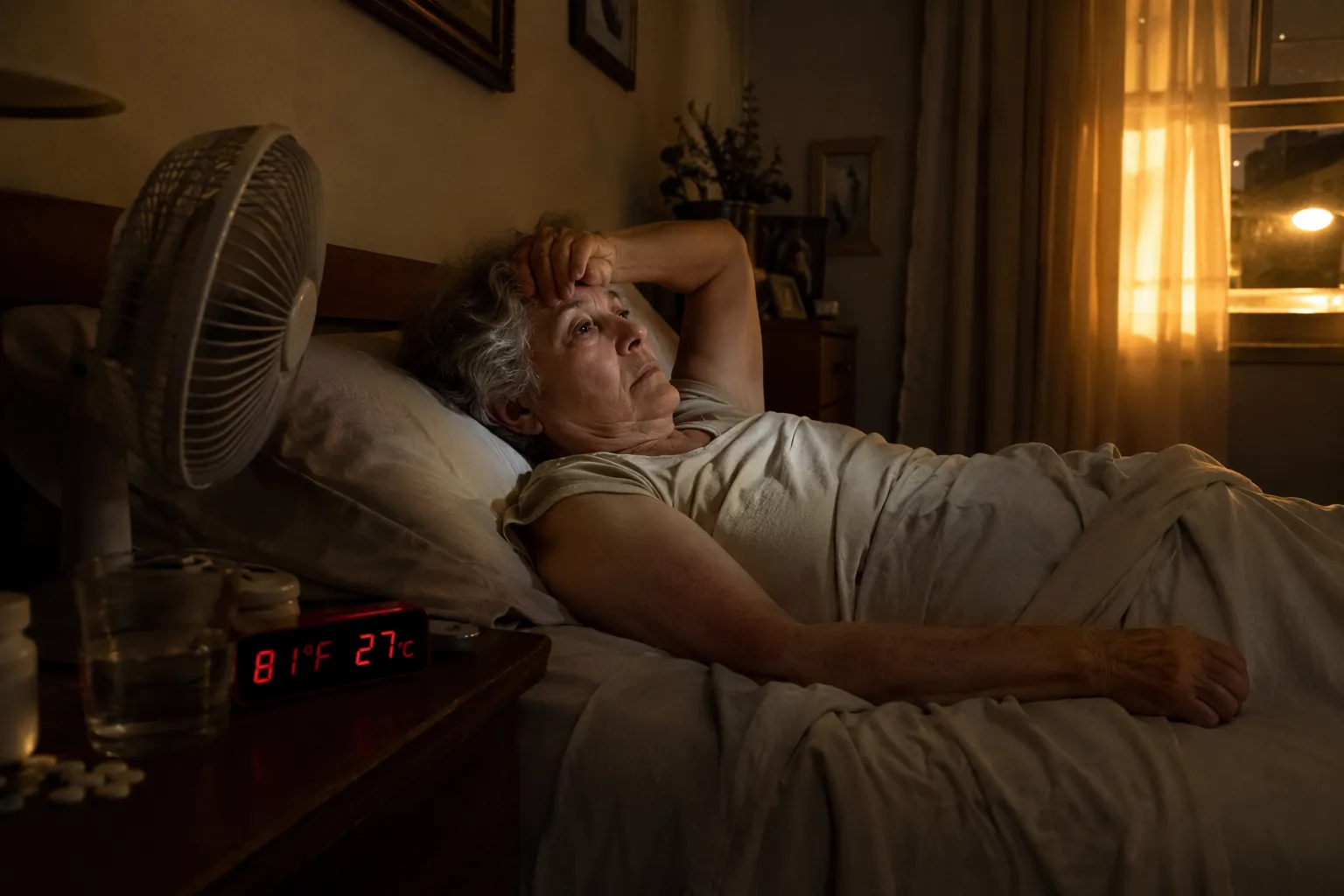
When an older parent sleeps badly during a heat wave, the next-day concern is not only mood or fatigue. The more practical question is what happens when that parent wakes groggy, stands up too fast, walks through a dark hallway, and reaches the bathroom before their balance has caught up.
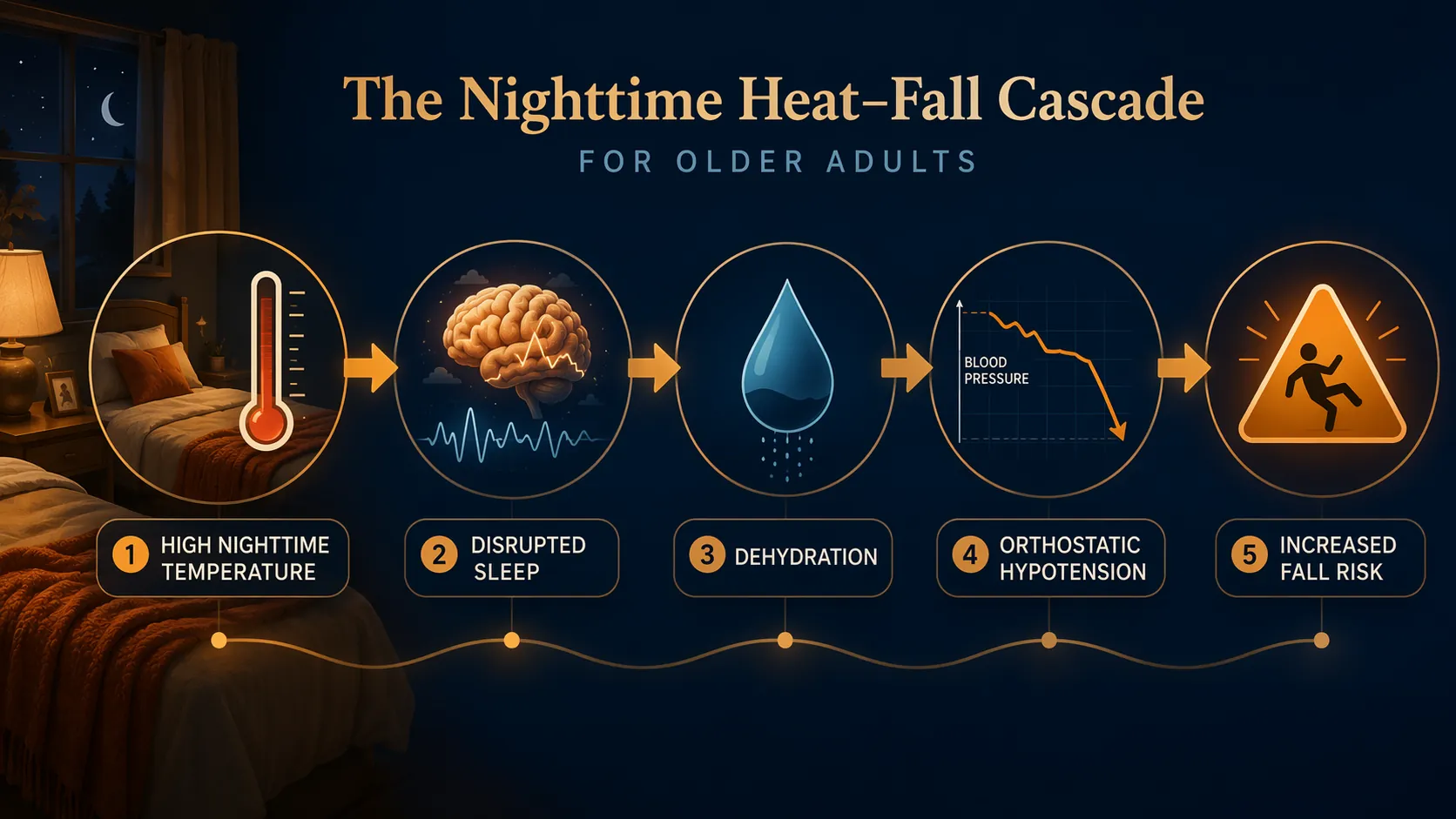
That is the overlooked answer to how heat waves disrupt sleep in older adults: a hot bedroom can interfere with the body’s normal cooling process for sleep, fragment the deeper parts of the night, speed dehydration, and make a morning blood-pressure drop more likely. None of this means one warm night automatically causes a fall. It means a hot night can add weight to a chain that is already familiar in many homes: poor sleep, dizziness, a rushed bathroom trip, and a near-miss that gets brushed off until it happens again.
The hot-night chain starts before the first bathroom trip
Sleep depends on a temperature shift. As bedtime approaches, the body normally releases heat and lets core temperature fall. A warm bedroom makes that harder, especially when humidity, heavy bedding, closed windows, or a cautious thermostat setting trap heat around the body.
Large sleep-temperature data put numbers behind what caregivers often notice. Liao et al. analyzed 14,232 participants and more than 12 million sleep nights, finding that each 10°C increase in nighttime temperature was associated with 2.6 minutes less total sleep time and a 1.7-minute delay in sleep onset. The same research reported that nighttime temperatures above 77°F, or 25°C, suppress the core-temperature drop needed for sleep onset [1].
A few minutes may sound small if you are thinking about one night. It matters more when the pattern repeats across a heat wave, when the person is already waking for pain, urination, anxiety, caregiving duties, or medication timing. The bedroom temperature range often cited for older adults is roughly 68–77°F, or 20–25°C, with sleep quality declining above that range; that range comes through a GAVI article citing a Science of the Total Environment study, so it is useful as a practical target rather than a hard medical boundary [2].
The important part is not whether the room is exactly one degree above or below a target. It is whether the room lets the body cool enough for sleep to start and stay organized. When it does not, sleep can become lighter and more broken. Deep sleep and REM sleep are not decorative stages; they are part of how the brain restores alertness, coordination, and reaction time for the next day.
Bad sleep becomes a balance problem
The bridge from sleep to falls is not just common sense, though common sense helps. A nationwide South Korean study of 201,700 participants found that poor sleep quality was associated with 30% higher fall odds, independent of other risk factors, and short sleep duration was associated with 14% higher fall odds [3]. The population matters; this was not a U.S. caregiver sample, and the finding should not be stretched into a prediction for every individual older adult. Still, it is a strong reminder that sleep quality belongs in the fall-risk conversation, not off to the side as a wellness complaint.
The home version is easy to miss because it looks ordinary. A parent says they were up half the night. They skip breakfast because they feel off. They stand from a recliner, pause at the kitchen counter, and say they are “just a little lightheaded.” If the family treats the hot bedroom as only a comfort issue, the next step in the chain may be handled too late.
Heat also works through fluid loss. The CDC identifies adults aged 65 and older as more vulnerable to heat-related illness, in part because bodies do not adjust to sudden temperature changes as efficiently with age and because chronic conditions and medications can interfere with heat regulation [4]. Harvard Medicine has also described why heat is harder on older adults: aging changes thirst, circulation, kidney function, and the ability to compensate under thermal stress [5].
A useful caregiver detail is that older adults may have 10–15% less total body water and a dulled thirst mechanism, so they can become dehydrated without feeling especially thirsty [6]. Dehydration can contribute to orthostatic hypotension, the blood-pressure drop that happens when someone stands up. That is the moment when a poor night’s sleep can turn into a fall trigger: the person rises, blood pressure lags, vision dims or the room tilts, and the nearest support is a towel bar, door frame, or nothing at all.
Walk the house in the order the risk happens
Broad heat guidance still matters. For the wider seasonal picture, including heat advisories and daytime fall risk, see why heat advisories raise fall risk in older adults. But if tonight’s problem is sleep, the home check should begin where sleep begins: the bedroom.
| Where to look | What to change before bedtime | Why it matters |
|---|---|---|
| Bedroom | Lower the room temperature if possible, lighten bedding, improve air movement, and check the actual room temperature near the bed. | This addresses the blocked core-temperature drop at the start of the cascade. |
| Bathroom route | Add night lighting, clear the path, and make sure the support points are real grab bars rather than towel bars. | This protects the trip most likely to happen while the person is groggy or dizzy. |
| Hydration cues | Place visible, easy-to-open water options where the person already pauses: bedside, favorite chair, kitchen counter. | Hydration advice only works when water is reachable and remembered. |
| Medication review | Ask a clinician or pharmacist whether heat, timing, or fluid balance changes affect current medicines. | Some medicines can compound heat vulnerability and standing dizziness. |
Start with the bedroom, not the lecture
The most useful first check is the actual sleeping temperature, not the thermostat setting in the hallway. A small digital thermometer near the bed can show whether the sleep zone is staying above the comfort range even when the rest of the home feels acceptable.
- If air conditioning is available, prioritize the bedroom for the hottest part of the night rather than cooling unused rooms evenly.
- If using a fan, make sure it improves air movement across the room; a fan alone does not solve dangerous indoor heat when the room stays very hot.
- Replace heavy blankets with lighter layers that can be adjusted without getting out of bed.
- Move heat-trapping items away from the bed area, including thick robes, extra pillows, and bedding that makes it hard to cool down.
- Check whether the window covering blocks afternoon heat before the room absorbs it, especially in west-facing bedrooms.
This is not about forcing a parent to accept a freezing room. It is about giving the body a fair chance to cool enough for sleep. If your parent resists air conditioning because of cost, noise, dryness, or habit, the conversation usually goes better when it is tied to a concrete next-morning goal: fewer dizzy starts, fewer rushed steps, and less need to “push through” fatigue.
Treat the bathroom route as part of the sleep setup
Nighttime bathroom trips are where several small risks meet. The person is half-awake. The hallway is darker than expected. Feet may be swollen or sweaty. Glasses may be on the nightstand. If dehydration or orthostatic hypotension is also in the picture, the first standing steps deserve more respect than they usually get.
- Put a motion-sensor night light between the bed and bathroom, not only inside the bathroom.
- Clear shoes, laundry baskets, cords, pet bowls, and loose rugs from the route before bedtime.
- Install grab bars where a hand naturally reaches near the toilet and shower; do not count on towel bars for body weight.
- Keep glasses, a cane, walker, or slippers in the same reachable place every night.
- Encourage a sit-pause-stand routine: sit on the edge of the bed first, stand, pause again, then walk.
That last pause can feel annoyingly simple, which is why the environment has to help. A chair arm, bed rail, stable nightstand, or properly placed grab bar does more than a reminder shouted from another room.
Make water visible where decisions actually happen
“Drink more water” is too vague for a hot night. It does not say where the water is, whether the bottle opens easily with arthritic hands, whether the person avoids drinking because they fear more bathroom trips, or whether they are limiting fluids because of a medical condition.
A better setup uses visual cues. Put a small glass or bottle at the bedside if it is safe for that person. Keep another at the chair where they watch television before bed. Use a container that is light enough to lift and familiar enough that it does not feel like medical equipment. If fluid restriction, heart failure, kidney disease, or swallowing difficulty is part of the picture, hydration plans need clinician guidance rather than family improvisation.
The same dehydration-dizziness-fall pattern can show up in other summer problems, including gastrointestinal illness; for a parallel example, see the CareWise piece on Cyclospora outbreak fall risk in older adults. The cause differs, but the practical question is similar: is the person losing fluid, standing up dizzy, and moving through a home that assumes they are steady?
Review medications, but do not adjust them on your own
Medication is the part of the house walk that should leave the house, at least by phone. Diuretics, beta-blockers, and anticholinergics may reduce the body’s ability to sweat or regulate temperature, which can worsen heat vulnerability at night [7]. Those categories are common enough that guessing is not good enough.
Ask the prescriber or pharmacist specific heat-wave questions: Should any dose timing be reviewed during prolonged heat? Are dizziness, dry mouth, reduced sweating, or nighttime confusion side effects to watch for? Are there fluid recommendations or restrictions that should be followed more carefully during hot weather? The answer may be “no change,” but that answer should come from someone who can see the medication list and the medical history.
What to monitor over the next few hot days
A single restless night is common. A pattern deserves attention. During a heat wave, watch for the combination that changes the safety picture: worse sleep, more daytime drowsiness, new unsteadiness, reduced drinking, darker urine, dizziness when standing, confusion, or a near-fall that gets minimized as clumsiness.
- Call a clinician promptly if dizziness, fainting, confusion, chest symptoms, severe weakness, or signs of heat illness appear.
- Treat repeated near-falls as useful warnings, not embarrassing stories to laugh off.
- Write down the bedroom temperature, sleep complaints, fluid intake concerns, and dizzy episodes before calling the clinician.
- If the home also has storm, outage, or recovery hazards, use broader seasonal fall-prevention planning such as the CareWise tropical storm checklist or flood recovery fall-risk guide.
This fits naturally with a CDC STEADI-style prevention mindset: falls are usually not caused by one thing, and prevention works best when medication, vision, balance, footwear, home hazards, and health changes are looked at together. Sleep should be in that same group during summer heat. A hot bedroom is not just uncomfortable; it is one modifiable condition that can make the next morning less safe.
References
- Impact of heat exposure on sleep health and its population vulnerability in the United States, ScienceDirect.
- Heat waves can be deadly for older adults: An aging global population and rising temperatures mean millions are at risk, GAVI.
- Association Between Sleep Quality and Falls, PMC, 2021.
- Heat and Older Adults Aged 65+, CDC.
- The effects of heat on older adults, Harvard Medicine Magazine.
- The Summer Fall Risk No One Talks About: Senior Dehydration and Balance, Personal Living Alert, 2026.
- How Heat and Humidity Can Impact Senior Safety at Home, Oakley Home Access.
Related reading
Noticed something outdated or inaccurate on this page? Flag a correction. We review every report against CDC, NIA, and AARP HomeFit guidance before updating a page.
Part of the Fall Prevention section.