
Is It Cyclospora? Recognizing Infection in Seniors
Learn how to recognize Cyclospora infection in seniors during the 2026 outbreak, why the explosive diarrhea can rapidly lead to dehydration and falls, and when to call a doctor or 911.
An older adult with sudden watery diarrhea is not just dealing with a bathroom problem. During the 2026 Cyclospora outbreak, the immediate danger can be the short trip from bed or chair to toilet: standing quickly, getting lightheaded, reaching for a towel rack instead of a grab bar, or leaving the walker outside the bathroom because the urge came too fast.
That is why cyclospora infection symptoms in seniors deserve a different kind of attention than routine “stomach bug” advice. The infection can cause explosive watery diarrhea, often after a delay of about a week, and symptoms may fade and return rather than ending neatly after a day or two. In an older adult, that pattern can drain fluid reserves, worsen dizziness, and turn a normally careful person into a fall risk before anyone has named the illness.
The question is live in Q3 2026 because case counts are unusually high and still changing. As of July 21, CNN reported roughly 11,500 confirmed and pending U.S. cases across 41 states, with Michigan reporting 7,171 cases; the outbreak has been linked to shredded iceberg lettuce from Taylor Farms de Mexico served at Taco Bell, though public reporting also notes that important supply-chain questions remain unsettled.[1] A CDC health advisory dated July 14 listed 1,645 confirmed domestically acquired cases, 141 hospitalizations, and patient ages ranging from 2 to 95.[2]
The Clue Is Often the Timing
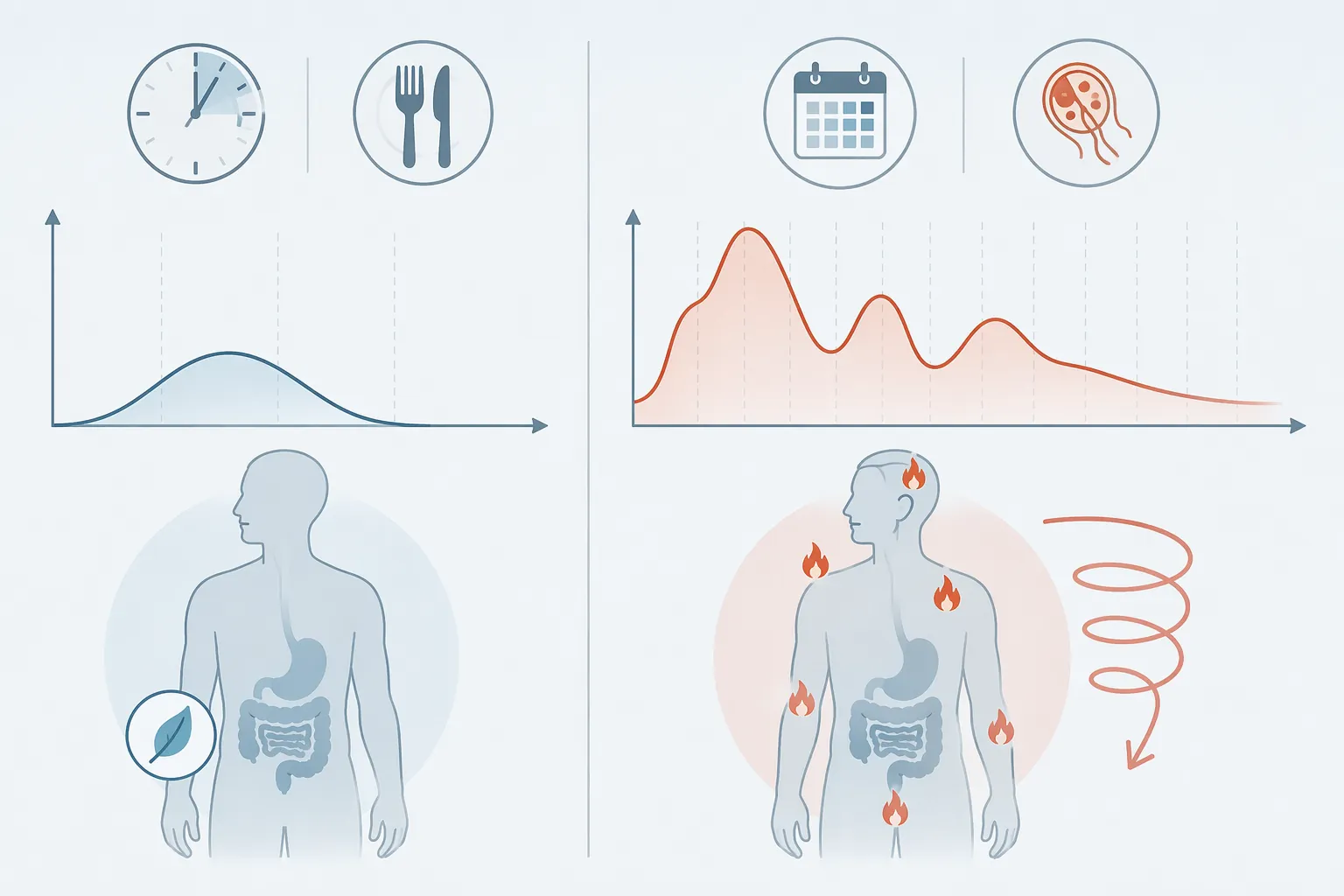
Many people expect foodborne illness to announce itself within hours of a meal. Cyclospora often does not. The CDC describes an incubation period of about one week, with a range of 1 to 14 days, and Johns Hopkins notes that this longer delay makes it harder for people to connect symptoms with a specific food exposure.[3][4]
That delay matters at home. If a senior ate suspect lettuce last night and has diarrhea this morning, Cyclospora is not the only possibility. If the diarrhea starts several days later, especially during a known outbreak window, it belongs on the call list when speaking with a clinician.
| Feature | More typical short food poisoning pattern | Cyclospora pattern to mention to a clinician |
|---|---|---|
| Timing after exposure | Often hours to a couple of days | About 1 week on average; range 1 to 14 days |
| Diarrhea | May be brief | Watery diarrhea, often described as explosive |
| Course | Often improves steadily | Can wax and wane |
| Duration | Often short | Can last days to more than a month if untreated |
What Cyclospora Can Look Like in an Older Adult
The main symptom is watery diarrhea. The CDC’s clinical overview describes the diarrhea as often “explosive,” and it may be accompanied by loss of appetite, weight loss, stomach cramps or pain, bloating, increased gas, nausea, fatigue, and low-grade fever.[3] AARP’s coverage for older adults highlights the same concern: the illness can be prolonged, and diarrhea may come and go rather than behaving like a one-day stomach upset.[5]
For caregivers, the useful history is not only “Does she have diarrhea?” It is the pattern: when it started, how many times she has gone, whether it is watery, whether there is urgency, whether she is eating less, whether she is losing weight, and whether yesterday seemed better before today became worse again.
The waxing-and-waning course can fool families into waiting too long. A senior may have a quieter afternoon, refuse a drink because the stomach feels unsettled, skip a meal, and then spend the night making urgent bathroom trips. By morning, the infection has become a mobility problem as much as a digestive one.
- Ask about timing: symptoms beginning roughly a week after a possible exposure fit Cyclospora better than an illness that starts within a few hours.
- Describe the stool plainly: watery and explosive is more useful than “upset stomach.”
- Track the day, not just the diagnosis: number of diarrhea episodes, fluid intake, urination, dizziness, and whether the person can safely get to the bathroom.
- Do not let a brief improvement erase concern if symptoms return, appetite drops, or weakness increases.
Why “I’m Not Thirsty” Is Not Reassuring
Older adults have less margin for fluid loss. AARP notes that total body water falls to about 40% to 45% in older adults, compared with about 70% at birth, and aging kidneys are less able to conserve water efficiently.[5] Thirst is also a poor alarm system in later life; older adults can be dehydrated without feeling especially thirsty.
A Mayo Clinic Proceedings study of 30,634 adults age 65 and older found that 37.9% were dehydrated at baseline. Dehydration was associated with 13% higher odds of falling after adjustment for comorbidities and medications, a modest but meaningful association in a population where one fall can change everything.[6]
With Cyclospora, the mechanism is not mysterious: explosive watery diarrhea drains fluid and electrolytes; blood volume can drop; blood pressure may fall when the person stands; dizziness and leg weakness follow; then the person tries to hurry to the bathroom. The walker is by the recliner. The bathroom floor is damp. The towel bar is not designed to hold body weight.
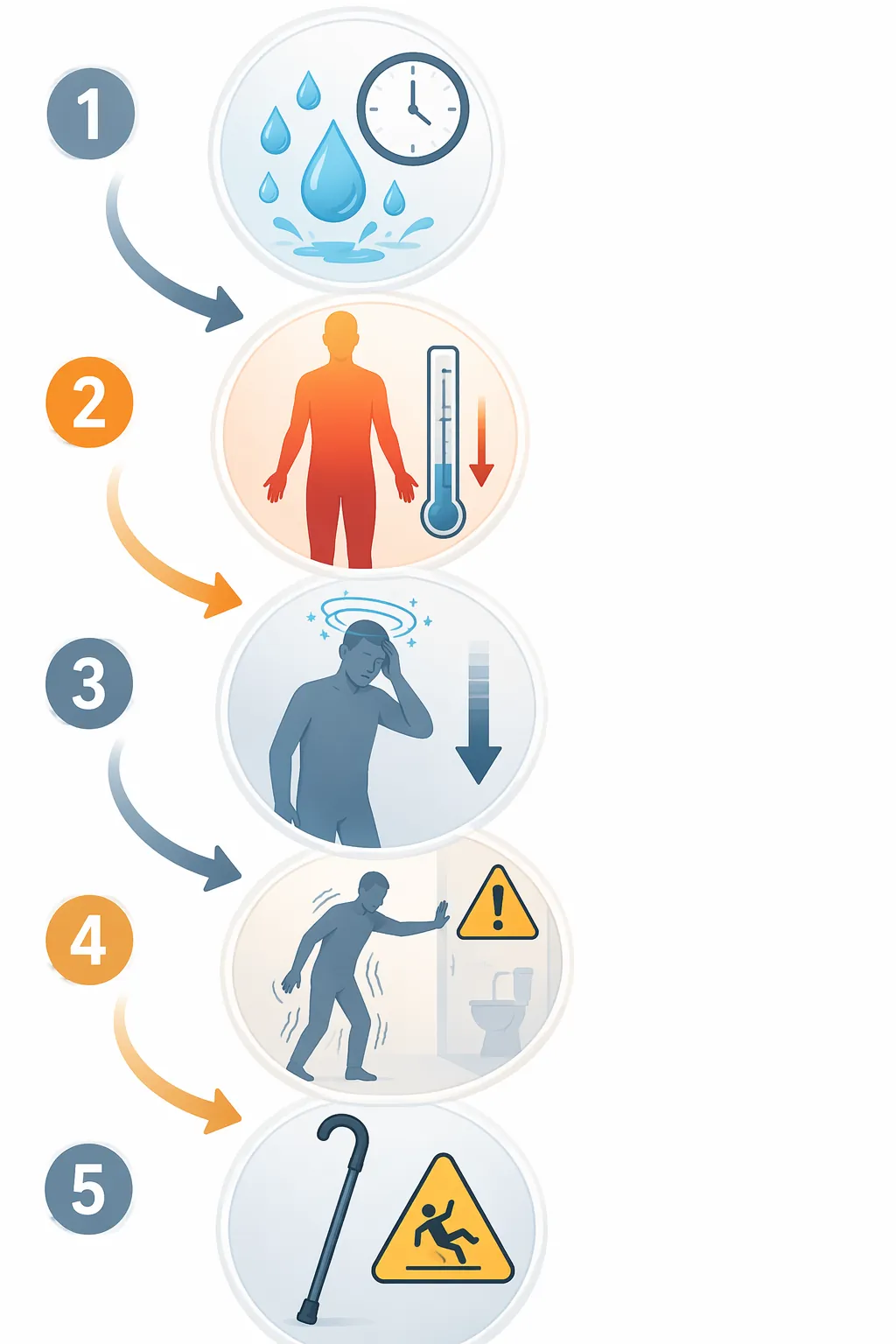
Public health advisories have been unusually direct about this risk. Alabama Public Health warned in July 2026 that, for older adults with underlying medical conditions, dehydration can lead to weakness, dizziness, falls, acute kidney injury, and worsening chronic conditions.[7] AARP quoted Dr. Luis Marcos of Stony Brook Medicine listing complications that include “electrolyte problems, acute kidney injury, weakness, dizziness, falls and worsening of chronic conditions.”[5]
The Medications on the Counter Matter
Diarrhea does not happen in isolation from the pill organizer. Diuretics, blood pressure medicines, and other chronic medications can make dehydration and standing dizziness more consequential. A person who is normally steady on a familiar medication routine may become unsteady when fluid intake drops and diarrhea continues.
Treatment adds another reason to call rather than improvise. The standard treatment for Cyclospora is trimethoprim-sulfamethoxazole, often called TMP-SMX or Bactrim, typically given for 7 to 10 days.[8] In older adults, that prescription should come with a medication review, because TMP-SMX can raise potassium risk with ACE inhibitors, ARBs, or spironolactone; increase digoxin levels; and potentiate warfarin, raising INR and bleeding risk.[8][9]
This is not a reason to avoid treatment when Cyclospora is suspected or confirmed. It is a reason to make sure the clinician knows the full medication list, including diuretics, blood pressure drugs, heart medications, anticoagulants, and supplements. The safety plan is not only “kill the parasite.” It is also “keep this person upright, hydrated, and monitored while the illness and treatment run their course.”
Testing May Need to Be Requested Specifically
A routine stool test may not be enough. The CDC says Cyclospora can be difficult to detect and that health care providers may need to specifically request testing for it, including modified acid-fast staining or molecular methods such as PCR.[3] Johns Hopkins gives similar guidance, noting that the parasite is not always found unless the lab is looking for it.[4]
For a caregiver, the practical step is simple: when calling the doctor, say the word Cyclospora if the symptoms fit, especially if there was possible exposure during the outbreak. Mention the longer delay, watery explosive diarrhea, waxing-and-waning pattern, appetite loss, weight change, dizziness, and any recent urgent bathroom trips or near-falls.
What to Watch Over the Next Several Hours
The most useful home observations are the ones that show whether the body is keeping up. Count diarrhea episodes. Notice whether the older adult is urinating less. Watch the first few steps after standing. Look for a dry mouth, new confusion, racing pulse, faintness, or a sudden need to hold furniture while walking.
Temporary fall precautions should start early, not after the first fall. Keep the walker within arm’s reach before the next bathroom trip. Clear the route. Turn on lights. Put a commode near the bed if the walk is long. Have the person sit at the edge of the bed before standing. Replace the loose bathmat with a safer surface. If a spouse is embarrassed to talk about diarrhea, talk about safety instead: “I need to know how often you’re going so we can keep you from falling.”
Fluids matter, but “drink more” is not a complete plan for a senior with repeated watery diarrhea. Some older adults have heart failure, kidney disease, fluid restrictions, or medications that complicate hydration advice. Oral rehydration may be appropriate for many people, but persistent diarrhea, dizziness, very low urine output, or inability to keep fluids down needs medical input rather than a larger glass on the nightstand.
When to Call the Doctor or 911
AARP, citing Cleveland Clinic family physician Dr. Cory Fisher, advises emergency care for severe warning signs such as confusion, fainting, very little urination, racing heartbeat, blood in the stool, or being unable to keep fluids down.[5] Those are not “wait until morning” signs in an older adult with ongoing diarrhea.
- Call 911 for confusion, fainting, very little urination, racing heartbeat, blood in the stool, inability to keep fluids down, or a fall with injury or new inability to stand safely.
- Call a doctor promptly for frequent diarrhea, diarrhea lasting more than 2 to 3 days without improvement, dizziness, dry mouth, worsening weakness, weight loss, or symptoms that improve and then return.
- Ask about Cyclospora testing if the timing, watery explosive diarrhea, outbreak exposure, or waxing-and-waning course fits.
- Review medications before and during treatment, especially blood pressure drugs, diuretics, ACE inhibitors, ARBs, spironolactone, digoxin, and warfarin.
Cyclospora belongs in the fall-prevention conversation because the dangerous moment may not be the diagnosis itself. It may be the third urgent bathroom trip after too little fluid, too much weakness, and one fast stand from a chair.
References
- CNN outbreak tracking, CNN, July 21, 2026.
- CDC HAN-00531, Centers for Disease Control and Prevention, July 14, 2026.
- Clinical Overview of Cyclosporiasis, Centers for Disease Control and Prevention.
- Cyclosporiasis Outbreak, Johns Hopkins Medicine.
- What Older Adults Should Know About Cyclospora, AARP.
- Association of Dehydration and Falls, Mayo Clinic Proceedings, 2020.
- Cyclosporiasis, Alabama Public Health, July 2026.
- Cyclospora in Older Adults, Health Pals.
- Bactrim side effects in elderly, SingleCare.
Related reading
Noticed something outdated or inaccurate on this page? Flag a correction. We review every report against CDC, NIA, and AARP HomeFit guidance before updating a page.
Part of the Fall Prevention section.