
STEADI: Intervene
How to treat cyclospora in older adults at home
A caregiver's step-by-step guide to cyclospora treatment and recovery for an older adult at home: the 7–10 day antibiotic course, a measurable hydration plan, when to call the doctor versus go to the ER, and a temporary fall-protection routine while weakness and dizziness last.
Cyclospora treatment for older adults is usually straightforward once the diagnosis is confirmed, but the home danger is usually dehydration first: weakness, dizziness, electrolyte trouble, and falls. This guide is educational, not medical advice, and should be used with the clinician's instructions. Reviewed for clinical accuracy by Denise Alvarez, RN.

Start with the diagnosis and the right antibiotic
The first practical step is not guessing at the cause of the diarrhea; it is making sure Cyclospora-specific testing is actually on the order. Routine stool tests can miss Cyclospora, and the clinician may need to request it on more than one sample [2]. That matters because untreated illness can last from a few days to a month or longer, and symptoms can relapse after they start to improve [1].

The CDC treatment of choice is trimethoprim-sulfamethoxazole (TMP-SMX): one double-strength tablet, 160 mg/800 mg, twice daily for 7 to 10 days, prescribed by a clinician [1]. The same CDC guidance notes that metronidazole, azithromycin, and doxycycline have been ineffective, and that there is no highly effective alternative for people who cannot take sulfa drugs, so substitutions and dose changes belong with the treating clinician [1].
Check the medicine list before the first dose
TMP-SMX is common, but it is not a pill to hand out casually in an older adult. The Mayo Clinic notes that elderly patients are more likely to have folate deficiency and age-related kidney or liver problems, which can make side effects more likely, including severe rash, increased potassium, and blood-clotting or immune problems [3].
- ACE inhibitor or ARB: a 2011 review found about a 7-fold higher risk of hospitalization for hyperkalemia when TMP-SMX was combined with these drugs [4].
- Sulfonylurea: the same review found about a 4- to 6-fold higher risk of hospitalization for hypoglycemia [4].
- Warfarin: the same review found about a 2- to 3-fold higher risk of gastrointestinal hemorrhage [4].
- New gait trouble, delirium, or a rash: the review also described rare gait disturbances and delirium in elderly patients [4].
Make hydration measurable
This is the part caregivers can actually control at home. Write down the number of bowel movements, how much the person drinks, how often they urinate, and whether dry mouth, dizziness on standing, confusion, or a fast heartbeat show up [2][5]. A Stanford Medicine expert noted that some patients have lost as much as 10% of body weight from the diarrhea, which is a good reminder that the illness can drain an older adult quickly [9].

The thresholds below come from named expert guidance, not universal rules, but they are useful when a caregiver needs a line to act on [2][5].
| What you see | What to do |
|---|---|
| More than 6–8 bowel movements per day, or symptoms lasting 2–3 days without improvement | Call the clinician today; this is the AARP-cited threshold and should be used as a prompt, not as a universal rule [2]. |
| Dizziness, confusion, decreased urination, dry mouth, or rapid heartbeat after 1–2 days | Call sooner rather than later [2]. |
| Severe diarrhea plus dizziness when standing or a heart rate that speeds up | Go to urgent or hospital care [5]. |
If the person is too weak to make the bathroom trip safely, treat that as a fall-risk problem at the same time as a dehydration problem.
Keep falls out of the recovery
The fall risk is simple: dehydration leads to weakness, dizziness, and falls [2]. So the home routine has to change while the diarrhea is active. Put the walker or cane within reach of the bed and bathroom, clear the path, leave a night light on, and keep the floor free of clutter. Have the older adult sit on the edge of the bed before standing, pause before the first step, and keep one-hand support available during transfers.
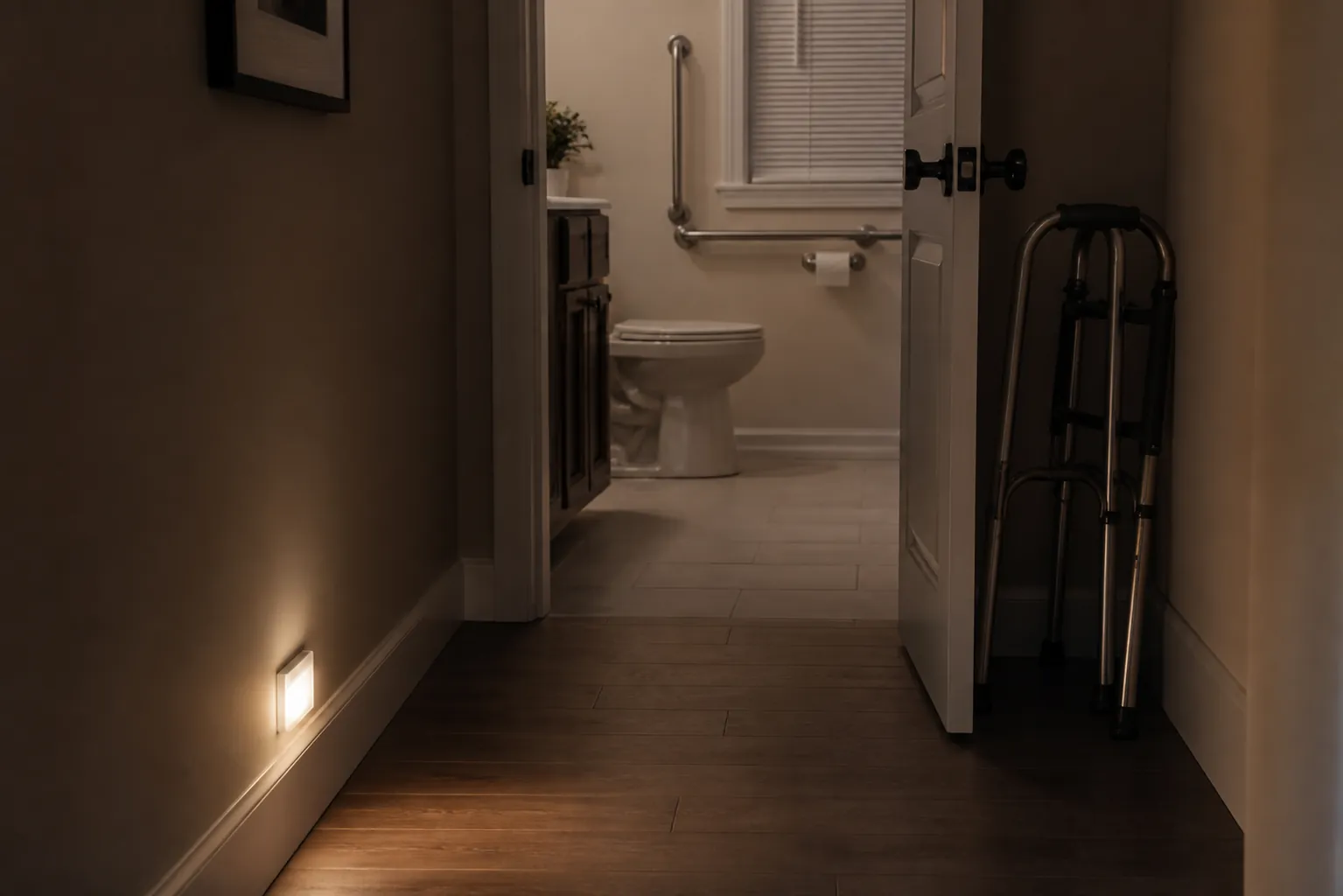
- Keep the walker, cane, or other mobility aid within arm's reach, not across the room.
- Turn on night lighting before the first bathroom trip, not after the person is already unsteady.
- Have the older adult sit first, then stand slowly, then wait a moment before walking.
- Do not rush the bathroom trip; speed is the enemy when dizziness is part of the illness.
- Stay close during transfers until standing feels steady again.
Why the diagnosis still matters in 2026
The current U.S. outbreak is why many families are looking this up now. As of Aug. 18, 2026, CDC reported 15,716 laboratory-confirmed U.S.-acquired cases since May 1, plus 11,841 additional cases under investigation, 828 hospitalizations, and 2 deaths across 47 states, the District of Columbia, and Puerto Rico [6][7]. The outbreak was still under investigation, and CDC linked cases to iceberg lettuce from central Mexico and a July 17, 2026 recall of Taylor Farms de Mexico products [6][7].
That outbreak context explains why families may be hearing about Cyclospora now, not the home-care plan. For older adults, FDA notes that illness may be more severe or complicated by dehydration [8]. And for kitchen prevention later, washing alone cannot guarantee Cyclospora removal; the safer option for foods that can be cooked is heating them thoroughly [8].
References
- Clinical Care of Cyclosporiasis — CDC
- What Older Adults Should Know About Cyclospora — AARP
- Sulfamethoxazole and trimethoprim (oral route) — Mayo Clinic
- Considerations when prescribing trimethoprim–sulfamethoxazole — CMAJ (2011)
- Cyclosporiasis outbreak — Johns Hopkins Medicine
- HAN Archive - 00531 — CDC — Aug. 18, 2026
- Cyclosporiasis Outbreaks in the United States — CDC
- Cyclospora — FDA
- Cyclosporiasis diarrheal outbreak: what experts say — Stanford Medicine
Related reading
Noticed something outdated or inaccurate on this page? Flag a correction. We review every report against CDC, NIA, and AARP HomeFit guidance before updating a page.
Part of the Fall Prevention section.