
STEADI: Assess
Is Dallas or Vancouver Better for Retirees?
Choosing between Dallas and Vancouver as a retirement city comes down to the retiree's fall risk, budget, and healthcare needs rather than one clear-cut winner. This side-by-side scorecard compares seasonal fall risk, housing cost, walkability, transit, and Medicare versus MSP coverage so retirees and adult children can weigh the trade-offs against their own situation.
First, specify which Vancouver. This comparison is Dallas, Texas versus Vancouver, British Columbia — not Vancouver, Washington, which often gets mixed into search results. And the useful answer to “which city is better to live for retirees Dallas vs Vancouver” is not a skyline answer. It is a body-and-budget answer: which place creates fewer daily fall hazards, fewer transportation workarounds, and fewer healthcare coverage gaps for this particular retiree?
For many retirees, Dallas is the safer default if lower housing cost, less wet-hill winter footing, and immediate Medicare-based healthcare access at 65 are the main concerns. Vancouver, BC becomes the stronger choice for retirees who can afford it, can manage rain and slopes, value walkability and transit enough to use them often, and have a clear plan for provincial health coverage eligibility.
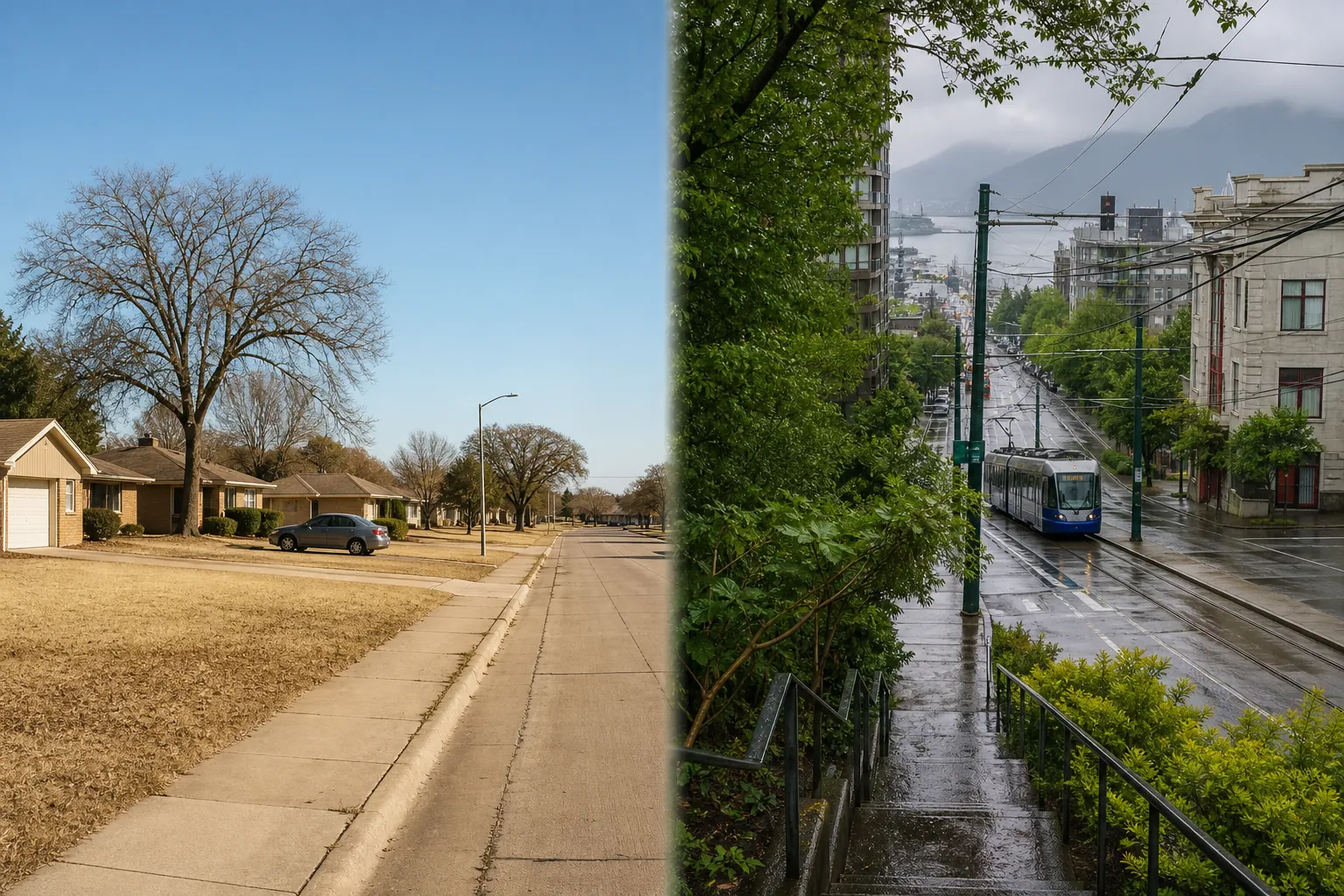
Dallas vs Vancouver retirement scorecard
| Retirement factor | Dallas, Texas | Vancouver, British Columbia | Practical read |
|---|---|---|---|
| Seasonal fall risk and climate | Generally stronger for retirees who are more worried about wet or icy footing than heat, though summer heat still changes errands, hydration, and outdoor walking. | Mild summers help, but wet winters, hills, stairs, leaves, and slick curb cuts can make everyday walking more demanding. | Dallas has the simpler footing profile for many older adults; Vancouver is better only if the retiree can safely manage wet and sloped routes. |
| Housing cost and safe layouts | Generally better budget fit, with more room to shop for a safer layout, parking, services, or care support. | Higher cost pressure can reduce choices, especially for retirees who need an elevator building, transit access, or a location near clinics and shops. | Cheaper housing only matters if it buys safety: fewer stairs, better bathroom access, reliable transportation, and room in the budget for help. |
| Walkability and transit | Weaker overall for retirees who do not drive or should soon stop driving; daily life may require family rides, paratransit planning, delivery, or paid help. | Strong advantage for retirees who can use sidewalks, buses, rail, and neighborhood services despite rain and grade changes. | Vancouver wins on urban form, but the route still has to be tested in bad weather, not just admired on a map. |
| Healthcare access | Medicare eligibility at 65 gives many U.S. retirees a familiar coverage path if providers and plans are chosen carefully. | MSP is not simply available to every newcomer on arrival; eligibility and the waiting period must be planned before the move. | A healthcare gap can make an otherwise attractive move unsafe, especially for someone with chronic conditions or fall history. |
| Overall budget fit | Often better for retirees trying to control housing and service costs. | Better for retirees with enough income or assets to absorb higher housing pressure and still live near transit, groceries, and care. | The safer city is the one where the retiree can afford the safe version of daily life, not just the rent. |
Start with the route from bed to bathroom, not the view
Falls are not a side issue in a retirement move. The CDC reports that more than 1 in 4 adults age 65 and older falls each year. Falls also lead to about 3 million emergency department visits and about 1 million fall-related hospitalizations annually among older adults in the United States.[1] Those numbers are broad, but the lesson is plain enough: a city comparison that ignores footing, stairs, weather, and recovery access is not really comparing retirement safety.
The first inspection should be ordinary and slightly boring. Can the retiree get from the bed to the bathroom at night? From the apartment door to the elevator? From the front entrance to the curb without crossing a broken apron, a steep driveway, or a slick tile lobby? After that, widen the circle: pharmacy, groceries, primary care, transit stop, mailbox, trash room, parking space.
That is where Dallas and Vancouver separate. Dallas may be less charming on foot in many neighborhoods, but flatter, drier daily surfaces can be easier for an older adult with balance trouble. Vancouver’s walkable neighborhoods are a real asset, but a walkable route on a dry afternoon is not the same as a safe route in a wet winter, on a slope, with leaves at the curb and a cane tip landing near a puddle.

Why mild weather does not automatically mean lower fall risk
Vancouver’s mild summers are a genuine point in its favor. Heat can shrink a retiree’s day: errands get pushed to early morning, bus stops feel harder, dehydration becomes easier, and a long walk across exposed pavement may stop being realistic. For someone who wants to keep walking to shops and appointments, avoiding punishing summer heat has value.
But “mild” is not the same as “easy underfoot.” Wet pavement, hills, outdoor stairs, slick curb cuts, and low winter light are a different kind of hazard. Vancouver’s strength — dense, walkable urban fabric — can become a test of ankles, vision, reaction time, and confidence when the same route is wet. A retiree with neuropathy, prior falls, vertigo, slow gait, poor vision, or a new hip should not evaluate Vancouver by neighborhood score alone.
Dallas has its own climate problem, but it is a different one. Heat can discourage walking and increase dependence on cars, delivery, or rides. That matters. A retiree who stops walking because July errands feel punishing may lose conditioning, and a weaker body is not safer indoors. Still, for many older adults with balance concerns, avoiding frequent wet, sloped outdoor walking is a meaningful advantage.
The practical test is not “Which city has nicer weather?” It is: in the worst regular season, can this person still do the weekly essentials without rushing, carrying too much, crossing unsafe surfaces, or waiting outside too long?
Healthcare access can make the move safe now — or not yet
For U.S. retirees, Dallas has a major administrative advantage: Medicare generally begins at age 65 for eligible people, and many retirement plans are built around that age line.[2] That does not mean care is effortless. A retiree still has to compare plan networks, drug coverage, specialists, hospital access, and out-of-pocket costs. But the basic pathway is familiar, immediate for many at 65, and not dependent on becoming a new permanent resident of another country.
Vancouver is different because moving to British Columbia is not the same as moving across a state line. British Columbia’s Medical Services Plan is tied to eligibility rules for B.C. residents, and newcomers should expect a waiting period before coverage begins.[3] For a healthy, well-insured retiree with a carefully planned immigration and coverage timeline, that may be manageable. For someone with diabetes complications, heart disease, recent surgery, a fall history, or expensive prescriptions, the gap is not a detail to clean up later.
This is also where adult children often become the unpaid system. They are the ones confirming whether a parent can keep a specialist, pay privately during a gap, refill medications, understand enrollment letters, or get seen after a fall. In Dallas, that work may still be heavy. In Vancouver, it can include cross-border eligibility, immigration status, temporary insurance, and timing the move so care does not break in the middle.
Before choosing Vancouver, a retiree should be able to answer three questions in writing: what legal status supports the move, when provincial coverage would actually begin, and what insurance pays for care before then. If those answers are vague, the safer answer may be to delay the move rather than hope the paperwork catches up.
Housing cost matters because safety costs money
Dallas’s housing-cost advantage is not just about having more money left over. It can change the kind of home a retiree can choose. A lower monthly housing burden may make it possible to choose a one-level layout, a bedroom near the bathroom, covered parking, wider halls, a walk-in shower, better lighting, or a location closer to family and medical care.
Vancouver’s cost pressure can push in the opposite direction. A retiree may love the idea of a walkable neighborhood, then discover that the affordable option is smaller, farther out, up a hill, in an older building, or not as close to the doctor and pharmacy as expected. Walkability is only useful if the retiree can afford to live near the things being walked to.
The right housing question is not “Can I afford the city?” It is more specific:
- Can I afford a unit with no essential stairs?
- Can I afford to be near groceries, pharmacy access, and routine care?
- Can I pay for transportation when I should not drive or should not walk in bad weather?
- Can I afford grab bars, shower changes, better lighting, medication delivery, or part-time help without cutting into food or prescriptions?
- If I fall, can I recover at home without the layout working against me?
A cheaper city can still be a poor aging-in-place choice if the only affordable home is isolated, stair-heavy, or dependent on unsafe driving. An expensive city can work if the retiree can buy proximity, elevator access, and reliable transit without hollowing out the care budget. Between Dallas and Vancouver, though, Dallas gives more retirees room to solve those practical problems before the budget is exhausted.
Vancouver’s walkability is real. So is the weather test.
Vancouver deserves credit for the thing many North American cities make difficult: living without a car, or at least driving less. For a retiree who sees well, walks steadily, can carry light groceries, and is comfortable with transit, that can preserve independence. The adult child is not automatically the ride to every appointment. The pharmacy and bus stop can be part of a normal routine rather than a family scheduling problem.
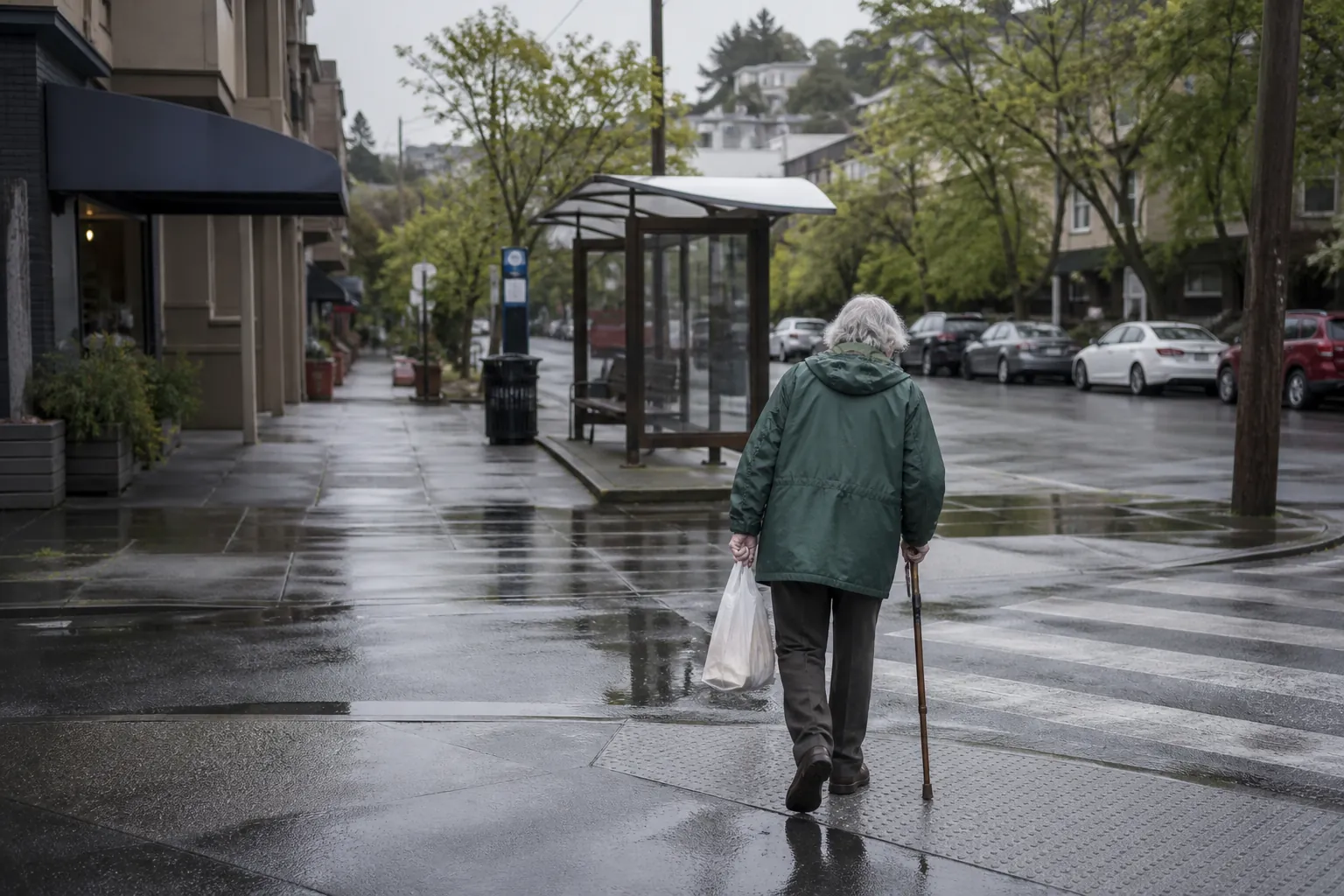
But the useful walkability audit has to be done slowly and in the conditions the retiree will actually face. Stand at the building entrance and look downhill. Notice whether the curb cut drains well. Count the stairs between the bus stop and the front door. Check whether the nearest grocery trip requires carrying bags uphill. Ask where the retiree waits when it rains. A transit-rich neighborhood still has to be usable by the person who will live there on a tired Tuesday.
Dallas is weaker for retirees who cannot drive and do not have dependable backup. A flat sidewalk beside a wide road is not enough if the grocery store is too far, crossings feel exposed, and transit does not line up with medical appointments. In that case, Dallas safety may depend on a plan: family availability, paratransit, rideshare comfort, delivery services, senior transportation programs, or a housing choice close enough to essential services.
This is one of the few places where a retiree’s preferences should carry heavy weight. Someone who becomes depressed or sedentary when driving is the only practical option may do better in Vancouver if their body can handle the terrain. Someone who feels unsafe on wet slopes may lose confidence there and leave the apartment less, even with transit nearby.
Who should lean Dallas
Dallas is generally the better retirement fit for someone who needs the safer answer to be available quickly and with fewer administrative unknowns. That includes many retirees who are already Medicare-eligible or approaching 65, who want a lower housing burden, and who are more worried about wet footing than summer heat.
- A retiree with prior falls, poor balance, neuropathy, low vision, or fear of slipping on wet slopes.
- A retiree whose budget needs room for home modifications, rides, delivery, or paid help.
- Someone who already has a U.S. healthcare plan path and does not want cross-border coverage timing to become part of the move.
- A person with family nearby in Dallas who can realistically help with appointments, emergencies, and paperwork.
- A retiree who can still drive safely, or who has a credible plan for the day driving stops.
The weak point is transportation. If Dallas means isolation once driving ends, its cost advantage starts to erode. The Dallas version of aging in place should be built around a specific neighborhood and service plan, not the broad idea that Texas is easier or cheaper.
Who should lean Vancouver
Vancouver is the stronger choice for a narrower group: retirees with enough money to live in the right location, enough mobility to use walkable streets and transit, and enough planning discipline to solve health coverage before arrival. For them, the city’s mild summers and car-light routines can support independence in a way Dallas may not.
- A retiree who walks steadily, uses handrails, and is not especially vulnerable on wet or sloped pavement.
- Someone who values transit and neighborhood services enough to use them routinely.
- A retiree who can afford housing near daily essentials rather than simply somewhere in the metro area.
- Someone with a written plan for MSP eligibility, the waiting period, temporary coverage, prescriptions, and ongoing care.
- A person whose adult children or support network understand the cross-border logistics and are not assuming Medicare follows them unchanged.
The caution is simple: Vancouver’s beauty and urban design do not cancel the ground conditions. A retiree who will avoid going out when it rains, or who will need someone else to carry groceries uphill, may not get the independence the city appears to offer.
A practical way to decide
Before choosing either city, pick the exact home or neighborhood and walk the real route. Do not compare downtown Vancouver with a vague idea of Dallas, or a comfortable Dallas suburb with a postcard version of Vancouver. Compare door to curb, curb to transit or car, home to pharmacy, home to clinic, home to groceries.
| Question | If the answer points to Dallas | If the answer points to Vancouver |
|---|---|---|
| What is the retiree’s biggest safety risk? | Falls on wet or sloped surfaces, tight budget, or healthcare timing uncertainty. | Loss of independence from car dependence, heat-limited walking, or lack of neighborhood access. |
| Can the retiree safely complete errands in the worst regular season? | Yes, with heat precautions, rides, delivery, or nearby services. | Yes, even in rain, on slopes, and while using transit or walking. |
| Is healthcare coverage clear on move-in day? | Usually clearer for Medicare-eligible U.S. retirees, though plan details still matter. | Only if immigration status, MSP eligibility, waiting-period coverage, and prescriptions are already solved. |
| Can the budget buy the safe version of the city? | More likely for many retirees because housing pressure is generally lower. | Possible for retirees with enough resources to live near transit, groceries, and care without unsafe compromises. |
Dallas is generally the safer default for retirees prioritizing lower housing cost, fewer wet-hill winter hazards, and immediate Medicare-based healthcare access at 65. Vancouver is the stronger choice for retirees who can afford it, can handle wet and hilly conditions, value walkability and transit highly, and have a clear plan for provincial health coverage eligibility. The better city is the one whose risks match the retiree’s body, budget, and coverage timeline.
References
- Facts About Falls | CDC, Centers for Disease Control and Prevention.
- Get started with Medicare, Medicare.gov.
- Medical Services Plan (MSP) for British Columbia (B.C.) Residents, Government of British Columbia.
Related reading
Noticed something outdated or inaccurate on this page? Flag a correction. We review every report against CDC, NIA, and AARP HomeFit guidance before updating a page.
Part of the Fall Prevention section.