
STEADI: assess
Why Salmonella Is More Dangerous for Older Adults
Adults 65 and older don't catch salmonella more often than younger people — they are hospitalized and die from it at far higher rates, so "just food poisoning" is an unsafe default. Age-related changes and everyday medications quietly raise those stakes, and acting early after symptoms is evidence-based, not alarmist.
Salmonella has a way of sounding familiar enough to underestimate. The CDC estimates that Salmonella causes about 1.35 million infections in the United States each year, identifies it as a leading cause of foodborne hospitalization and death, and notes that only about 1 in 30 infections is diagnosed and confirmed in a laboratory.[1][2] That last point matters: family stories about “food poisoning” usually come from the cases that never needed a lab test, an IV, or a hospital bed.
The practical question behind salmonella symptoms in older adults is not whether diarrhea, fever, stomach cramps, or vomiting can happen. They can. The harder question is whether a 75-year-old with the same infection as a 35-year-old is working with the same reserve. Very often, the answer is no.
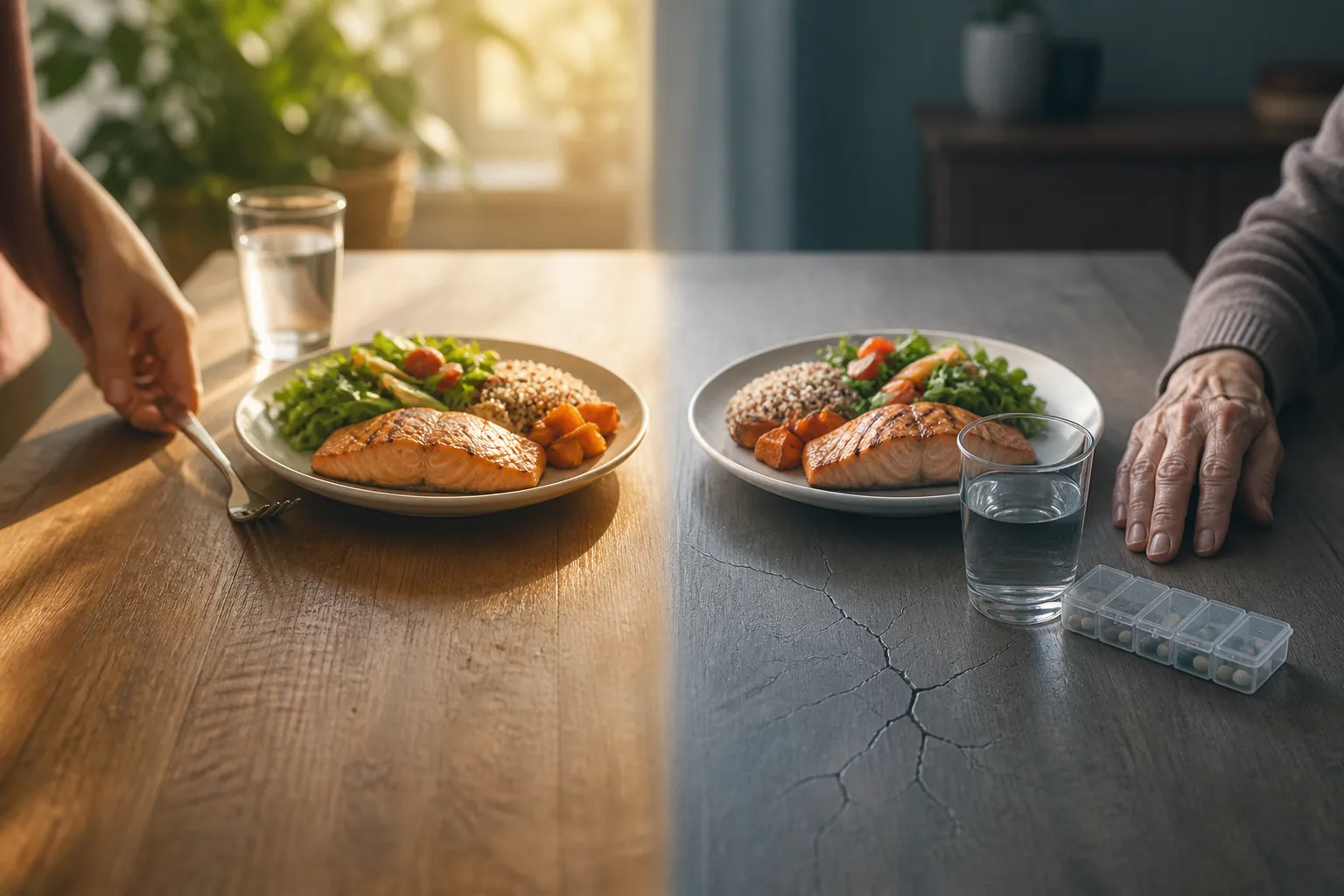
The risk changes after infection, not just at exposure
There is a common mistake in 65+ households: treating salmonella as if the main issue is whether the person was exposed. Exposure matters, especially after a known recall or a shared meal that made others sick. But the sharper danger for older adults is what happens after the infection starts.
The CDC lists adults 65 and older among people at increased risk for food poisoning and says nearly half of people 65 and older with lab-confirmed foodborne illness from Salmonella, Campylobacter, Listeria, or E. coli are hospitalized.[3] That figure is often repeated too loosely, so it is worth keeping it exact: it is for those four pathogens combined, not salmonella alone, and it refers to lab-confirmed illness.
The age pattern is still hard to dismiss. In a Canadian administrative-data study of reported salmonella cases from 2000 through 2010, adults 60 and older accounted for 23% of reported cases but about half of salmonella hospitalizations and 82% of deaths. Hospital stays were longer too: the median stay was 7 days for hospitalized seniors, compared with 4 days for other adults, and 9 days for those 80 and older.[4]
Those are not current U.S. population-wide rates, and they should not be used that way. They are still useful because they show the direction of the problem clearly: once salmonella is serious enough to be counted, older adults take a larger share of the severe outcomes. The same Canadian paper cited U.S. FoodNet data from Scallan and colleagues showing a 2.4% case-fatality proportion for people 65 and older, compared with 0.3% for ages 5 through 64.[4]
For a caregiver deciding whether to call early, that is the point. Reassurance has to fit the patient in front of you. “Most people recover” may be true in a broad population, but it is not a safety plan for an older adult who is already weak, dry, dizzy, or taking medications that change gut defenses.
Why the same infection is harder on an older body
The higher hospitalization and death pattern is not mysterious. FoodSafety.gov describes several age-related changes that make foodborne illness more hazardous: the immune system begins to decline around age 60, the digestive tract may hold food longer, the stomach may produce less acid, and the liver and kidneys may be less efficient at clearing bacteria or toxins from the body.[5]

Each of those changes has a practical consequence. A younger immune system may contain the infection before it spreads or before fluid losses become dangerous. An older immune system may respond more slowly. A slower digestive tract can give contaminated food more time in the gut. Lower stomach acid removes part of the body’s first-line defense, because stomach acid helps kill some organisms before they move farther down the digestive tract.
Then there is the recovery problem. Diarrhea and vomiting are not just unpleasant symptoms in a frail or medically complex older adult. They can mean less fluid intake, less medication staying down, more time in bed, and less ability to stand safely. A person who was walking independently on Monday can be unsafe crossing the room on Wednesday if dehydration and weakness settle in.
That is why the gut symptoms should not be separated from the rest of the body. The CDC lists dizziness when standing, little urination, and dry mouth or throat among signs of dehydration after salmonella infection.[2] In an older adult, those signs are not background details. They are reasons to involve a clinician, because they change the risk of a fall, a medication error, or a hospital-level decline.
The quiet amplifiers: antacids, recent antibiotics, and bowel disease
Age alone does not describe every older adult well. A vigorous 68-year-old and an 88-year-old with kidney disease, poor appetite, and multiple medications are not in the same clinical lane. The details that raise risk are often sitting in the medicine cabinet or listed in the medical history.

Mayo Clinic lists several factors that can weaken natural defenses against salmonella, including antacids, inflammatory bowel disease, and recent antibiotic use. Antacids can lower stomach acidity, inflammatory bowel disease can damage the intestinal lining, and recent antibiotics can reduce the normal bacteria that help protect the gut.[6]
None of that means a person should stop a prescribed medication because of a suspected exposure. It does mean the call to the clinician should include the medication and condition list. “She has diarrhea after recalled food” is useful. “She has diarrhea after recalled food, takes acid-reducing medicine every day, finished antibiotics recently, and is getting lightheaded when she stands” is a different level of information.
This is also where families can miss risk because the older adult is trying to be reasonable. Many people minimize symptoms because they do not want to “make a fuss.” But salmonella does not have to look dramatic at the start to become a problem. The first unsafe turn may be that the person stops drinking, cannot keep fluids down, skips necessary medicines, or becomes too weak to get to the bathroom without help.
What to do with symptoms after a possible exposure
This article is educational and cannot diagnose salmonella infection or replace medical advice. If an older adult has symptoms after a possible salmonella exposure, a recall, undercooked food, contaminated produce, or contact with a known source, early medical guidance is a measured step. It is not alarmism.
The CDC gives a symptom window of 6 hours to 6 days after exposure for salmonella illness, and many people recover within several days.[2] That window is useful for recognizing a possible connection, but it should not be used to talk an older adult out of care when they are worsening. Timing helps frame the story; condition determines urgency.
For a step-by-step symptom guide, use When to Seek Care for Salmonella Symptoms in Older Adults. For the home-safety side of the illness—weakness, dizziness, bathroom trips, and fall exposure—see Why Salmonella Symptoms in Seniors Become a Fall Risk. If the concern is preventing another exposure in the kitchen, Salmonella Food Safety Tips for Seniors Who Cook at Home is the better place for that practical work.
The main judgment is simpler than a decision tree: in a 65+ household, do not wait for salmonella symptoms to become impressive before taking them seriously. Call earlier when the person is older, medically complex, unable to keep fluids down, dizzy when standing, newly weak, or acting unlike themselves. New confusion during an illness is not something to interpret at home; it is a reason to involve a clinician.
This topic belongs on a fall-prevention site because the danger is not confined to the intestine. Foodborne illness can drain an older adult’s fluid, strength, balance, and attention faster than families expect. The hospital risk starts with salmonella, but the home risk often shows up as the person trying to stand.
References
- About Salmonella Infection | CDC, CDC.
- Symptoms of Salmonella Infection | CDC, CDC.
- People at Increased Risk for Food Poisoning | Food Safety | CDC, CDC.
- Hospitalization and mortality rates of elderly patients in the Canadian Notifiable Disease Surveillance System, 2000–2010, Epidemiology and Infection.
- The Importance of Food Safety for Older Adults, FoodSafety.gov.
- Salmonella infection - Symptoms and causes, Mayo Clinic.
Related reading
Noticed something outdated or inaccurate on this page? Flag a correction. We review every report against CDC, NIA, and AARP HomeFit guidance before updating a page.
Part of the Fall Prevention section.