
STEADI: Intervene
3-Phase Dust Storm Plan for Seniors with Breathing Problems
A before, during, and after plan for keeping a senior with breathing problems safe in a dust storm. It covers alert setup, medication prep, a clean indoor room, and the 911 warning signs — including symptoms that can appear days after the dust settles.
If the senior has severe trouble breathing, chest pain, confusion, blue or gray lips or face, fainting, or symptoms their written asthma, COPD, or heart-care action plan labels as an emergency, call 911 now. A dust storm plan is for reducing exposure and catching a flare early; it is not a substitute for emergency care or the senior’s clinician-written instructions.
If no emergency signs are present, use the plan in three phases. Dust storm safety for seniors with breathing problems starts before the alert, continues while the house is sealed, and does not end when the sky looks normal again. The American Lung Association warns that dust particles can linger from a few hours up to 10 days, and that older adults and people with lung disease are among the groups most at risk.[1]
| Phase | What the caregiver does first | When this stops being a home plan |
|---|---|---|
| Before the storm | Turn on alerts, confirm medications and written action plans, set up one clean-air room, and plan backup power for oxygen or nebulizer equipment. | If medications, oxygen, power, or transportation cannot be secured before a forecast event, call the clinician, oxygen supplier, pharmacy, local emergency management, or the senior’s support network early. |
| During the storm | Keep the senior indoors, close windows and doors, reduce outdoor-air intake, run filtration, avoid exertion, and follow the senior’s medication plan. | Call 911 for severe breathing trouble, chest pain, confusion, blue or gray lips or face, fainting, or any emergency threshold in the written action plan. |
| After the storm | Keep clean-air habits going, watch symptoms for days, clean dust with wet methods or a HEPA-filter vacuum, and delay heavy outdoor work. | Seek urgent help if wheezing, chest tightness, or breathing trouble appears, worsens, or does not respond as the written plan says it should. |
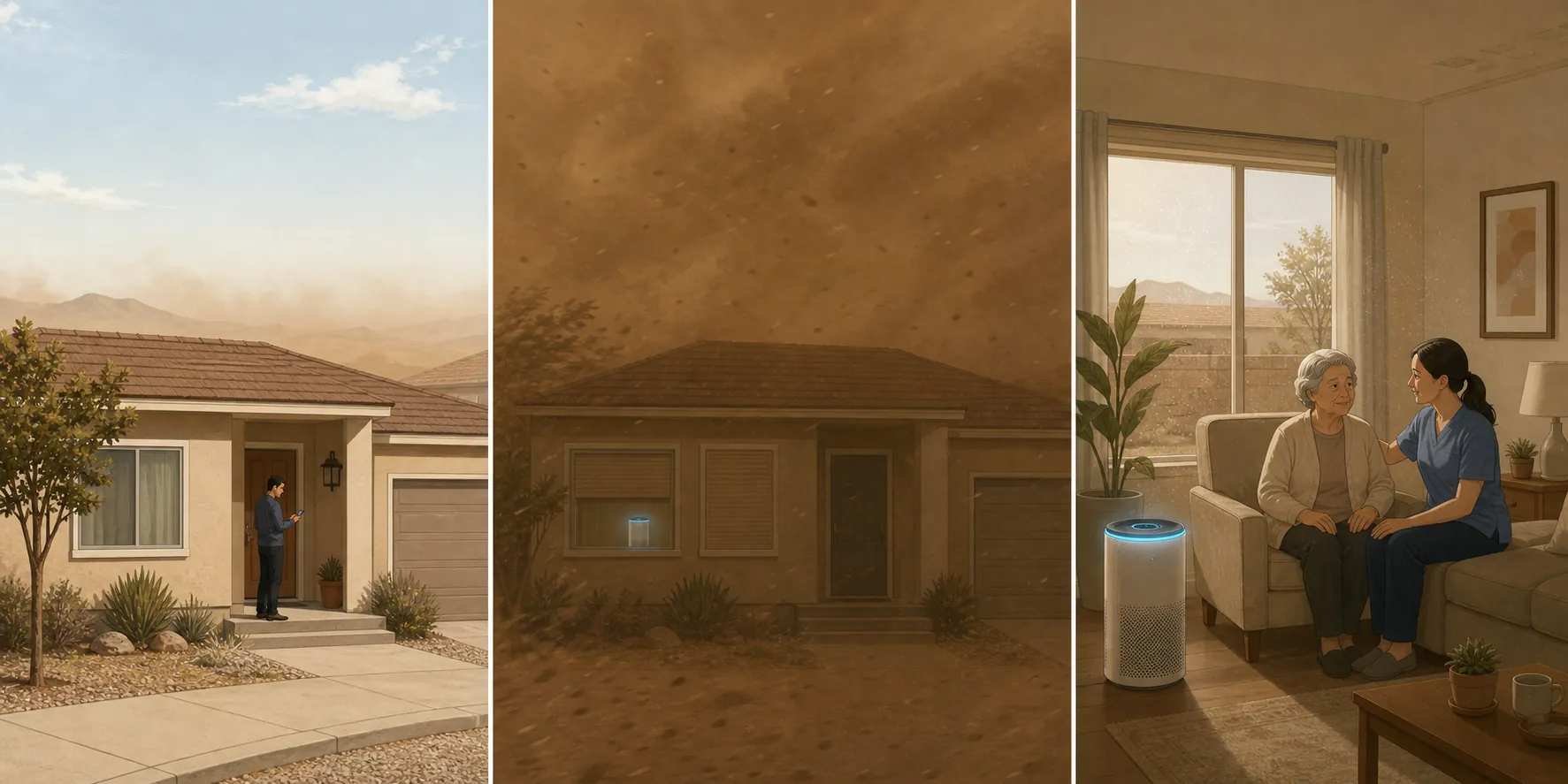
Before the storm: make the plan boring enough to follow
The best dust storm plan is not a heroic scramble at the window. It is a short refrigerator list, a charged phone, a medication check, and one room in the home that can become the safest breathing space quickly.
Set alerts the senior and the backup person will actually notice
Check that Wireless Emergency Alerts are enabled on the senior’s phone and on the caregiver’s phone. The American Lung Association points to National Weather Service Wireless Emergency Alerts as a key way to receive dust storm warnings, and notes that they are automatically enabled on most phones.[1] The National Weather Service also warns drivers not to enter dust storms when visibility drops and to pull off the road if caught in one.[2]
For an older adult who may silence a phone, miss a text, or live alone, add redundancy: a NOAA Weather Radio, the FEMA app, and at least one named person who agrees to check in when alerts are issued. Ready.gov’s older-adult preparedness guidance emphasizes building a support network and planning for communication, supplies, medicines, and assistive needs before a disaster.[3] If your family already uses a daily check-in routine, dust storm alerts should plug into that routine instead of sitting in a separate app nobody opens.
If you also track air quality for smoke or ozone, fold dust alerts into the same habit. A simple version is to check official weather alerts first, then local air-quality information, then the senior’s symptoms. Our guide to a three-layer air-quality check for elderly parents uses that same “alert, air, person” order.
Put the written breathing plan where the medicine is
For a senior with COPD, asthma, or heart disease, the written action plan from the clinician is the rulebook. Before storm season, check that the plan is current and that the caregiver knows what each instruction means: daily preventer medicine, reliever medicine, nebulizer use if prescribed, oxygen instructions if prescribed, peak-flow zones if the senior uses them, and the symptoms that mean urgent care or 911.
Then look at the actual inhalers, not just the medication list. Check dose counters, expiration dates, spacer availability, nebulizer tubing, oxygen supplies, and whether refills require a clinician’s approval. A reliever inhaler that is nearly empty is not a small errand when the alert is already on the phone.
- Keep the senior’s medication list in the emergency kit and on the refrigerator.
- Write down the pharmacy, prescribing clinician, oxygen supplier if applicable, and after-hours numbers.
- Store a spacer with inhalers if the clinician has recommended one.
- Keep backup batteries or a power plan for prescribed devices that need electricity.
- Ask the clinician in calm weather what symptoms should trigger urgent care versus 911 for this specific person.
For broader kit-building, the senior flash-flood emergency kit checklist is useful because the medication-list problem is the same even when the hazard is different.
Choose one clean-air room before you need it
Pick one room where the senior can spend several hours comfortably: usually a bedroom or living room with a door that closes, few exterior leaks, a place to sit upright, access to water, medications, a phone charger, and a clear path to the bathroom. A “clean room” is not the whole house. It is the room you can protect fastest.
If the home has a portable HEPA air cleaner, put it in that room before the season starts and confirm the filter is installed correctly. In high-dust areas, the American Lung Association says HEPA filtration is worth considering, and its Saharan dust guidance also notes that people with chronic lung disease should take extra precautions during dust pollution events.[4]
Do not wait until the room smells dusty to decide where the purifier goes. Moving a heavy unit during an alert invites rushing, bending, tripping over cords, or asking the older adult to help carry something awkward. Set it up once, tape down or route the cord safely, and keep replacement filters where the caregiver can reach them without climbing.
If you have already built a smoke-season clean room, much of that work carries over because smoke and dust both involve particle exposure indoors. Our two-track wildfire-smoke guide for seniors walks through the same practical setup: one cleaner room, medications close by, and a symptom-watch plan.
Plan for the sealed-house problem: breathing safety and heat safety can collide
Dust storm advice often says to close the house. In the Southwest and other hot regions, that may create a second risk if the home becomes too hot. Before storm season, decide how the senior will stay cool while reducing outdoor-air intake: working air conditioning, shaded rooms, safe fan placement when appropriate, backup cooling locations, and transportation help if the home cannot stay safe.
If the senior uses oxygen, a nebulizer, refrigerated medication, or powered mobility equipment, the power plan belongs in the dust storm plan too. Ready.gov tells older adults to plan for medicines, medical equipment, and support needs as part of disaster preparedness.[3] Our power-outage-after-storm guide and heat-plus-wildfire-smoke checklist are useful companions for that conflict: cleaner air is not enough if the room becomes dangerously hot.
During the storm: reduce exposure and lower demand on the lungs
A serious dust storm is not just “dirty air.” A 2021 systematic review reported PM10 concentrations above 6,000 µg/m3 during seriously strong dust storms, compared with the World Health Organization’s 24-hour guideline of 50 µg/m3.[5] That comparison is not a prediction for every storm or every neighborhood. It is a reminder that the safest plan is to keep the dust out of the senior’s lungs as much as possible.
- Bring the senior indoors before the wall of dust reaches the area, if there is time to do so safely.
- Close windows and exterior doors.
- Set heating or air conditioning to recirculate when the system allows it, so the system is not intentionally pulling in outdoor air.
- Move the senior to the clean-air room and run the HEPA air cleaner if available.
- Pause vacuuming, sweeping, laundry shaking, garage work, and other tasks that stir particles.
- Avoid vigorous exertion, including rushing around to tape windows, move boxes, or check the yard.
- Follow the senior’s written medication plan for preventer and reliever medicines.
- Keep water, phone, charger, glasses, hearing aids, walker or cane, and medications within easy reach.
Washington State’s Department of Ecology gives the same core indoor steps: go inside, close windows and doors, and set the air conditioner to recirculate if possible.[6] The National Asthma Council also tells people with asthma to stay indoors, close windows and doors, avoid vigorous exercise, and take preventer medication as directed during dust storms.[7]
If the senior must go outside briefly — for example, to get from a car into the house — use the shortest safe route, avoid carrying awkward items, and consider a new, snug-fitting N95 or KN95 respirator if the senior can tolerate it and it does not interfere with breathing or medical instructions. The American Lung Association’s Saharan dust guidance says a snug-fitting new N95 or KN95 is the most effective mask option when going outdoors during dust pollution is unavoidable.[4]
A mask is not a reason to send a frail older adult outside to move patio furniture, check the mailbox, or sweep the porch. Fit matters, breathing comfort matters, and the safer task is usually to wait.
When symptoms start during the storm
Use the senior’s written plan first. If it says to use a reliever inhaler, use it exactly as directed. If it says to call the clinician, urgent care, or 911 at a certain point, do not wait to see whether the dust clears.
For asthma, the National Asthma Council’s dust storm guidance says that anyone experiencing wheezing, chest tightness, or difficulty breathing should seek urgent medical assistance. It also describes asthma first aid as giving 4 separate puffs of reliever, waiting 4 minutes, and repeating if breathing does not return to normal, while calling emergency assistance if there is still no improvement.[7] That protocol should support, not replace, the senior’s own asthma action plan.
Call 911 for severe breathing trouble, chest pain, confusion, blue or gray lips or face, fainting, or sudden breathlessness that feels different from the senior’s usual COPD or asthma pattern. For a broader older-adult reminder on sudden breathlessness and chest pain, see our page on pulmonary embolism warning signs in the elderly. The point is not to diagnose the cause at home; it is to treat severe or unusual breathing symptoms as an emergency.
After the storm: the dangerous part may be the part that looks over

The sky clearing is not the same as the lungs being safe. This is the phase many households skip because the visual emergency is gone. The American Lung Association’s warning that dust particles can linger from a few hours up to 10 days changes the job: keep watching the person, not just the weather.[1]
For the first several days after a significant dust event, keep the clean-air room available and keep outdoor activity light. If the senior has a history of delayed COPD or asthma flares, follow the clinician’s instructions for monitoring symptoms, oxygen levels if prescribed, peak flow if used, and medication changes if the written plan includes them.
- Keep windows and doors closed until local conditions and the senior’s symptoms support reopening them.
- Keep the HEPA unit running in the clean-air room if dust is still visible indoors or symptoms are active.
- Delay yard cleanup, porch sweeping, garage organizing, and other dusty jobs.
- Check whether the senior is coughing more, wheezing, using reliever medicine more often, sleeping upright, tiring unusually fast, or avoiding normal walking because of breathlessness.
- Call the clinician or seek urgent care according to the written plan if symptoms appear later or worsen after seeming stable.
A simple symptom note can help: date, time, what the senior was doing, symptoms, reliever use, oxygen reading if prescribed, and what happened afterward. This is not busywork. It gives the clinician a cleaner story than “she has been worse since the storm.”
Clean dust without putting it back into the air
Post-storm cleanup should be slow, damp, and boring. The CDC advises using wet mops or vacuums with HEPA filters instead of dry sweeping when cleaning dust after disasters, because dry sweeping can put particles back into the air.[8]
- Use a damp cloth on hard surfaces instead of feather dusters or dry rags.
- Wet mop hard floors or use a HEPA-filter vacuum if one is available.
- Keep the senior out of the room being cleaned when possible.
- Avoid shaking rugs, blankets, curtains, or cushions indoors.
- Break cleanup into short sessions so nobody rushes, overreaches, or carries too much at once.
- Wear a well-fitting respirator for dusty cleanup if it is safe for the person doing the work.
This is where the fall-prevention piece matters without taking over the respiratory plan. Fine dust can make hard floors slick. Cleanup can also create trip hazards: cords from air cleaners, buckets in walkways, wet floors, step stools, and stacks of filters or supplies near doors. The older adult should not have to prove independence by climbing, sweeping, or hauling dusty items while their lungs are still irritated. Offer choices instead: “Do you want to sit in the bedroom or the den while I mop this area?” preserves more dignity than “stay out of the way.”
If the storm also caused roof, window, fence, or electrical damage, separate breathing cleanup from damage inspection. Our storm-damage safety checklist for seniors is a better place for downed lines, wet insulation, ladders, and structural hazards. A senior with breathing problems should not be the person sent outside to inspect damage in dusty air.
When normal routines can resume
Resume normal routines gradually, not all at once. Start with short indoor movement, then brief necessary outdoor trips, then light cleanup, while watching whether coughing, wheezing, chest tightness, fatigue, or breathlessness increases. If symptoms return when activity increases, step back to the cleaner-air routine and follow the written care plan.
Do not use the calendar alone as the stopping rule. Use three checks together: local conditions have improved, the home is not visibly dusty or musty from the event, and the senior’s breathing has returned to their usual baseline. Because particles can linger for days, a household may need to keep the clean-air room, filtration, and symptom notes going after the neighborhood looks normal.[1]
End the home plan and get urgent help if breathing symptoms worsen, reliever medicine is needed more often than the written plan allows, chest tightness or wheezing does not settle as expected, confusion appears, or the senior has severe or sudden breathlessness. If the signs are severe — chest pain, blue or gray lips or face, fainting, or major trouble breathing — call 911.
References
- Dust Storms, American Lung Association.
- Dust Storms and Haboobs, National Weather Service.
- Older Adults, Ready.gov.
- Tips to Keep Yourself Safe from Saharan Dust Pollution, American Lung Association.
- Dust storms and their impact on health: A systematic review, PMC, 2021.
- Dust storms: how to protect yourself, Washington State Department of Ecology, July 2024.
- Dust storms and asthma, National Asthma Council Australia.
- What You Can Do to Protect Your Respiratory Health During Disaster Cleanup, CDC.
Related reading
Noticed something outdated or inaccurate on this page? Flag a correction. We review every report against CDC, NIA, and AARP HomeFit guidance before updating a page.
Part of the Fall Prevention section.