
STEADI: Intervene
How Seniors Can Avoid Falls During Post-Storm Cleanup
The first walk around a storm-damaged property is the highest-risk moment for a senior fall — post-storm injuries concentrate during cleanup, not during the storm itself. Older adults and their helpers can prevent most of those falls with a three-point pre-cleanup check: look up, look down, then test footing and light before walking anywhere.
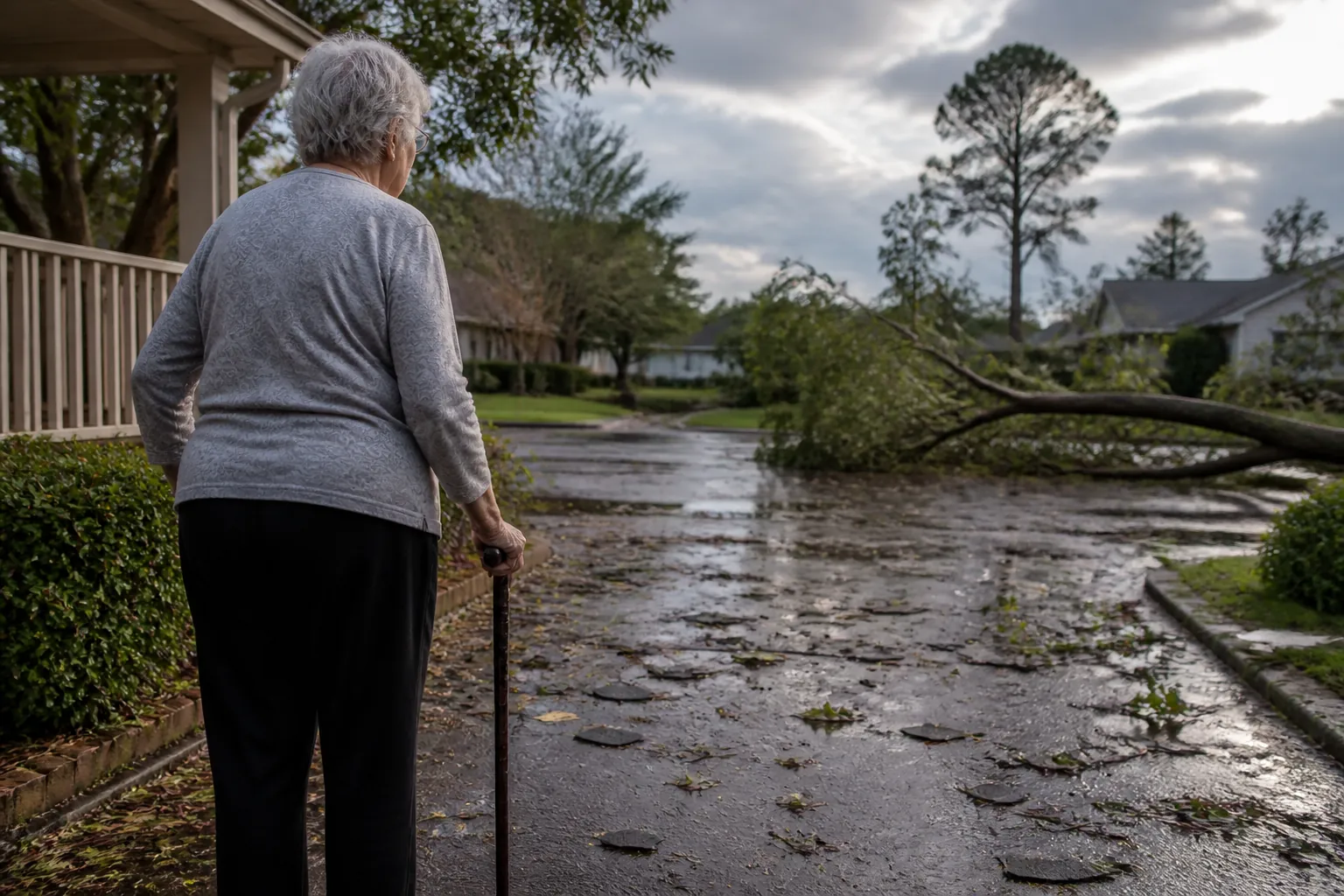
The first risky step after a storm often happens before anyone calls it cleanup. A parent gets out of the car, sees a branch across the walk, a strip of shingle in the grass, a puddle near the porch, and says they only want to look. An adult child hears that and starts choosing words carefully: not too sharp, not too controlling, but clear enough to stop a foot from landing where the ground cannot be seen.
That first walk around the property needs to be treated as a safety assessment, not a quick inspection. In a CDC report on injuries after Hurricane Sandy, injuries were reported almost exclusively among residents doing cleanup or repair after the storm: 166 cleanup-or-repair injuries compared with 17 injuries during the storm itself.[1] AHRQ data on hurricanes also found that in the week a hurricane made landfall, injury-related emergency department visits resulting in hospital admission rose 53.2% for adults 65 and older in direct-path counties, while treat-and-release injury visits rose 48.2%.[2] Those AHRQ numbers are for injuries broadly, not falls alone, but they point to the same practical warning: the danger does not end when the wind stops.
For falls specifically, the strongest recovery-phase evidence comes from hurricane research. A Hurricane Maria trauma-admission study found that falls were the leading mechanism of injury in the recovery phase; adults 40 and older had 3.2 times the odds of a fall-related trauma admission, and recovery-work-related falls increased as well.[3] That does not give families a precise count of senior falls after every kind of storm. It does give them a reason to slow the first five minutes down.
The first walk is different from ordinary yard work
A storm-damaged yard is not just a messy yard. The usual landmarks are changed. A branch may hide the porch step that a person normally finds by memory. Mud can make a familiar patch of grass behave like ice. Standing water can cover a hole, a loose paver, an electrical hazard, or a slick layer of silt. A cane or walker tip that works well on dry concrete can lose grip after it picks up mud.
The strongest studies here are hurricane-specific, but the first-pass logic also applies after tornadoes, derechos, floods, severe thunderstorms, winter storms, and ice storms when the same hazards are present: debris underfoot, poor light, wet surfaces, unstable trees or limbs, damaged utilities, and walkways no one has cleared yet.
The job of the first pass is not to start hauling, cutting, sweeping, or rescuing every object that looks out of place. The job is to decide what can be approached safely and what cannot. If the person walking cannot see the surface, stabilize the path, or step around the hazard without losing balance, the next action is to stop and get help.
Before stepping in: prepare for assessment, not cleanup
Protective gear belongs before the first walk, because the first walk is when the hidden hazards are still hidden. FEMA advises wearing long pants, sturdy closed-toe shoes, goggles, gloves, and a mask when cleaning up after a flood.[4] CDC/NIOSH storm and flood response guidance also treats protective clothing and equipment as part of safe storm response, not as something to think about after work has already begun.[5]
For a senior, the shoes matter as much as the gloves. Thin slippers, loose sandals, smooth soles, and wet socks make the first pass harder to control. If a cane or walker is used, its tips should be checked before the first step and again after crossing mud, grass, or wet leaves. The Ohio Department of Aging specifically warns that mud can be as slippery as ice and recommends cleaning mud from shoes and from cane or walker tips.[6]
A helper should not begin by grabbing tools. Begin by making the walker visible and steady: glasses on, phone available, shoes tied, cane or walker tips clear, flashlight ready, and no objects carried in both hands. If the older adult wants to hold a bag, a rake, or a box “just for a second,” that is already too much for the assessment pass.
The three-point pre-cleanup scan
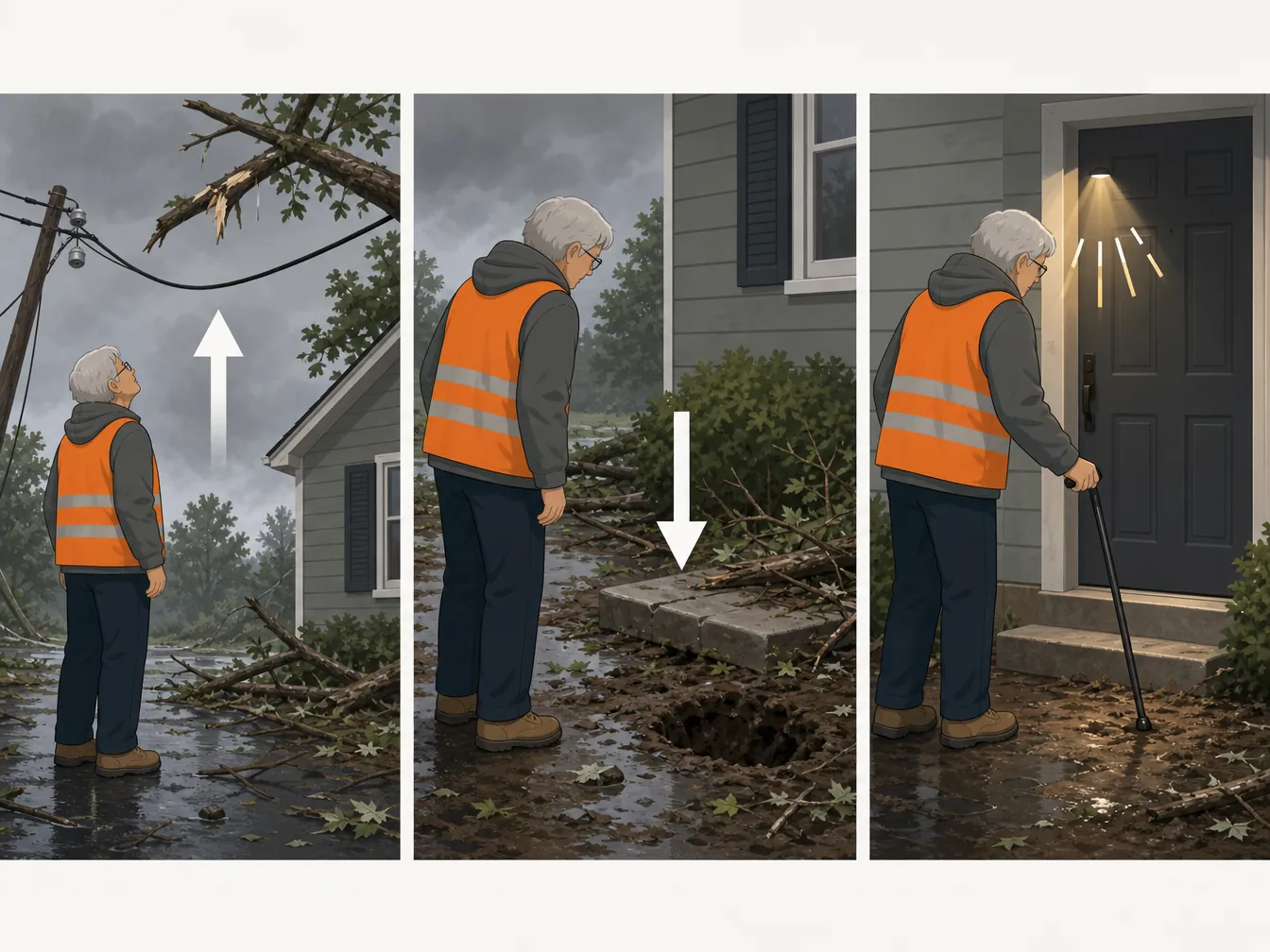
Use the same order every time: look up, look down, then test footing and light. The order matters because a person can become so focused on the branch at their feet that they miss the broken limb above them, or so focused on the porch light that they step into water they have not checked.
| Scan point | What to look for | Stop-and-get-help trigger |
|---|---|---|
| Look up | Downed wires, leaning trees, dangling limbs, loose gutters, broken branches caught overhead | Anything overhead could fall, or any wire is down, sagging, or touching debris, water, a fence, a tree, or a structure |
| Look down | Debris hiding steps, holes, uneven ground, mud, standing water, loose boards, outdoor walkways blocked by branches or objects | The walking surface cannot be seen, looks unstable, or requires stepping over debris while off balance |
| Test footing and light | Wet concrete, slick grass, muddy shoes, packed cane or walker tips, dark porch, dark entry, power outage, glare or shadow | The foot or mobility aid slips, the next landing spot cannot be clearly seen, or the walker needs both hands to stay steady |
1. Look up before looking at the branch by your feet
The fallen branch on the driveway is the thing everyone wants to move first. Resist that pull. Before anyone bends, reaches, or walks under a tree, look above the path from the car to the porch, from the porch to the side yard, and from the side yard to any shed, garage, or gate.
Stop immediately for any downed or sagging power line. FEMA’s flood cleanup guidance says never touch, cut, or move downed power lines.[4] CDC/NIOSH storm and flood response guidance gives the same hard boundary: damaged electrical lines are not a homeowner cleanup task.[5] A wire does not have to spark to be dangerous, and a branch touching a line is not safe to pull away by hand.
The same stop rule applies when a limb is cracked and hanging, a tree is leaning toward the path, or a broken branch is caught above a walkway. The fall risk is not only that the limb could come down. It is also that the walker will keep glancing upward while stepping over uneven ground. If the eyes must stay on the hazard overhead, the feet do not have enough attention to navigate debris below.
A useful helper sentence is plain and repeatable: “Stop there. We have not checked above you yet.” It gives a reason without turning the moment into an argument about independence.
2. Look down for what debris is hiding
Once the overhead path is clear, scan the ground as if the familiar property has become unfamiliar. Steps may be covered by leaves, shingles, branches, insulation, siding, or wet cardboard. A porch edge may disappear under mud. A walkway may look passable from the driveway and then narrow into a slick strip between puddles.
The Ohio Department of Aging names storm debris in outdoor walkways as a seasonal fall hazard and also warns about mud, ice, and wet leaves.[6] That matters after more than hurricanes. A thunderstorm can leave the same wet leaves at the back step. A derecho can scatter branches across a ramp. An ice storm can make a clear-looking walkway behave like glass.
Do not step where the walking surface is hidden. If a branch lies across a porch step, the task is not to “just step over it.” The task is to expose the step from a stable position or have someone else clear it. If a puddle covers the bottom of a ramp or the edge of a sidewalk, treat the covered area as unknown until it is checked from dry, stable ground.
This is where helpers often need to be firmer than they feel. “I know you know this walkway. I can’t see the edge of it right now” is better than “be careful.” The first sentence names the actual problem. The second leaves the older adult to guess which danger matters most.
3. Test footing and light before walking anywhere
After a storm, a surface can pass the visual scan and still fail under a foot. Wet concrete, muddy grass, algae-slick steps, loose gravel, and water-tracked tile near the doorway can all change the first step. Before committing weight, test the surface with the shoe or mobility aid from a stable position. If the foot slides, the cane tip skids, or the walker legs do not sit evenly, stop.
Check the cane or walker after each muddy patch. Mud packed into a cane tip can turn the next dry step into a slip. Walker feet and wheels can also pick up leaves, grit, or soft soil. The Ohio seasonal falls guidance specifically calls for cleaning mud off shoes and mobility-aid tips because that mud can carry the slip hazard forward onto the next surface.[6]
Light is part of footing. A dark porch, unlit garage, shadowed entry, or hallway without power should be treated as an unknown walking surface. Do not step inside just because the outside path has been checked. Use a flashlight before the threshold, keep one hand free, and pause at each change in surface: driveway to walk, walk to step, step to porch, porch to doorway.
For a deeper plan on lighting before and during outages, use the site’s guide to fall-proofing a senior’s home before a power outage. This first-pass check only has to answer one question: can the next few steps be seen clearly enough to place each foot or mobility aid with confidence?
The stop rule: if you cannot see it, stabilize it, or step around it safely, get help
Families do not need a long speech at the property edge. They need a short rule that survives stress: if the walker cannot see the surface, stabilize the path, or step around the hazard without losing balance, the walk stops there.
- Stop for wires: any downed, sagging, or debris-tangled line is a utility or emergency call, not a cleanup task.
- Stop for overhead instability: dangling limbs, leaning trees, and loose materials above the path are not safe to inspect from underneath.
- Stop for hidden footing: puddles, mud, leaves, branches, and scattered objects that hide steps, holes, ramp edges, or walkway borders must be cleared or checked from stable ground.
- Stop for poor traction: slipping shoes, muddy cane tips, uneven walker legs, or wet indoor thresholds mean the person should not keep going by momentum.
- Stop for poor light: a dark porch, garage, or entry is not a place to feel around with a foot.
Getting help can mean calling the utility company, emergency services, a tree professional, a neighbor with better equipment, or a family member who can clear a path while the older adult stays on dry, level ground. It can also mean waiting. Waiting feels frustrating after damage, but it is still safer than turning the first walk into an improvised obstacle course.
Winter and ice storms change the surface, not the rule
After a winter storm, the first-pass scan should slow down even more at transitions: the end of the driveway, the bottom of a ramp, the top step, the garage threshold, the place where shoveled pavement meets packed snow. Ice may not look dramatic. It may simply erase traction.
The same mud rule applies to snow, slush, salt, and ice buildup on shoes and mobility aids. Check the soles. Check cane tips. Check walker feet and wheels. If traction changes after crossing one patch, stop before the next surface. The site’s guide to winter fall prevention for seniors living alone goes further into footwear, traction, and winter routines; during the first post-storm property walk, the immediate task is to avoid assuming that a familiar surface still grips the way it did yesterday.
After the outdoor pass, do not drift into the house without a new check
Once the outdoor path has been assessed, the next temptation is to open the door and keep moving. That is a separate fall-risk moment. A dark entry, damp floor, displaced rug, broken glass, or furniture shifted during the storm belongs to an indoor return walkthrough, not the outdoor cleanup assessment.
Use How to Keep Seniors Safe From Falls After Storm Damage for the room-by-room return and the 72-hour watch if a fall occurs. Use the Fall-Focused Severe Weather Safety Checklist for Seniors before the next storm, when there is still time to stage lights, shoes, mobility aids, and contact numbers without standing in mud at the edge of the driveway.
The first outdoor pass ends when the safe path is known, the stop points are named, and nobody has to prove they can manage a damaged property by walking through hazards that have not been checked.
References
- Nonfatal Injuries 1 Week After Hurricane Sandy, CDC MMWR
- Hurricanes and Injury-Related Emergency Department Visits, 2005–2016, AHRQ HCUP Statistical Brief #267
- Hurricane Maria, Injury Epidemiology, 2020
- Stay Safe Cleaning Up After a Flood, FEMA
- Storm/Flood and Hurricane Response, CDC/NIOSH
- Falls Prevention in Every Season, Ohio Department of Aging
Related reading
Noticed something outdated or inaccurate on this page? Flag a correction. We review every report against CDC, NIA, and AARP HomeFit guidance before updating a page.
Part of the Fall Prevention section.